
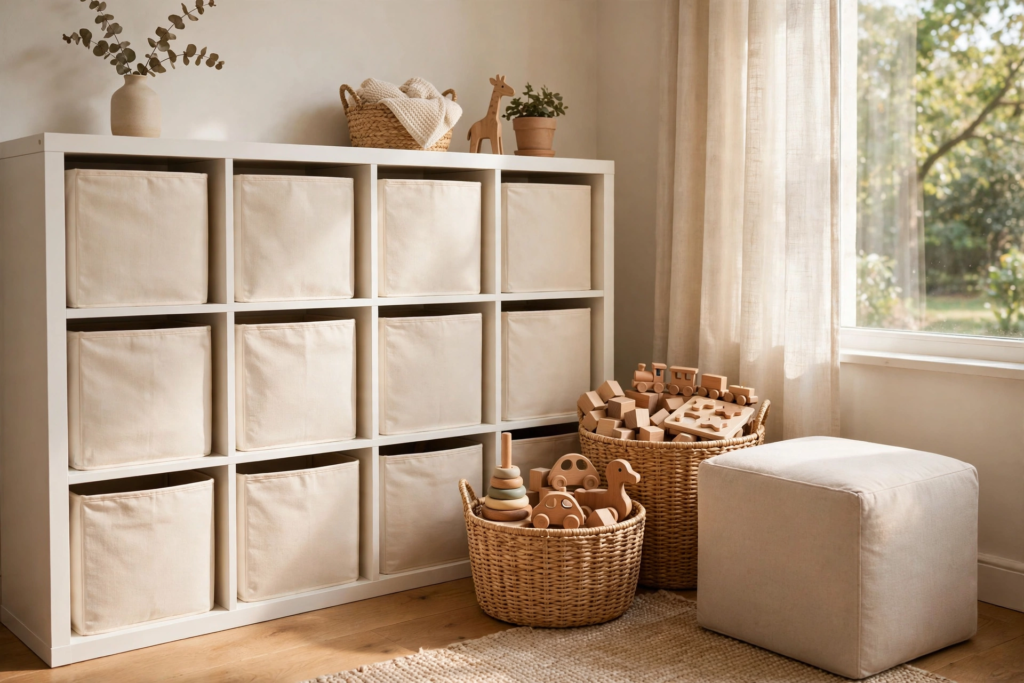
Let me tell you what my living room looked like two years ago. A plastic bin avalanche in the corner. A rogue dinosaur under the coffee table. Puzzle pieces in the couch cushions like some kind of treasure hunt I never signed up for. I love my kids fiercely, but I did not love what their stuff was doing to my house.
Here is what I figured out after a lot of trial and error. The problem was never the amount of toys. It was that every toy needed a home, and most of our homes were just the floor. Once I gave every category of toy a beautiful place to live, cleanup stopped being a battle and started being a five minute reset. The house looked like adults lived here again. The kids could still find everything. Everybody won.
This post is 19 toy storage ideas that actually look good. Not the primary color plastic tubs that scream daycare. Real, stylish storage. Woven baskets that belong in a living room. Ottomans that hide an entire stuffed animal collection. Closets that work harder than your playroom. Every idea here was chosen with one rule in mind. If a guest walked in, they would think your house was just this tidy, not that you shoved everything in a closet ten minutes before they arrived.
A quick note on philosophy before we dive in. The best toy storage is storage your kids can actually use. If a bin is too heavy, too high, or too complicated, your kids will not use it and you will be the one doing all the cleanup. Every idea here keeps the toys reachable for little hands and the pretty on the outside for yours. That is the whole game.
Love these ideas? Get more every week.
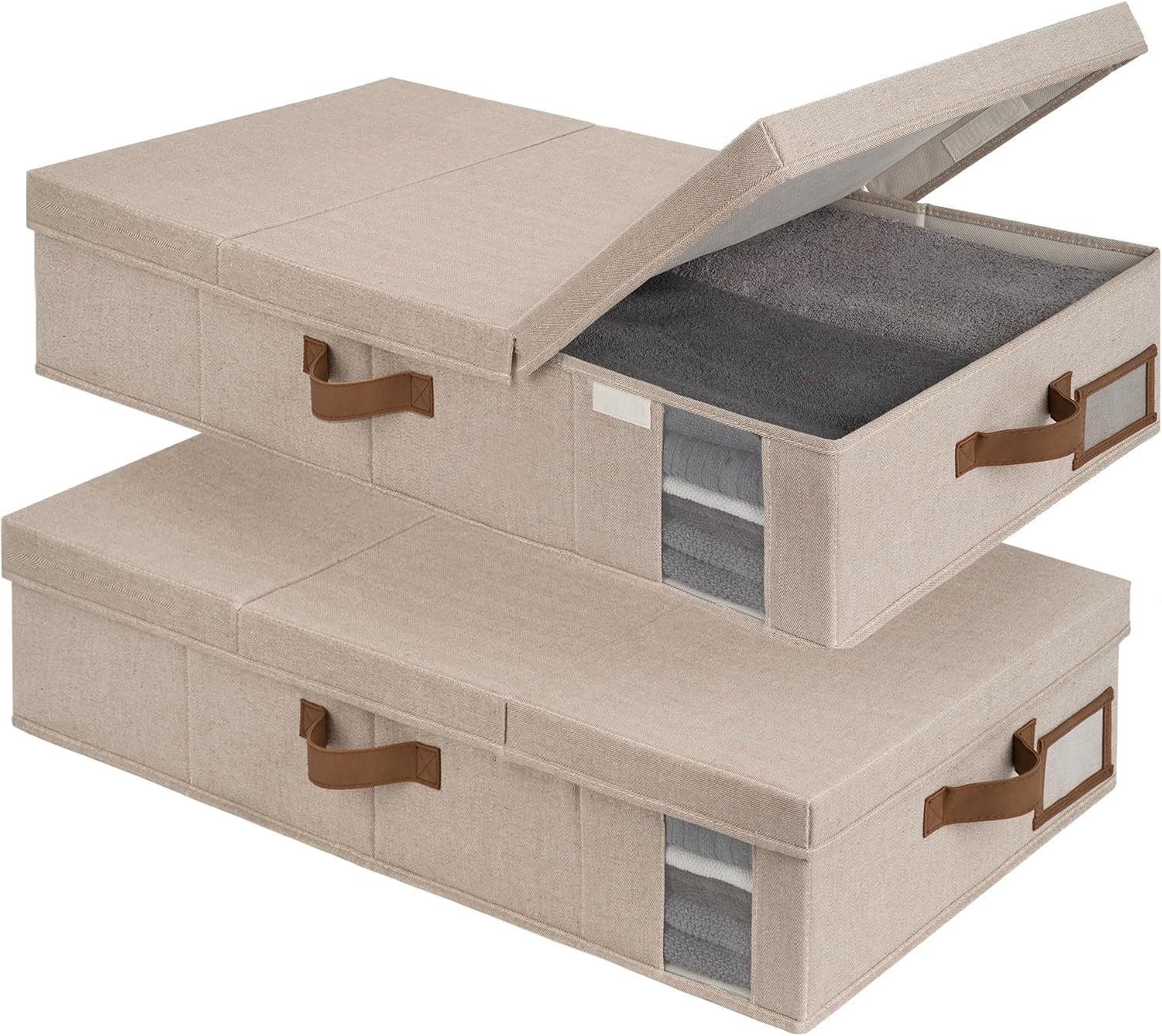
Join the newsletter for seasonal decor and cozy home inspiration.
Hide it in plain sight: storage that looks like decor
The fastest way to a tidy house is storage that does not look like storage. These are the pieces that live in your main rooms and hold a shocking amount of toys while looking like they were chosen by a designer. Your living room stays your living room. The toys just have really nice hiding places.
1. A Trio of Woven Baskets
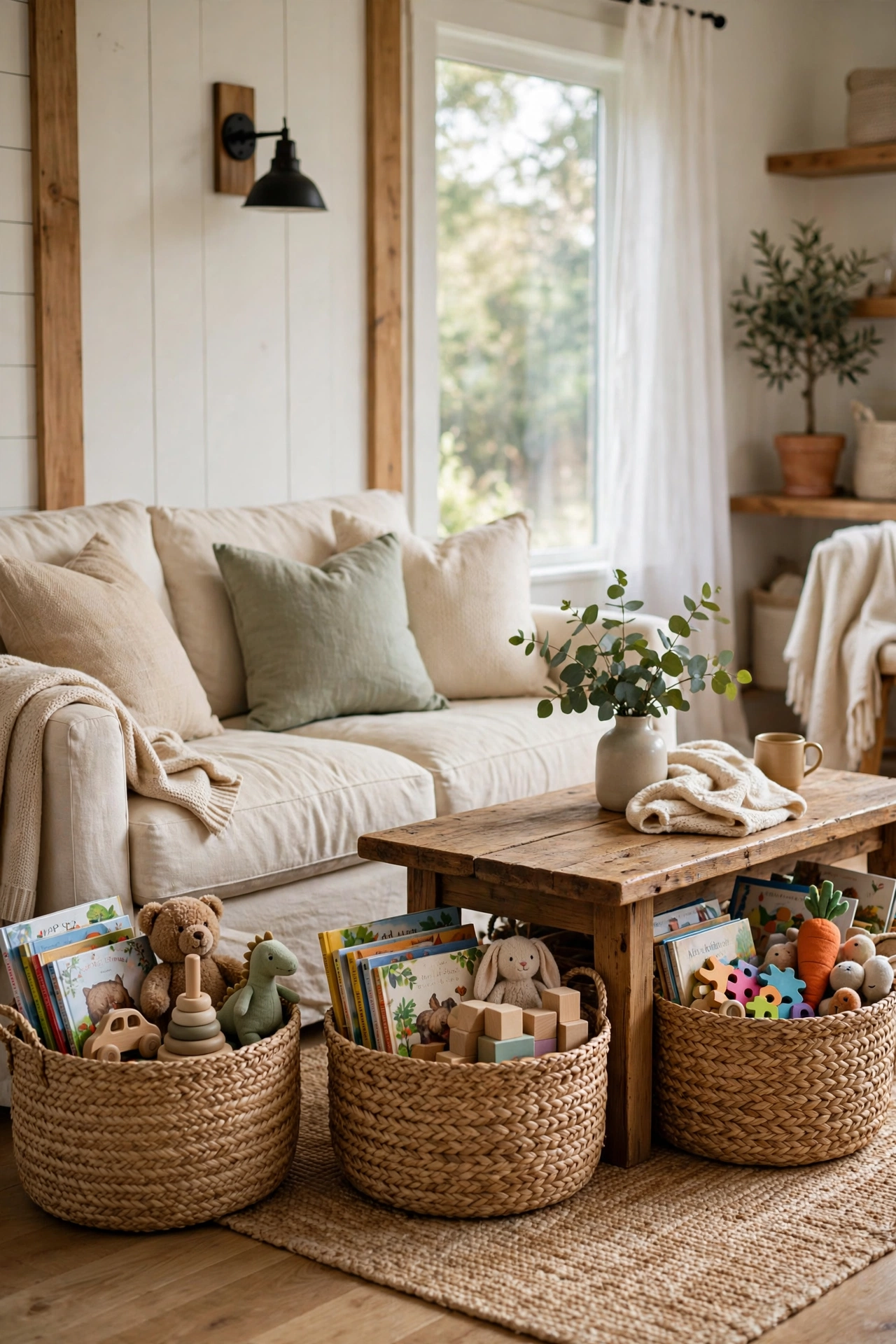
If you do nothing else from this post, do this one. Three large woven baskets in your living room will swallow more toys than you think possible, and they look like decor. I keep one for stuffed animals, one for the current favorite toys, and one for books. When friends come over, I toss the strays in and the room looks instantly calm. It takes forty seconds.
The trick is size and placement. Go big. Small baskets look cluttered the second a toy sticks out. Large seagrass or woven baskets with some height can hold a shocking amount, and they tuck beautifully beside a sofa or under a console table. Choose a natural texture that matches your room. Seagrass, wicker, or rope all disappear into a neutral living room in the best way.
Give each basket a loose job so the kids know where things go. Stuffies in the tall one. Small toys in the wide one. Books in the one by the chair. You do not need labels on these. The categories are obvious enough that even a four year old gets it, and that is the whole point. Storage only works if the whole family uses it without thinking.
Shop This Look
This post contains affiliate links. If you buy through them, I may earn a small commission at no extra cost to you.
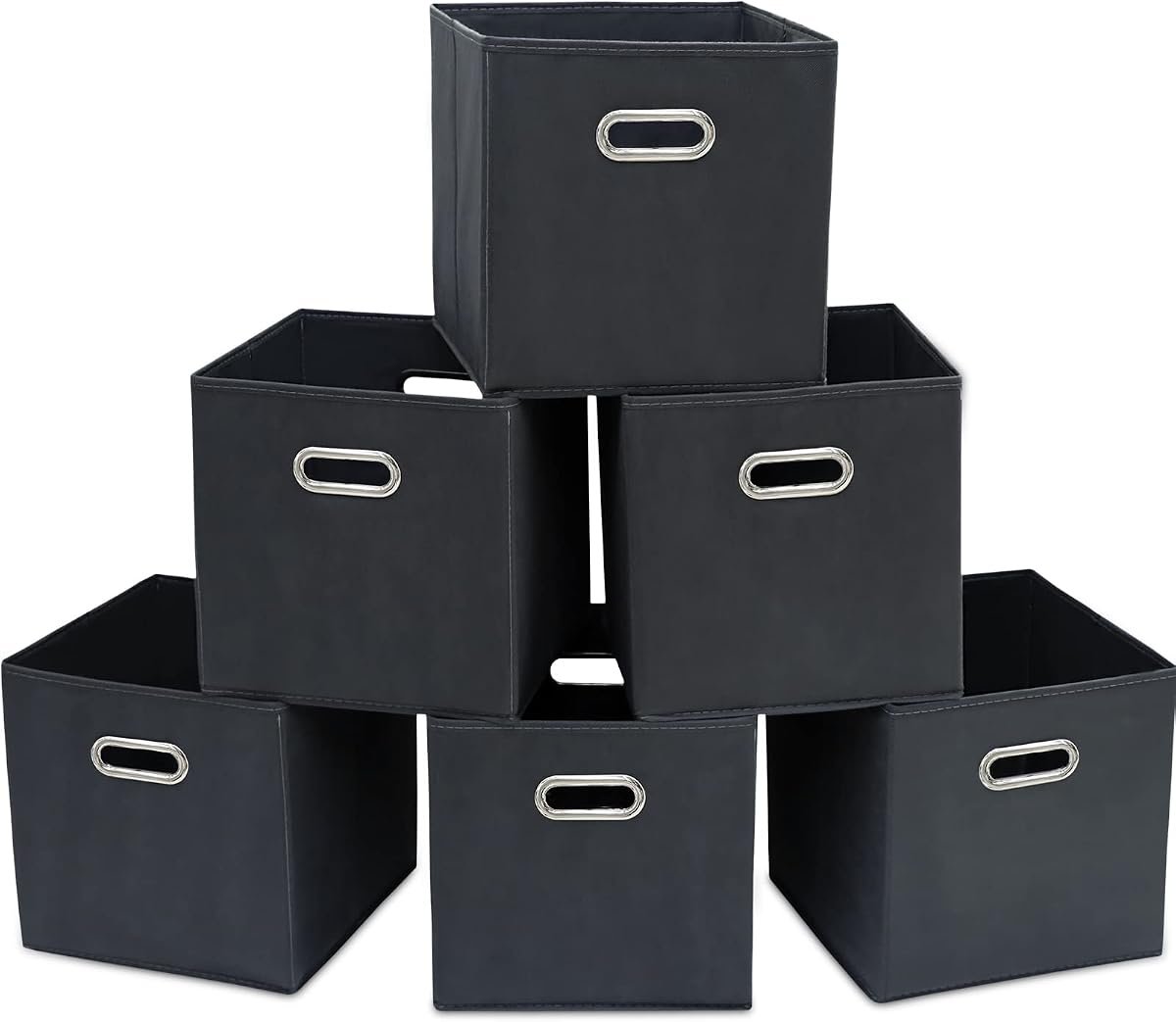
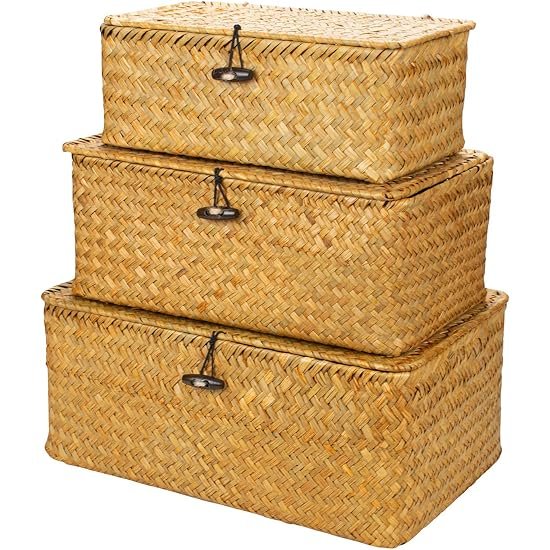
A few favorites featured in the ideas above:
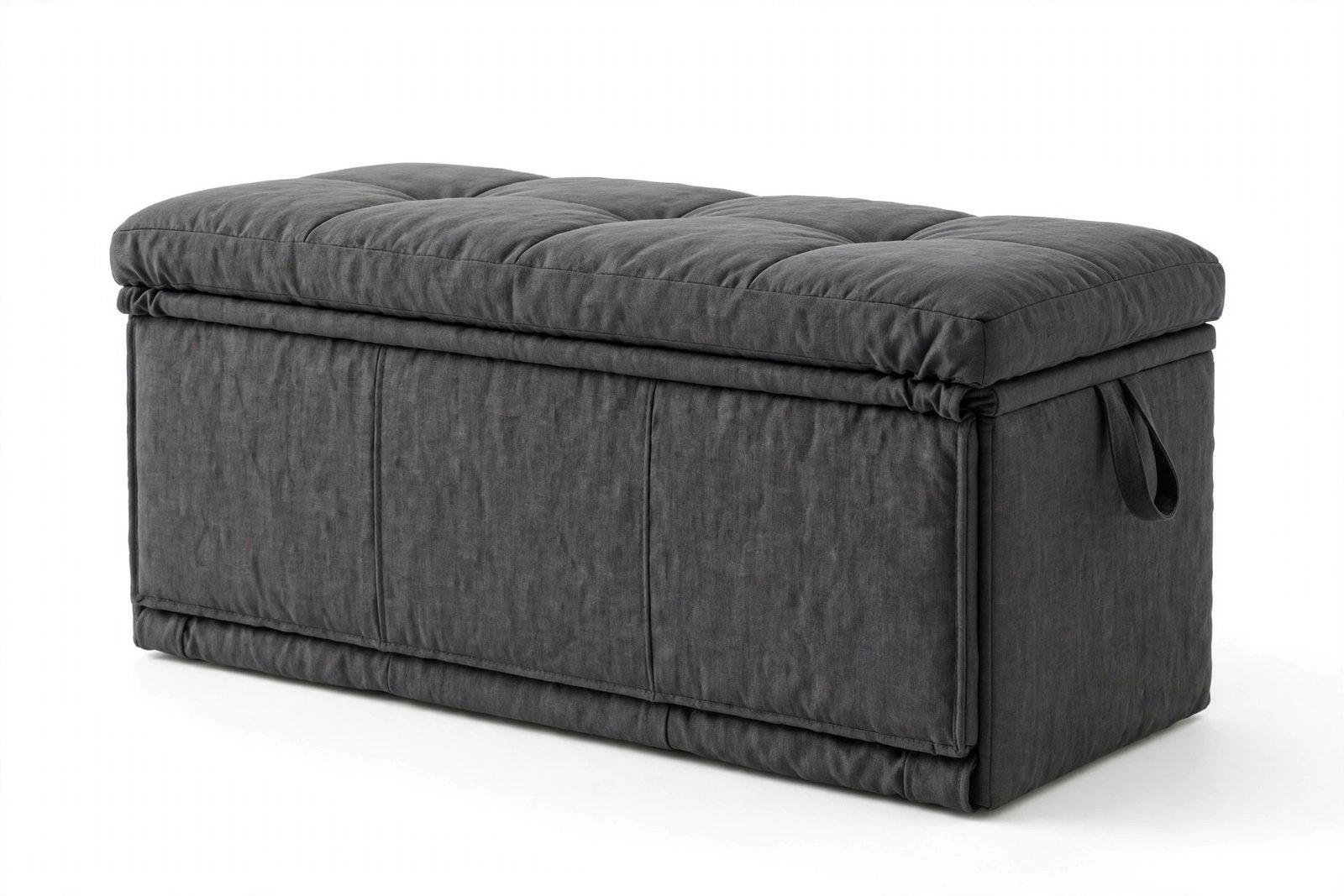
2. A Storage Ottoman That Does Everything
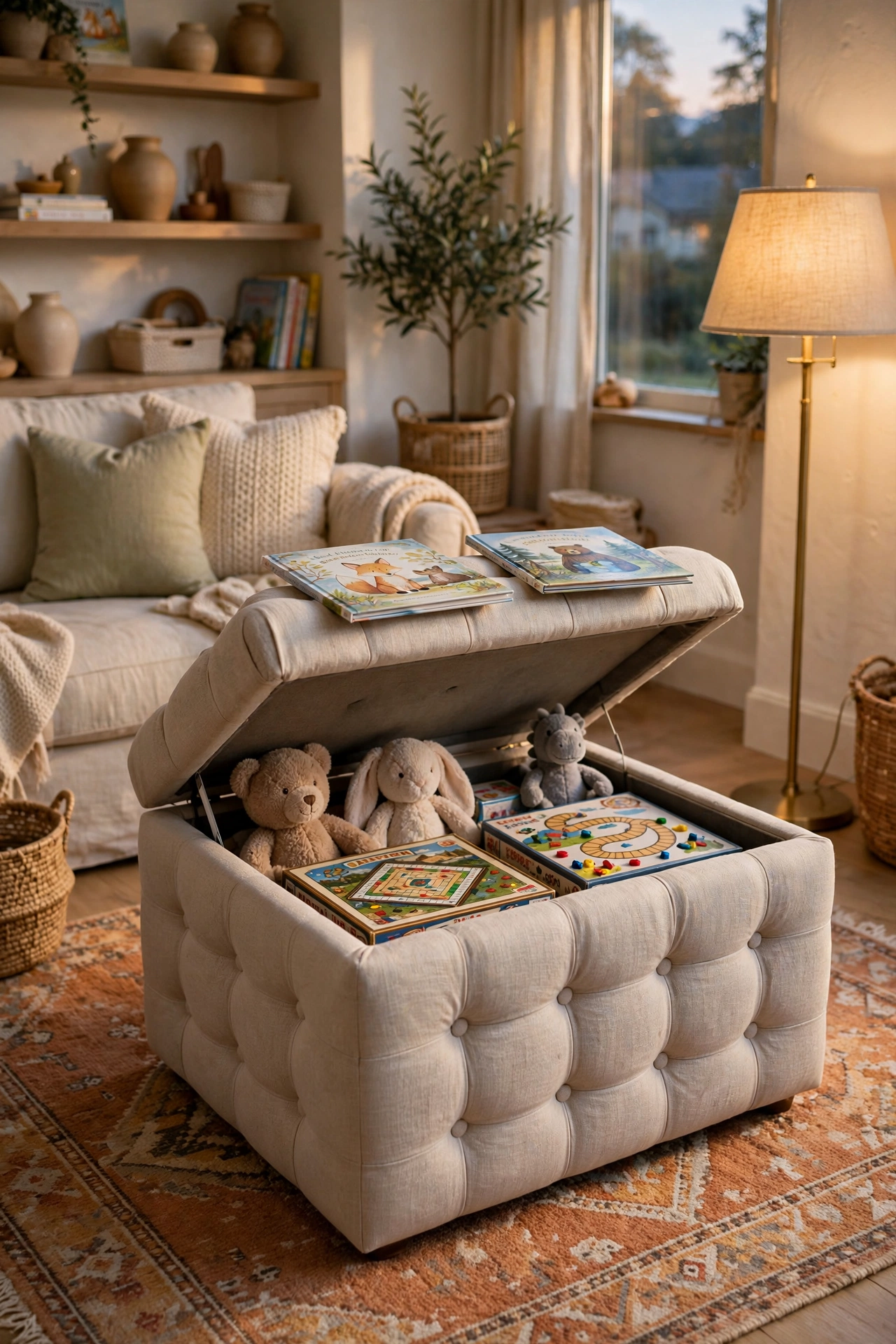
A storage ottoman is the hardest working piece of furniture in a family home and I will die on this hill. Footrest, extra seat, coffee table with a tray on top, and a secret cave for toys inside. Ours holds every stuffed animal my kids own plus two board games, and from the outside it is just a pretty tufted ottoman in the middle of the room.
Size matters here more than style. Measure the toys you want to hide before you shop. A small cube ottoman looks cute but holds about six toys. A proper bench style ottoman, the kind two kids can sit on, holds an entire category of chaos. Look for one with a safety hinge if you have toddlers, so the lid cannot slam on little fingers.
Put it where the mess happens. That is the golden rule of all toy storage. If the toys explode in the family room, the ottoman lives in the family room. Storage in the wrong room is just decoration. Storage in the right room is a cleanup miracle.
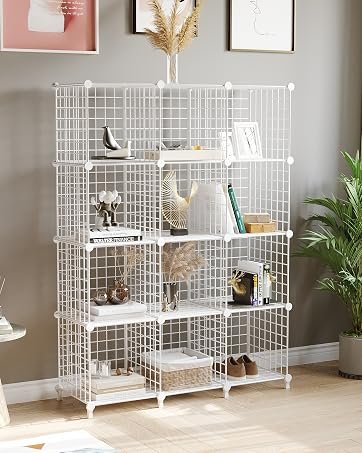
3. Cube Shelving With Fabric Bins
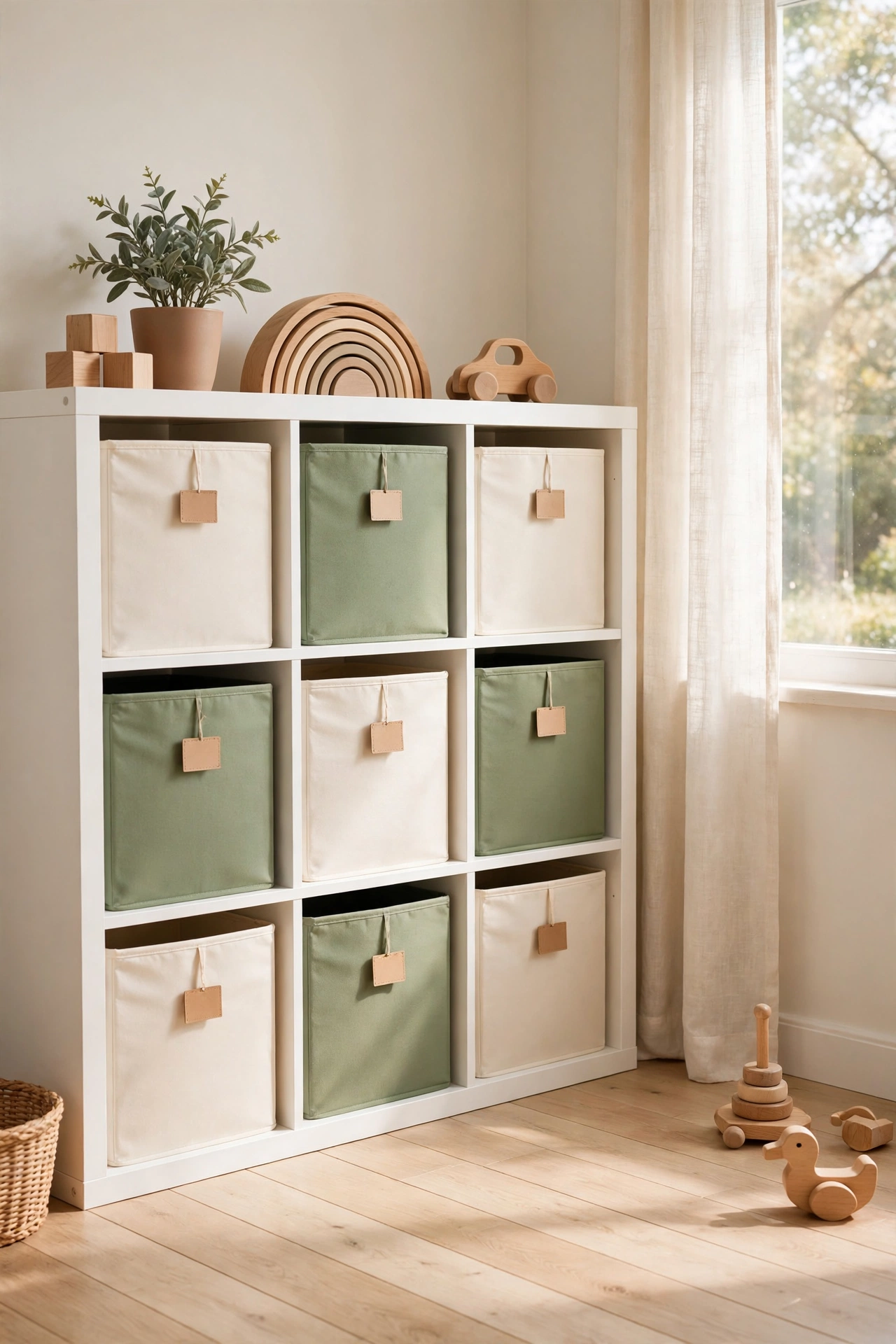
The cube shelf with fabric bins is the classic for a reason. It is affordable, it fits anywhere, and it holds a truly ridiculous amount of toys while looking neat and intentional. Our playroom has a nine cube unit and it is the backbone of the whole room. Every bin has a category. Cars. Dolls. Building toys. Art supplies. Dress up. Done.
The bins are what make it look good instead of chaotic. Choose fabric bins in two or three calm colors, cream, sage, soft gray, and the whole unit reads as furniture instead of a toy explosion. Skip the bins with cartoon characters. They are cute for about a week and then they clash with everything you own.
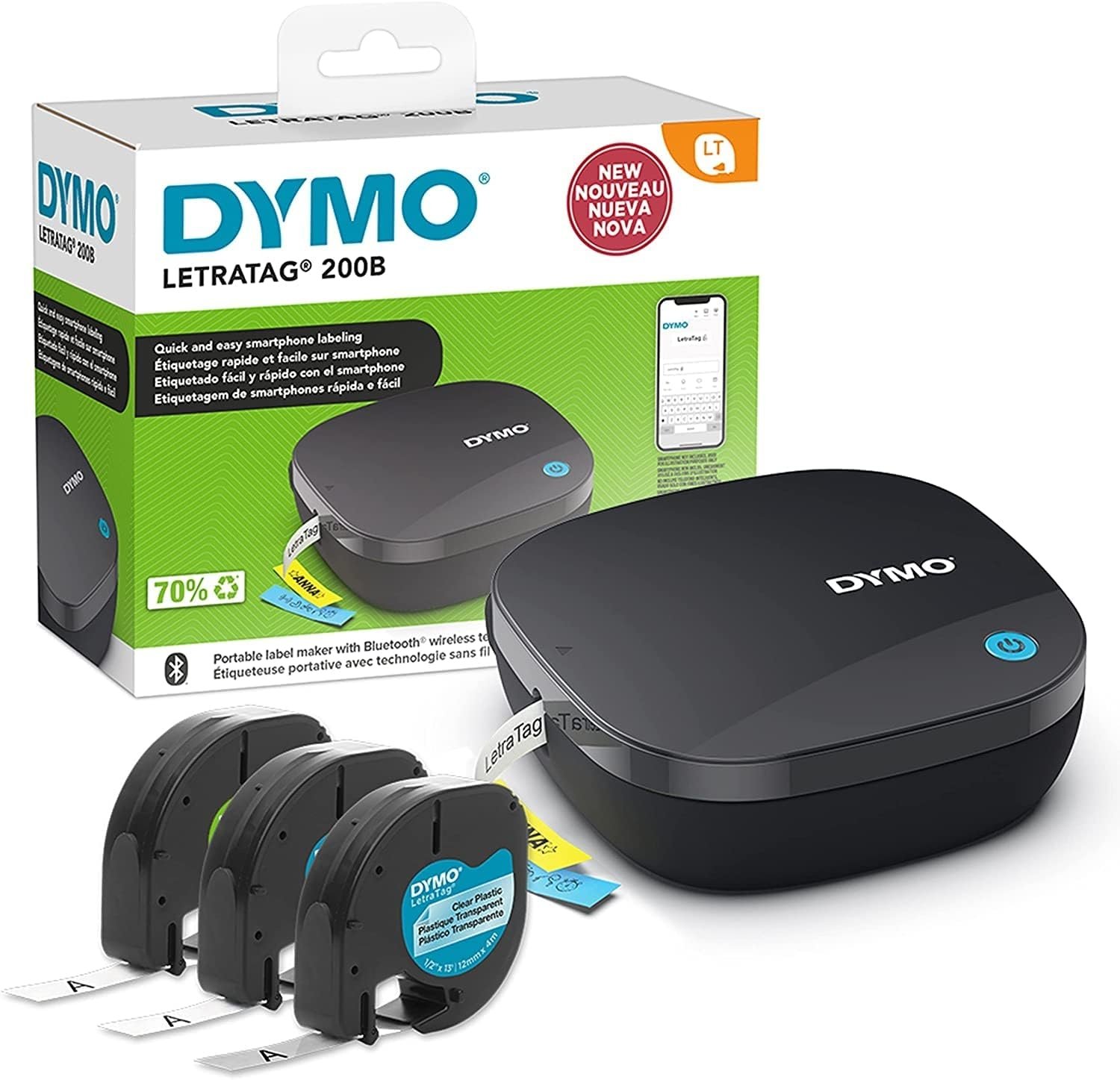
Labels are the secret weapon. Picture labels for kids who cannot read yet, word labels for the ones who can. A label maker or simple chalkboard tags turn the shelf into a system the kids can actually maintain. My six year old puts his cars away without being asked now, and I take full credit for the labels.
4. Labeled Baskets on Open Shelves
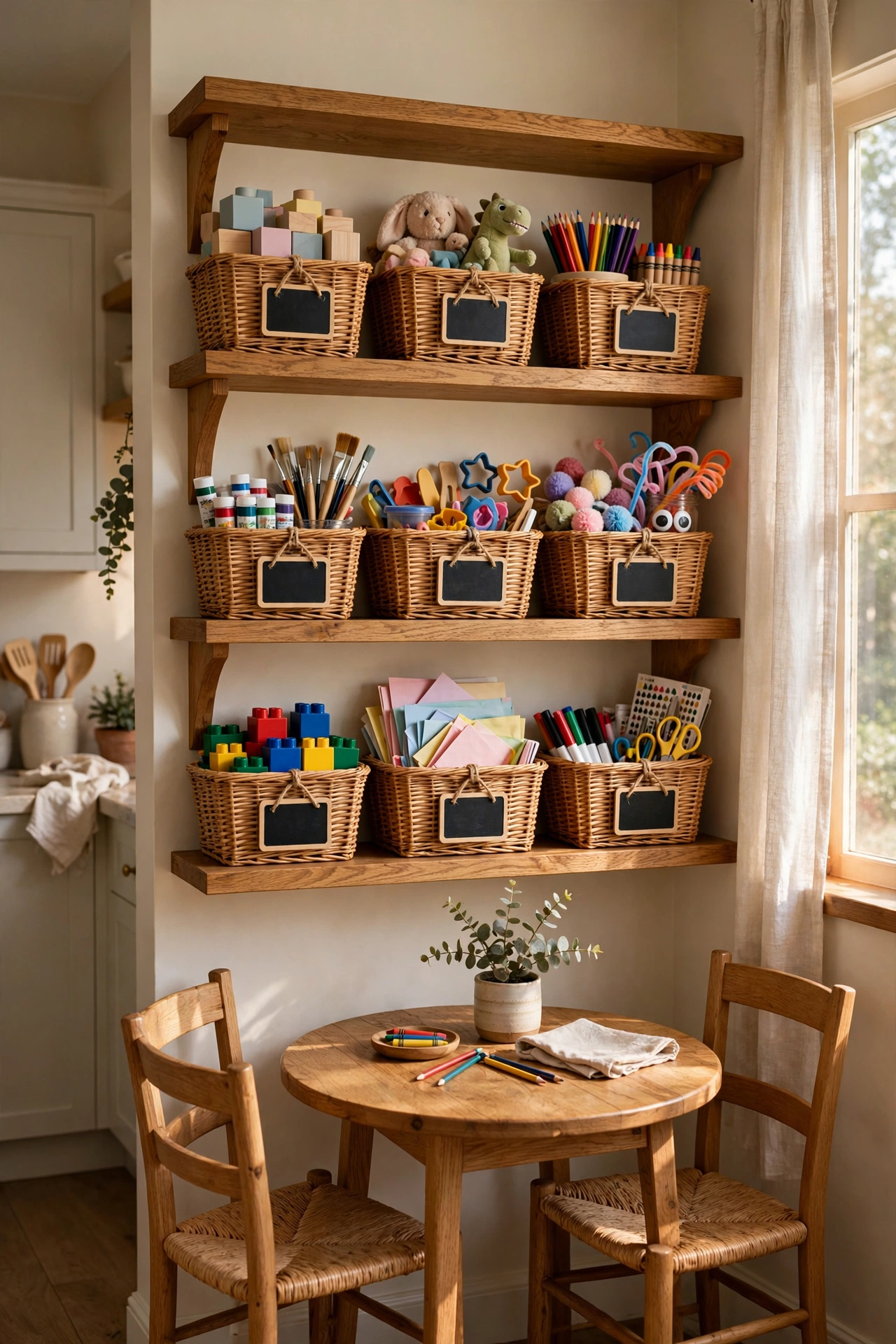
Open shelves get a bad reputation with kids, but labeled baskets change everything. The shelf looks styled and pretty. The baskets hide the chaos. The labels tell everyone where things belong. I have these in our kitchen nook for art supplies and small toys, and it is the difference between a junk drawer explosion and a system.
Small wicker baskets with chalkboard labels are my favorite for this. They are sturdy enough for daily kid use, pretty enough for a main living space, and the chalkboard labels mean you can change categories as the kids grow. Crayons become markers become friendship bracelet supplies, and the basket just gets a new label.
Keep the categories tight. One basket for coloring, one for stickers, one for small figurines. The narrower the category, the easier the cleanup. A basket labeled miscellaneous is where toys go to die. Ask me how I know.
5. Drawers That Roll Under the Bed
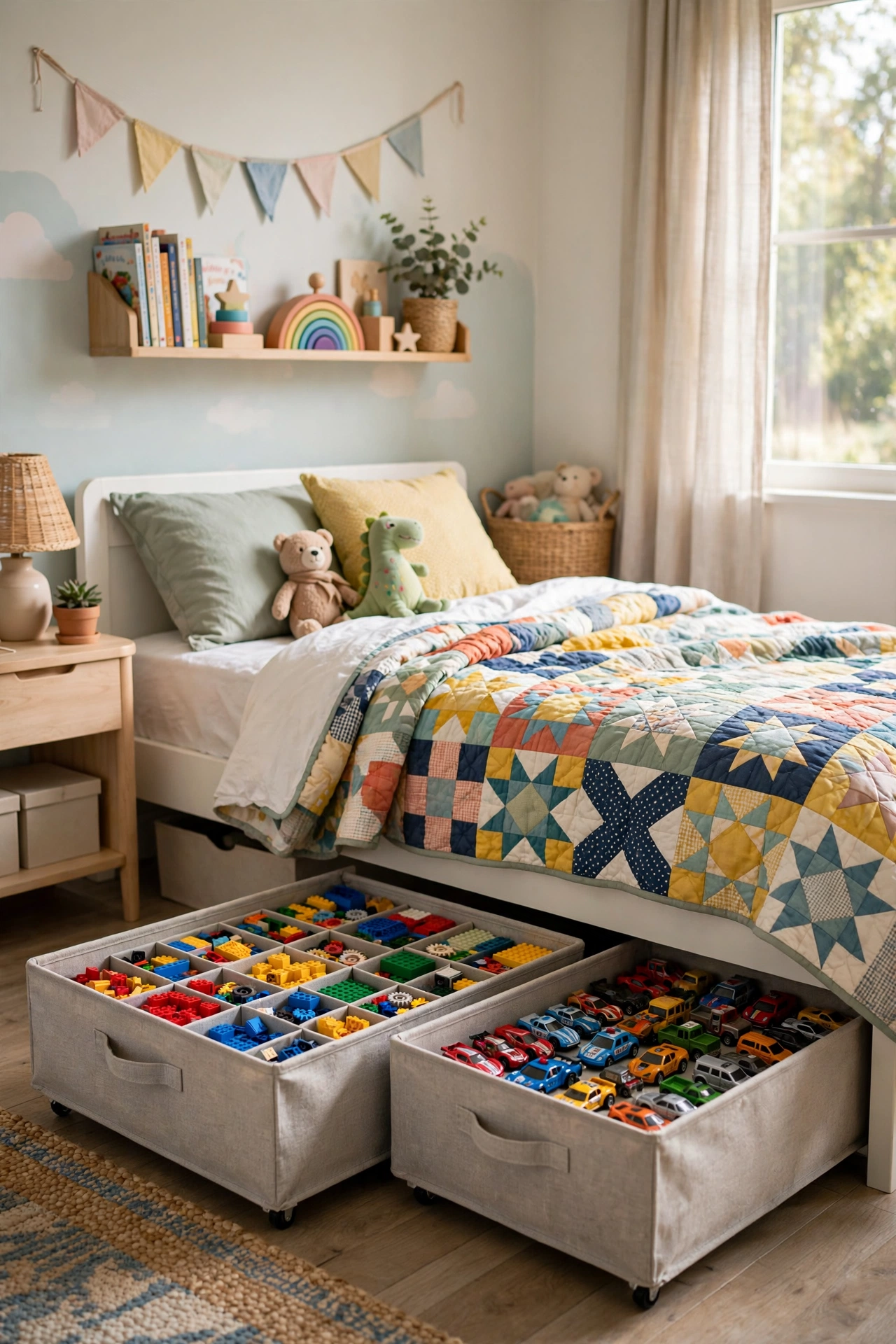
The space under the bed is free real estate and most of us waste it on dust bunnies. Rolling drawers turn it into a toy garage. Our kids keep LEGO in one drawer and toy cars in another, and they roll out like magic when it is playtime and disappear when it is not. The bedroom floor stays clear. It feels like a magic trick.
Fabric drawers on wheels are the best version of this. They are light enough for kids to pull out themselves, soft enough not to scratch the floors, and they come with lids to keep the dust out. Hard plastic bins work too, but they are loud and they crack. Ask me about the great bin crack of last year.
This is also the perfect spot for the toys that are currently out of rotation. Seasonal toys, the puzzle nobody wants right now, the building set they will love again in three months. Out of sight is not out of mind when the drawer rolls out. It is just tidier.
Small spaces, big storage: the square footage you forgot
Some of the best toy storage in your house is space you are not using at all. The closet with the broken rod. The window with the sad blinds. The entryway where shoes go to form a mountain range. These ideas turn forgotten square footage into storage that works as hard as you do.
6. A Toy Rotation Shelf
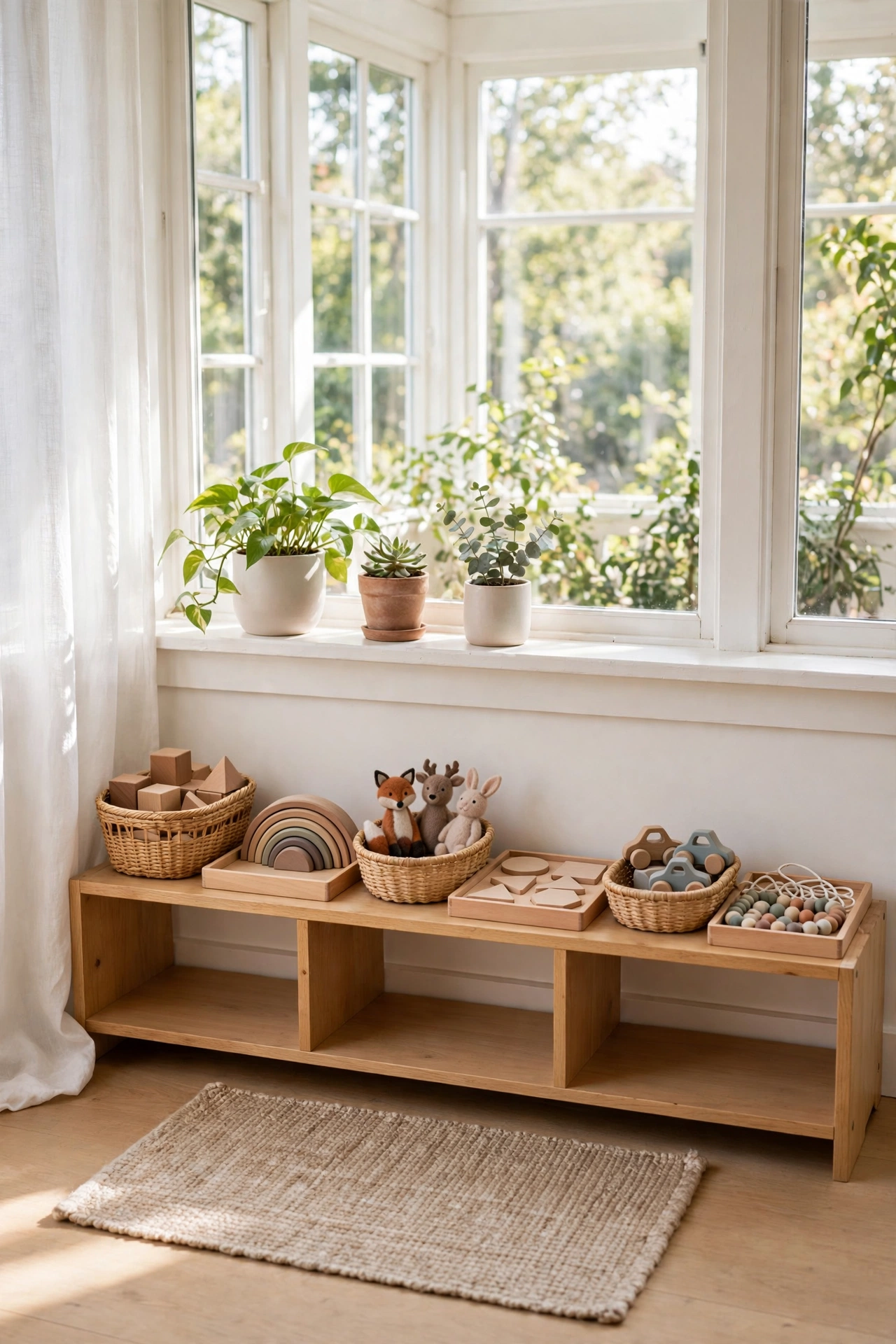
Toy rotation changed our house more than any bin ever did. The concept is simple. Put out a small number of toys on a low open shelf, store the rest, and swap them every week or two. The kids play with the toys like they are brand new. The house stays tidy because there are only six things out. It feels like you bought new toys every other week for free.
A low wooden shelf is all you need. The Montessori style ones are perfect because everything is visible and reachable, which means the kids actually play with what is out. Put each toy or toy set in its own little basket or tray on the shelf. The tray is key. It defines the space, it makes cleanup obvious, and it looks beautiful.
Store the rest in labeled bins in a closet or the garage. The swap takes ten minutes on a Sunday night and it is weirdly satisfying. Old toys come back like long lost friends. The kids rediscover things they forgot they loved. And you get to enjoy a living room that is not buried in plastic.
7. A Window Seat That Stores Toys
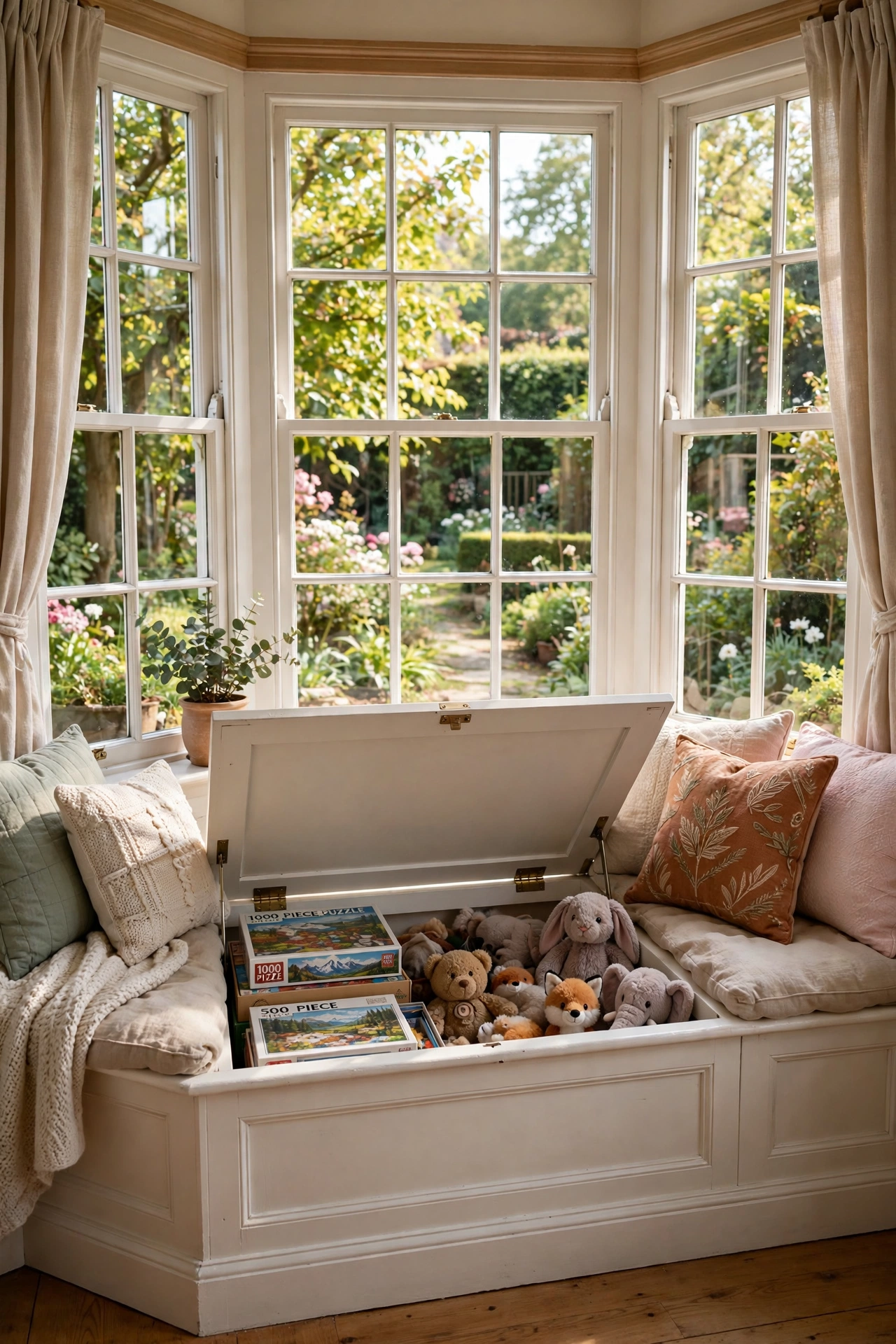
A window seat with storage inside is the dream, and if you have one, use it. If you do not, a simple storage bench under a window does the same job. Ours holds every puzzle we own plus the stuffed animals that did not make the ottoman cut. The kids sit on it to read. The toys hide inside. It is the hardest working seat in the house.
The hinged top is what makes it work for kids. They can open it themselves, grab what they want, and shove it closed. No doors to leave open, no bins to pull out. Just lift and drop. For little kids, this is the easiest cleanup system there is. Even a two year old can do the lift and drop.
Add cushions and pillows on top and it becomes the favorite spot in the house. A window seat is where kids read, daydream, and watch the rain. The fact that it also swallows a shocking number of toys is just a bonus. A very large, very useful bonus.
8. Entryway Cubbies for Every Kid
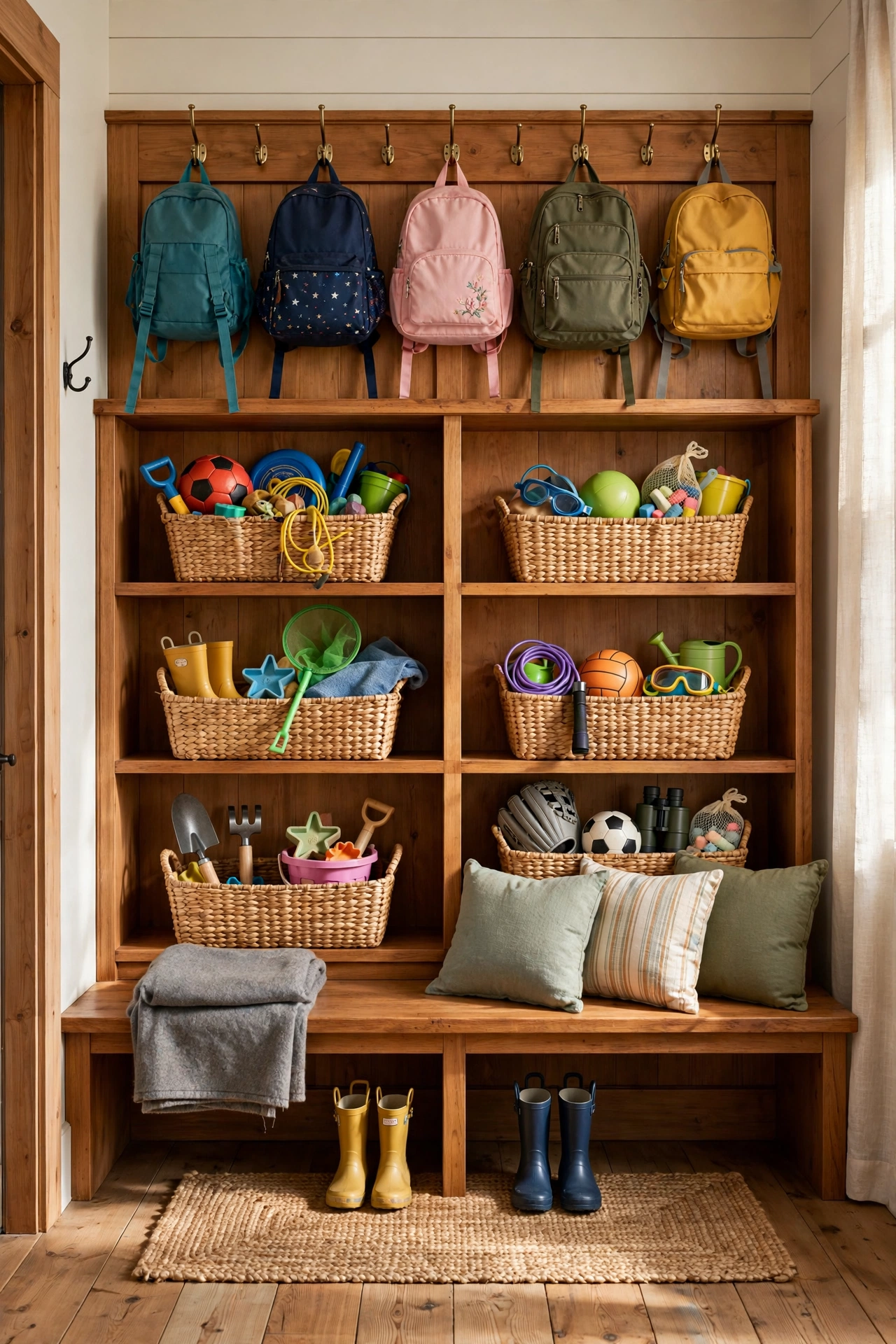
The entryway is where outdoor toys go to multiply. Balls, bikes helmets, sidewalk chalk, the bubble wands. Give each kid their own cubby and the mountain range of shoes and gear suddenly has a system. Our mudroom cubbies hold each kid’s outdoor toys in a labeled basket, and the rule is simple. If it does not fit in your cubby, it does not live by the door.
Cubbies work because they are personal. Kids take ownership of their little square. They will defend that cubby like it is prime real estate, which means they will also keep it reasonably tidy. Put their name or a picture label on it and watch the pride kick in.
Hooks above for backpacks and jackets, a bench below for sitting to put on shoes, and the basket in the cubby for the outdoor toys. That is the whole entryway formula. It handles the morning rush and the after school explosion with the same calm system. If your front entry needs the full treatment, my fall front entryway ideas will get the whole space feeling welcoming too.
9. A Closet That Works Like a Playroom
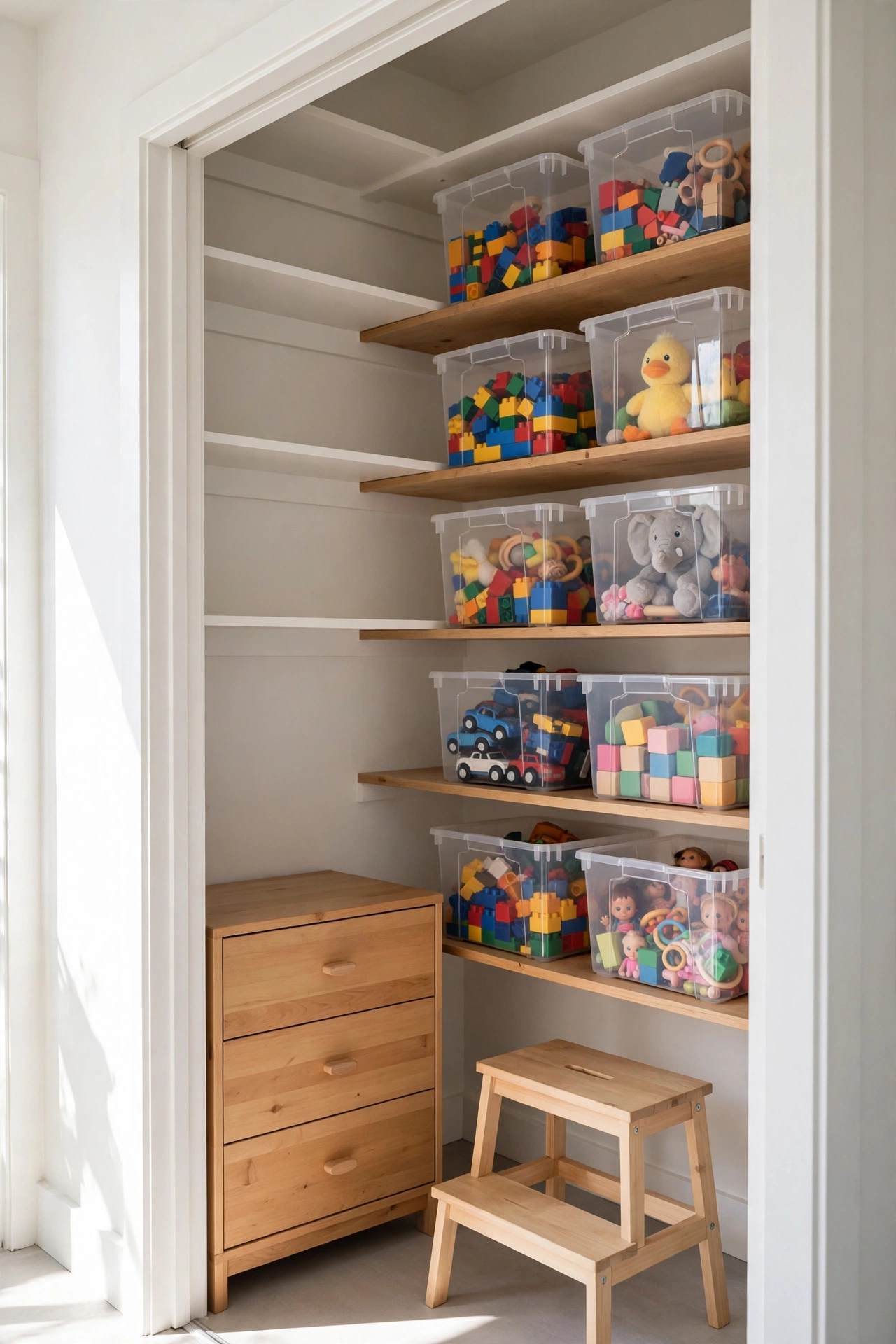
Take the doors off a kids closet, add low shelves and bins, and suddenly you have a playroom inside a closet. This is my favorite small house trick. The closet becomes a contained little world. The toys live there. The mess lives there. And when you need the room to look tidy, you just close the doors. Instant clean room.
Remove the hanging rod if the kids are past the baby clothes stage and install shelves at kid height. Clear bins on the shelves so they can see what is inside. A small dresser with labeled drawers for the tiny stuff. A step stool for the top shelf. It is a whole organization system in about six square feet.
The contained part is the real magic. Kids play differently in a small defined space. They focus more. They make less of a sprawling mess. And you get your bedroom floor back. If the closet is in a bedroom that needs a cozy refresh too, my cozy fall bedroom ideas pair beautifully with an organized closet.
10. A Toy Chest at the Foot of the Bed
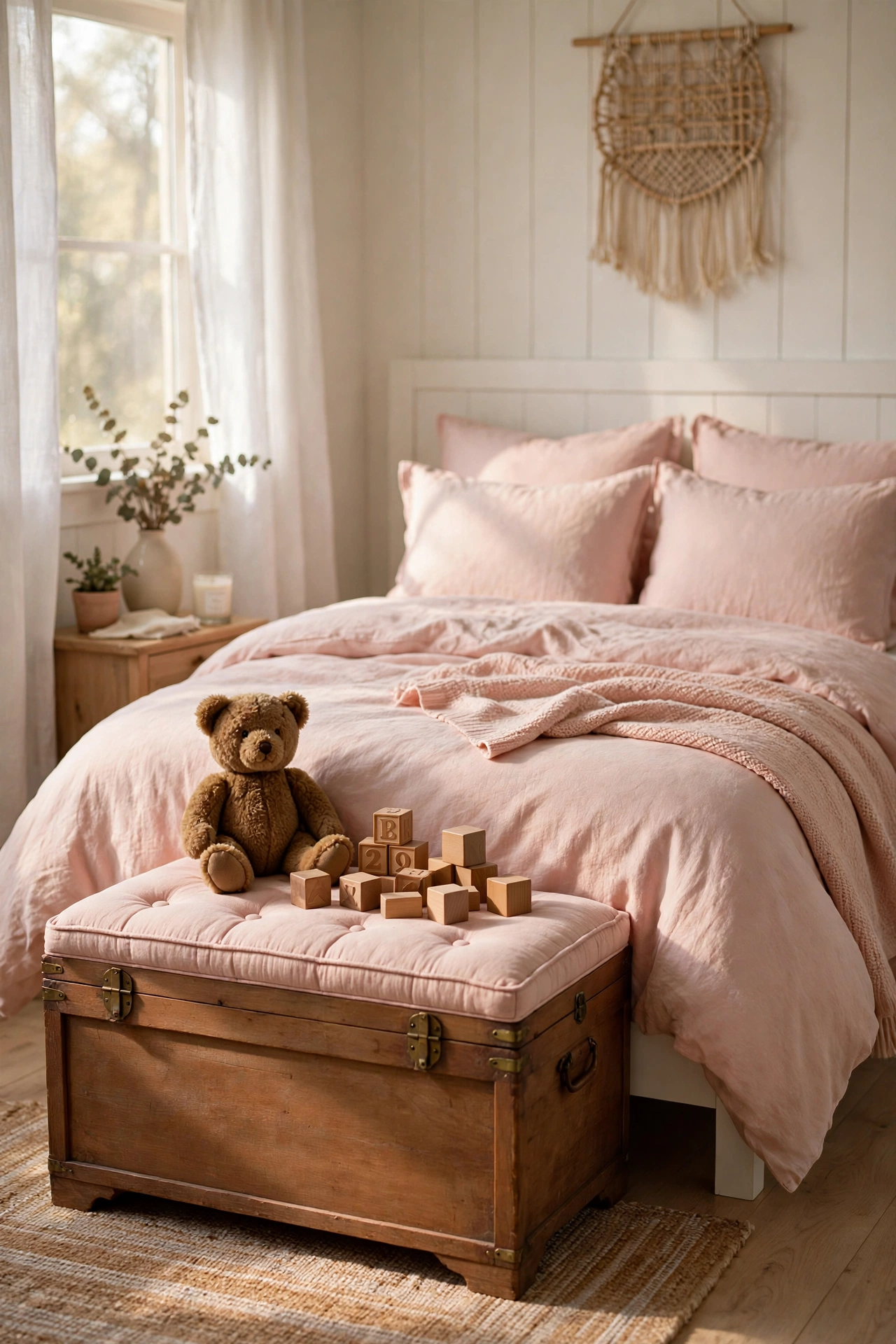
The classic toy chest still works, especially the kind with a cushioned top that doubles as a bench. At the foot of the bed it holds dress up clothes, blankets for fort building, and the big awkward toys that do not fit in bins. The kids sit on it to put on shoes. They hide inside it during hide and seek. It earns its floor space.
Safety first with this one, always. Modern toy chests have safety hinges and ventilation holes, and the lid should never slam. If you are using a vintage chest, add a soft close hinge yourself. It is a ten minute job and it matters. Little fingers are worth the ten minutes.
Choose one that matches the bedroom furniture and it looks like it was always meant to be there. Wood tones that match the bed frame. A cushion in the bedding colors. It stops being a toy box and starts being part of the room. That is the difference between storage and furniture, and it is a difference worth paying for.
The playroom, tamed: systems for the toy explosion zone
The playroom is allowed to be the messy room. That is literally its job. But there is a difference between creative chaos and a landfill. These ideas give the playroom zones and systems so the kids can make their glorious mess and still clean it up in ten minutes flat. A playroom with a system is a gift to everyone in the house.
11. Play Zones on a Big Rug
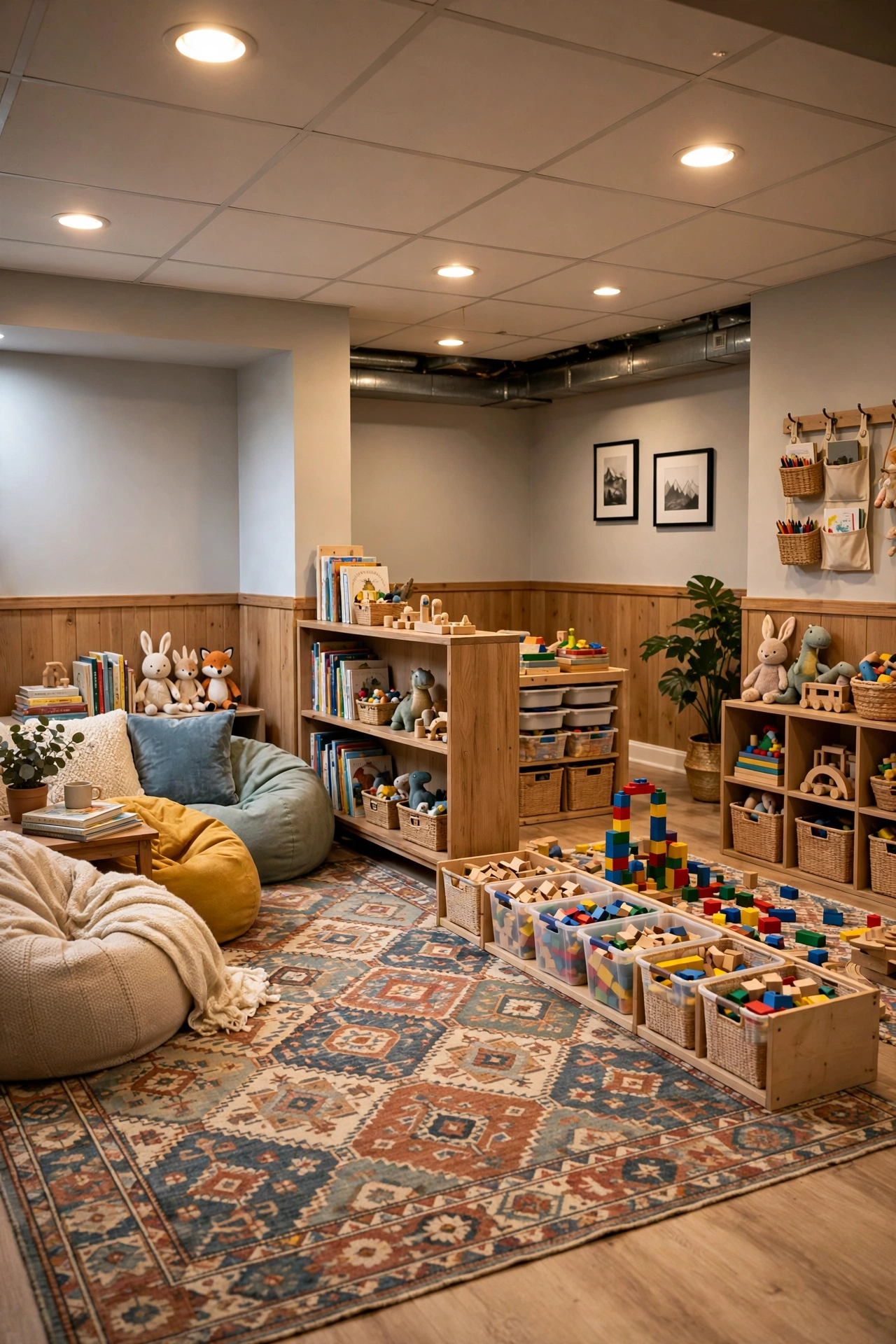
Divide the playroom into zones and watch the chaos organize itself. A big rug defines the main zone. A low bookshelf becomes a room divider between the reading corner and the building zone. Each zone has its own storage right there. Blocks live in the block zone. Books live in the reading zone. The kids learn that things have places, and cleanup becomes putting things back in their zone instead of facing the whole room at once.
The rug does more work than you think. It marks the territory. Toys that wander off the rug get returned to the rug. It also softens the noise of a thousand plastic bricks hitting the floor, which your downstairs neighbors or your sanity will appreciate. Choose a big flat weave rug that is easy to clean. Playroom rugs take a beating.
Keep each zone simple. A zone needs its storage, its toys, and nothing else. The reading corner gets a bean bag and a book bin. The building zone gets the blocks and a low table. When a zone starts collecting random stuff, that is your signal to reset it. Five minutes per zone and the whole playroom is back.
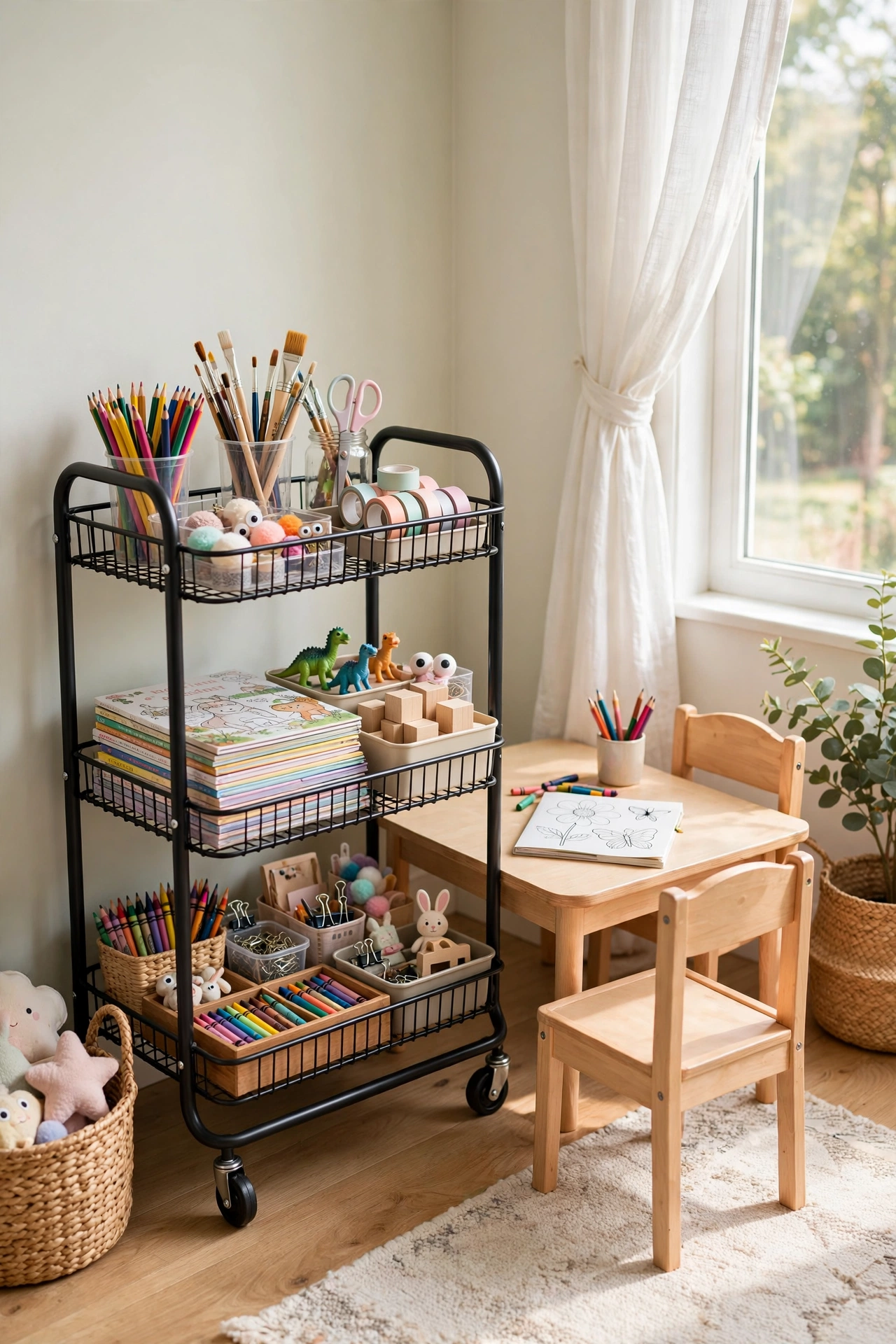
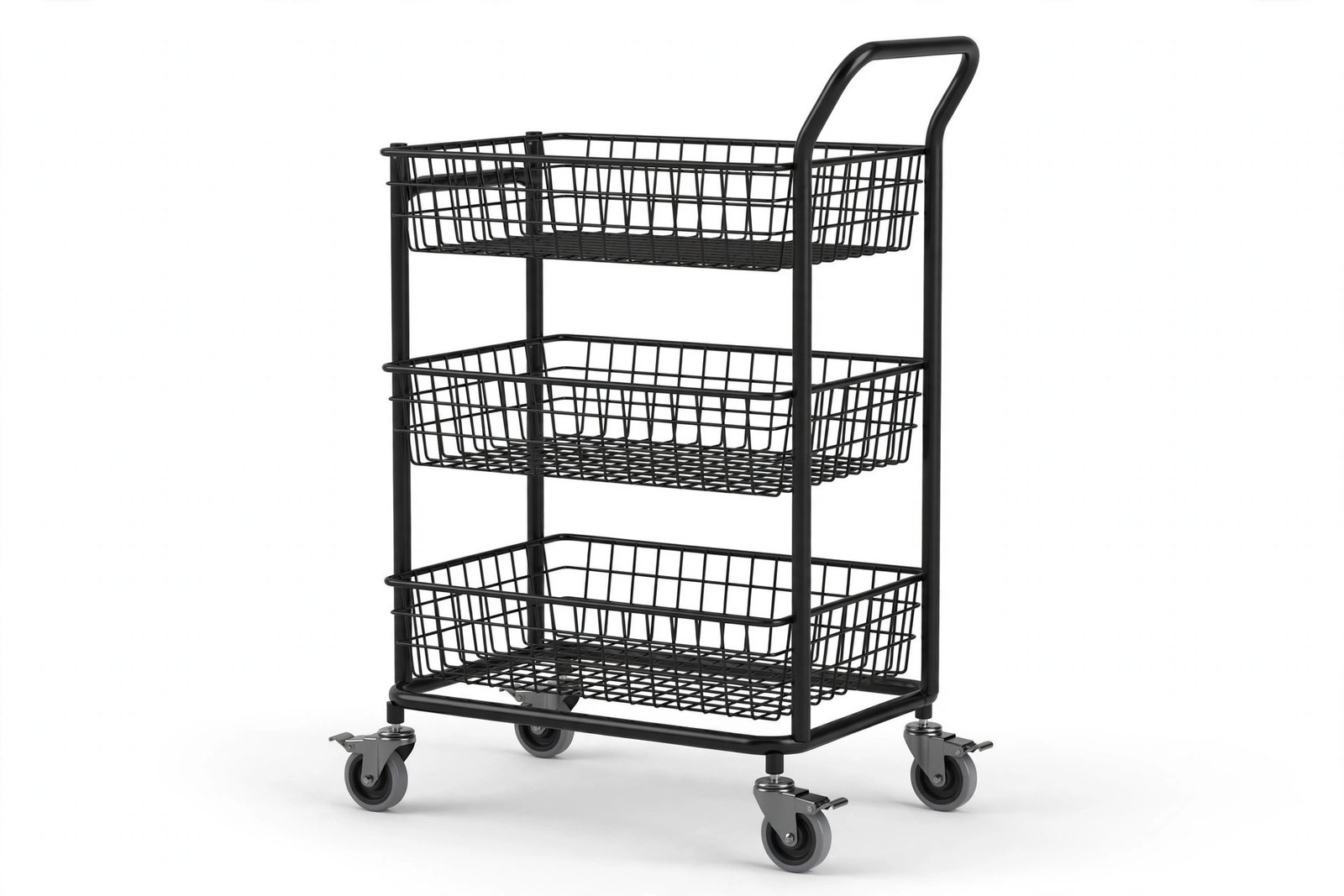
12. A Rolling Craft Cart
Art supplies are the glitter bomb of toy storage. They get everywhere, they stain everything, and they multiply when you are not looking. A three tier rolling cart contains the whole operation. Markers on top, paper in the middle, stickers and stamps on the bottom. When craft time is over, the whole cart rolls into a closet. The glitter stays in the cart. Mostly.
The rolling part is the whole point. A craft station that lives in the middle of the room all the time becomes clutter. A cart that rolls out for projects and rolls away after is a system. The kids can wheel it to the kitchen table, make their masterpieces, and wheel it back. Independence for them, sanity for you.
Use cups and small trays inside each tier to sort the supplies. Loose markers in a big tier become a tangled mess in about three days. Little cups for markers, crayons, and colored pencils keep everything visible and grabbable. It is the same principle as the labeled baskets. Everything needs a tiny home inside the bigger home.
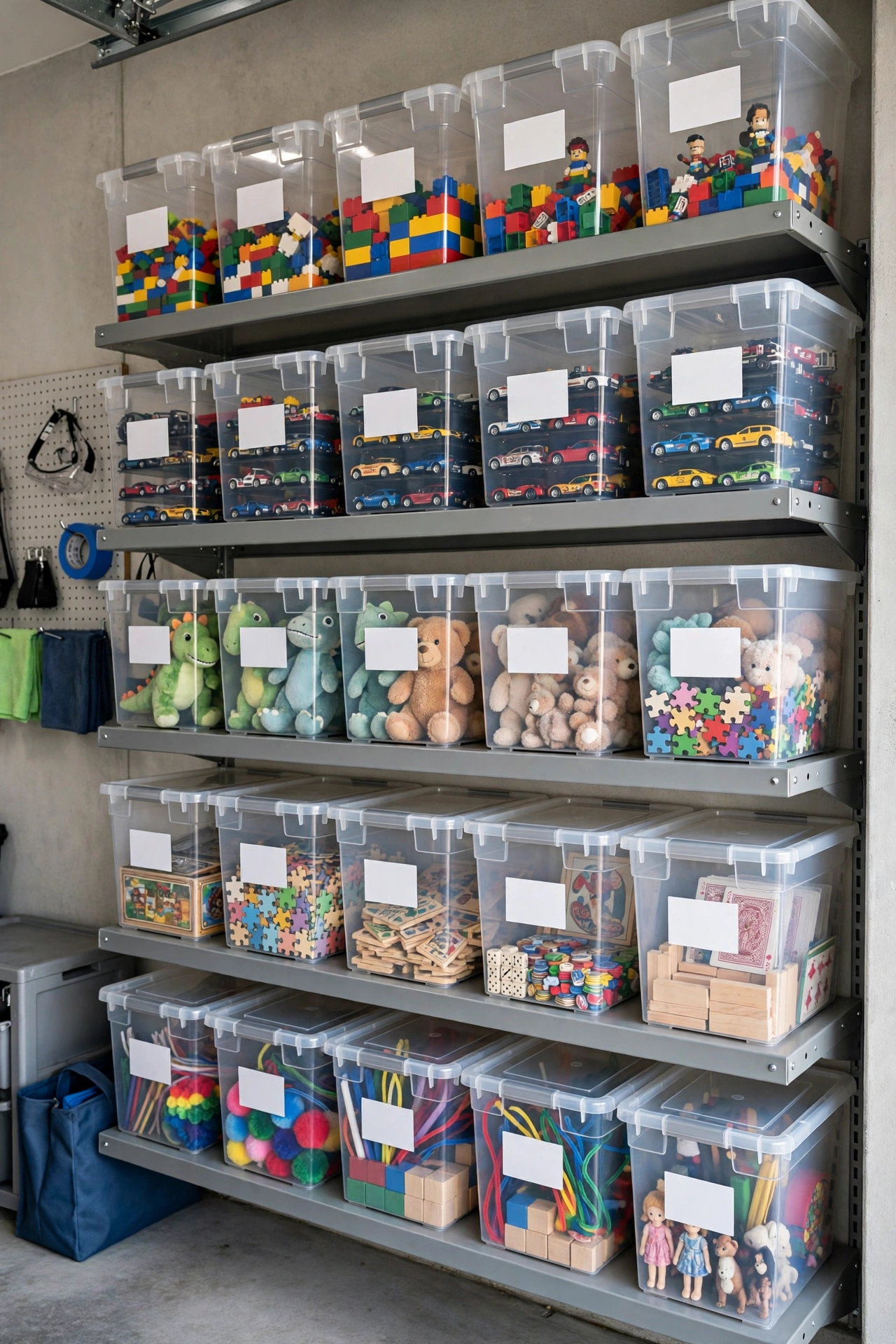
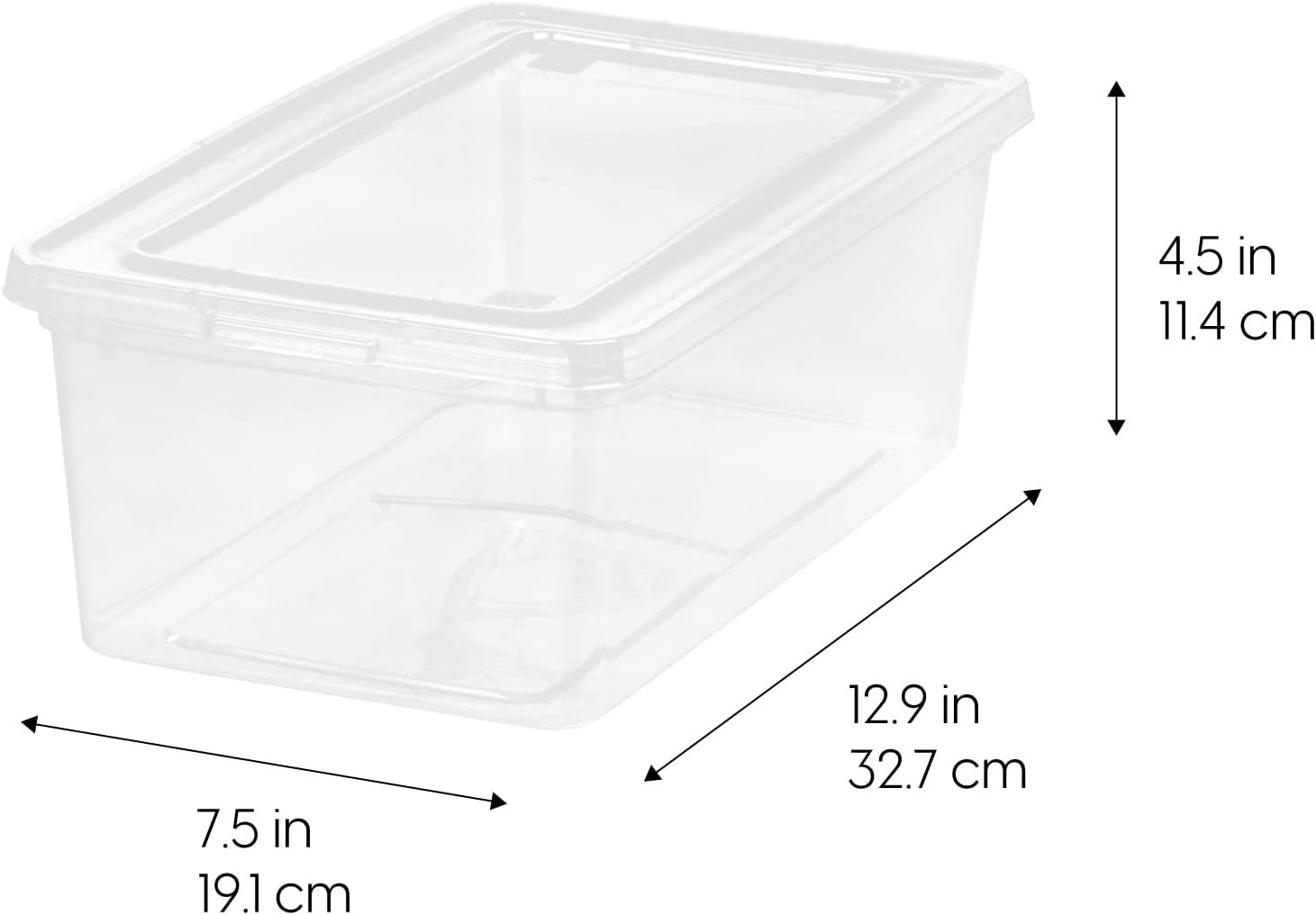
13. Clear Bins You Can Actually See Through
For the overflow, the seasonal toys, and the great big categories, nothing beats clear stackable bins. The clear part matters. When the kids can see what is inside, they find what they want without dumping every bin on the floor. It cuts the mess in half all by itself. Opaque bins are mystery boxes. Clear bins are a menu.
Stack them on a garage or basement shelving wall and you have a toy library. Label each bin with what is inside and the kids can shop their own collection. Board games in one. Outdoor toys in another. The dress up bin. The building sets. It looks incredibly satisfying, like a little toy store, and it keeps the main living areas clear.
This is also where the toy rotation stash lives. The bins in active rotation stay accessible. The rest stack neatly and wait their turn. When swap day comes, you are not digging through a closet. You are shopping a shelf. It makes the whole rotation system ten times easier to maintain.
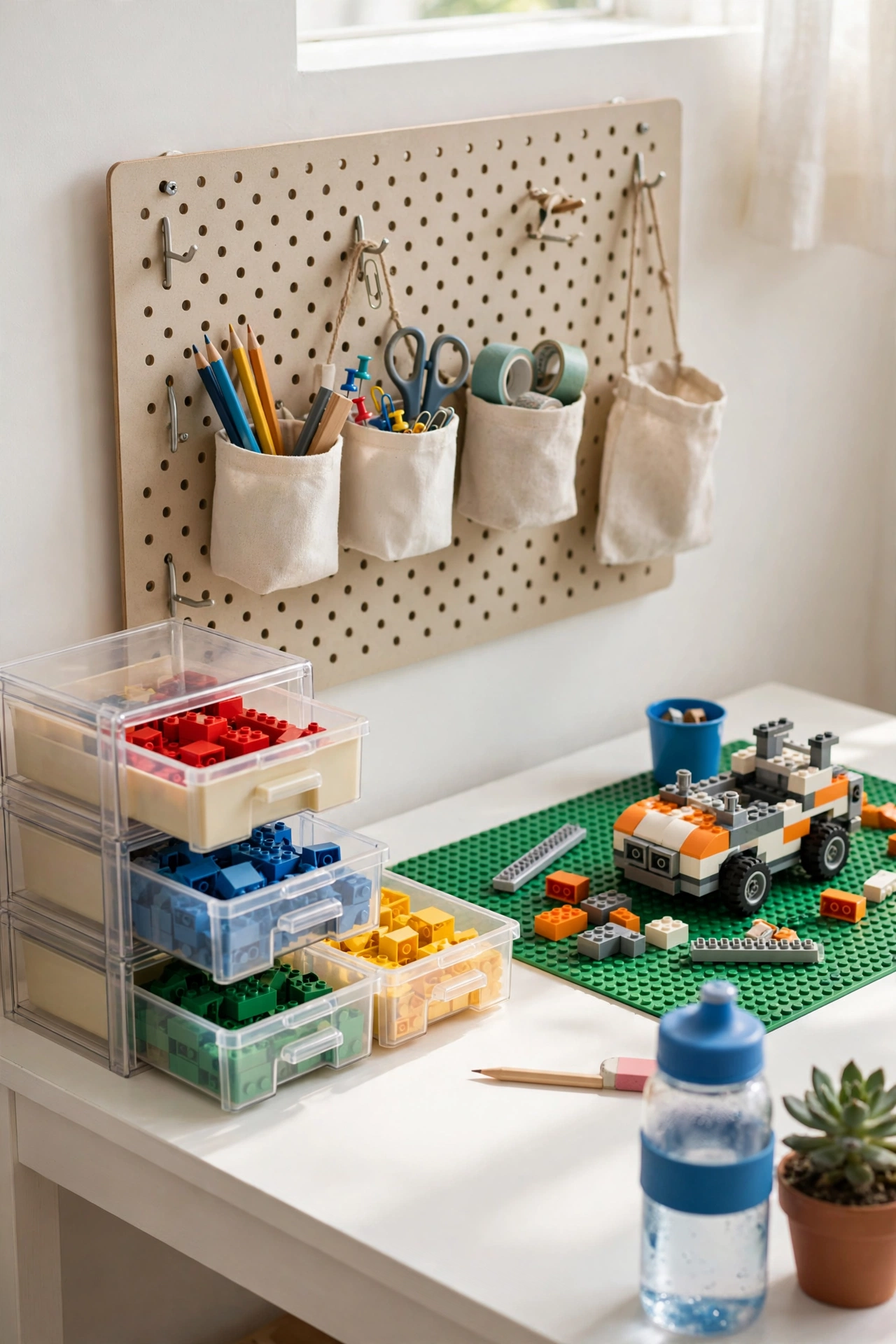
14. Sorters for Small Pieces at the Desk
LEGO bricks are wonderful and they are also tiny chaos agents that end up in every corner of the house. A set of small stackable drawer sorters at the desk contains them. Sort by color or by type, whatever your kids prefer. The drawers pull out, the bricks stay sorted, and the desk stays usable for actual homework. Revolutionary.
The desk location matters. Small piece toys need a defined building area or they migrate. Give LEGO and similar toys a home base at a desk or a building table, with the sorters right there. The rule is simple. The small pieces live at the desk. They do not travel to the living room. They do not visit the bathtub. The desk is their home.
A building mat or a tray with edges on the desk keeps the in progress creations contained. Half built masterpieces need a safe place to live between sessions. A tray they can slide onto a shelf means the creation survives and the desk clears. Everybody is happy, especially the masterpiece.
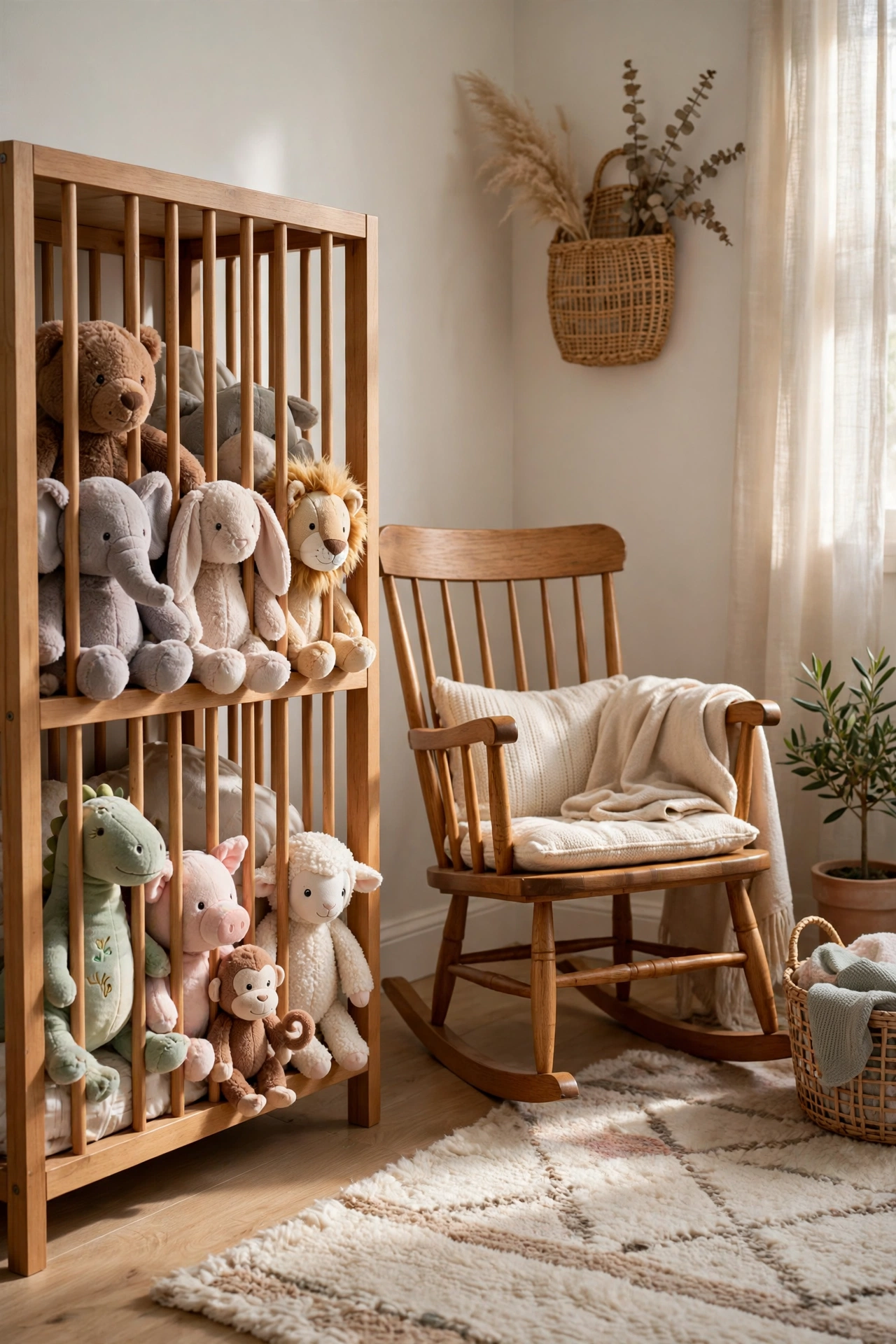
15. A Stuffed Animal Zoo
Stuffed animals reproduce in the dark. I am convinced of it. One day you have five, the next day there is a mountain on the bed and you cannot find the pillows. A stuffed animal zoo, that wooden frame with vertical slats, corrals the whole collection into something that looks adorable instead of overwhelming. The kids can see every animal. They can pull one out and push it back in. It is a zoo, and zoos are fun.
The slats are genius because they keep the animals visible but contained. A basket of stuffies becomes a black hole where the favorite bear disappears to the bottom. The zoo displays them all like a little audience. Kids play with the ones they can see, which means the whole collection actually gets loved instead of just the top layer.
This is perfect for a nursery or a young kids room where the stuffy collection is still growing. It holds a shocking number of plush friends in a small footprint, and it looks like decor instead of clutter. If the nursery needs more love, my nursery ideas will keep the whole room feeling sweet and calm.
Corners and middle spaces: storage where you least expect it
The last section is for the spots you walk past every day without seeing their potential. The hallway. The stairs. The side of the nightstand. The dead space under a loft bed. These are the ideas that make guests say wait, where do you keep all the toys, and you just smile.
16. A Reading Nook That Stores Toys Too
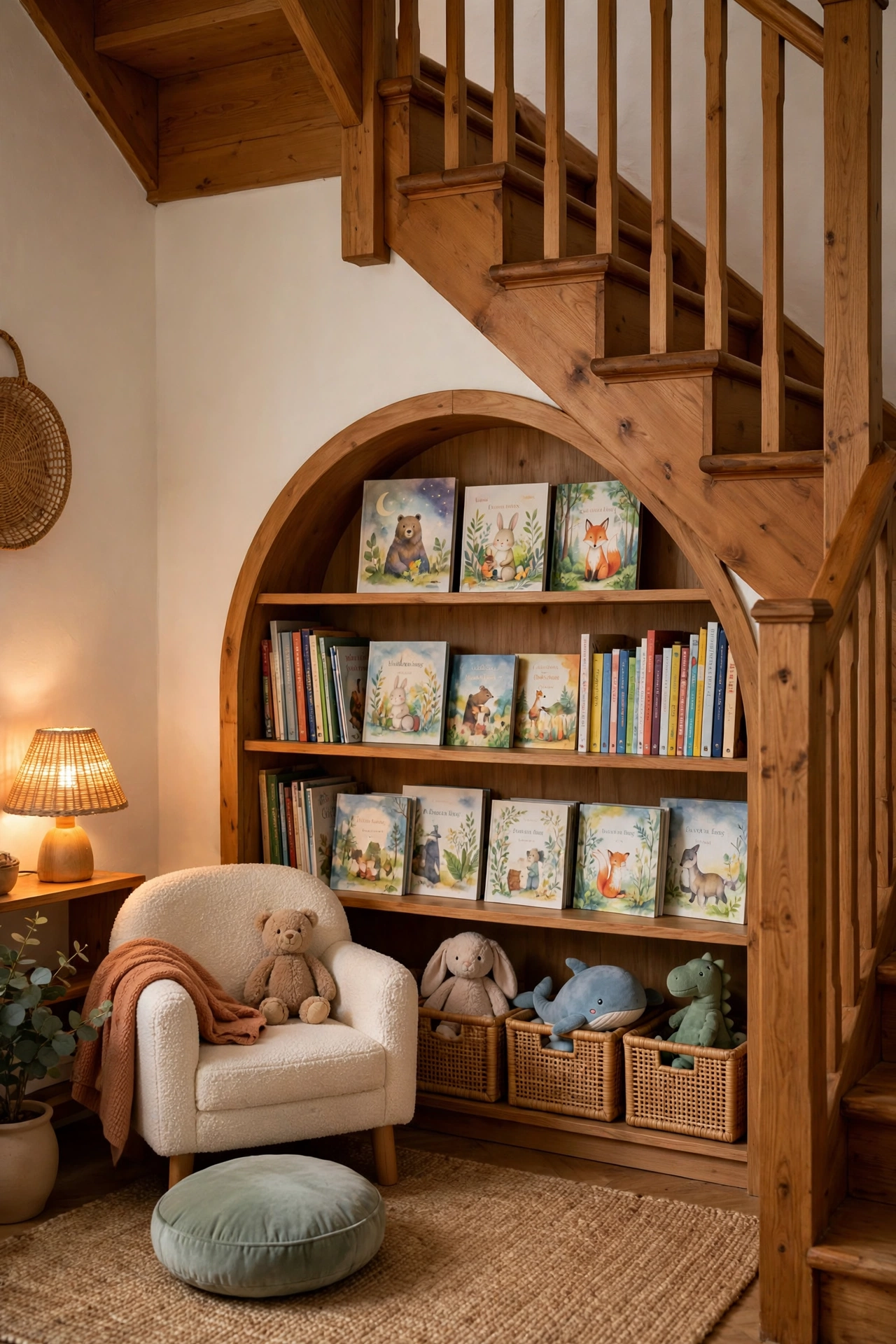
The space under the stairs is the most wasted square footage in the average house. Turn it into a reading nook with a low bookshelf and you get a magical kid space that also stores toys. Books on the top shelves where they are visible and inviting. Toy bins on the bottom shelves where they are easy to grab and easier to shove back.
Kids adore small cozy spaces. A nook feels like a secret clubhouse, which means they will actually spend time there, which means the toys migrate to the nook instead of exploding across the living room. It is storage that entertains. The toys have a destination the kids want to visit.
Add a small armchair or a pile of floor cushions and a warm lamp, and the nook becomes the reading spot too. Books and toys living together in one cozy corner. It is the kind of space that makes a house feel like a home, and it swallows an impressive amount of stuff for its size.
17. A Hallway Bench With Hidden Storage
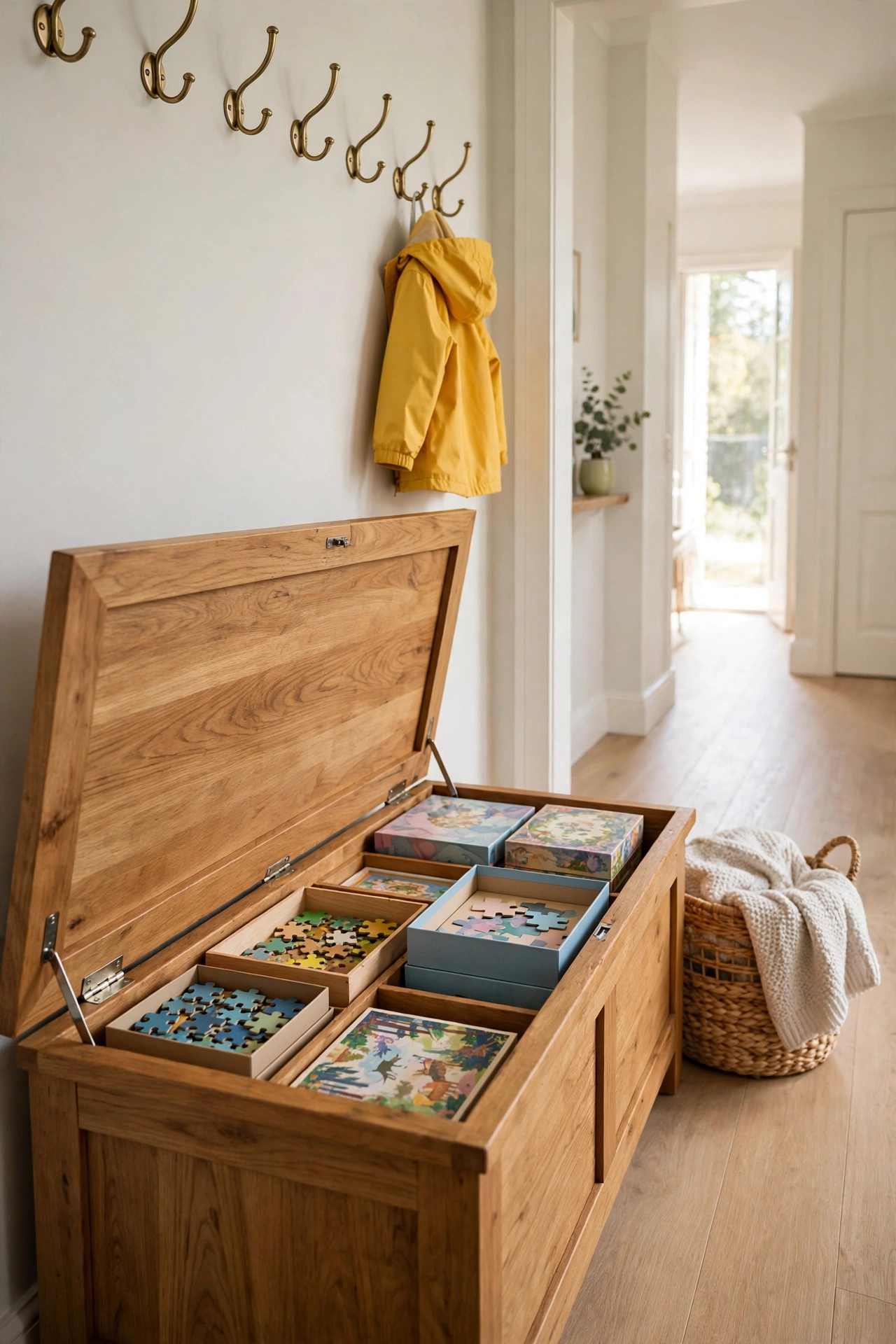
Hallways are for walking through, right. Not anymore. A storage bench in the hallway holds board games, puzzles, and the toys that belong to no particular room. The lift up seat means the kids can open it themselves, and the bench gives everyone a place to sit and put on shoes. Dead space becomes hardworking space.
This is the perfect home for the in between toys. The puzzle that is half done. The board games that come out on weekends. The building set that is too big for the bedroom. They do not belong in the playroom chaos and they do not belong in the bedroom. They belong in the hallway bench, waiting for their moment.
Choose a bench that matches your hallway style and it looks like it was always there. Wood for a farmhouse hall. Upholstered for a softer look. The toys inside are invisible. The bench outside is just a pretty place to sit. That is the whole philosophy of this post in one piece of furniture.
18. Nightstand Baskets
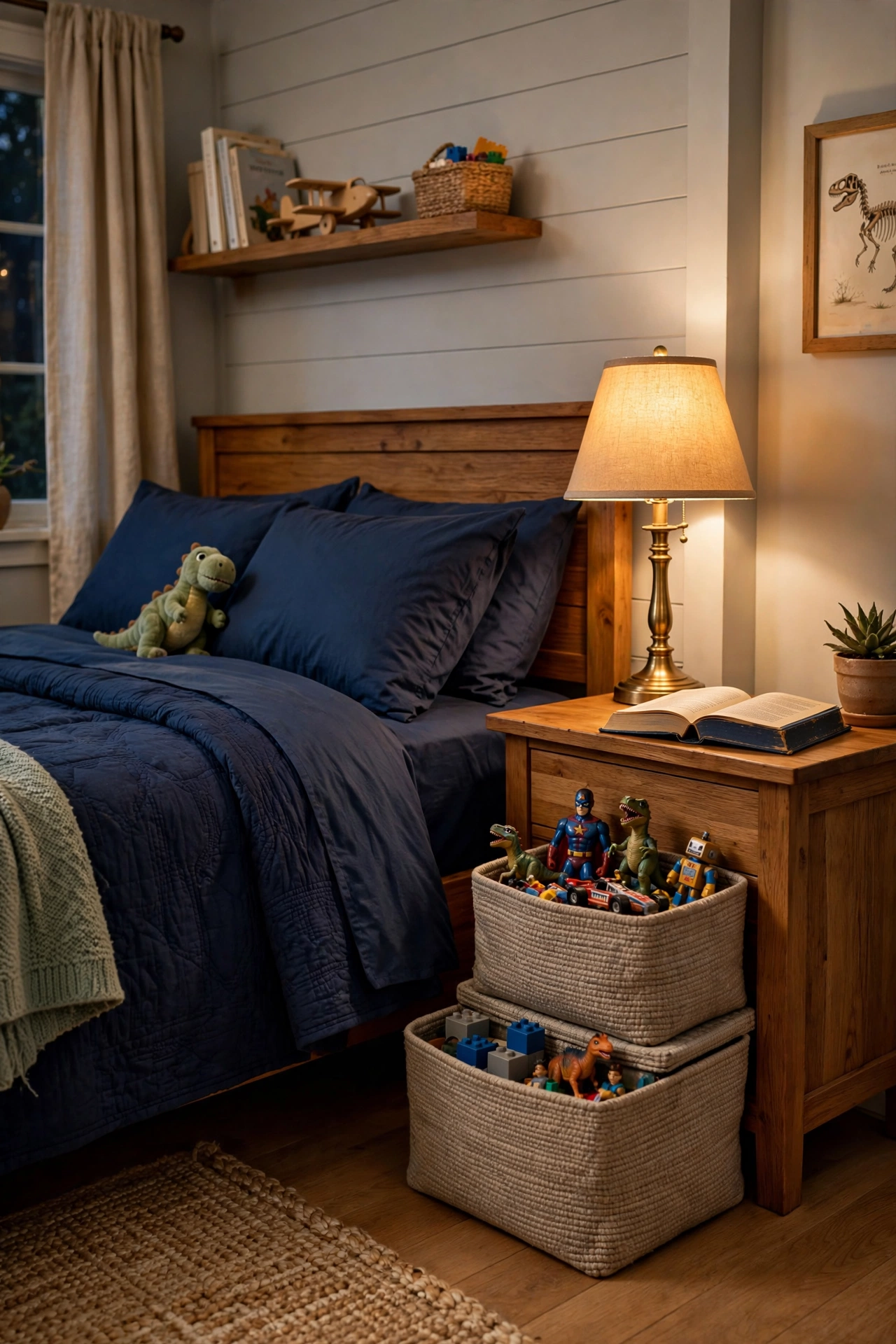
The nightstand is prime real estate that most kids waste on a lamp and a glass of water. Add two stacked fabric baskets and it becomes bedtime toy storage. The current favorite small toys live in the baskets. They are right there for morning play and they disappear in seconds at bedtime. The bedroom looks calm. The kids are happy. Bedtime gets easier.
This works because of proximity. Kids play with what is near them. A basket of small toys by the bed means quiet morning play instead of a 6am march to the playroom. It also means the toys have a home that is not the floor. At night, everything goes in the baskets. The room resets. You can walk in without stepping on a dinosaur.
Match the baskets to the bedroom colors and they look like part of the decor. Soft fabric, no loud patterns. The nightstand stays pretty. The toys stay contained. If the bedroom needs a full cozy makeover to match, my warm minimalist approach works beautifully in kids rooms too. Calm colors, simple storage, everything with a home.
19. The Loft Bed Zone
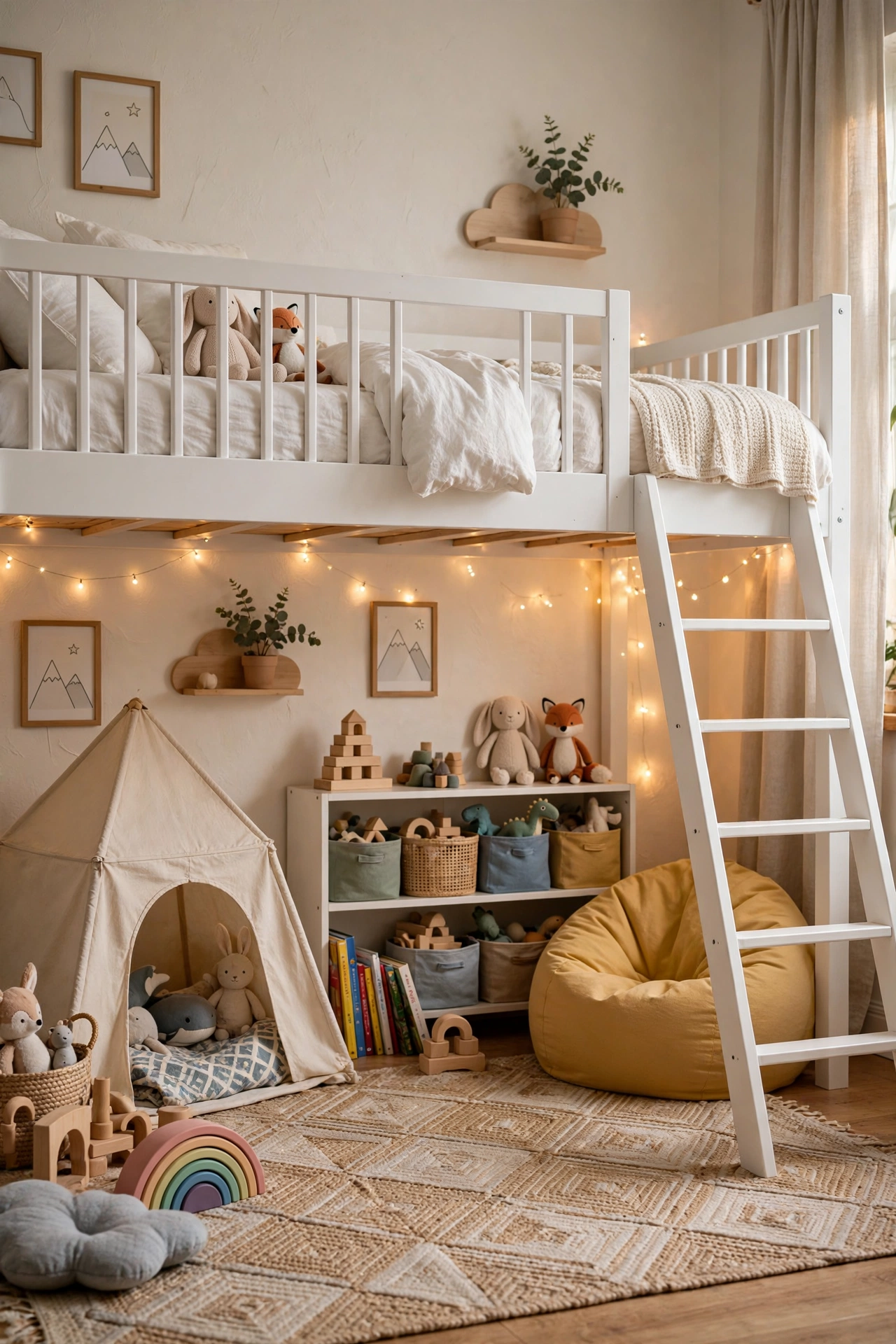
A loft bed turns one piece of furniture into two rooms. Sleep up top, live down below. The space underneath becomes a play zone, a reading spot, or a desk area, and the storage builds right into it. A small bookshelf of toy bins under the loft holds the collection. A bean bag makes it cozy. String lights make it magical. The kids will never want to leave.
This is the ultimate small bedroom solution. The bed takes up the same floor space as always, but you gain an entire play area underneath. For kids sharing a room or working with a tiny bedroom, it is transformative. The toys have a whole zone. The floor stays clear. The room feels twice as big.
Keep the under loft storage low and open so the kids can reach everything. Bins on a low shelf, not a tall bookcase. The zone should feel like a nest, not a warehouse. Cozy, contained, and completely theirs. When they outgrow the play zone, it becomes a desk zone, and the storage just changes jobs.
More Favorites
This post contains affiliate links. If you buy through them, I may earn a small commission at no extra cost to you.
A few more favorites from the ideas above:
Start with one bin, not all nineteen
You do not need to do all of this this weekend. Please do not try. Pick the messiest spot in your house, the one that makes you sigh every time you walk past it, and fix just that one. One set of baskets. One ottoman. One shelf with bins. Live with it for a week and feel the difference.
Then do the next spot. Toy storage is a system you build over time, not a makeover you do in a day. Every bin you add makes the next cleanup a little faster. Every label you stick on makes the kids a little more independent. It compounds. A month from now you will walk through your house and realize it just looks like this now. Tidy. Calm. Like adults live here, with very happy kids.
The real secret is that the prettiest storage is the storage that gets used. Do not buy the gorgeous baskets if your kids need open bins. Do not build the perfect closet system if the toys live in the living room. Match the storage to your real life, not your dream life. Your real life is the one that needs the help.
If you are carrying this calm, organized feeling through the whole house, my warm minimalist living room ideas keep the main rooms serene, and my organic modern living room post brings that same natural warmth to the family spaces.
Start with one bin. Label it. Watch what happens. Then come back and tell me which idea changed your house, because I want to hear everything.
Get Fresh Home Ideas Every Week
Seasonal decor ideas, organizing tips, and cozy home inspiration, straight to your inbox.
More Ideas You Will Love
Keep browsing for more seasonal inspiration: