
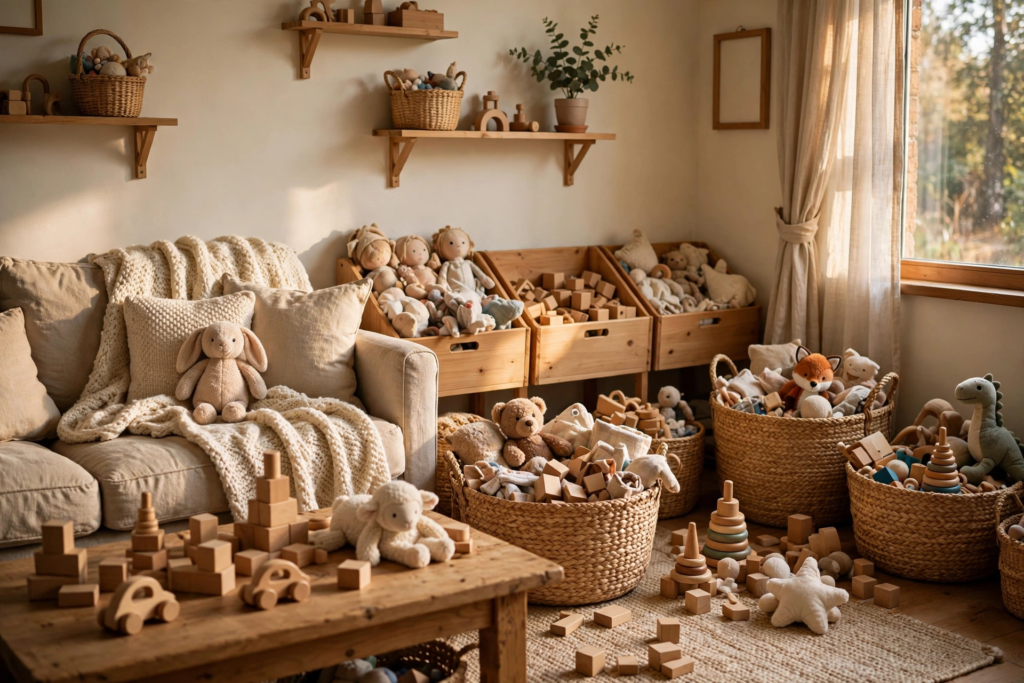
It is 11pm. The house is finally quiet. You are padding down the hallway in the dark, half asleep, and then it happens. A plastic dinosaur under your bare foot. You bite back a yell because the last thing you need is anyone waking up at this hour. You glance at the living room in the dim light from the kitchen and it looks like a toy store exploded in slow motion. Blocks under the couch. A doll with one shoe. Puzzle pieces doing their best confetti impression across the rug. And you think the thought every mom of little kids has thought at least once: where does it all keep coming from?
Here is the thing nobody warns you about. The toys do not arrive all at once. They arrive in a steady drip that never stops. Birthday parties. Grandparents who show love through shopping bags. Party favors. The little plastic treasures from restaurant kids meals. The toy you bought because she asked seventeen times and you were tired. The toy he had to have because his friend has one. Each one feels small on its own. Together they become a flood. And somewhere along the way, getting rid of any of it started to feel like a moral failing, like a bad mom throws toys away and a good mom somehow finds room for all of it.
I am here to tell you something freeing. You can stop the flood. Not with a brutal weekend purge that leaves everyone crying, and not with some perfect minimalist fantasy that lasts three days before reality moves back in. With a simple system that actually fits real life with kids. One that keeps the toys your kids truly love, quietly moves the rest along to new homes, and stops the inflow at the door before it starts. No guilt required. Let us get into it.
TL;DR: The Toy Flood Fix in 5 Moves
- Audit everything. Gather every toy in the house into one room and sort into four piles: keep out, rotate, donate, trash. You cannot organize what you have not counted.
- Rotate, do not display. Keep a small set of toys out and store the rest in labeled bins. Swap every few weeks. Old toys feel brand new again.
- One in, one out. Every new toy means one old toy leaves the house. This single rule stops the flood from ever coming back.
- Sweep before the presents. Do a donation pass two weeks before birthdays and holidays, not after the new stuff arrives.
- Redirect the grandparents. Give them a wish list of experiences and contributions instead of saying no to their love.
Love these ideas? Get more every week.
Join the newsletter for seasonal decor and cozy home inspiration.
Why This Happens (And Why It Is Not Your Fault)
First, let us get something straight. The toy flood is not happening because you are disorganized or because you buy too much or because you are failing at some secret test of motherhood. It is happening because your kids are loved. Deeply, abundantly, express it through shopping bags loved. Grandparents, aunts and uncles, friends, neighbors. Every birthday doubles the collection. Every holiday triples it. Every well meaning adult in your child’s life has figured out that toys are the easiest way to see a little face light up, and so the toys keep coming. That is not a parenting failure. That is a family that adores your kids.
And then there is us. We buy too, and we do it for reasons that make complete sense. We buy because we love them and want to see that joy. We buy because we worked late all week and the guilt is sitting heavy on our chest in the toy aisle. We buy because we said no seventeen times already today and we are simply out of no. We buy because it was on sale and it felt like a smart move at the time. The entire toy industry is engineered to make kids beg and parents cave, with bright packaging at exactly child eye level and commercials that make every plastic gadget look like the key to happiness. You are not weak. You are up against professionals.
Here is the part that makes it all so hard to undo. To a child, a toy is never just a toy. That ratty stuffed bunny is the thing she sleeps with when she is scared. That half broken truck is the one grandpa gave him before he moved away. That pile of plastic figurines is proof, in their minds, that they are loved and remembered. Kids attach memories and safety and identity to these objects in a way that looks irrational from the outside and makes perfect sense from the inside. So when we look at the mountain and think about getting rid of it, what we feel is not really about the toys. It is about the fear that we are throwing away love.
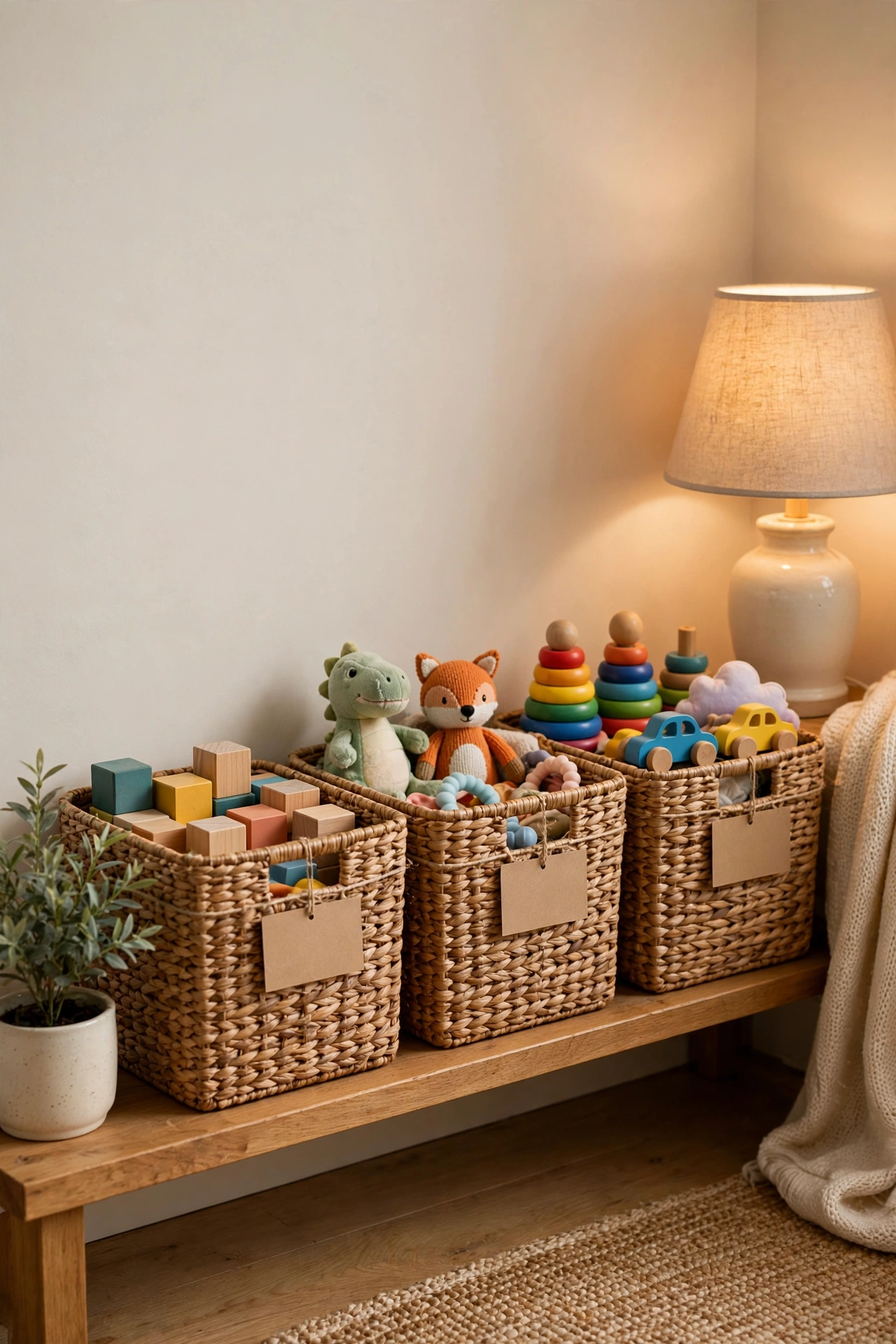
This is also why most organizing advice falls completely flat for parents. It assumes a reasonable number of toys. It shows you a beautiful playroom with twelve wooden toys in woven baskets and tells you to just get some bins. But no bin system on earth survives four hundred toys. The problem was never your organizing skills. The problem is volume. You cannot organize your way out of an amount of stuff that no storage system was designed to hold. Every mom who has bought the cute labeled bins, filled them all, and still had toys spilling across the floor knows exactly what I am talking about.
And then the guilt cycle starts spinning. The mess stresses you out. The stress builds until one Saturday you snap and start shoving toys into trash bags in a rage. The kids cry. You feel terrible. The guilt sits there until the next birthday or the next hard week, when you buy new toys to make up for it. More toys come in. The mess returns. Around and around. Breaking this cycle does not start with better bins or stricter rules. It starts with dropping the guilt, because guilt is the fuel that keeps the whole miserable loop running. You are a good mom with too many toys, not a bad mom who needs to earn a tidy house.
The Plan
Here is the full system, start to finish. Six steps. None of them require a perfect weekend, a label maker obsession, or a personality transplant. Each one builds on the last, and you can move at whatever pace your real life allows. Ready? Let us go.
Step 1: The Toy Audit
You cannot organize your way out of too many toys. The audit comes first, and it changes everything.
Pick a day when the kids are at school, at grandma’s, or otherwise out of the house. Then walk through every room and gather every single toy into one place. I mean all of them. Under the couch cushions. The car. The weird pile behind the bathroom door that you have been pretending not to see. The backpack with the party favor still in it from March. Get it all into the living room floor. This will look absolutely horrifying, and that is exactly the point. You need to see the true volume with your own eyes, because our brains are excellent at underestimating clutter when it is spread across eight rooms. When it is all in one mountain, there is no more pretending.
Now sort that mountain into four piles. Pile one is KEEP OUT: the true favorites, the toys played with weekly, the ones that would cause genuine heartbreak if they vanished. Be honest here but be generous too. This is not about minimalism. Pile two is ROTATE: good toys in good shape that your kids like but that do not need to be out right now. These go into bins for the rotation system in step two. Pile three is DONATE: outgrown toys, duplicates, the things nobody has touched in months, the gifts that were never quite right. Pile four is TRASH: broken beyond repair, missing critical pieces, dried out markers, the sad plastic trinkets from party favor bags. Give yourself full permission to throw away actual garbage. A broken toy with three wheels is not a donation. It is trash, and letting it go is not wasteful.
The four piles, explained with real examples
If you are staring at the mountain feeling stuck, use these decision rules. Has it been played with in the last two months? Keep out or rotate. Is it broken, missing pieces, or stained beyond saving? Trash, no guilt. Do you own two or three versions of basically the same thing? Keep the best one, donate the rest. Did your child receive it as a gift and never once reach for it? That is a donate, and it says nothing about how much you appreciate the giver. Is it a half finished craft kit or a puzzle with the box taped shut and pieces everywhere? Be ruthless. The keep out pile should feel like a curated collection of favorites, not a slightly smaller mountain.
Should the kids help with the audit?
For kids under five, do the audit without them. I say this with love and zero judgment. A three year old cannot make rational keep or donate decisions about forty stuffed animals, and trying will turn a two hour project into a two day negotiation with tears. Do it while they are out, keep the favorites safe, and they will never miss the broken crayons and mystery plastic. For kids around six and up, you can involve them with clear ground rules: they choose the keep out pile from their own things, everything else goes to rotate or donate, and the final call on donations stays with you. Frame it as making room for the toys they love most, not as losing things. And if you want ideas for what the playroom looks like on the other side of all this, 19 Playroom Organization Ideas will give you plenty of inspiration for the calm, organized space you are working toward.
What to do with the maybe pile
You will have one. Everyone does. The toys you cannot quite decide on. Do not let them stall the whole project. Put every maybe into a box, tape it shut, write today’s date on it, and stash it somewhere out of sight. If nobody asks for anything in that box within two months, donate the whole thing unopened. If someone does ask for a specific toy, pull just that one out and put it in the keep out pile. This trick works because it separates the fear of letting go from the actual letting go. Most maybe boxes leave the house without a single request, and that tells you everything you need to know.
Step 2: The Rotation Bin System
Kids play more deeply with fewer toys. Rotation makes old toys feel brand new again, and it is the closest thing to magic this system has.
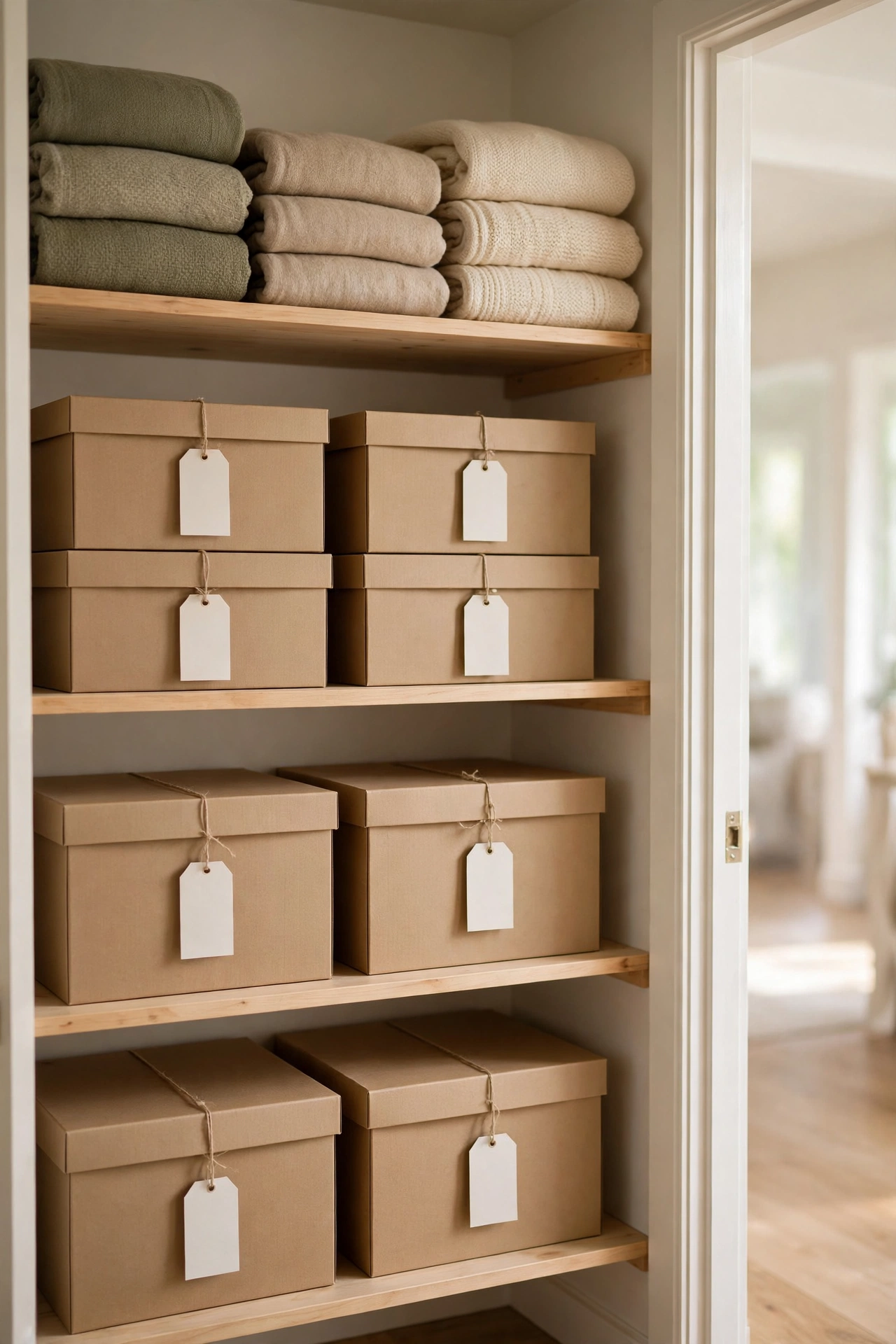
Here is how it works. Take everything from your ROTATE pile and divide it into two or three bins. Each bin should hold a good mix: something to build with, something for pretend play, something creative like art supplies, a puzzle or game. Label each bin simply, Bin A, Bin B, Bin C, or by theme if you prefer. Put one bin’s worth of toys out and store the rest out of sight. Every two to four weeks, swap. The bin that was out goes into storage, a fresh bin comes out. That is the entire system, and it works better than any organizing product ever sold.
The reason it works is simple psychology. When kids face a mountain of toys, they do what we all do with too many choices: they skim the surface, flit from thing to thing, and play with nothing deeply. Fewer choices means deeper play. They build bigger, imagine longer, and actually use what is in front of them. And when a fresh bin appears after a few weeks, it genuinely feels like Christmas morning. Toys they ignored for months suddenly become fascinating again. Parents tell me their kids play longer and fight less on rotation weeks, and I believe them because I have watched it happen in my own living room.
How many toys should stay out?
Less than you think. For toddlers and preschoolers, aim for what fits on one low shelf or in one medium bin per child, plus beloved comfort items like stuffed animals for sleep. For early elementary kids, a shelf and a small table’s worth is plenty. You will feel like it is not enough for approximately three days. Then you will notice something wonderful: the toys that are out actually get played with, and cleanup takes ten minutes instead of forty. If a specific toy is truly missed, you can always pull it from a stored bin. The system bends. That is what makes it sustainable.
Where to stash the bins when space is tight
The number one objection to rotation is storage space, and it is a fair one. Good news: rotation bins do not need a dedicated storage room. A closet shelf works. The top of a bedroom closet works. Under your own bed works beautifully. A corner of the garage, a laundry room shelf, even the trunk of the car in a pinch. The bins themselves do not need to be fancy. Sturdy cardboard boxes, dollar store bins, or whatever you already own will do the job. What matters is that the stored toys are out of sight, because out of sight is what makes them feel new again. If you want storage that looks good in the rooms where it lives, 19 Toy Storage Ideas That Actually Look Good is full of ideas for bins and baskets that blend right into your decor.
Step 3: The One In One Out Rule
Every new toy means one old toy leaves the house. This single rule stops the flood from ever returning, and it is the most important step in the whole plan.
The audit clears the backlog. Rotation manages what remains. But without a rule for the inflow, you will be right back in the mountain within a year, because birthdays and holidays and grandparents do not stop. The one in one out rule is beautifully simple: for every toy that enters the house, one toy leaves it. New birthday present? Your child chooses one toy to donate. Christmas morning haul? A donation bag gets filled before the new year. Grandma drops off a surprise? Something goes into the donation box by the front door that same week. The outgoing toy does not need a ceremony. It just needs to leave.
Keep a dedicated donation box or bag somewhere permanent and visible, like the front hall closet or the laundry room. When it is full, it goes to the donation center, the shelter, the toy drive, wherever you have chosen. Do not let full bags sit in the garage for six months. That is just clutter with extra steps. Make the drop off part of the routine, the same way you take out recycling. Some families do a monthly drop. Some do it whenever the box is full. Either way, the box itself is the system. It makes letting go a normal, ongoing background process instead of a dramatic annual event.
How to introduce the rule without a mutiny
Do not announce it on Christmas morning while wrapping paper is still on the floor. Introduce it during a calm moment, and frame it as a family value, not a punishment. Something like: in our family, we make room for new things by passing along things we have outgrown, so other kids can enjoy them too. Let your child choose which toy goes. Choice is everything. A child who picks the outgoing toy feels generous. A child who has a toy grabbed from their hands feels robbed. For little ones who cannot quite grasp it yet, you choose quietly and they will not notice. For older kids, make it a point of pride. Many kids genuinely love the idea that their old toys go to kids who need them.
What counts as one out?
Keep this simple or the rule collapses under its own fine print. One toy in, one toy out. A big Lego set counts as one. A single action figure counts as one. Do not get into debates about whether a pack of ten mini figures counts as ten. It counts as one set. Broken toys that go in the trash also count. The point is not perfect accounting. The point is a steady outward flow that matches the inward flow. If your child wants to donate three toys for one new arrival, wonderful. If it is exactly one for one, that is completely fine too. Consistency matters more than precision.
Step 4: The Before Birthday and Holiday Donation Sweep
Purge before the presents arrive, not after. Timing is everything, and this one shift prevents the worst of the pileup.
Most families do their big toy cleanout in January, staring at the wreckage of Christmas morning and feeling overwhelmed. That is backwards. By January the new toys are already mixed in with the old, the kids are attached to the new arrivals, and sorting feels impossible. Do the sweep two weeks before the birthday or the holiday instead. Go through the keep out pile and the current rotation bin together, pull what has been outgrown or ignored, and get it out of the house before a single new present arrives. When the new toys come in, there is already space waiting for them. It feels completely different. Instead of drowning, you are ready.
This also turns decluttering into a positive ritual instead of a dreaded chore. Make it part of how your family does birthdays. A week or two before the big day, you and the kids do a toy sweep together. Put on music. Make it fun. Talk about how exciting it is that new toys are coming and how great it will feel to have room for them. Kids who would melt down over a surprise purge in March will happily fill a donation bag in the context of birthday excitement. The anticipation of new things makes letting go of old things feel natural instead of forced.
How to frame it so kids feel good about it
The language you use here matters enormously. Never frame the sweep as getting rid of junk or as a punishment for having too much. Frame it as generosity and growing up. You are getting so big, and these baby toys need a new little kid to love them. Let us pick some toys for kids who do not have as many. Let them be the hero of the story. Many parents find that their kids become more generous, not less, when donating is presented as a proud big kid job rather than a loss. And here is a secret: kids are often far less attached to the mountain than we fear. We project our own guilt onto them. Half the time they will cheerfully toss things into the donation bag that we were agonizing over.
Where the donations actually go
Have a plan before you start, because bags of toys sitting in your garage for three months are just relocated clutter. Good options: local women’s shelters and family shelters, which often desperately need toys for kids in crisis. Toy drives in November and December. Consignment stores if you want to recoup a little money, though be honest about whether the effort is worth it for used plastic. Buy nothing groups and local parent groups online, where toys disappear within hours. Preschools and daycares often welcome Duplo, puzzles, and art supplies. Pick two or three regular destinations and make the drop part of your routine. When donating feels easy and meaningful, you will actually do it.
Step 5: Handling Grandparents’ Gifts With Love and Boundaries
Grandparents give love in toy form. Your job is not to reject the love. It is to gently redirect it into shapes that fit your home.
Let us be honest about the grandparent situation, because it is the number one source of toy flood frustration I hear from moms. You have asked nicely. You have hinted. You have flat out begged. And still, Christmas morning looks like a toy store sponsored the event. Here is the reframe that changes everything: your parents are not trying to bury you in clutter. They are expressing love in the only language they know, and for their generation, love looks like a big pile of presents. When you say stop buying so much, what they hear is stop loving my grandkids so much. No wonder the conversation goes badly. You have to give them a new way to show the love, not just take away the old one.
Start by telling them what you actually want, specifically and warmly. Vague requests like please do not buy so much never work because they leave a vacuum. Instead, hand them a short wish list of alternatives: contributions to the college fund or savings account, memberships to the zoo or children’s museum, swimming lessons or art classes, one quality experience like a special day out together, or a single bigger gift from a short list you provide. Many grandparents light up at the idea of experience gifts once someone suggests them, because what they really want is time and connection, not a receipt from a big box store. Make it easy for them. Send the list in October, before holiday shopping starts, with genuine warmth.
What to actually say
Here is a script that works far better than the frustrated text sent on December 26th. Try: Mom, the kids are so lucky to have you, and they talk about your gifts for weeks. This year we are trying something new as a family. We are keeping the toy collection small so the kids actually play with what they have, and we would love your help. Would you be open to doing an experience gift this year? The kids would be over the moon about a zoo membership or a special day with you. If you would rather do a physical gift, here are three specific things they would truly love. Notice what this does. It leads with appreciation. It explains the why. It gives clear, easy alternatives. It preserves their role as the generous grandparent. Most grandparents say yes to this version because it does not feel like a rejection.
When they buy anyway
Sometimes they will. You sent the list, you had the talk, and there are still fourteen presents under the tree. This is where you pick your battles and protect your peace. Smile, say thank you, let the kids enjoy the moment. Then, quietly, over the following weeks, fold the excess into your system. Duplicates and untouched items go straight into the donation box. A few favorites join the rotation. Nobody needs to know. You are not being sneaky or ungrateful. You are managing your home. And here is something worth remembering: the grandparents got their joy on Christmas morning watching little faces light up. That moment already happened. What happens to the seventeenth stuffed animal in February does not undo it. Keep the relationship warm and keep your house calm. Both can be true.
Step 6: When Kids Resist Letting Go
Resistance is normal and healthy. Work with their feelings instead of against them, and letting go becomes a skill they carry for life.
Even with the kindest framing and the best system, some kids will cling. They will rescue toys from the donation box. They will suddenly remember that the broken robot was their absolute favorite. They will cry over a Happy Meal toy from two years ago. This does not mean the system is failing. It means your child is developing normally. Kids cling to objects for real reasons: control in a world where they control very little, comfort during transitions, memory and identity, and sometimes just plain fear of missing out. Your job is not to override those feelings. It is to give them a safe path through them.
Start by validating before problem solving. I can see you really love that one is more powerful than but you have not played with it in months. Let them tell you why it matters. Often, once a child feels heard, the grip loosens on its own. Then offer structured choices instead of open ended decisions. Would you like to keep the red car or the blue car? works infinitely better than which toys should we donate? Limit the scope so it never feels like everything is on the chopping block. We are picking five toys to share with other kids today. Five is a number they can wrap their heads around. The whole room is a number that triggers panic.
The photo trick
This one is pure magic for sentimental kids. When your child cannot bear to part with a toy, take a beautiful photo of them holding it, or of the toy in a favorite spot. Print it or save it in a special album on your phone. Tell them the memory is safe forever, and the toy can go make another kid happy. It sounds almost too simple, but it works because it addresses the real fear, which is forgetting. Kids are often not attached to the object itself. They are attached to what it represents, and a photo preserves that perfectly. I know families who have entire photo albums of beloved outgrown toys, and the kids flip through them with total joy. The love stayed. The clutter left.
The toy hotel method
For the truly stuck cases, try the toy hotel. Put the contested toys in a box, label it with your child’s name, and explain that the toys are checking into the hotel for a little rest. Put the box somewhere out of sight but accessible. Tell your child that if they really miss a specific toy, they can check it out of the hotel anytime. Most of the time, they never ask. After a month or two, donate the box quietly. If they do ask for something, check it out with zero fuss and put it back in the keep pile. The hotel works because it removes the pressure of a permanent decision. Nothing is gone forever, so the panic never spikes. And the funny thing is, once the pressure is off, most kids simply forget the hotel exists.
Try It Tonight: The 20 Minute Toy Triage
You do not need to wait for the perfect weekend. Tonight, after the kids are in bed, grab one trash bag and one box or bag for donations. Set a timer for 20 minutes and walk the main living areas. Into the trash bag: anything broken, anything missing pieces, dried out markers, fast food toys, party favor plastic. Into the donation box: ten toys nobody has touched in weeks. You will be amazed how much leaves the house in 20 minutes. When the timer goes off, take the trash bag straight to the outside bin and put the donation box by the front door. Tomorrow morning the living room will feel lighter, and you will have proof that this system works before you commit to the full audit.
Mistakes to Avoid
Before you dive in, let us talk about what backfires, because I have watched lovely, well meaning moms make every one of these mistakes, myself included. Learning from them will save you tears, yours and theirs.
Secretly throwing toys away while the kids sleep
It is tempting. The kids are finally asleep, the donation bags are calling, and it would be so easy to just make things disappear. Do not do it. Kids notice far more than we think, and the moment your child realizes a beloved toy vanished without warning, something breaks. It is not really about the toy. It is about trust. They learn that their things are not safe and that you cannot be trusted with what matters to them. The fallout is worse than the clutter: kids who have had toys secretly purged often start hoarding, hiding toys, and melting down over every future decluttering attempt. Everything in this plan works because it is honest. Keep it that way. The toy hotel and the photo trick exist precisely so you never need to sneak.
The dramatic one weekend purge
You know the fantasy. One heroic Saturday, the whole family, every closet, total transformation by Sunday night. In reality, marathon purges end with everyone exhausted, snapping at each other, and making panicked decisions you regret. You throw away things you wanted to keep. The kids are in tears by hour three. You quit halfway and the house looks worse than when you started. The toy flood was not created in a weekend and it does not need to be solved in one. The audit can be one afternoon. Rotation setup can be another day. The donation sweep happens naturally before birthdays. Slow and steady actually finishes. Dramatic and exhausting usually stalls out in the garage next to the bags you never donated.
Purging as punishment
That is it, I am throwing all these toys away. Every parent has said some version of this in a moment of pure frustration, usually while stepping over the same Lego bricks for the tenth time. But using decluttering as a threat teaches kids that their belongings are conditional on your mood, and it turns the whole system into something scary instead of something healthy. Purge when you are calm. Purge on schedule, before birthdays, as a family ritual. Never in anger, never as a consequence, never with an audience of a crying child meant to serve as a warning to the others. The goal is a calm home, and you cannot rage your way to calm.
Buying the bins before doing the declutter
This one is so common it deserves its own warning. You get motivated, you go to the store, you buy beautiful matching bins and baskets, you come home feeling accomplished. Then you try to fit four hundred toys into bins designed for one hundred, and you end up with beautiful bins overflowing with clutter. Containers are the last step, not the first. Audit first. Rotate second. Then, once you know exactly how much you are actually storing, buy only the bins you need. Otherwise you have just purchased expensive new homes for the same old mess.
Keeping everything for the next kid, without limits
Hand me downs are wonderful and I am not suggesting you rebuy everything for each child. But the next kid does not need four hundred toys either, and the maybe someday box has a way of becoming a permanent annex of clutter in the basement. If you are saving for a younger sibling, apply the same four pile logic. Keep the true favorites and the genuinely useful in one or two labeled bins, maximum. Donate the rest now while it still has life in it. A toy sitting in a basement for four years is not being saved. It is being stored past its prime, and your future self will have to deal with it anyway.
Giving kids total veto power over every single item
Involving kids is good. Giving a four year old final say over all four hundred toys is a recipe for keeping all four hundred toys. Young children cannot do big picture triage, and asking them to will overwhelm them into keeping everything. Guide the process with structured choices: pick five to donate, keep the red one or the blue one, choose which bin these go in. You hold the overall framework. They get meaningful choices inside it. That balance teaches decision making without turning your living room into a hostage negotiation.
Letting donation bags sit in the garage for months
The purge is not done when the bag is full. It is done when the bag leaves your property. Bags that sit in the garage have a magical way of getting reopened, re raided by curious kids, and slowly migrating back into the house. Worse, they occupy mental space. Every time you see them you feel the unfinished task. Make the drop off part of the system from day one. Full box goes to the car the next time you run errands. Done. A toy that made it to the donation center is a victory. A toy sitting in your garage is just clutter that moved rooms.
What About…?
We live in a small apartment. Where do rotation bins even go?
This is the most common objection I hear, and it is completely fair. But here is the truth: small spaces need this system more than big houses do, because every square foot counts double. You do not need three big bins. One medium bin in the top of a closet works. Under your bed works. A single shelf in a hallway closet works. And here is the real secret: in a small space, ruthless curation matters more than storage. When you can only keep what truly earns its place, the audit becomes your best friend. Keep the collection genuinely small, rotate a single bin, and enforce one in one out like your sanity depends on it, because in 800 square feet it really does. For ideas on storage that disappears into your decor, 19 Toy Storage Ideas That Actually Look Good has a whole section on hidden storage that works beautifully in tight spaces.
My parents will not stop buying toys. I have asked. Nicely. Twice.
Okay, deep breath. Some grandparents will not change, and that is information, not failure. Your strategy shifts from prevention to management. First, try the experience gift conversation one more time, but bring reinforcements: have your partner talk to their own parents, since requests land softer from one’s own child. Suggest super specific alternatives, because vague does not work on determined gift givers. If it still does not work, implement the quiet system. Let the kids enjoy the presents. Then, over the following weeks, fold the excess into rotation or the donation box. Keep a small stash of grandparent toys at their house for visits, which delights everyone. And release the need to control it completely. You cannot manage other adults. You can only manage your own front door, and the one in one out rule handles the rest.
My kid notices EVERYTHING that goes missing. Everything.
Some kids are hawks, and I say that with admiration. For these kids, the sneaky approaches are off the table permanently, so go all in on the honest ones. The toy hotel is made for this child: nothing is gone, it is just resting, and they can visit anytime. The photo trick gives them permanent proof that beloved toys are remembered. Involve them more, not less: let them be the boss of the donation box, in charge of choosing which toys go to which kids. Often, hawk children become the most enthusiastic declutterers once they feel in control of the process, because what they feared was powerlessness, not loss. And start with your own clutter first. Declutter your junk drawer, your closet, your bookshelf, out loud, where they can see. When they watch you let go of your own things cheerfully, it normalizes the whole idea.
We are on a tight budget. I cannot buy fancy storage systems.
Wonderful news: this system barely needs any purchases at all. The audit needs trash bags you already own and boxes you can get free from any grocery store. Rotation bins can be cardboard boxes, laundry baskets, or dollar store bins. Labels can be masking tape and a marker, and honestly kids love decorating their own labels with crayons. The donation box is any box. The most effective parts of this plan, the audit, the rule, the sweep, the conversations, cost exactly zero dollars. Fancy matching bins are lovely, but they are the garnish, not the meal. Plenty of calm, organized homes run this entire system on cardboard and masking tape. Start with what you have. Upgrade later if you want to, not because you need to.
Here is what I want you to take away from all of this. The toy flood is not a character flaw. It is what happens when loved kids live in a generous world, and the fact that it bothers you just means you are paying attention. You do not need a perfect home. You need a system that bends with real life, a few clear rules, and permission to let go of the guilt that has been fueling the whole cycle. Start tonight with the 20 minute triage. Do the audit this weekend. Set up one rotation bin. Tell the grandparents you love them and hand them the zoo membership link. Small moves, steady rhythm, and one day you will walk through your living room at 11pm and step on absolutely nothing. That night is coming.
With love and light
Get Fresh Home Ideas Every Week
Seasonal decor ideas, organizing tips, and cozy home inspiration, straight to your inbox.