
If your mornings feel like a fire drill with backpacks, you are not alone. Mine used to start with the same soundtrack every single day. The alarm. The groan. The realization that the library book was never found, the shoes were never located, and the child in question was somehow still in pajamas with the bus in ten minutes.
I would be standing in the kitchen with one shoe on, trying to spread peanut butter with one hand while signing a permission slip with the other. My son would be looking for his water bottle, which turned out to be in the living room, under a couch cushion, next to a Lego piece that had clearly been there for a week. We would leave the house in a state of barely controlled panic. And then I would spend the whole drive replaying everything I had yelled about, feeling guilty before my coffee had even cooled down.
Here is what nobody tells you about chaotic school mornings. They are not a discipline problem. They are not a motivation problem. And they are absolutely not a reflection of how much you love your kids. They are a systems problem. Which is actually great news, because systems can be fixed. You do not need a more obedient child. You do not need to become a morning person overnight. You need a plan that does the thinking for everyone while everyone is still half asleep.
That is exactly what this post gives you. A complete morning system that moves most of the work to the night before, puts everything in one spot by the door, and hands your kids a checklist they can actually follow on their own. The promise is simple. Calm, on time mornings where you are not the one holding the entire operation together with adrenaline and a prayer.
Love these ideas? Get more every week.
Join the newsletter for seasonal decor and cozy home inspiration.
The TL;DR Version
- Prep at night, not in the morning. Clothes picked out, bags packed, lunches made. Mornings should contain zero decisions.
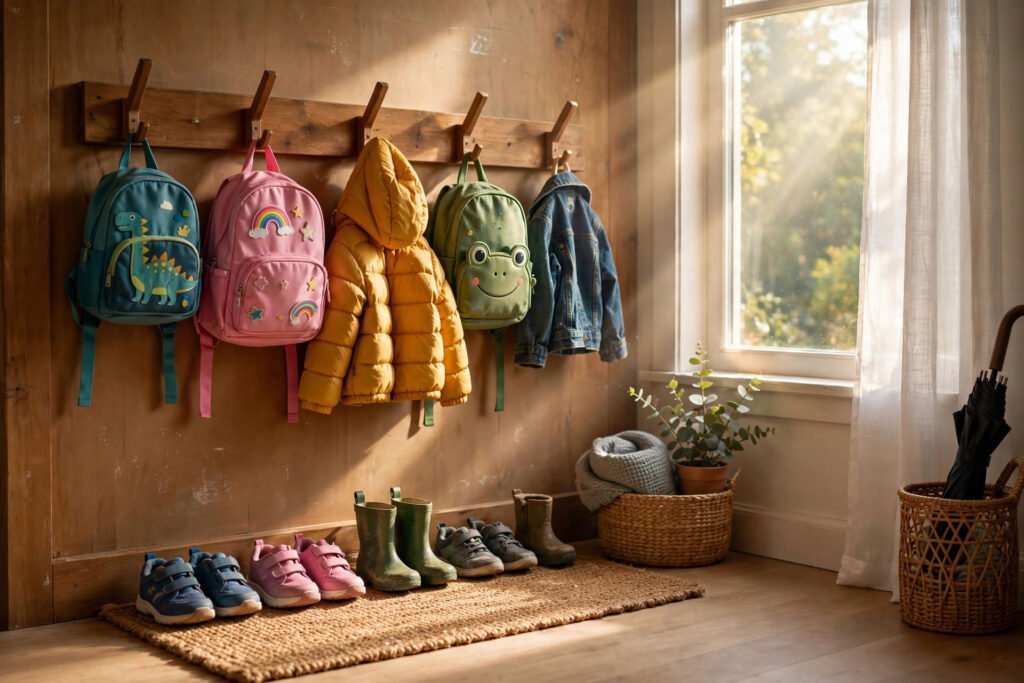
- Build a launch pad by the door. One spot where backpacks, shoes, coats, and anything leaving the house lives. Everything has a home, so nothing gets lost.
- Give kids a visual checklist. Pictures they can follow on their own, so you stop being the human alarm clock.
- Work backwards from leave time. Figure out how long the morning really takes, then add a buffer. The math is kinder than the panic.
- Simplify breakfast. A small rotation of easy options beats a fresh menu every day. Fed is the goal, not fancy.

Why Mornings Feel Impossible (And Why That Is Normal)
Let us get something out of the way first. If your mornings are a mess, you are not failing. You are dealing with one of the hardest logistical puzzles of family life, and you are doing it while tired, while caffeinating, and while negotiating with small humans who just discovered that their socks feel wrong.
Think about what a school morning actually asks of a family. In roughly one hour, everyone has to wake up, get dressed, eat, brush teeth, gather belongings, remember special items, get shoes and coats on, and leave on time. That is a lot of steps. And most of us try to do it with no plan at all, relying on memory and shouting. No wonder it falls apart.
The guilt is the worst part. You yell about the shoes. Then you feel terrible about the yelling. Then you apologize in the car. Then the next morning, it happens again. That loop can make you feel like a bad mom. You are not. You are a tired mom running a system that was never designed. The yelling is not a character flaw. It is what happens when a person with no margin hits a morning with no plan.
I want you to hear this clearly. Chaotic mornings are a design problem, not a parenting failure. Factories do not run on memory and shouting. They run on checklists, stations, and prep work done the shift before. Your kitchen at 7 in the morning deserves the same respect. Once I stopped trying to fix my attitude and started fixing the system, everything changed. I did not become a different person. I just stopped asking my sleepy brain to make thirty decisions before breakfast.
What Changed Everything For Me
There was a morning, and I remember it vividly, when my son missed the bus. Not by a little. By a lot. I drove him to school, late, in tears, mine and his. The teacher gave me that look. You know the look. The one that says this family has it together everywhere except 8 in the morning. I sat in the parking lot after drop off and thought, I cannot do this every day. I just cannot.
That night, instead of scrolling my phone on the couch, I did something small. I laid out his clothes. I packed his backpack. I put his shoes by the door. It took maybe fifteen minutes. The next morning felt different. Not perfect. But different. Less frantic. And that tiny experiment turned into a whole system, built one piece at a time, that I am going to walk you through right now.

The Plan: Your Calm Morning System
This is the full system, step by step. You do not have to do all of it this week. Start with the pieces that sound easiest and add the rest as they start feeling natural. The whole thing is built on one idea. Morning You is tired. Night Before You is capable. Let the capable one do the work.
Step 1: Do the Night Before Prep Routine
Every decision you make tonight is one you do not have to make at 7 AM.
The night before routine is the single most powerful part of this system. It takes about fifteen to twenty minutes, and it removes roughly half the chaos from the morning. Here is exactly what goes in it.
First, clothes. Full outfits, laid out or hung up, down to socks and underwear. Let your kids pick, within reason. Give a little one two choices so they feel in charge without turning it into a fashion show. For older kids, this is their job entirely. Check the weather while you are at it, so there is no debate about shorts versus pants when it is forty degrees out. If your home has a working laundry routine, this part gets much easier, because the clothes are actually clean and findable instead of living in a basket. I finally got my laundry under control with a simple weekly laundry system and mornings got smoother almost overnight.
Second, backpacks. Packed, zipped, and sitting by the door. Homework inside. Library books inside. That permission slip you were supposed to sign three days ago, signed and inside. Ask your kids one question before bed. Is there anything special you need tomorrow? Gym shoes, a show and tell item, a snack for the class party. Get it into the bag now, when everyone is calm, not at 7:40 when it is a crisis.
Third, lunches. Made, packed, and in the fridge. I know, I know. Nobody wants to make lunches at 8 PM. But five minutes at night beats fifteen frantic minutes in the morning, every time. If mornings are the worst part of your day, this one change alone will shock you with how much it helps.
Fourth, a quick reset of the launch pad area, which we will get to in the next step. Shoes in their spot. Coats on their hooks. Anything that migrated to the living room during the evening, returned to base.
Do this right after dinner or right before the kids brush their teeth. Tie it to something you already do, so it becomes a habit instead of a chore you have to remember. Some families do it right after the dinner dishes. We do it right before the bedtime story. It is just part of the evening now, like locking the front door.
Step 2: Build a Launch Pad by the Door
Everything that leaves the house in the morning lives in one spot. No exceptions.
The launch pad is the physical heart of the whole system. It is a dedicated zone by the door you use most, where every single morning item has a home. Backpacks. Shoes. Coats. Hats and mittens in winter. Sports bags. That one weird item for spirit day. All of it, right there.
Here is how to set one up. Pick your exit door. Most families have one door they actually use in the morning. That is your spot. Then give every person their own hook and their own bin or cubby. A low hook for the little one so they can reach it themselves. A bin for shoes that is big enough to actually hold shoes, because a bin that is too small just becomes a pile on the floor next to the bin.
Add a small tray or basket for the odds and ends. Sunscreen. The permission slip that still needs a signature. The check for the field trip. The library book that was read in bed last night and needs to make it into the backpack. This tray is the landing zone for everything that does not have a hook.
The rule that makes the launch pad work is simple. When you come home, everything goes back to the launch pad. Backpack on the hook. Shoes in the bin. Coat hung up. It takes thirty seconds and it is what makes the morning possible. If stuff scatters all over the house in the evening, the launch pad is empty in the morning and you are back to the fire drill.
You do not need to spend a lot of money on this. Hooks from the hardware store, a couple of bins, a small bench if you have room for one. If you want it to look nice, there are plenty of entryway and home design ideas out there to steal from. The pretty part is optional. The having a spot part is not.
Step 3: Make a Visual Morning Checklist
Kids who can see the steps can do the steps without you narrating every one.
This is the step that gets you out of the job of human alarm clock. A visual checklist is a simple chart with pictures showing each morning task in order. Get dressed. Eat breakfast. Brush teeth. Put on shoes. Grab backpack. Head to the door. Your child moves a magnet or checks a box as they finish each one.
Why pictures and not just words? Because a sleepy brain processes images faster than text. A preschooler who cannot read yet can follow pictures. An older kid who can read will still move faster with a visual, because it removes the need to think. The whole point is to remove thinking from the morning.
Make it together. Sit down on a calm afternoon, not a school morning, and ask your child what the steps are. Let them draw the pictures or pick stickers for each one. A kid who helped make the chart feels ownership over it. A chart that appeared mysteriously on the fridge is just more wallpaper.
Keep it short. Five to seven steps is the sweet spot. If the list has twelve items, nobody will use it. Order the steps the way your morning actually flows. And put the chart where the action happens. On the fridge for the kitchen steps, near the launch pad for the leaving steps. Some families use one chart in the bedroom and one by the door.
The magic of the checklist is that it changes your role. Instead of saying get dressed, then eat, then brush your teeth, then shoes, then backpack, on repeat until you lose your voice, you get to say one thing. Check your chart. That is it. The chart is the boss now. You are just the friendly assistant. Kids argue with parents. They do not argue with a laminated piece of paper.
If getting your kids to follow through without constant reminders feels impossible in other parts of the day too, the same principle applies everywhere. Getting kids to tidy up on their own works the same way. Clear steps, visible cues, and letting the system be the boss instead of you.
Step 4: Do the Buffer Time Math
Work backwards from the moment you leave, and then add more time than you think you need.
Most families are late because their morning plan is built on fantasy. We imagine the morning will take forty minutes. It actually takes an hour. We imagine the kids will move at adult speed. They move at kid speed, which is roughly half that, with random pauses to stare at nothing.
So let us do the math for real. Start with your leave time. That is the time everyone needs to be out the door, shoes on, backpacks in hand. Now list every step of the morning and give each one an honest time. Wake up and get out of bed. Five minutes if you are lucky. Getting dressed. Ten minutes for a little one, five for an older kid. Breakfast. Fifteen to twenty minutes. Teeth and face. Five minutes. Shoes, coat, backpack, out the door. Ten minutes. Add it up.
Now here is the part everyone skips. Add a buffer of fifteen to twenty minutes on top of the total. Not because you are slow. Because life happens. Someone spills the milk. Someone cannot find the other shoe even though it is right there. Someone has a sudden urgent need to tell you about a dinosaur. The buffer is not wasted time. It is the shock absorber that keeps a small hiccup from becoming a missed bus.
When you have your real total, that tells you the wake up time. If you need to leave at 7:45 and the morning takes an hour plus a fifteen minute buffer, everyone is up at 6:30. Write it down. Put it on the fridge next to the checklist. When the wake up time is a math result instead of a guess, it stops feeling arbitrary. And it stops being negotiable at 6:25 when someone wants five more minutes.
A word about the buffer. On a smooth morning, you will finish early. That is not a problem to solve. Early finish time is gift time. Ten minutes of calm before leaving. A few pages of a book. Sitting on the porch. Do not fill the buffer with extra tasks. Let it be the reward for a morning that worked. Kids learn fast that moving efficiently earns them relaxed time, and that is a lesson that pays off for years.
Step 5: Simplify Breakfast Until It Is Boring
Fed is the goal. Fancy is optional. A tiny rotation beats a fresh menu.
Breakfast is where a lot of mornings die. Not because eating is hard, but because we turn it into a daily negotiation. What do you want? I do not know. How about oatmeal? No. Eggs? No. Cereal? The wrong cereal. Twenty minutes later, everyone is crying and the toast is burning.
The fix is a breakfast rotation. Pick five to seven breakfasts your kids will actually eat, and rotate through them. Oatmeal with toppings they choose. Scrambled eggs and toast. Yogurt with granola. Pancakes on the weekend, frozen waffles on weekdays. A smoothie they can drink in the car on truly rough days. Write the rotation on the fridge so nobody has to decide. Monday is oatmeal. Tuesday is eggs. Done. Decision removed.
Prep what you can the night before. Overnight oats in jars. Smoothie ingredients in a bag in the freezer, ready to blend. Muffins baked on Sunday for the week. A basket of grab options for the mornings when everything is running behind. Granola bars, fruit, those little cheese portions. Nobody ever got a bad grade because breakfast came from a wrapper.
Set a breakfast end time. This sounds strict, but it is actually kind. When breakfast has no end, it sprawls until it eats the whole morning. When everyone knows breakfast ends at 7:15, kids learn to sit down and eat instead of wandering around the kitchen. If someone is not done, they can take it to go. A banana in the car still counts as breakfast.
And let go of the ideal breakfast image. The one with the balanced plate and the sliced fruit arranged like a rainbow. Some mornings, breakfast is a granola bar eaten in a winter coat. That is fine. Your kid is fed and you are on time. That is a win. Save the rainbow fruit for Saturday.

Step 6: Handle the Dawdlers and the Meltdowns
When a kid stalls, the system adjusts. When a kid melts down, connection comes before correction.
Even with a perfect system, kids are kids. Someone will dawdle. Someone will have a full meltdown over the blue cup versus the red cup. This step is about what to do in the moment, so one wobbly kid does not take down the whole morning.
First, the dawdler. The kid who gets dressed at the speed of a sleepy sloth. Who finds seventeen fascinating things between the bedroom and the kitchen. The trick is to make time visible. Little kids have no sense of how long ten minutes is. A visual timer, one of those clocks where the red disc shrinks as time passes, turns time into something they can see. Set it for getting dressed. When the red is gone, it is time to move on. No arguing with you required. The timer is the boss, just like the chart.
Another trick for dawdlers is the race that is not really a race. Can you beat the timer to the breakfast table? Can you get your shoes on before this song ends? Kids who will not move for a command will sprint for a game. You are not tricking them. You are translating the morning into a language their brain actually responds to.
For the chronic dawdler, build the dawdling into the plan. If you know your daughter needs ten extra minutes to wake up fully, her wake up time is ten minutes earlier than her brother’s. That is not unfair. That is personalized. The system bends to fit the kid, not the other way around.
Now the meltdown. The full, on the floor, nothing is right kind of morning meltdown. Here is what I have learned. You cannot logic a child out of a meltdown, and you definitely cannot rush them out of one. The fastest way through is actually to slow down for ninety seconds. Get down to their level. Name what you see. You are really upset about the socks. That is okay. Then offer the smallest possible choice. These socks or those socks? Choice restores a feeling of control, and control is usually what the meltdown is about.
If the meltdown is about leaving, a comfort object helps. A small toy in the backpack. A note in the lunchbox. A special handshake at the door. These tiny rituals tell a worried kid that home comes with them, in a way. Separation is hard at every age. A little bridge between home and school makes it softer.
And here is the part for you. When your kid is melting down and the clock is ticking, your nervous system will scream at you to yell, to threaten, to say we are going to be late because of you. That sentence has never once made a child move faster. It has only ever made everyone feel worse. If you feel the yell rising, take one breath and lower your voice instead. A quiet parent is more powerful than a loud one. Whisper the next step. It is time for shoes. Whispering cuts through a meltdown better than shouting ever will.
Some mornings will still fall apart. The system reduces the chaos. It does not eliminate being human. When a morning goes sideways, repair it after. A hug at drop off. I am sorry I got frustrated. We will try again tomorrow. Kids do not need perfect mornings. They need a mom who keeps trying.
Try It Tonight: Your 20 Minute Quick Win
Try It Tonight
You do not need the whole system to feel a difference tomorrow. Tonight, do just two things, and give yourself twenty minutes.
- Set up a starter launch pad. Pick the door you use in the morning. Put a hook or a chair there. Line up every backpack, pair of shoes, and coat that needs to leave the house tomorrow. Add a small basket for the odds and ends. That is your launch pad, version one.
- Lay out tomorrow’s clothes. Full outfits for every kid, down to socks. Check the weather first so there is no morning debate. Put the outfits somewhere obvious, like on the dresser or hanging on the bedroom door.
That is it. Two things. Tomorrow morning, watch what happens when the two biggest morning hunts, the clothes hunt and the stuff hunt, simply do not exist. Then come back and add the next piece when you are ready.
Mistakes to Avoid: What Backfires
Knowing what not to do is just as important as knowing what to do. These are the traps I fell into, and I see other moms fall into them too. Each one feels like it should help, and each one quietly makes mornings worse.
Waking the Kids at the Last Possible Minute
It is tempting to let everyone sleep as long as possible. More sleep feels like kindness. But waking kids with just enough time to rush creates a morning with zero margin. Every tiny delay becomes a crisis. And kids who are yanked from sleep into a sprint start the day stressed, which makes them slower, which makes you later. It is a loop.
Waking up fifteen minutes earlier feels wrong. It feels like stealing sleep. But those fifteen minutes are the difference between a morning with breathing room and a morning that starts at a full sprint. A calm wake up, even a slightly earlier one, beats a frantic one every time. If the bedtime needs to shift a little earlier to protect sleep, that is a trade worth making. A well rested kid who wakes up calmly moves faster than a groggy kid who is being rushed.
Doing Everything For Them
This one is sneaky, because it feels like love. Packing the bag yourself. Laying out the clothes yourself. Putting the shoes on their feet yourself. It is faster in the moment. But every task you do for a capable kid is a task they never learn to do, which means you are signing up to do it forever.
The goal is a morning where you are the manager, not the entire staff. A four year old can put their shoes in the bin. A six year old can pack their own backpack with a checklist. An eight year old can make their own lunch. It will be slower at first. It will be messier at first. That is the tuition you pay for a kid who can run their own morning by age ten. Pay it gladly.
Start by handing over one task. Just one. Let them own the backpack, or the shoes, or the lunchbox into the bag. Celebrate when they do it. Do not redo it in front of them. A slightly crooked job they did themselves builds more capability than a perfect job you did for them.
Using Yelling as the Alarm Clock
We have all done it. The escalating series of calls up the stairs. Kids, time to get up. Kids. KIDS. GET UP NOW. It works, in the sense that they eventually move. But it trains everyone in the house to ignore the first three requests and wait for the yelling. You become the boy who cried wolf, except the wolf is your own voice.
Worse, it sets the emotional tone for the whole day. Kids carry the morning into the classroom. You carry it into your work. Everyone starts the day with their stress response activated, and it takes hours to come down from that. A real alarm clock, a visual timer, a checklist on the fridge. All of these do the job of the first three yells without the emotional cost. Save your voice for the things that actually need it.
Adding New Steps on a School Morning
The school morning is not the time to introduce the new chore chart, start the new toothbrushing routine, or decide that today is the day everyone makes their beds. New things take extra time and extra brainpower, and the morning has neither to spare.
Any change to the routine gets introduced on a weekend or a school break, when there is time to practice without pressure. Teach the new lunch packing system on a Saturday. Try out the new checklist on a Sunday. By Monday, it is familiar instead of foreign. Protect the school morning like the fragile ecosystem it is. New species get introduced in the off season.
Trying to Fix It All in One Night
After reading a post like this, the urge is to overhaul everything tonight. New launch pad, new checklist, new breakfast rotation, new wake up time, all at once. Do not. A total overhaul lasts about three days before everyone rebels, including you.
Pick the one change that would relieve the most pressure. For most families, that is the night before prep or the launch pad. Do that one thing for a week. Let it settle. Then add the next piece. Systems that are built slowly are systems that stick. You are not behind. You are building.

What About…? Your Questions Answered
What about multiple kids at different ages?
This is the real life version, and it is absolutely manageable. The key is that each kid gets a system matched to their age, not one system stretched across all of them. Your teenager does not need a picture chart. Your preschooler cannot use a written list. And that is fine.
Give the little ones the visual checklist with pictures, and give them earlier wake up times since everything takes them longer. Give the older kids written checklists or a simple list on their phone, and give them real ownership. An older sibling can be the launch pad monitor, checking that the little one’s backpack is packed. Not as a parentified chore, but as a genuine responsibility they can feel proud of.
Stagger the schedule. The youngest gets up first, because they need the most time. The oldest gets up last, because they move fastest. This keeps everyone out of the bathroom at the same time, which is honestly half the battle. Write each kid’s timeline on one family chart on the fridge so everyone can see the whole operation. Kids love seeing their name on the plan. It makes them feel like part of a team instead of a problem to be managed.
And lower the bar for the baby and toddler years if you are in them. If you have a baby or a toddler plus school age kids, the morning system is about the big kids being as independent as possible, so your hands are free for the little one. That is the whole strategy. Independent big kids, contained little kids, and grace for yourself on the days it all collides.
What about kids who refuse to get dressed?
The child who will not get dressed is usually not being defiant. They are either still half asleep, overwhelmed by choices, or sensitive to something about the clothes. Figuring out which one changes everything.
If it is sleepiness, move getting dressed later in the sequence. Let them eat breakfast in pajamas, wake up fully, and then get dressed. There is no law that says dressed comes first. The checklist order should match your kid’s actual rhythm, not some ideal sequence.
If it is choices, the night before prep solves most of it. Two options, picked the night before, laid out and ready. No morning wardrobe decisions at all. Some families go further and do a full week of outfits on Sunday. Five outfits, hung in order, and the kid just grabs the next one. It sounds extreme until you try it and realize mornings got ten minutes shorter.
If it is sensory, with tags and seams and socks that feel wrong, believe them. Cut the tags. Buy the seamless socks. Let them wear the soft pants three days in a row if that is what it takes. This is not the battle to fight at 7 in the morning. A kid in yesterday’s soft shirt who leaves on time is doing better than a kid in a screaming match over the itchy sweater.
For the truly stubborn moments, natural consequences teach better than lectures. If getting dressed takes so long that there is no time for the fun part of the morning, that is the consequence. No yelling required. You moved slowly, so we do not have time for the extra story. Said kindly, once, it lands harder than any threat.
What about mornings when a parent leaves early for work?
This is so common, and the system actually handles it well, because the system does not depend on both parents being present. It depends on the prep being done and the steps being visible.
The night before routine becomes even more important here. When one parent leaves at 6:30, everything for the morning needs to be fully ready the night before, because there is no backup adult to problem solve at 7:15. Clothes out, bags packed, lunches made, launch pad loaded. The morning should be executable by one tired adult and a checklist.
Consider shifting some morning tasks to the night before that you would normally do in the morning. Breakfast can be fully grab and go on early days. Overnight oats, muffins, fruit, yogurt tubes. Nobody is cooking eggs when one parent is already gone. That is not a failure. That is adaptation.
If the early parent can help, their contribution happens the night before, not the morning of. They do the lunch packing after dinner. They check the backpacks. They lay out the clothes. Then the morning parent just runs the checklist. Divide the system across the evening and the morning, and it stops mattering who is home at 7 AM.
And if you are a solo parent doing all of this alone, first of all, you are doing an incredible job. Second, lean even harder on kid independence. A solo parent cannot be in three places at once, so the checklist and the launch pad are not nice extras. They are the other adult in the room. Build them well and let them carry weight.
What if you are just not a morning person?
Then welcome. You are in excellent company, because most of us are not morning people. We are just people who have to be up in the morning. The beautiful thing about this system is that it was designed by a non morning person, for non morning people.
Every piece of the plan moves work away from the morning. The night before prep exists specifically so that morning you, groggy and slow, has almost nothing to do. The launch pad exists so you do not have to search for anything. The checklist exists so you do not have to think. The breakfast rotation exists so you do not have to decide. This whole system is a love letter to people who are not at their best before 9.
Protect your own wake up routine too. Set your alarm fifteen minutes before the kids, not because you love mornings, but because those fifteen minutes of quiet are the difference between starting the day as a person and starting it as a firefighter. Coffee in silence. A few deep breaths. Getting dressed before the chaos starts. You cannot pour calm into your kids from an empty cup, and you definitely cannot do it while still in pajamas hunting for someone else’s shoes.
And be honest with your kids about it, in an age appropriate way. Mom is not a morning person, so we have a system that helps all of us. Kids respect honesty. They will even start helping protect the system, reminding each other to check the chart, because they understand it is how the family functions. You do not need to become a different person. You just need a system that works for the person you are.
With love and light, for calmer mornings and the moms making them happen.
Get Fresh Home Ideas Every Week
Seasonal decor ideas, organizing tips, and cozy home inspiration, straight to your inbox.