
Love these ideas? Get more every week.
Join the newsletter for seasonal decor and cozy home inspiration.
If You Are Basically Running a Short Order Diner Every Night
If you are basically running a short order diner every night, one menu for the grown ups and a separate menu for the tiny critic who sends everything back untouched, this post is for you.
You are not here because you are a bad cook. You are here because your four year old looked at the beautiful pasta you made, the one the rest of the family inhaled, and announced that it was yucky before the fork even left the plate. You are here because your seven year old eats exactly eleven foods and has strong opinions about all of them. You are here because you made chicken nuggets at six thirty while your own dinner went cold, and you told yourself this was just a phase, and then the phase lasted two years.
Here is the truth nobody tells you at the playground: you do not have to cook two dinners. Not tonight, not tomorrow, not ever again. There is a way to feed the whole family from one pot, one pan, or one sheet tray, in a way that even a picky eater can handle. It does not require hiding spinach in brownies. It does not require bribery. It does not require you to become a different person with more patience than you currently own.
By the end of this post you will have a complete plan. One meal for everyone. A calm way to introduce new foods without tears at the table. A script for the nights they refuse everything. And your evenings back.
I know this works because I lived the two dinner life for longer than I care to admit. My kitchen looked like a restaurant with a very demanding regular who never tipped. The plan below is what finally got us out. It is gentle. It is realistic for tired parents. And it starts with one small change, not a whole personality transplant.
The ready made version: Dinner Quest
When the one bite rule needs backup, we made this in our Etsy shop. Sir Nibbles the Brave, a very small mouse knight, leads a 14 day quest with taste missions, bravery badges, and three boss battles. It gives picky eaters a story to be brave inside, and it gives you a script that is not “just try it.”
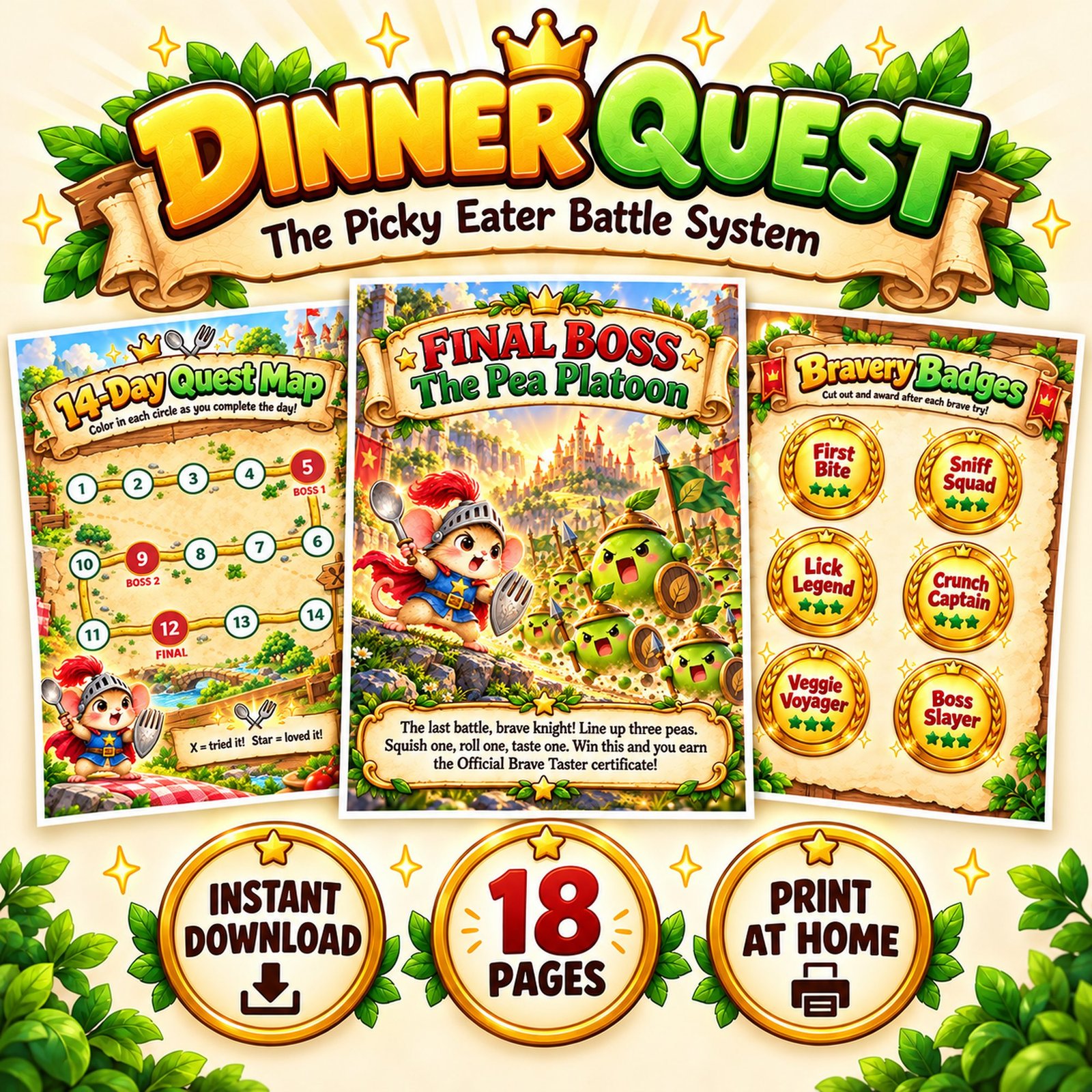
Full disclosure: Dinner Quest is our own product, from the Sprinkle Pop Print Etsy shop.
The Short Version
TL;DR: The whole system in five lines
- Cook one meal for everyone, but serve it in separate components so picky eaters can build a plate from the parts they trust.
- Ask for one polite bite of anything new, then drop the subject completely. No praise, no pressure, no dessert deals.
- Bring kids into the kitchen to wash, stir, and choose. Kids eat what they helped make.
- Snack plate dinners count as dinner. Cheese, fruit, crackers, and veggies on a tray is a legitimate meal.
- New foods move up a slow ladder from seeing to touching to tasting, over days or weeks, never in one sitting.
You Are Not Failing. Picky Eating Is Normal.
Before we get to the plan, you need to hear this, and I need you to actually believe it: picky eating is a normal phase. It is not a report card on your cooking. It is not proof that you did something wrong in the baby food era. It is a developmental stage, as ordinary as the phase where they only wore one specific shirt.
Somewhere between ages two and six, most kids go through a stretch where their food world shrinks. Foods they used to love become suspicious. New foods are treated like intruders. Meals that used to be peaceful become negotiations. This happens in almost every family, including the families who post those perfect lunchbox photos. Those photos are a highlight reel. The reality behind them usually involves a kid who ate the crackers and left the rest.
There is even biology behind it. Young children are wired to be cautious about new foods. Long ago, that caution kept wandering toddlers from eating something dangerous. Your child is not being difficult on purpose. Their brain is running an old safety program that says unfamiliar equals risky. Understanding this does not make the rejected meatloaf less annoying, but it does take the sting out. This is not defiance. It is development.
And here is the part that matters for your sanity: most picky eaters grow into perfectly fine eaters. The research on this is reassuring. The vast majority of selective eaters expand their diets as they get older, especially when mealtimes stay low pressure. The kids who stay stuck are usually the ones whose dinner tables became battlegrounds, because pressure makes pickiness worse, not better. Which means the kindest thing you can do for your picky eater is also the kindest thing you can do for yourself: take the fight out of dinner.

So let go of the guilt about the chicken nuggets. Let go of the worry that the neighbor kid eats sushi while yours eats plain pasta. Your job is not to raise a gourmet by age six. Your job is to keep mealtimes pleasant, keep offering variety without force, and trust the process. The plan below does exactly that.
One more thing before we start. If your child eats fewer than twenty foods total, gags or vomits at the sight of certain textures, or mealtimes regularly end in real distress, that can be more than typical pickiness. I cover the red flags and what to do about them in the questions section near the end. For everyone else, the everyday picky eater who survives on a short list of safe foods, this plan is for you.
The Plan: Seven Steps to One Family Dinner
This is the whole system. Seven steps, in order. You do not have to do all seven tonight. Start with step one and let the rest follow naturally over the coming weeks.
Step 1: Cook One Meal, and Build It So Everyone Can Eat It
Cook a single dinner for the whole family, and design it so the picky eater can always find something safe on the table.
This is the foundation everything else rests on, so let me be very clear about what it means. You are done making a separate kid meal. From now on, dinner is dinner. One meal, one table, one tired cook who gets to sit down and eat while the food is hot.
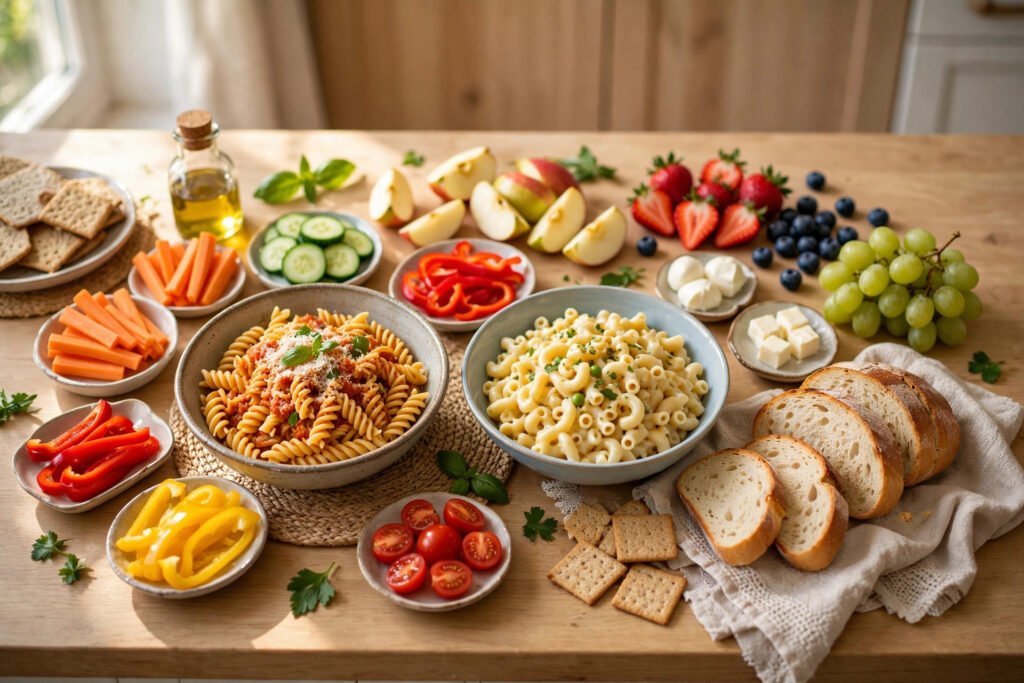
The trick is not to cook bland food everyone tolerates. The trick is to cook the food you actually want to eat, and make sure at least one or two parts of it are familiar and safe for your picky eater. Tacos are a perfect example. You make seasoned beef, warm tortillas, shredded lettuce, cheese, salsa, and sour cream. You eat the full loaded taco. Your picky eater eats a plain tortilla with cheese. Same meal. Same table. Nobody cooked twice.
Pasta night works the same way. Cook the pasta. Make the sauce. Put out parmesan, and maybe some plain buttered noodles in a small bowl before you toss everything together. Your picky eater gets plain pasta with parmesan. You get the real dinner. Stir fry night: cook the chicken and vegetables, serve the rice on the side, and let the picky eater have rice with a few pieces of chicken. Breakfast for dinner: eggs, toast, fruit. There is always something safe in a breakfast spread.
The rule is simple: every dinner includes at least one safe food, no special cooking required. A safe food is anything your child already eats without a fuss. Bread, rice, plain pasta, fruit, cheese, crackers, milk. You are not adding work. You are just making sure the meal you already planned includes one familiar anchor. When a picky eater sits down and sees something safe on the table, their whole body relaxes. And a relaxed kid is a kid who might, just might, reach for something new.
This step alone will change your evenings. You will sit down. You will eat hot food. You will stop feeling like a short order cook. And here is the quiet magic: when kids see the whole family eating the same meal, the new foods stop looking like a punishment aimed at them and start looking like just what the family eats. That shift matters more than any recipe ever will.
Step 2: Take Dinner Apart and Let Them Build Their Own Plate
Serve dinner deconstructed, with the components in separate bowls, so your child controls what goes on their plate.
This is the single most powerful tactic in this entire post, so give it your full attention. Deconstructed means taken apart. Instead of serving a finished plate, you put the parts of the meal on the table in separate bowls and let everyone assemble their own dinner. Taco bar. Pasta bar. Baked potato bar. Salad bar with warm chicken on the side. Rice bowls with toppings lined up like a little buffet. Pizza night where everyone tops their own crust.
Why does this work so well? Because picky eating is mostly about control. Your child cannot control much of their life, but they can absolutely control what goes in their mouth, and they will defend that territory with everything they have. When you hand them a finished plate, every unfamiliar item on it feels like an invasion. When you hand them an empty plate and a table full of bowls, the same foods feel like choices. Choice turns a battle into a project.
Watch what happens the first time you try it. Your child will load up on the safe foods, and that is fine. Celebrate it silently. But keep watching over the coming weeks, because something interesting happens with deconstructed meals. Kids start experimenting. A noodle lands next to a meatball and gets eaten by accident. Cheese from the taco bowl migrates onto the rice. They try a topping because they put it there themselves, and food they chose tastes different from food that was forced on them. It just does.
A few practical tips to make this work on real weeknights. Use small bowls or even muffin tins for the components; it feels fun and keeps portions manageable. Keep the components simple: you are not running a restaurant, you are just not mixing everything together before it hits the table. And resist the urge to comment on what they build. No “oh good, you took some chicken!” No “are you sure you do not want sauce?” Just let the plate be theirs. The less attention you pay to the construction, the more freely they build.
This approach also ends the “I do not like it mixed together” complaint, which is one of the great classics of picky eating. So many kids reject casseroles, stews, and mixed pasta dishes not because of the flavors but because the foods are touching. Deconstructed serving sidesteps the whole issue. And as a bonus, this is genuinely how a lot of families prefer to eat anyway. It feels abundant and fun, like a little feast, even on a Tuesday.
Step 3: Ask for One Polite Bite, Then Drop the Subject
The rule is one polite bite of anything new, asked once, with zero follow up pressure.
Here is how the polite bite works. When there is something new or previously rejected on the table, you invite your child to take one small bite. Just one. A nibble counts. A lick counts on the very first exposures. You ask kindly, one time, and then you let it go completely. If they take the bite, you stay calm. If they refuse, you stay calm. The magic is in the calm.
This is the part most parents get wrong: the bite only works if there is genuinely no pressure attached. No “just try it, you will like it.” No hovering while they chew. No disappointed face when they decline. No praise parade when they comply, because big praise turns the bite into a performance and teaches them that eating is something they do for your applause. You want eating to be their thing, not yours. So you ask once, you accept the answer, and you move on with your evening.
Why does one bite matter if you are not allowed to make a big deal about it? Because repeated low pressure exposure is how taste buds and brains learn. Research on food acceptance shows that kids often need to encounter a new food many times before they accept it, sometimes ten or more exposures. Most parents give up after three rejections. The polite bite keeps the food in rotation without turning dinner into a standoff. Each calm exposure is a tiny deposit. One day the balance tips and they eat the thing like it was always theirs.
A few ground rules to keep this working. The bite is always optional in the sense that refusal has no consequence. No “no dessert unless you try it,” because that turns dessert into a bribe and the new food into a toll booth. The bite is small; never demand a full serving of something new. And the bite applies to foods that are actually on the family table, not to special challenge foods you cooked just to test them. It should feel like a normal part of dinner, because it is.
What do you say, exactly? Keep it short and boring. “Would you like to try one bite of the chicken?” If yes, great. If no, “Okay, maybe another time,” and you genuinely mean it. Then talk about something else. Talk about the dog. Talk about the weird cloud you saw. Talk about anything except the food. The less dinner revolves around eating, the more eating happens. I know that sounds backward. It is also true.
Step 4: Bring Them Into the Kitchen Before Dinner Ever Hits the Table
Kids who help make dinner are dramatically more willing to eat dinner.
This one surprised me with how well it works. There is something about washing the vegetables, stirring the pot, or tearing the lettuce that turns a suspicious food into a personal project. A child who would never touch a mushroom on a plate will happily slice mushrooms with a kid safe knife and then announce that they need to taste their work. Ownership changes everything.
You do not need to run a cooking class. You need ten minutes and a few real jobs. Toddlers and preschoolers can wash produce in a bowl of water, tear lettuce, sprinkle cheese, stir a cool batter, or press the button on the blender with you standing right there. Older kids can measure, chop soft foods with supervision, read recipe steps out loud, or be in charge of one whole component like the salad or the garlic bread. Give them a job with a real outcome, not a pretend task. Kids can tell the difference, and the real jobs are the ones that build pride.
The other half of this step happens away from the stove. Let them choose. At the store or the market, let each child pick one fruit or vegetable for the week. It can be anything, even something weird. The rule is they picked it, so it comes home and it appears on the table. Let them flip through a cookbook or scroll recipes with you and choose one dinner a week. When a child chose the broccoli, the broccoli arrives at the table with a completely different reputation than broccoli that was imposed on them.
Will this create some mess? Yes. Will dinner take a little longer? Sometimes. Is it worth it? Completely. Think of it as an investment. The ten minutes of flour on the floor today is buying you a kid who eats the meal next month. And honestly, some of my favorite memories with my kids are the chaotic ones in the kitchen, the two of us laughing over a lopsided pizza. The food acceptance is almost a side effect. The real win is that the kitchen becomes a happy place instead of a battleground.
One caution: do not turn cooking together into a lecture about nutrition. No speeches about vitamins while you stir. Just cook, chat, taste, and enjoy. The food does the teaching on its own.
Step 5: Declare the Snack Plate Dinner an Official Family Meal
A tray of cheese, crackers, fruit, and veggies is a real dinner. Serve it proudly.
I need you to hear this from another mom: the snack plate dinner is not giving up. It is a strategy. On nights when you are exhausted, when the planned meal fell apart, or when you can just tell it is going to be one of those evenings, you are allowed to put a beautiful spread on a tray and call it dinner. The French do a version of this. So do the Spanish. Grazing boards are practically a food group at this point. You are not being lazy. You are being European.
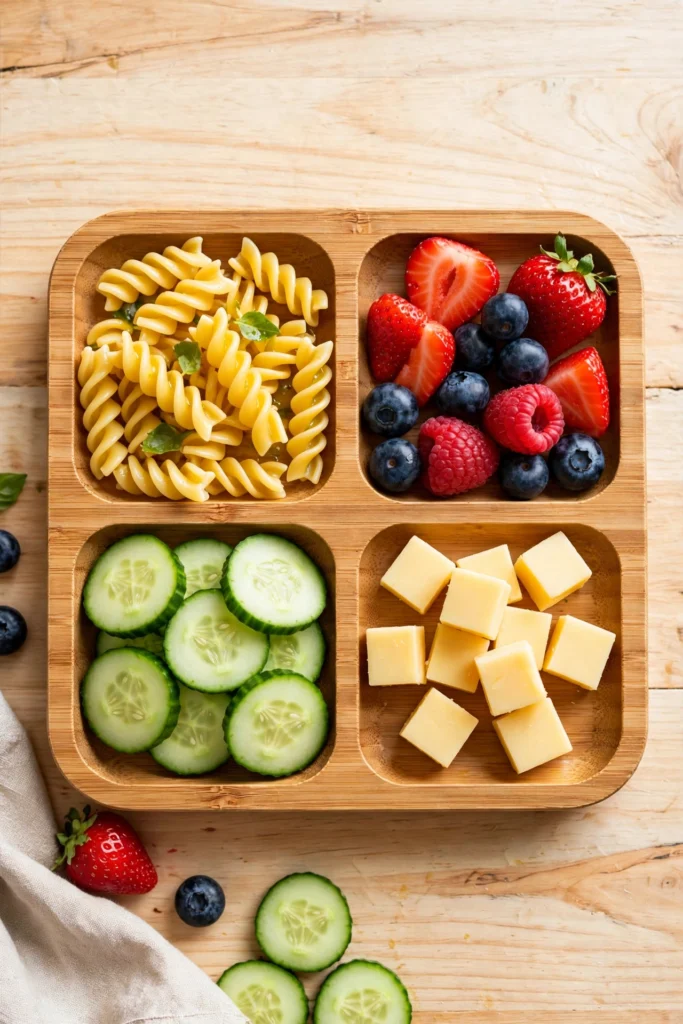
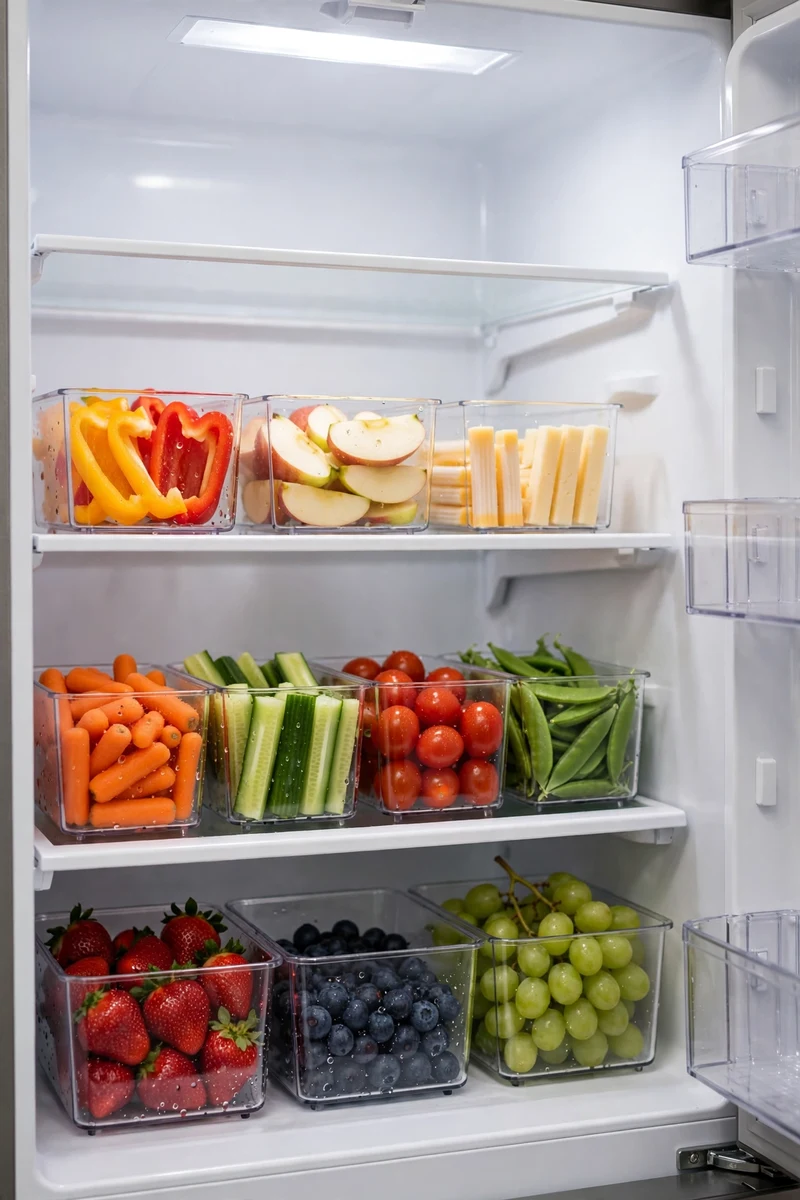
Here is how to build a snack plate dinner that is genuinely nourishing. Aim for four or five categories: a protein like cheese cubes, deli turkey roll ups, hard boiled eggs, or hummus. A fruit like apple slices, berries, grapes, or clementines. A vegetable like cucumber rounds, baby carrots, bell pepper strips, or cherry tomatoes. A grain like crackers, pita triangles, or breadsticks. And a dip, because dips make everything more appealing to kids. Ranch, hummus, peanut butter, or even ketchup. Dips are the great negotiator of the picky eater world.
The reason snack plates work is that they remove every pressure point at once. Nothing is mixed together. Everything is visible and identifiable. Portions are small and non threatening. Kids graze at their own pace. And because it looks fun, like a party on a tray, the mood around the table lifts. I have watched my kids eat more vegetables off a snack tray than they ever ate from a served plate, simply because nobody asked them to.
Make this a standing option, not an emergency fallback. Put “snack plate dinner” on the meal plan once a week, right there in ink, so it feels intentional. When kids know it is a real category of dinner and not a sign that mom ran out of ideas, they embrace it. Some families do a big family style snack board in the middle of the table and everyone grazes together. It is relaxed, it is social, and the dishes are minimal. On a weeknight, that combination is pure gold.
And if anyone, including the voice in your own head, suggests this is not a proper meal, remind yourself what dinner is actually for: feeding your people, being together, and ending the day on a warm note. A snack plate does all three. That is dinner.
Step 6: Move New Foods Up the Ladder One Tiny Rung at a Time
New foods are accepted in stages, from seeing to touching to tasting, and you cannot skip rungs.
Think of every unfamiliar food as sitting at the bottom of a ladder. Your child climbs it one rung at a time, and each rung is a smaller ask than the last one felt. The ladder looks something like this. First, the food simply appears on the table, on a serving plate, with no expectation that anyone touches it. Then it appears on their plate, in a tiny amount, still with no pressure. Then they touch it, poke it, or smell it. Then they lick it or take a mouse sized nibble. Then one polite bite. Then a few bites. Then, one ordinary day, it is just food they eat.
The key insight is that every rung counts as progress, even the ones that look like nothing. When your child tolerates broccoli on the table without a meltdown, that is a rung. When they let a piece sit on their plate, that is a rung. When they smell it and make a face, that is genuinely a rung, because their brain just collected data that the food did not hurt them. Parents miss this and get discouraged, because they are watching for the finish line instead of the ladder. Watch the ladder. It is always moving.
This process takes days or weeks per food, and that is normal. Put the new food on the table regularly, in tiny amounts, alongside plenty of safe foods. Never make it the main event. Never announce “tonight we are trying salmon!” like it is a medical procedure. Just include it quietly and repeatedly. Familiarity is doing the heavy lifting here. The tenth calm sighting of roasted sweet potato does something in a child’s brain that the first sighting cannot do, no matter how nicely you ask.
You can make the ladder more fun without adding pressure. Food play counts: stamping with apple halves in paint is still exposure to apples. Sorting pomegranate seeds by size is still touching a new food. Smelling spices with eyes closed and guessing is still learning about flavor. None of this requires eating. All of it moves the food from “unknown threat” to “familiar object,” which is the entire journey.
Keep a loose mental note of where each food sits on the ladder, and celebrate progress privately. Not out loud at the table, remember. But later, when you are telling your partner about the day, notice it: she kept the peas on her plate tonight. That is a win. The ladder is working.
Step 7: When They Truly Will Not Eat, End the Night Kindly
If your child refuses dinner, stay warm, offer no replacement meal, and trust breakfast.
Even with all seven steps in place, there will be nights when your child eats three crackers and declares themselves done. This is the moment that tests everything, so let us talk through exactly what to do.
First, stay kind. No sighing, no “after all the work I did,” no disappointed silence. Just a warm, matter of fact response: “Okay, dinner is here if you get hungry.” Then carry on with your own meal and enjoy it. Your calm is the whole strategy. The minute refusal gets a big reaction, positive or negative, it becomes a tool. Kept boring, it stays just a skipped dinner.
Second, do not cook a replacement. This is the hard one, and it is also the one that makes the whole system work. If a refused dinner is reliably followed by a custom second meal, your child learns a very logical lesson: hold out, and the good stuff arrives. The family meal is what is on offer. That is the deal, and it is a fair one, because there was always something safe on the table. You are not withholding food. You are holding a boundary around your own labor, and that is allowed.
Third, have a boring backup, not an exciting one. If your child is genuinely hungry later, the backup is something plain and unexciting: a banana, a piece of toast, a bowl of cereal. Not the fun snack drawer, not a fresh round of cooking. Boring backup food keeps hunger from becoming a crisis without rewarding the refusal. Offer it warmly, without a lecture, and move on.
Fourth, trust breakfast. A child who skips dinner will be hungry in the morning, and breakfast is coming. One light evening does not harm a healthy child. Kids are remarkably good at balancing their intake over days, not single meals. The skipped dinner feels enormous to you and is completely forgettable to them. Let it be forgettable.
What you must not do on these nights is turn the refusal into a long conversation. No negotiating bite counts. No “just three more bites and you can go.” No following them with the plate. End the meal for them the same way you would for anyone who is done: clear their plate without drama, and shift to the evening routine. Bath, books, bed. The rhythm of the evening matters more than the calories of one meal.
And notice something important: these nights get rarer. When the pressure leaves the table, when safe foods are always present, when dinner is pleasant company instead of a performance review, most kids start eating more, not less. It feels backward. It works anyway.
Try It Tonight: Plan One Deconstructed Dinner for Tomorrow
Your twenty minute win: grab a piece of paper and plan exactly one deconstructed dinner for tomorrow night. That is the whole assignment.
Pick a meal your family already likes that comes apart easily. Tacos. Pasta with toppings on the side. Baked potatoes with a topping bar. Breakfast for dinner. Rice bowls. Write down the components, check that at least one is a safe food your picky eater already trusts, and add the ingredients to your grocery list.
That is it. You are not overhauling your kitchen. You are not having a big talk with the kids. You are just serving tomorrow’s dinner in separate bowls and letting everyone build their own plate. One dinner, one change, and you will see the difference immediately.
Bonus points: invite your picky eater to choose one topping for the spread. Ownership starts before the first bite.
Mistakes to Avoid: The Four Traps That Make Picky Eating Worse
Now that you have the plan, let us talk about the traps. These are the very understandable things parents do, usually out of love and exhaustion, that accidentally make picky eating stick around longer. I have done every single one of these. No judgment here, just a flashlight.
Mistake 1: Becoming the Short Order Cook
Cooking a separate meal teaches your child that holding out works.
It starts innocently. They reject the soup, so you make toast. They reject the toast, so you heat nuggets. Within a month you are running a diner with a menu of one very specific customer. The problem is not the extra work, although the extra work is real. The problem is the lesson. Every custom meal confirms that the family dinner is optional and that persistence gets room service.
Ending this does not require a dramatic announcement. Just stop offering the alternative. Serve the family meal with its safe anchor foods, and let the boundary be quiet and kind. The first week is the hardest. After that, the expectation resets, and so does your evening. You get to eat sitting down. That alone is worth it.
Mistake 2: Bribing With Dessert
“Three more bites and you can have ice cream” makes the new food the punishment and the dessert the prize.
This one is so tempting because it works in the moment. The bites get eaten. The ice cream gets served. Everyone moves on. But look at what your child just learned: the dinner food is the obstacle, and the sweet food is the reward for enduring it. You have accidentally ranked your foods, with vegetables at the bottom and sugar at the top. Over time, this makes the dinner foods even less appealing, because they are now officially the thing you suffer through.
Instead, separate dessert from dinner entirely. Serve dessert sometimes, not as a reward but as its own pleasant thing, and serve it regardless of how dinner went. Or serve a small dessert alongside dinner, no strings attached. When dessert stops being a bargaining chip, dinner stops being a negotiation. Both get calmer.
Mistake 3: Forcing the Clean Plate
Forcing bites overrides the hunger signals you actually want your child to keep.
Many of us grew up in clean plate households, and it is a hard habit to break. But a child who is forced to keep eating after they feel full learns to ignore their own body. That is the opposite of the healthy relationship with food we want. It also turns the table into a power struggle, and power struggles are where picky eating digs in its heels.
Let them decide when they are done. “Are you all done?” asked kindly, and then you believe the answer. This does not mean food gets wasted dramatically; you can serve small portions and offer seconds. It means the person who lives in the body gets the final vote on how much goes in it. That trust pays off for years.
Mistake 4: Hiding Veggies as the Whole Strategy
Sneaking vegetables into food does not teach kids to eat vegetables.
Pureed cauliflower in the mac and cheese, zucchini in the muffins, spinach in the smoothie. It feels clever, and it does get some nutrients in. But as a complete strategy, it has a ceiling. Your child never learns what a vegetable tastes like, never gets comfortable seeing one on a plate, and never climbs the exposure ladder for the real thing. Worse, if they discover the trick, trust takes a hit, and trust is everything at the table.
Visible veggies served without pressure will always beat hidden veggies in the long run. Keep doing the smoothie if you love it, but let it be a bonus, not the plan. The plan is the food on the table, out in the open, climbing the ladder one calm exposure at a time.
Side note for the rest of the household: mealtime calm is easier when the rest of the evening runs smoothly too. If the chaos is bigger than dinner, you might like my post on how to keep your house clean with little kids, which is really about systems that lower the volume on the whole day, not just the floors.
What About…? Your Toughest Questions Answered
You have read the plan. Now let us handle the “yes, but” questions, because real life always has a few.
What about kids with sensory issues? When is it more than pickiness?
Typical pickiness is selective. Sensory based feeding issues show red flags, and those deserve professional support.
Most picky eaters will eat a short list of foods happily, eat fine at other people’s houses or at school, and are growing well. That is typical, and the plan in this post fits. But some signs point to something deeper: gagging or vomiting at the sight or smell of foods, eating fewer than twenty foods total and dropping foods from the list over time, extreme distress or panic around new foods, difficulty chewing or swallowing, or a diet so limited that growth or nutrition is affected. If any of that sounds like your child, skip the internet advice and talk to your pediatrician, who can refer you to a feeding therapist or occupational therapist.
This is not a failure, and it is not something a polite bite will fix. Sensory processing differences and ARFID, which is an eating disorder rooted in sensory sensitivity or fear, are real medical situations with real specialists who help kids every day. Getting support early makes everything easier. Trust your gut here. You know the difference between a kid who is being choosy and a kid who is struggling. If you are worried, that worry is data. Bring it to the pediatrician.
For kids in feeding therapy, the ladder in step six actually pairs beautifully with professional guidance, because therapists use very similar gradual exposure methods. You can be your child’s calm home base while the specialist handles the clinical side.
What if they skip dinner and wake up hungry at two in the morning?
Handle night hunger with a boring snack, given calmly, and keep breakfast predictable.
This is the fear that keeps parents cooking replacement meals at eight pm, so let us defuse it. First, genuinely hungry night waking after a skipped dinner is less common than parents expect. Most kids who skip dinner sleep fine and show up ravenous for breakfast, which is exactly the natural consequence that teaches them dinner matters.
But if it happens, do not panic and do not turn it into a second dinner. Keep a boring middle of the night option: a banana on the counter, a small bowl of cereal they can have with minimal fuss. Give it without a lecture and without turning on all the lights for a production. The goal is to meet the hunger without making midnight more rewarding than dinner was. No cooking, no choices, no fun snacks. Just enough to settle the tummy and get everyone back to sleep.
Then, in the morning, serve a solid breakfast at the usual time. Do not serve breakfast at six am as compensation. Keep the rhythm steady: meals happen at meals. Kids learn the pattern within a few days, and the night waking usually fades on its own. If night hunger is happening constantly even on nights they ate well, mention it to your pediatrician, because that can occasionally signal something worth checking.
What about siblings with totally different pickiness levels?
Feed the family, not each child individually, and let different plates be normal.
One kid eats everything, one eats beige foods only, and you feel like you are failing the beige one every time you praise the adventurous one. First, stop comparing them out loud, or even with your facial expressions. Kids are incredibly tuned in to who is the “good eater” and who is the “problem,” and those labels stick.
The deconstructed approach in step two is your best friend here, because it naturally serves both kids from the same meal. The adventurous eater builds a loaded plate. The picky eater builds a safe plate. Same table, same food, zero commentary about the difference. Different plates are just what dinner looks like in your house, and that is fine.
Avoid the trap of praising the adventurous eater for eating in front of the picky one. “Look how well your sister eats her broccoli!” feels encouraging to you and feels terrible to the kid with the plain noodles. Praise effort and manners, not menus. And give the picky eater the same kitchen jobs and choices from step four. Sometimes the “picky” sibling just needs a longer runway, and the ladder is still working quietly in the background.
If sibling dynamics are spilling over into the rest of the evening, by the way, a calmer house helps everything. My post on how to stop the toy flood without the mom guilt is about the living room, but the real lesson is the same one as here: systems beat nagging, whether the mess is toys or dinner.
How do I handle grandparents who cater to the pickiness?
Thank them for the love, set one clear boundary, and let the small stuff go.
Grandparents and picky eaters are a classic combination. Grandma has waited all week to see the kids, the kid announces the casserole is yucky, and suddenly there are chicken nuggets in the oven and a grandmother who looks triumphant. It is infuriating, and it comes from love, and both things are true at once.
Here is what actually works: one clear, kind boundary, stated ahead of time, about the big thing. “We are working on everyone eating the same dinner, so please do not make a separate meal. There will always be something she likes on the table.” That is it. One boundary. Not a lecture about nutrition, not a list of rules, not a critique of how they fed you in 1989.
Then let the small stuff go. If grandpa slips an extra cookie, if the portions are bigger, if dinner is at five instead of six, release it. Grandparents get a different job description than parents, and a few indulgent meals will not undo your system. What matters is the pattern at your table, five nights a week. That is where the habits are built. The occasional grandparent feast is just a happy memory.
If a grandparent is the regular after school caregiver and the catering is daily, that is a different conversation, and it deserves warmth, not war. Explain the plan, share what is working, and invite them into it: “She builds her own plate from the bowls now, and she loves choosing a topping.” Give them a role in the system instead of just rules against the old way. Most grandparents come around when they see it working, especially when the kid starts eating more, not less.
Dinner Does Not Have to Be a Battle
Let us zoom out for a second. The goal was never to raise a child who eats everything. The goal was to end the two dinner cycle, take the fight out of the table, and get your evenings back. Everything in this plan serves that goal: one meal with safe anchors, deconstructed so kids have control, one polite bite with no pressure, kids in the kitchen, snack plates without shame, new foods climbing a slow ladder, and kind firmness on the nights they refuse.
Start small. Pick the one step that felt easiest when you read it, and do just that one this week. Maybe it is the deconstructed taco night. Maybe it is the snack plate dinner on Thursday. Maybe it is simply asking for one polite bite and then talking about the dog instead of the food. One change is enough to start. The rest will follow, because calm is contagious, and kids adjust to new rhythms faster than we expect.
And on the nights it falls apart, because some nights will, give yourself the same grace you give them. Tomorrow is another dinner. The ladder is still there. You are doing better than you think.
Speaking of systems that make the whole house calmer, if weeknight chaos is bigger than just food, take a look at the laundry system that actually works for busy moms. Dinner peace and laundry peace come from the same place: a simple plan you can run on tired, instead of willpower you do not have.
With love and light, and a kitchen that finally closes at a reasonable hour
Get Fresh Home Ideas Every Week
Seasonal decor ideas, organizing tips, and cozy home inspiration, straight to your inbox.
More Parenting Ideas You Will Love
Keep reading for more calm-home inspiration: