
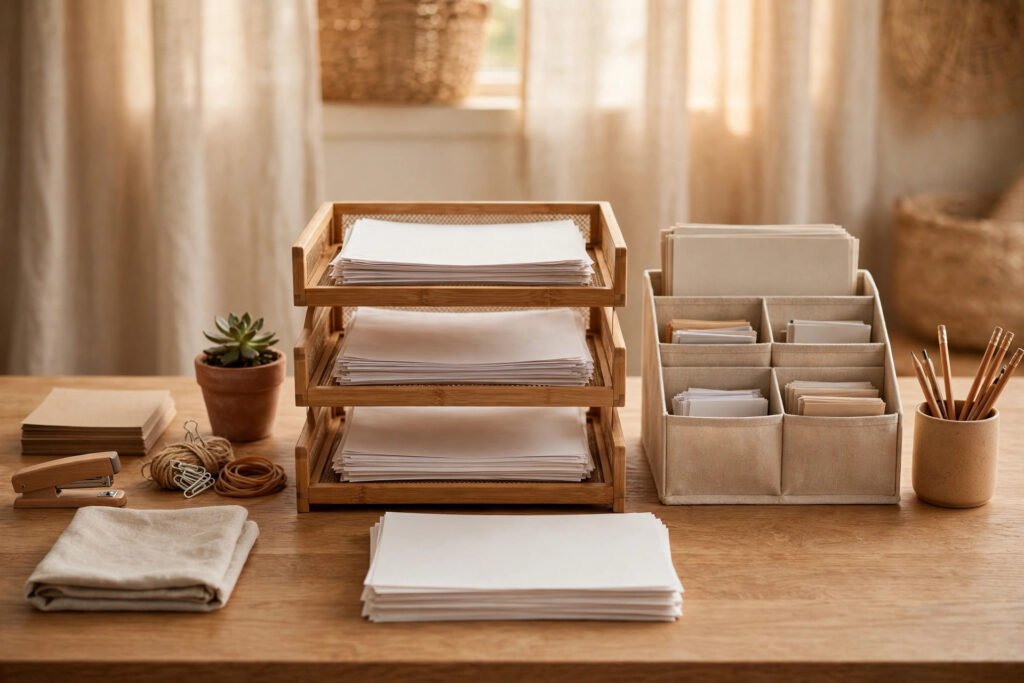
Somewhere in your house right now, there is a pile. You know the one. Permission slips, reading logs, fundraiser flyers, lunch menus, spelling lists, art projects, and seventeen drawings of your family where everyone has enormous hands. It started as a small stack on the counter in September. It is now a geological formation. And somewhere in the middle of it is a form that was due yesterday.
School papers are relentless. Every kid brings home a small blizzard every single day, and most of it needs at least a glance. Without a system, the papers take over your counters, your sanity, and your ability to find the one thing that actually matters. This post gives you a complete paper handling system: how to sort it in minutes a day, what to keep and what to toss without guilt, where it all lives, and how to preserve the precious stuff without drowning in it.
Love these ideas? Get more every week.
Join the newsletter for seasonal decor and cozy home inspiration.
TL;DR: Taming the Paper Avalanche
- Touch every paper once: a two minute daily sort (act, file, toss, keep) stops piles from forming.
- Give papers three homes: an inbox for action items, a file for reference, and a keepsake box for treasures.
- Toss ruthlessly: most school paper is trash. Flyers, duplicates, and old worksheets can go without guilt.
- Photograph the art: a photo preserves the memory without the paper taking over your house.
- One keepsake box per kid per year: a real boundary that makes keeping special things joyful instead of overwhelming.
Why School Papers Take Over (And Why It Is Not Your Fault)
Let us appreciate the sheer volume for a moment. A typical elementary kid brings home five to fifteen pieces of paper per day. Multiply that by 180 school days and you are looking at over a thousand pieces of paper per kid per year. With two or three kids, it is a part time job just to look at all of it. Nobody warned you about this part of parenting.
And the papers are sneaky. Each one feels slightly important. What if this is the permission slip for the field trip? What if I need this reading log? What if this drawing is the one they will want when they are grown? So instead of deciding, we set it down “for now.” And “for now” becomes a pile, and the pile becomes a landslide, and suddenly you are digging through three weeks of paper looking for the dental form while your kid waits by the door.
The guilt makes it worse. Throwing away your child’s artwork feels like throwing away their childhood. Keeping all of it feels like drowning. So we do neither, and the pile grows. Here is the permission slip you actually need: you are allowed to have a system. You are allowed to throw most of it away. And you are allowed to keep the truly special things in a way that honors them instead of burying them. That is what this post is about.
The Plan: Your School Paper System
Step 1: Set Up the Daily Two Minute Sort
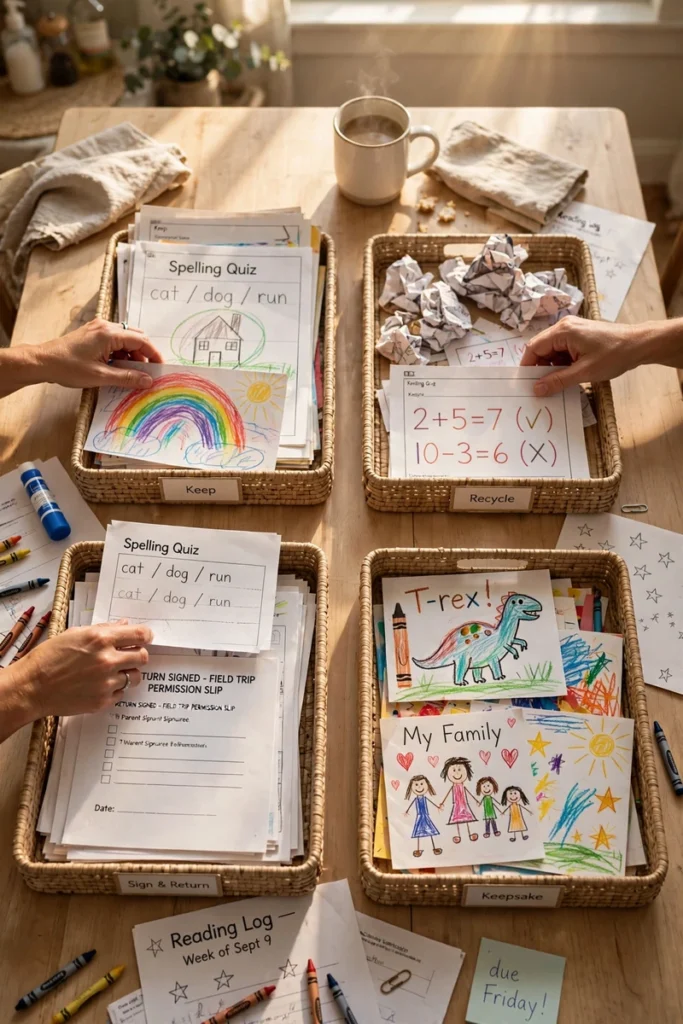
Every paper gets touched once, the day it comes home: act, file, toss, or keep.
This is the entire foundation. Paper piles form when papers sit undecided. The daily sort prevents that by forcing a fast decision on everything. When the backpack gets emptied (part of your after school routine landing zone), you spend two minutes sorting that day’s papers into four destinations.
Act: anything needing your signature, a response, money, or a calendar entry. This goes in the action inbox, which you process right then or that evening. Sign it, pay it, add the date to your calendar, put the completed form in the backpack immediately.
File: reference papers you might need: the lunch menu, the school calendar, the teacher’s contact info, the reading list. These go in the reference file, one per kid, and get tossed when replaced by a new version.
Toss: flyers for things you will not attend, duplicate notices, old worksheets, graded papers with no errors worth reviewing, the seventeenth copy of the same fundraiser form. Straight to recycling. No guilt.
Keep: the treasures. The drawing that made you cry. The story they wrote about the dog. The handprint art. These go in the keepsake box, which has a size limit that keeps it joyful (more on that below).
Two minutes. Once a day. That is the whole habit, and it prevents one hundred percent of paper avalanches.
Step 2: Create the Three Homes
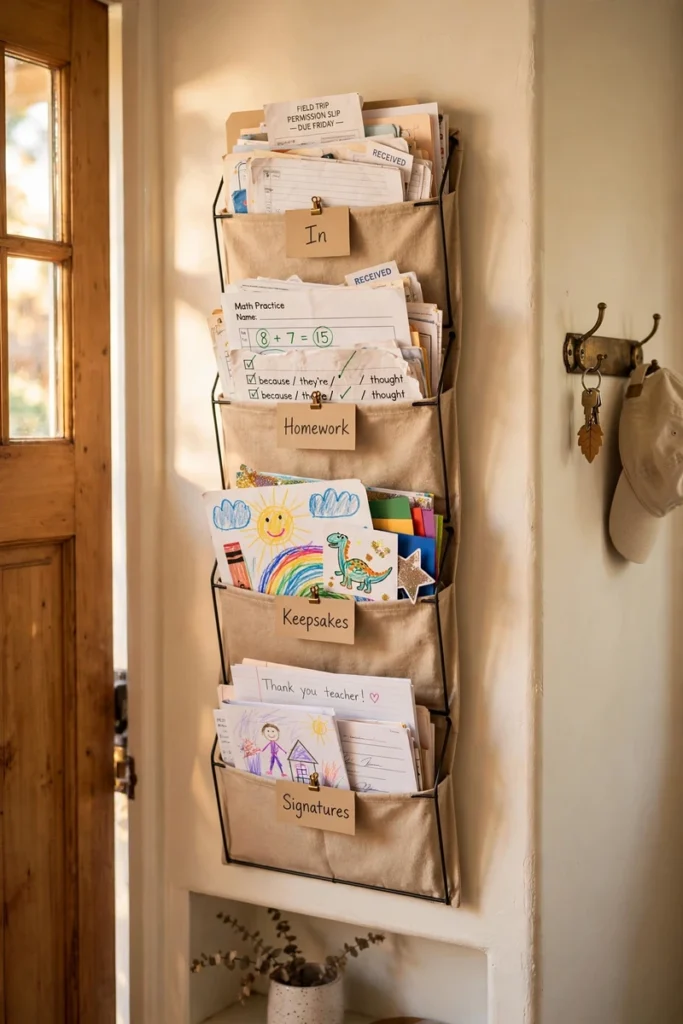
Every paper needs a home: an action inbox, a reference file, and a keepsake box. Three homes, no piles.
The action inbox is for things needing you. A wall mounted file, a tray on the counter, or a folder hung by the door. One per family is fine, or one per kid if you have several in school. The rule: it gets emptied completely every evening. An inbox that never empties is just a pile with a label.
The reference file is for papers you might need later. One folder or one section of a file box per kid. Lunch menus, calendars, contact sheets, curriculum overviews. Purge it monthly: if a new version arrived, the old one goes. If the event passed, the flyer goes. Reference files stay thin because most reference paper expires fast.
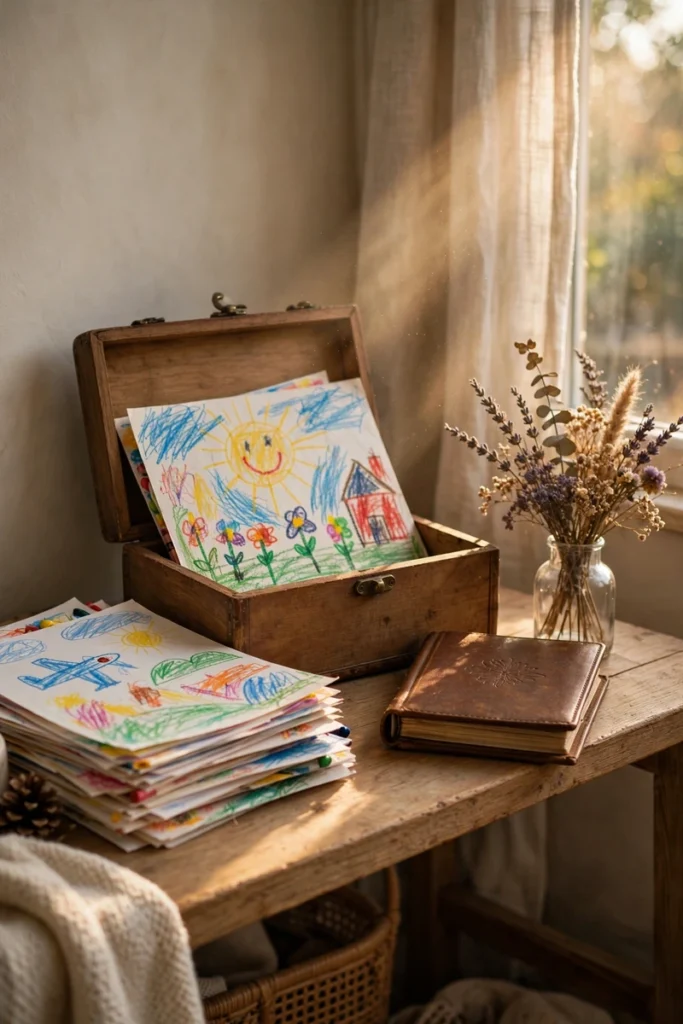
The keepsake box is for treasures. One box per kid, with a real physical limit: when it is full, something goes before something new comes in, or you photograph and release. The limit is the magic. Without it, “keepsake” becomes “everything,” and you are back to drowning. With it, choosing what makes the box becomes a joyful ritual instead of an overwhelming burden.
Set up all three this weekend. Label them clearly. Show the kids. The system only works if everyone knows where papers go, including the kids old enough to sort their own backpacks.
Step 3: Learn to Toss Without Guilt
Most school paper is trash. Saying so is not cold. It is honest.
Let us categorize honestly. The daily worksheet with ten math problems? Trash. The spelling list from October? Trash. The third copy of the fundraiser flyer? Trash. The lunch menu from last month? Trash. Graded papers with no surprises? Trash. None of these are memories. None of them matter. They did their job and now they can go.
The guilt comes from a good place: you love your kid and their efforts feel precious. But keeping everything honors nothing. A drawer stuffed with 400 worksheets is not a tribute. It is clutter that buries the ten things that actually matter. Tossing the ordinary is what makes space, physically and emotionally, for the extraordinary.
If tossing feels too abrupt, use a cooling off tray. Papers you are unsure about go in the tray. Once a month, glance through it. You will be amazed how obviously tossable everything looks with a month of distance. What felt precious in the moment reveals itself as just paper. Keep what still moves you. Recycle the rest with a clear conscience.
Step 4: Photograph the Art (The Game Changer)
A photo preserves the memory. The paper does not need to live in your house forever.
This is the strategy that changes everything for art-heavy families. Your kid brings home forty paintings a year. You cannot keep them all, and you should not. But photographing them before they go gives you the memory without the storage crisis.
Set up a simple system: a spot with good light (a blank wall or the floor by a window), snap a photo with your phone, and save it to a shared album per kid per school year. At the end of the year, you have a beautiful digital gallery of their artistic journey. Many families turn these into a photo book once a year, which becomes a treasured keepsake that takes up one inch of shelf instead of three boxes.
Then let the original go, with one exception: the truly special pieces still go in the keepsake box. The photo system handles the volume. The box handles the heart. Together, they mean you never have to choose between drowning in paper and losing the memories.
Involve the kids in the photographing. Let them hold up their art, tell you about it while you snap the photo, and then ceremonially recycle it (or keep it, their choice for the special ones). Kids are often much less attached to the paper than we fear. What they want is for us to see it, celebrate it, and remember it. The photo does all three.
Step 5: Master the Action Papers (Forms, Slips, Deadlines)
Action papers need a same day rule: sign it, schedule it, send it back tomorrow.
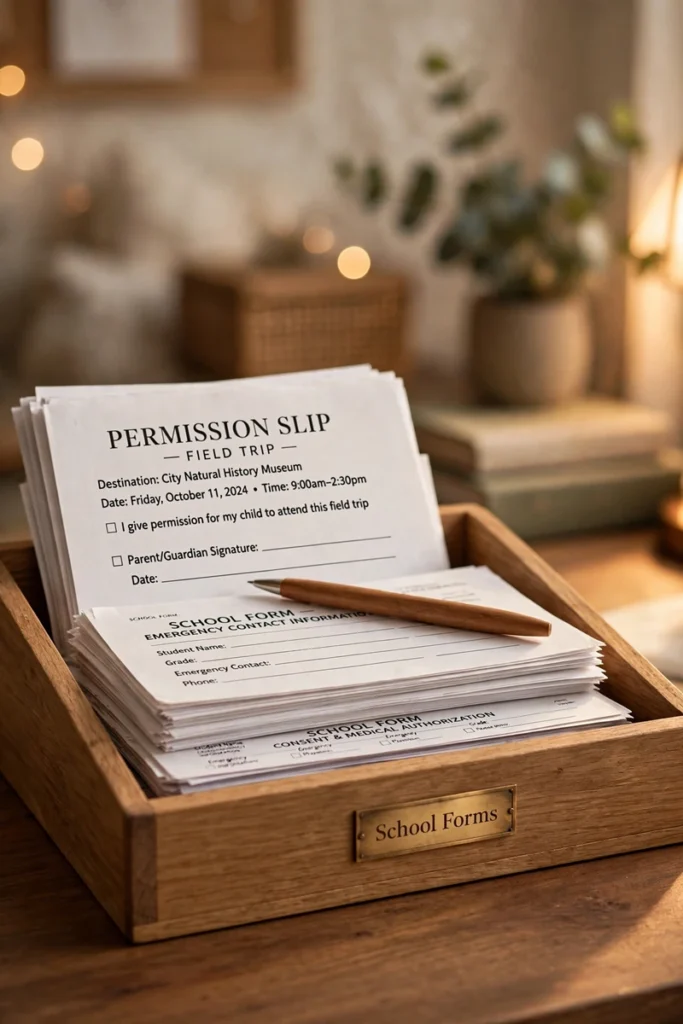
The papers that cause the most stress are the action ones: permission slips, order forms, sign ups with deadlines. These cannot sit, because they expire. The system: when you do the daily sort and find an action paper, deal with it immediately or put it in the action inbox with a specific plan.
Best practice is immediate. Sign the slip now. Add the date to your calendar now. Put the money in the envelope now. Put the completed form in the backpack now, not later. “Now” takes three minutes. “Later” takes three weeks of background anxiety and a frantic morning search.
For forms that need information you do not have handy (health card numbers, emergency contacts), keep a master info sheet taped inside a kitchen cabinet or saved in your phone notes. Every form asks for the same ten facts. Having them in one place turns a twenty minute form into a five minute one. Future you, filling out the fifth identical emergency contact form of the year, is grateful.
And for the love of calm mornings, check the backpack the night before for completed forms. Nothing derails a school morning like discovering the permission slip is still on the counter. Part of the evening reset: forms signed, forms in backpack, backpack by the door.
Step 6: Do a Monthly Purge
Once a month, spend 15 minutes purging the reference files and the cooling off tray. Systems stay clean with regular attention.
Even with a daily sort, reference files accumulate expired paper and the cooling off tray fills up. A monthly purge keeps both honest. Put it on your calendar for the first weekend of the month, or pair it with another monthly habit.
The purge is fast because the decisions are easy with distance. Old lunch menu? Gone. Last month’s newsletter? Gone. The worksheet you were unsure about? Obviously trash now. Cooling off tray contents get one glance each: still moves you, or recycling. Most of it will be recycling, and that is the point.
This is also when you glance at the keepsake boxes. Are they getting full? Is there anything in there that seemed special in September but feels ordinary now? It is okay to curate. Keepsake boxes are living collections, not archives. The best ones get better over time because someone cared enough to edit.
Step 7: Handle the Digital Paper Too
School email and apps are the new paper avalanche. Give them the same system.
Modern school communication is half paper, half digital: emails from teachers, app notifications, online forms, digital newsletters. Without a system, these are just as overwhelming as the paper pile, except invisible until the deadline passes.
Apply the same four destinations. Act: emails needing a response get handled or flagged immediately. File: save important ones in a labeled folder per kid per year. Toss: delete the FYIs and duplicates without mercy. Keep: screenshot or save the truly special digital moments (the email from the teacher praising your kid) in the same album as the art photos.
Turn off non essential notifications. You do not need a ping for every cafeteria menu update. Check the school app once a day at a set time, the same way you sort the paper backpack. Batching beats constant dripping. Your attention is the scarcest resource in the house. Spend it on purpose.
One more digital tip: unsubscribe ruthlessly from school mailing lists that duplicate the app. If the same newsletter arrives by email, app notification, and paper flyer, pick one channel and mute the others. Triple communication is not thorough. It is noise. You will actually miss fewer things when you are monitoring one channel well instead of three channels badly.
What to Do With the Backlog Mountain
If you are reading this with three months of unsorted paper staring at you, the daily sort feels impossible. You cannot sort two minutes a day when there is a mountain. So first, you clear the mountain. Here is how, without losing a weekend to it.
Do it in 20 minute bursts. Set a timer, sort fast into the four destinations, stop when it rings. Do one burst a day for a week. The mountain will shrink dramatically, because most of it is Toss. You are not organizing the backlog. You are demolishing it. Speed matters more than perfection.
Sort standing up at the recycling bin. This is a psychological trick. When the recycling bin is right there, tossing is frictionless. Pick up a paper, glance, decide, drop it in the right destination. Standing keeps your energy up and prevents the “sit down and reminisce over every drawing for ten minutes” trap. You can reminisce during the keepsake curation later.
Recruit the kids for their own piles. Dump each kid’s backlog in front of them and give them the four destinations. Kids are surprisingly ruthless sorters of their own old worksheets. They will toss with glee. For the keeps, let them choose their top ten favorites for the keepsake box. Their pile, their choices, your supervision.
Do not aim for zero. The goal of the backlog blitz is not a perfectly empty counter. It is getting the pile down to a manageable size where the daily sort can take over. If you clear eighty percent in a week, the daily two minutes handles the rest. Done beats perfect, especially with paper.
The End of School Year Ritual
Every June, do a bigger version of the monthly purge. This is the annual paper ritual, and it is genuinely lovely when you make it one.
Empty the reference files completely. The school year is over. Last year’s lunch menus, calendars, and newsletters are done. Recycle the lot. Start fresh in September with empty files. There is something deeply satisfying about this.
Curate the keepsake box with your kid. Sit down together and go through the year’s keeps. Let them tell you the stories behind their favorites. Photograph anything that is not making the final cut. Then close the box, label it with the school year, and put it away. This ritual turns a box of paper into a time capsule.
Make the photo book. If you have been photographing art all year, June is when you turn it into a book. Most photo book services make this easy: upload the album, pick a template, done. One book per kid per year becomes a shelf of childhood that you will actually look at, unlike the boxes in the basement.
Celebrate the system. Seriously. You handled a thousand pieces of paper this year without drowning. That is an achievement. The ritual is not just maintenance. It is proof that the system worked, and motivation to run it again next year.
The Command Center: Where Paper Meets the Calendar
School papers do not live in isolation. They connect to your calendar, your to do list, and your family’s schedule. A small command center ties it all together without adding complexity.
One wall calendar, visible to everyone. When an action paper has a date (field trip, concert, early dismissal), it goes on the wall calendar immediately, in front of the kids. This does two things: the date is captured where everyone can see it, and the kids learn that important dates get written down. A big paper calendar in the kitchen beats a phone calendar nobody else can see.
One weekly planning moment. Sunday evening, five minutes: glance at the action inbox, check the calendar for the week, note anything the backpacks need. This tiny ritual catches the things that slip through daily cracks. The permission slip that needs money by Wednesday. The library book due Thursday. Five minutes of foresight prevents five mornings of panic.
One place for the family’s master info. Emergency contacts, health card numbers, the school’s phone number, bus route details, after school program contacts. Keep a copy taped inside a kitchen cabinet and a copy in your phone. Every form, every emergency, every “what is the school’s number again” moment gets answered in seconds. This is the unglamorous backbone of the whole paper system, and it saves more time than anything else in this post.
Try It Tonight: The 15 Minute Paper Triage
Do not organize the whole pile tonight. Just triage it:
- Grab four bags or boxes and label them: Act, File, Toss, Keep.
- Set a timer for 15 minutes and sort as fast as you can. Do not linger. First instinct.
- Take the Toss bag straight to recycling. Feel the lightness.
- Put the Act papers in one visible spot and handle the top three tonight.
- Put the Keep papers in a box or bag. That is your starter keepsake box.
When the timer rings, stop. You will be shocked how much of the pile was Toss. This weekend, set up the three homes. Starting tomorrow, the daily two minute sort keeps it from ever piling up again.
Mistakes to Avoid
Trying to organize before purging. Buying a beautiful filing system and carefully filing 400 worksheets is just organized hoarding. Purge first, then set up homes for what survives. Most families discover they need far less storage than they thought.
Keeping everything “just in case.” “Just in case” is how paper avalanches start. Be honest: when have you ever needed a random worksheet from three months ago? Keep the reference papers that are genuinely useful (calendars, contact info, curriculum guides). Release the rest.
Making the keepsake box bottomless. A keepsake box with no limit is just a nicer pile. The physical boundary is what makes it work. One box per kid per year, or one box per kid total with annual editing. Limits force the joyful choosing that makes keepsakes meaningful.
Skipping the daily sort. The two minute sort is the whole system. Skip it for a week and the pile is back. It is the flossing of paper management: tiny, daily, and the only thing that actually prevents the problem. Tie it to something you already do, like emptying the backpacks at the landing zone.
Forgetting the digital avalanche. If you conquer the paper but ignore the inbox, you have only solved half the problem. Give the digital papers the same four destinations and the same daily attention. Fifteen minutes a day for both keeps you ahead of all of it.
What About…?
What about the giant art projects that will not fit in a box? Photograph them beautifully, then let them go. Take the photo in good light, maybe with your kid holding it for scale and memory. The photo preserves it better than a crumpled poster in a closet anyway. For the truly spectacular ones, consider hanging them for a season as rotating gallery art, then photographing and releasing. They got their moment of glory. That is enough.
What about report cards and official records? These are the exception to the tossing rule. Keep report cards, assessments, and official school records in a dedicated file per kid, separate from the keepsake box. One slim folder per kid for the whole school career. These matter for school transitions and your own peace of mind. Everything else is optional.
What about kids who are devastated when you throw their art away? Then do not throw it away in front of them, and involve them in the choosing. The photo system helps enormously here: “Let us take a beautiful picture of it for your album, and then it can go make new paper.” Most kids accept this happily once the photo ritual feels special. And always let them choose a few favorites for the keepsake box themselves. Their treasures, their choice.
What about multiple kids multiplying all of this? Run the same system, just with per kid homes. One inbox can be shared, but reference files and keepsake boxes should be per kid. Do the daily sort for all backpacks at once: it takes four minutes instead of two, but it is still one habit. And teach older kids to do their own sort. A ten year old can absolutely run the four destination system independently.
Here is to counters you can see again. Start with tonight’s 15 minute triage, set up your three homes this weekend, and enjoy the deep calm of a paper system that runs on two minutes a day. The memories are safe. The clutter is gone. You did it.
Get Fresh Home Ideas Every Week
Seasonal decor ideas, organizing tips, and cozy home inspiration, straight to your inbox.
More Parenting Ideas You Will Love
Keep reading for more calm-home inspiration: