
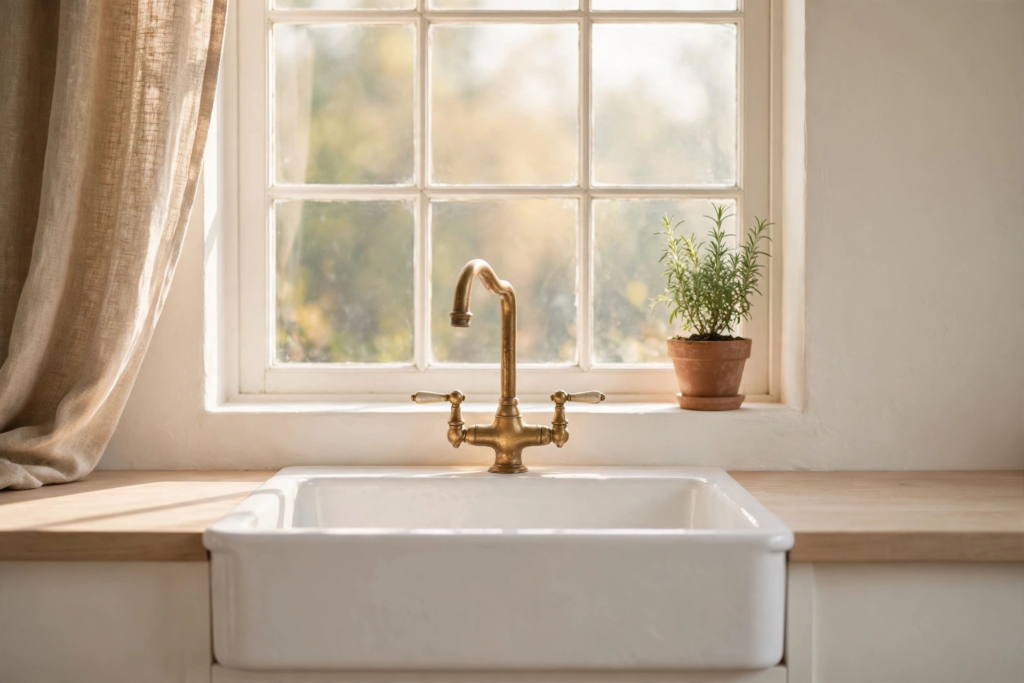
Picture the kitchen you walk into at six in the evening when the day is finally done. Something is simmering on the stove. The windows have gone gold. There is a candle lit on the counter, not for a dinner party, just because. The room smells like bread and thyme and clean linen. Nothing in it is precious. Everything in it is loved. That is the feeling we are building today.
Cottagecore gets misunderstood a lot. People hear the word and picture a costume. Bonnets. A milkmaid theme. That is not it at all. Real cottagecore is a feeling of enough. A room that looks like it was gathered slowly, by someone who cooks and means it. Cream paint with a little warmth in it. Wood that shows its age. Brass that has gone soft at the edges. Nothing matches perfectly and everything belongs.
My first principle for this whole style is simple. Gathered, not decorated. Say it with me. A cottagecore kitchen should look collected over years, not installed in a weekend. If you want the deeper foundation, my design guides walk through the palettes and materials that make this style sing.
I put together 19 ideas that build this feeling from the studs up. Some are big moves, like cabinetry and beams. Some are a single afternoon, like curtains or a new faucet. All of them lean into the same warm, muted palette. Rust, camel, oatmeal, olive, chocolate brown, soft burgundy, aged brass. Never bright. Never loud. Let us start with the bones, because a cozy room is built before it is styled.
Love these ideas? Get more every week.
Join the newsletter for seasonal decor and cozy home inspiration.
The bones: a kitchen that feels gathered, not built
Get these five right and the rest is just collecting pretty things. Cabinets, shelves, counters, the sink, the ceiling. The quiet architecture that makes everything after it easy.
1. Cream Cabinets with Aged Brass Cup Pulls
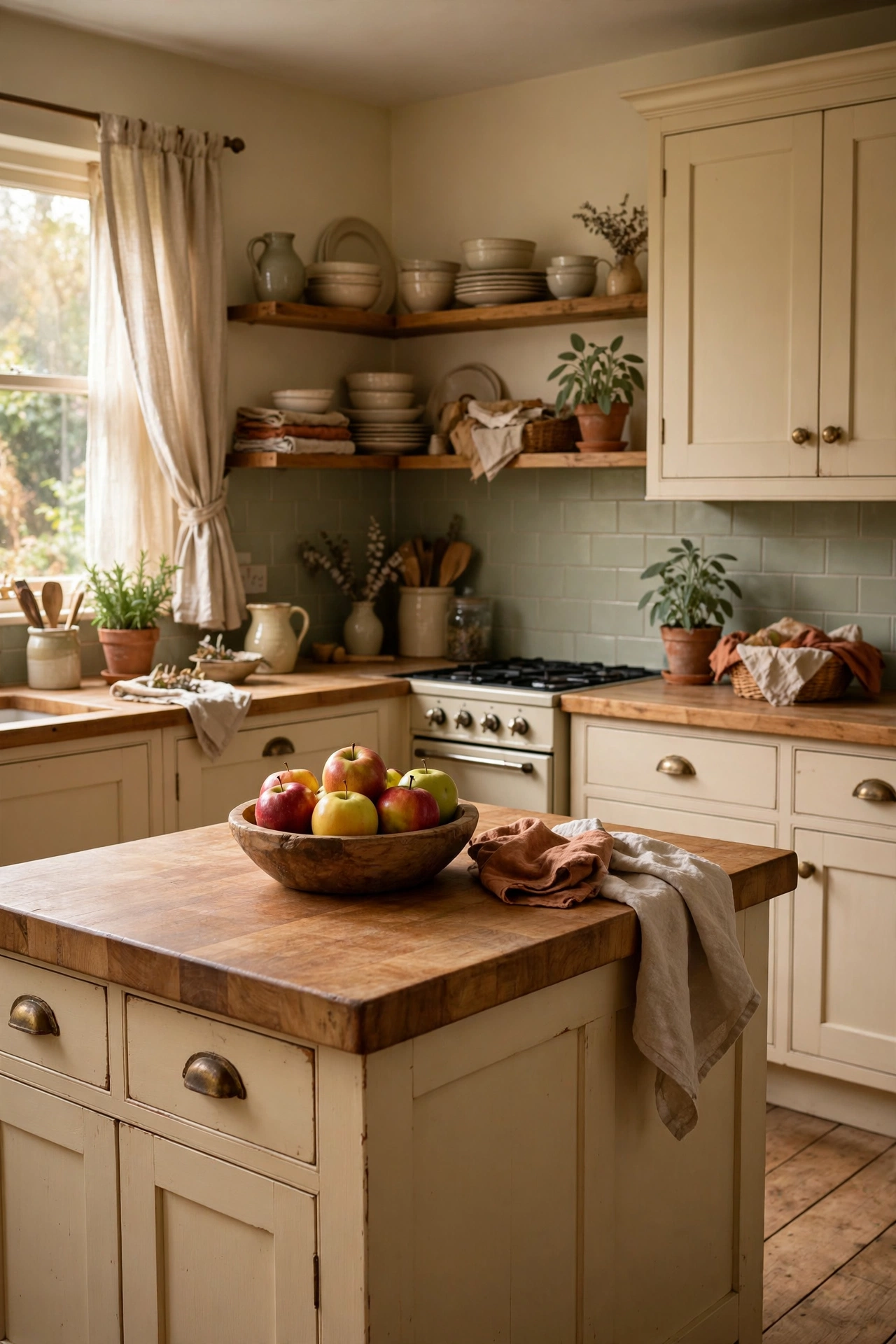
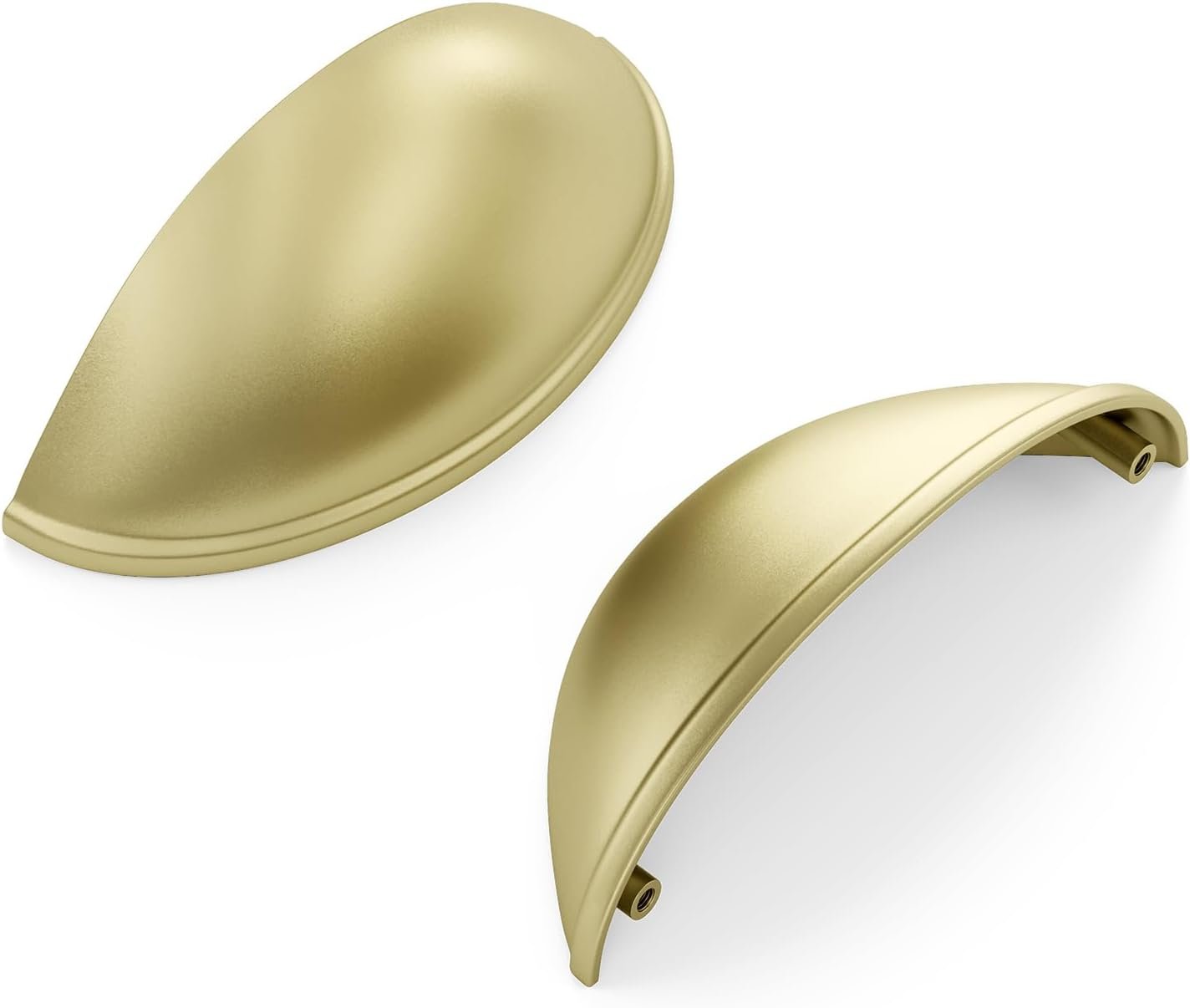
If I were starting from the studs, this is the kitchen I would build. Warm cream shaker cabinets on the perimeter, the kind of cream that leans toward butter, never toward gray. Then aged brass cup pulls on every drawer and small round knobs on the doors. Brass is the jewelry of a cottagecore kitchen. It glows in evening light in a way chrome never will. The two together are timeless in the truest sense. They looked right a hundred years ago and they will look right a hundred years from now.
Keep the uppers simple and let the island or a hutch carry the character. A butcher block top on the island warms the whole room up and gives you a work surface that forgives everything. Knife marks, flour dust, a hot pan set down too fast. Wood takes it all and looks better for it. That is the cottagecore promise. The room gets more beautiful the more you live in it.
Paint the cabinets before you do anything else. It is the single biggest shift for the money, and cream paint plays nicely with every other idea in this post.
Shop This Look
This post contains affiliate links. If you buy through them, I may earn a small commission at no extra cost to you.
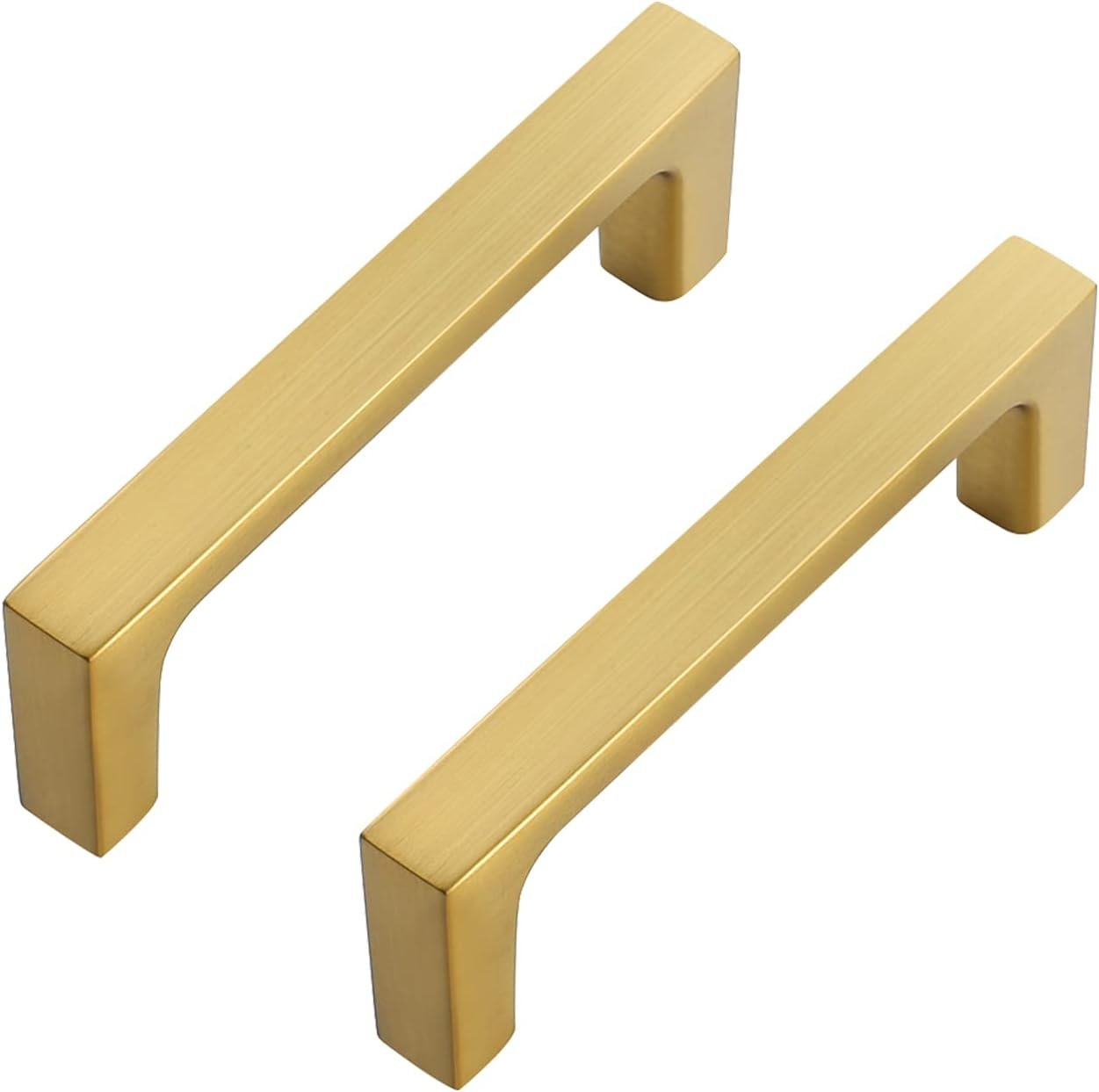
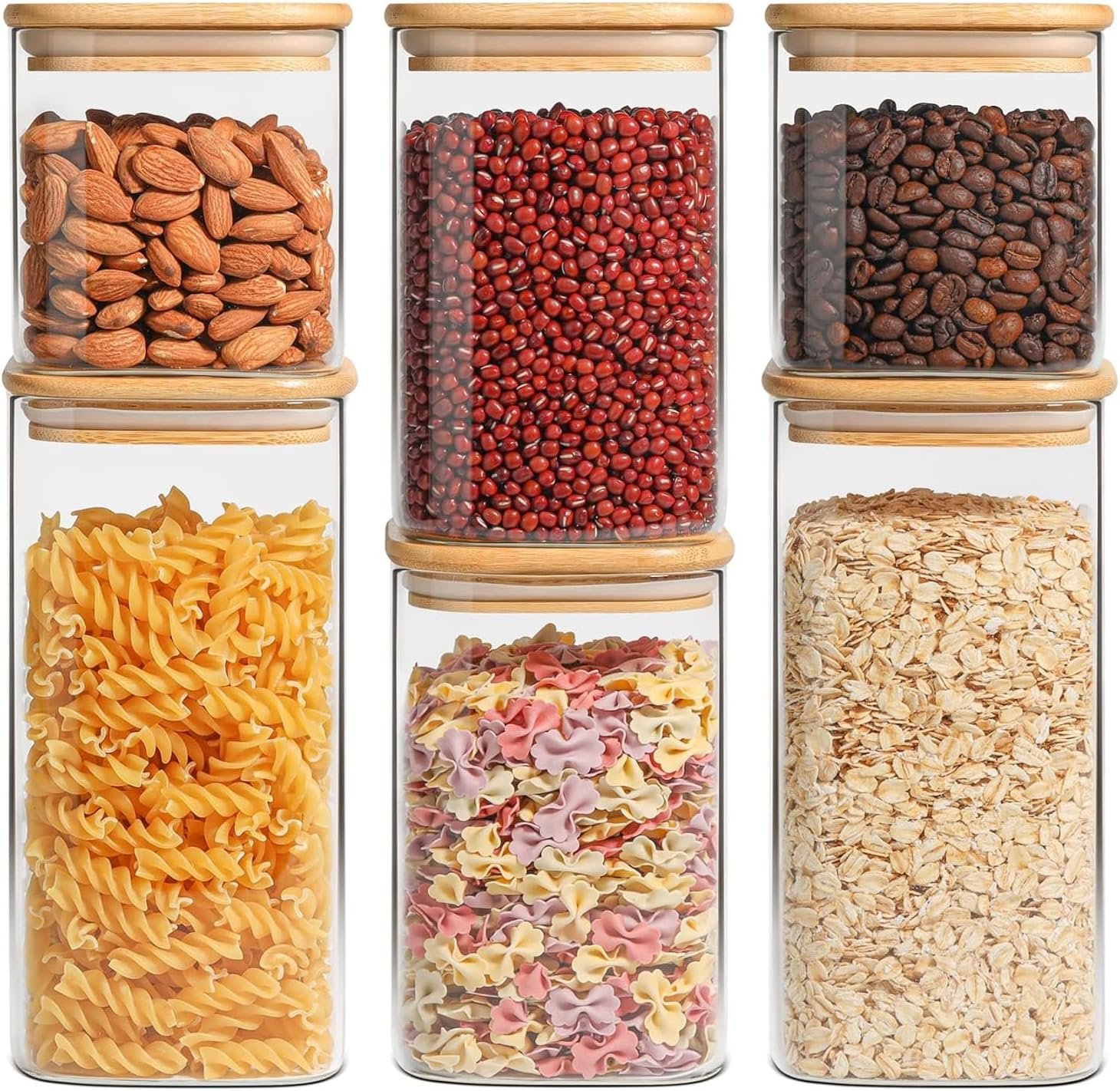
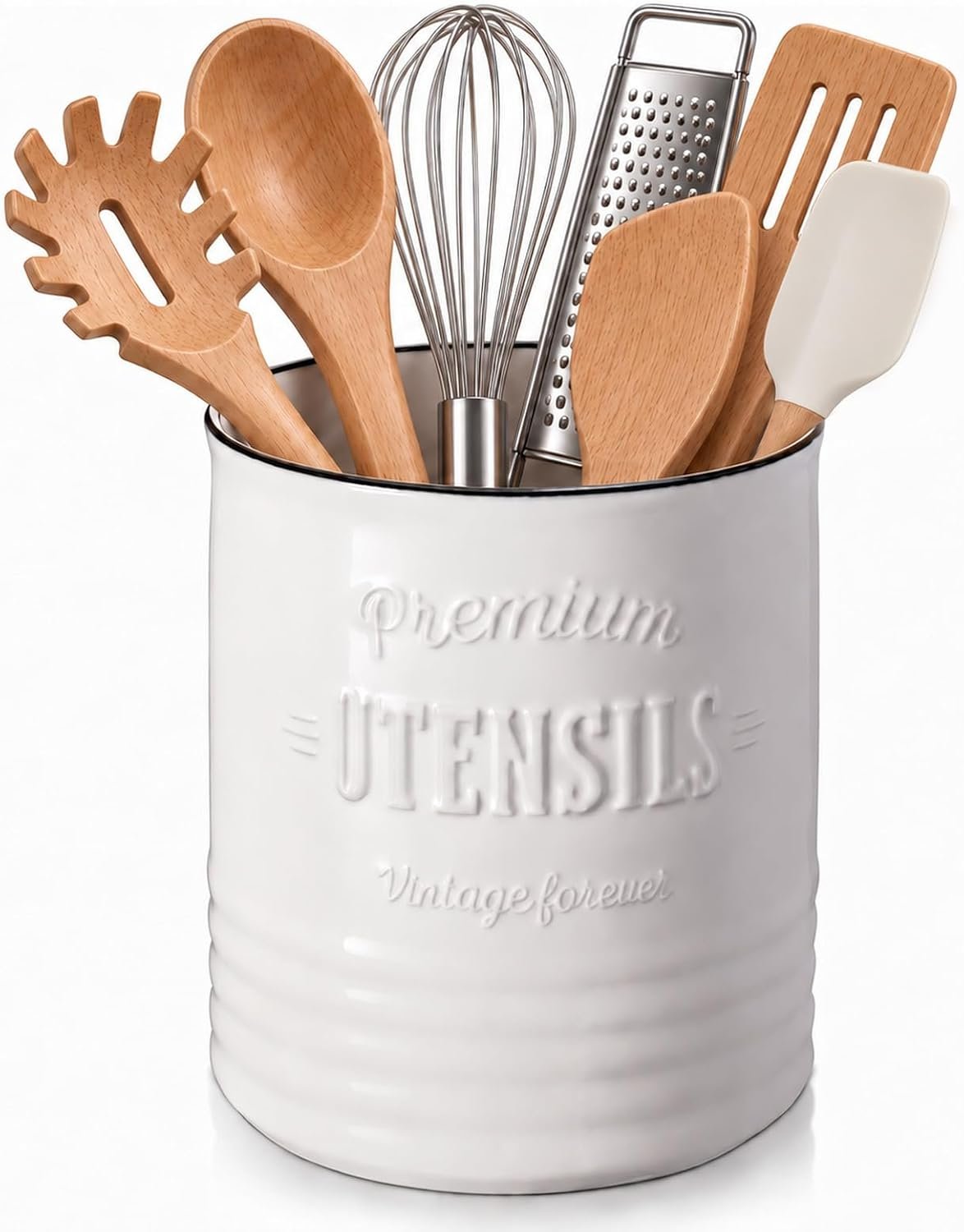
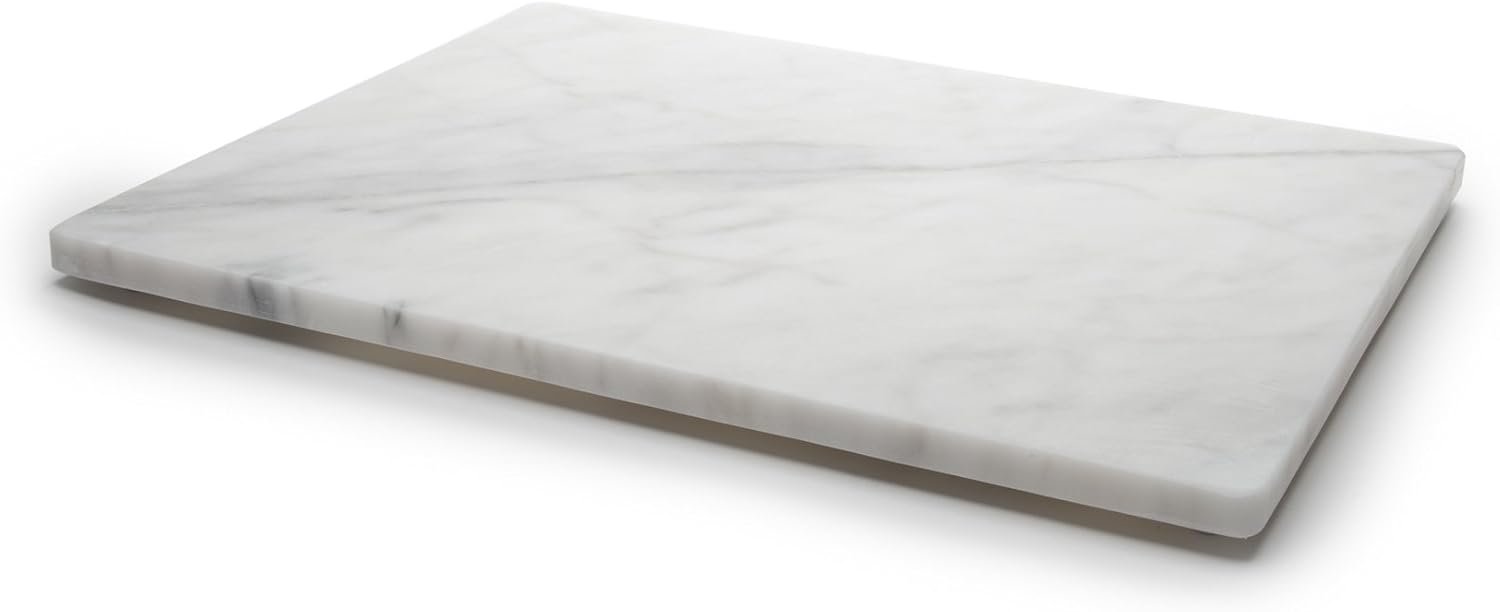
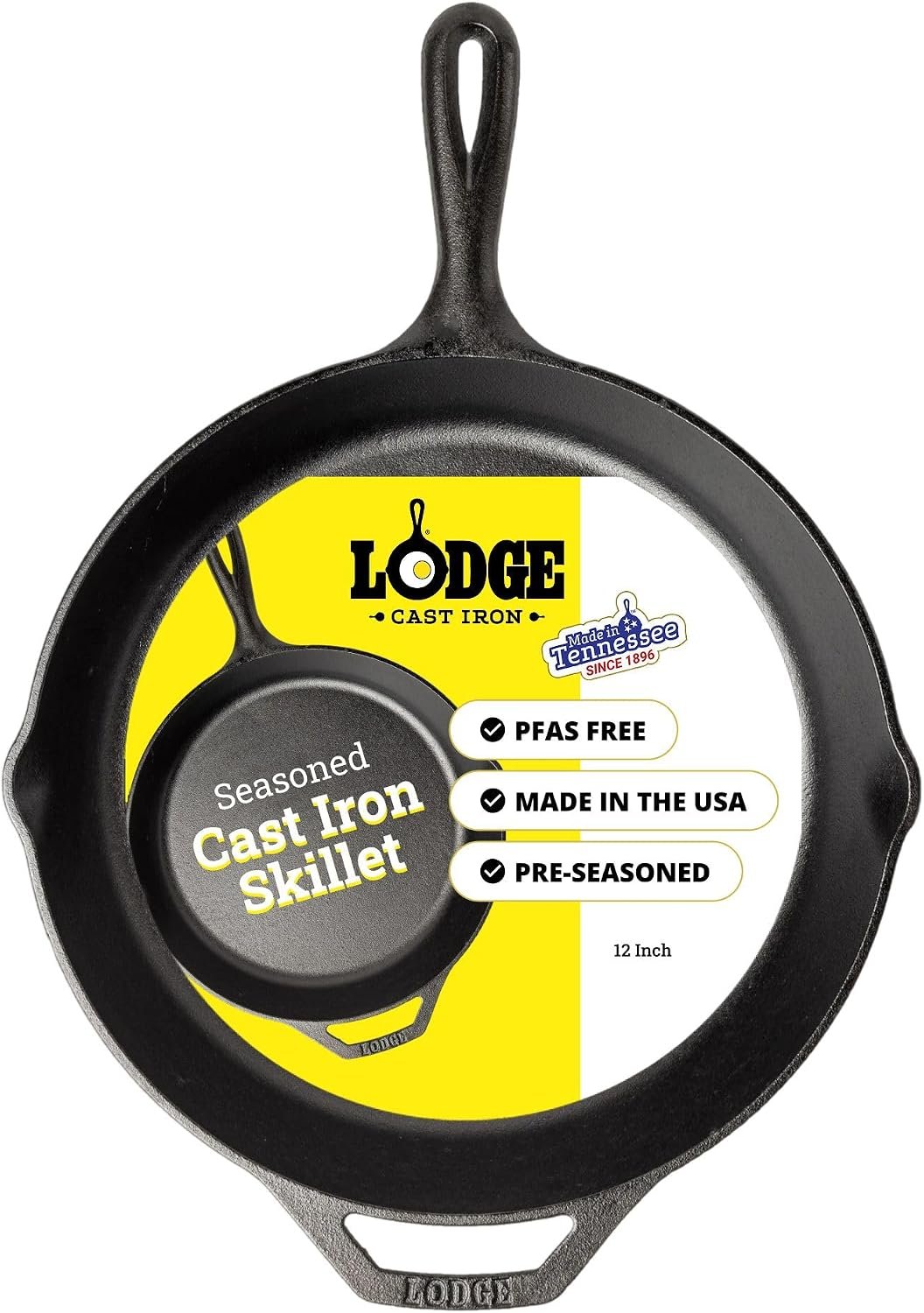
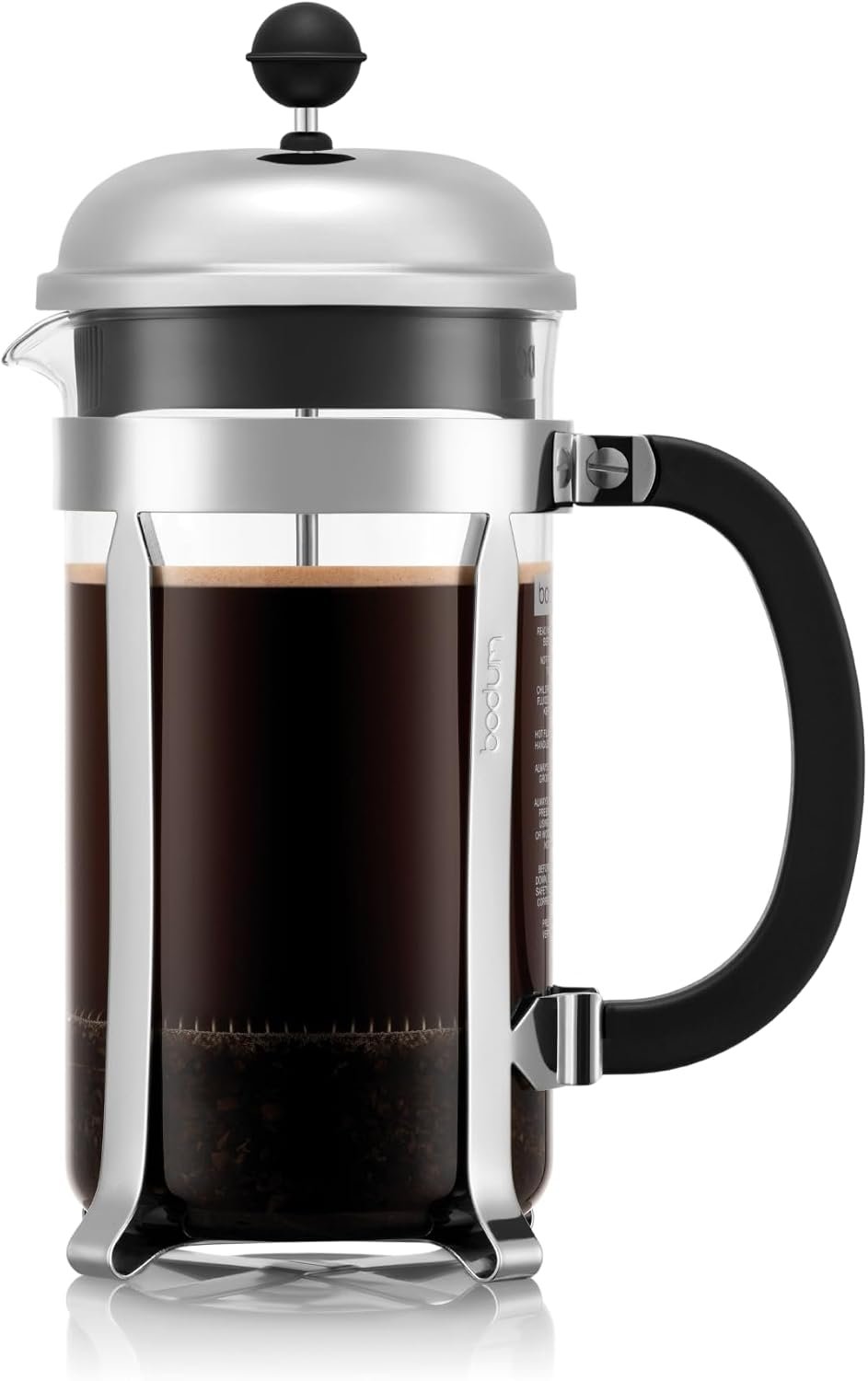
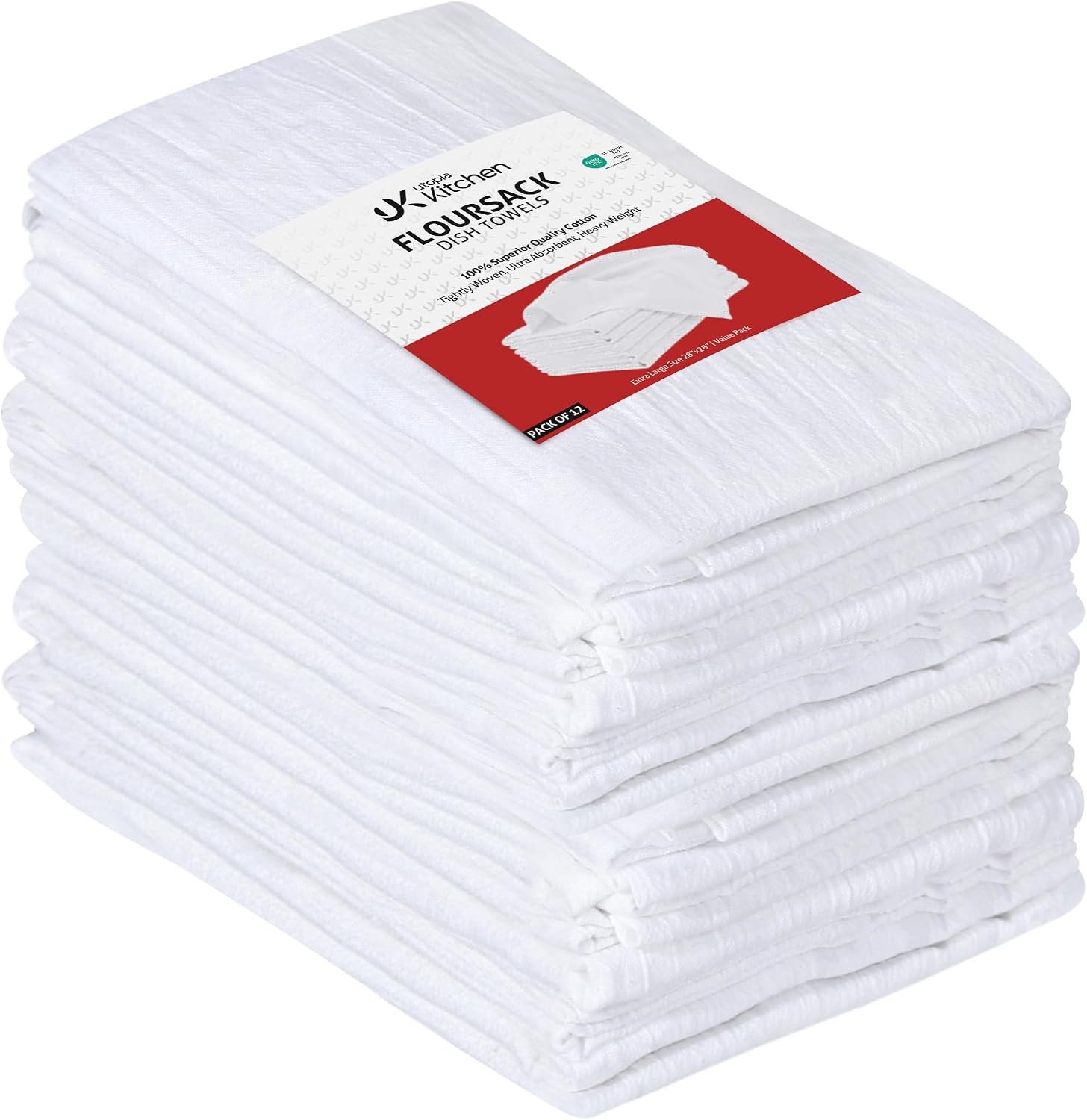
A few favorites featured in the ideas above:
2. Open Shelves Instead of Upper Cabinets
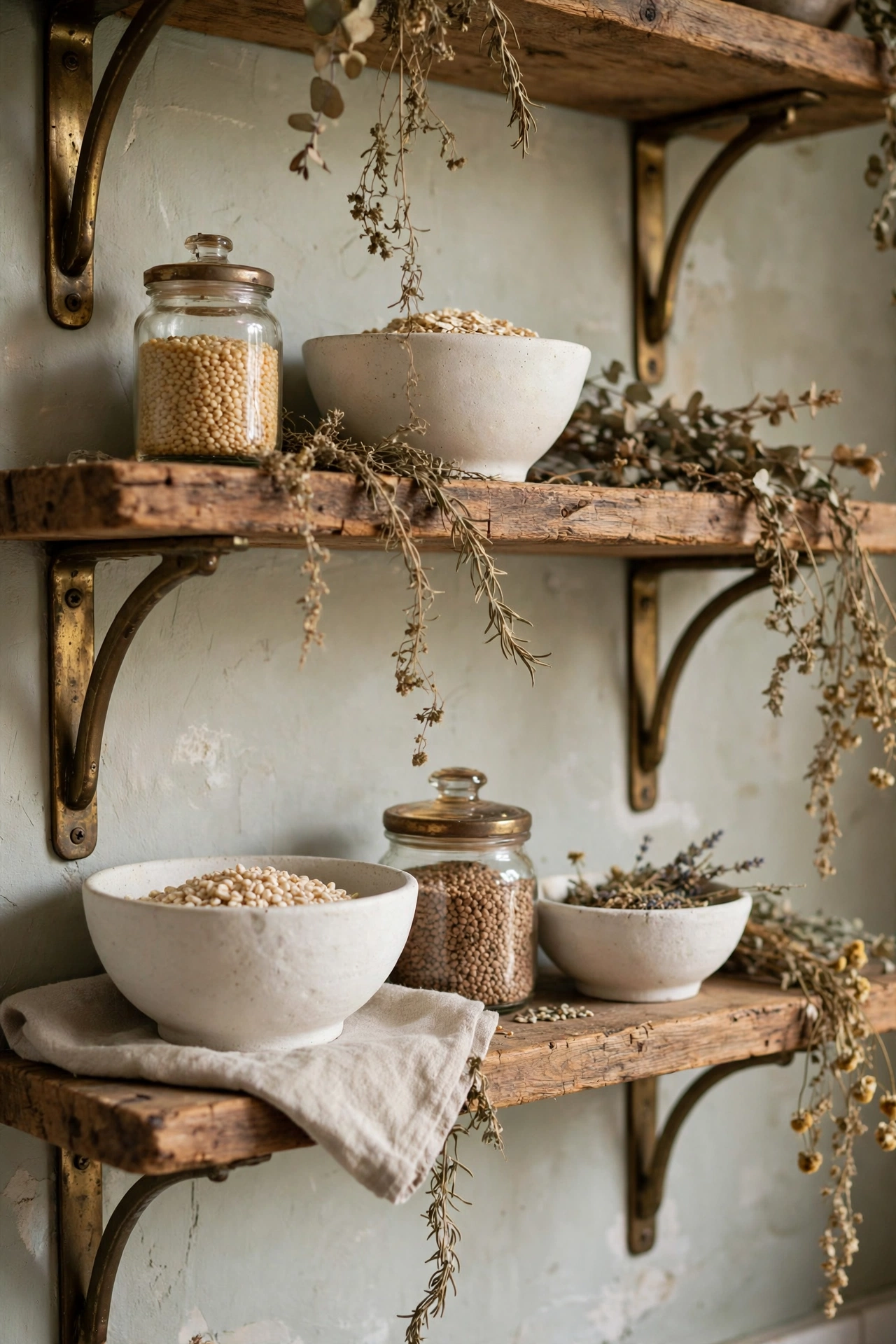
Take down half the upper cabinets. I know. Breathe. You do not need all of them, and what you gain is worth it. Open reclaimed oak shelves turn your everyday dishes into the decor. White stoneware, small glass jars, a trailing plant that is mostly surviving. It is honest. It is pretty. It costs less than new cabinets.
The trick is editing. This is not the place for the chipped mug collection and the novelty glasses. Keep the everyday things beautiful and let the rest live behind closed doors. My second principle lives here. Useful things can be the pretty things. Your mixing bowls, your wooden spoons, your stack of linen napkins. They do not need to hide.
Style the shelves the way you actually cook. Bowls near the stove. Glasses near the sink. Jars of the grains you reach for weekly. When the shelves match your habits, they stay tidy on their own.
3. Butcher Block Counters with a Past
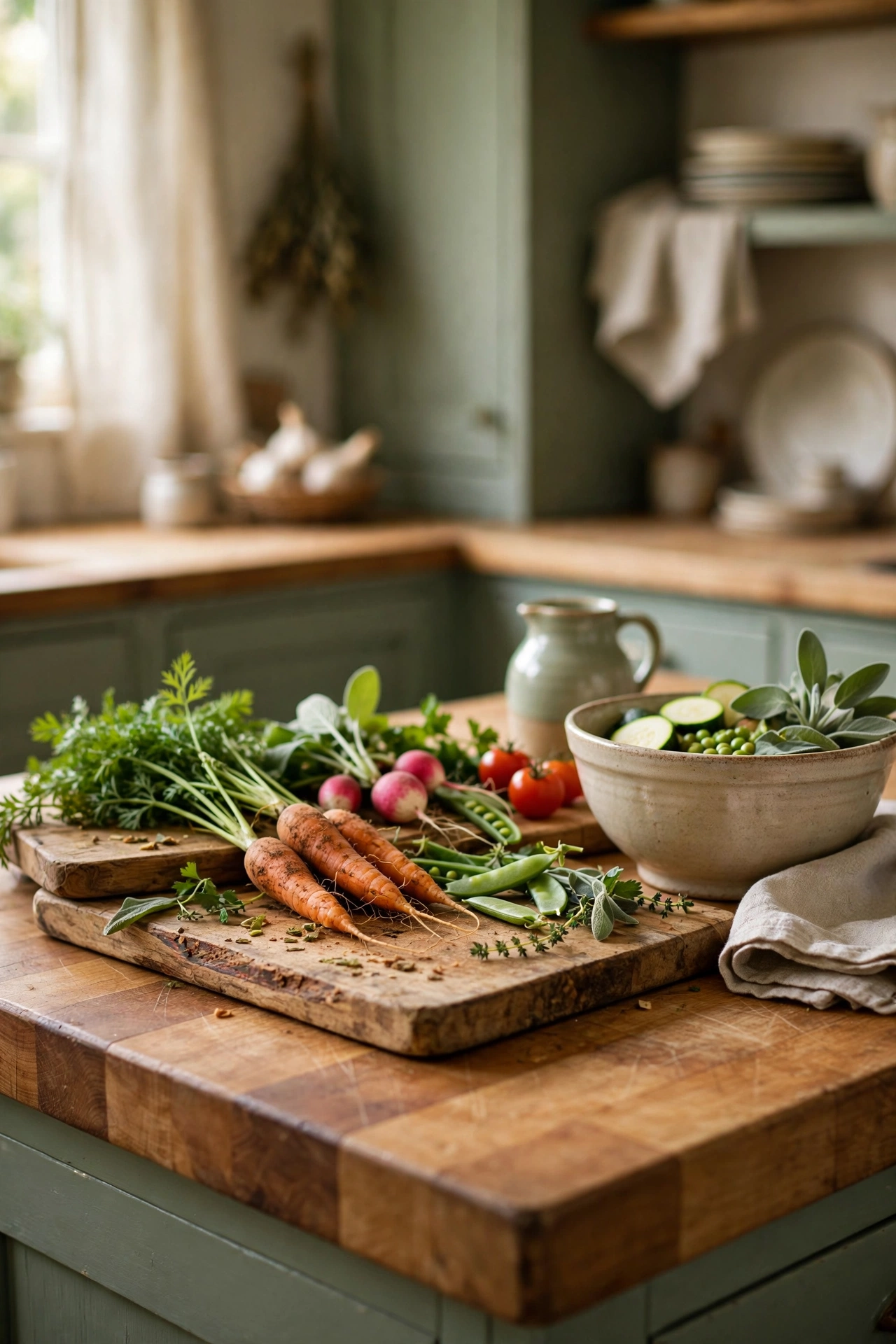
Butcher block is the most cottagecore surface that exists, and it is not close. It is warm under your hands. It smells faintly like every meal you have ever made. It scars, and the scars become the story. A stone counter wants to stay perfect. Butcher block wants to be used.
Go thick. A chunky top reads farmhouse in a way a thin one never does. Oil it regularly and it glows. Let it get a little dark around the sink and a little pale where the sun hits. That variation is not damage. That is patina, and patina is the whole aesthetic.
Pair it with almost anything. Cream cabinets, sage lowers, even a painted island in deep olive. Wood is the great peacemaker. It sits next to every color in the cottagecore palette and makes them all look intentional.
4. A Deep Farmhouse Sink with a Brass Faucet
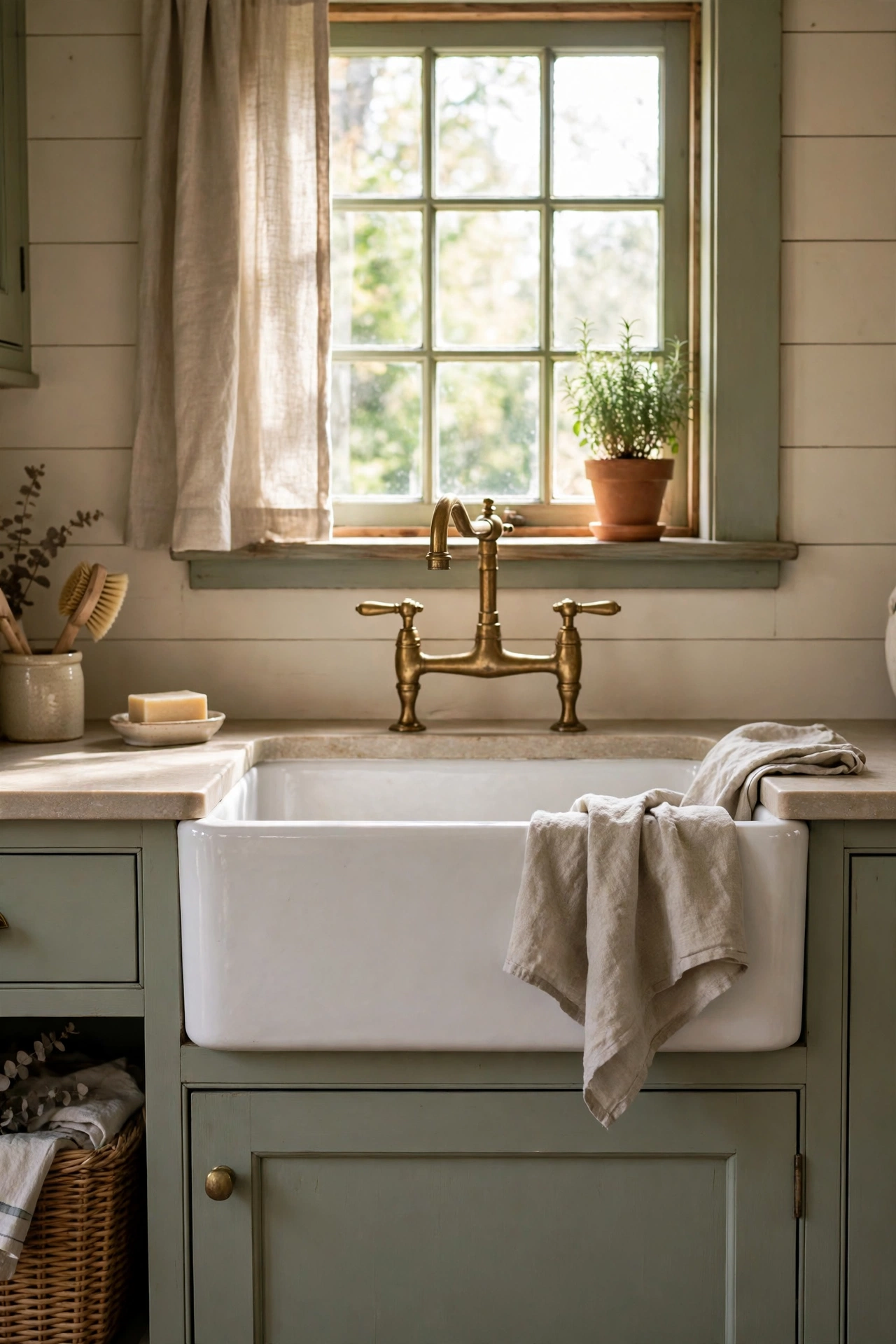
Some fixtures are just furniture that holds water. A farmhouse sink is a statement. That deep apron front, the white fireclay, the way it invites you to stand there and wash the good lettuce. Pair it with an aged brass bridge faucet and you have the hardest working pretty thing in the room.
Go deep and go single bowl. A big roasting pan should lie flat in it. A stockpot should fit under the faucet without tipping. Cottagecore is a cooking style as much as a look, and the sink has to keep up with the cooking.
Keep the styling around it minimal. A folded linen towel over the edge. A small crock of dish soap in a pretty bottle. A potted herb on the sill above. The sink is the moment. Let it have the stage.
5. Exposed Beams and a Soft Washed Ceiling
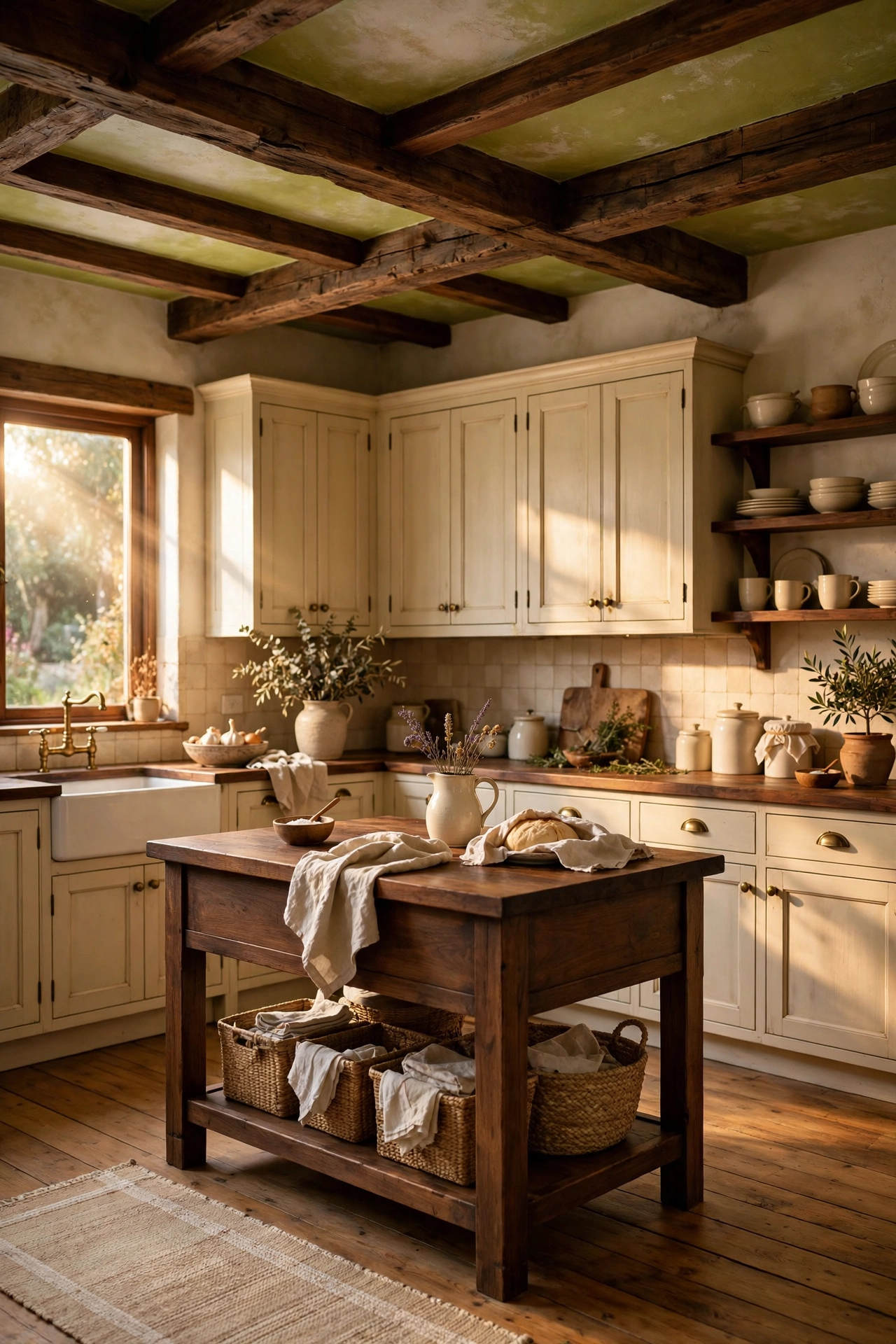
Look up. The ceiling is the most forgotten surface in the kitchen, and in a cottagecore room it can be the best one. Exposed dark wood beams against a soft washed ceiling give instant age and soul, even in a new build. They make the room feel held, like the house is hugging you a little.
You do not need structural beams to get the look. Box beams wrapped in reclaimed wood read exactly the same from below, and they weigh almost nothing. Stain them a deep walnut and wash the ceiling between them in warm white. The contrast is everything.
Keep the beams clear of decor. No hanging plants, no draped garlands as a permanent thing. Their job is architecture. A few seasonal touches are lovely, but the wood itself is the decoration.
The hearth: where the real cooking happens
A cottagecore kitchen earns the name in this section. The stove, the pots, the tools you touch every day. This is where the style stops being a look and starts being a life.
6. A Vintage Style Range as the Heart
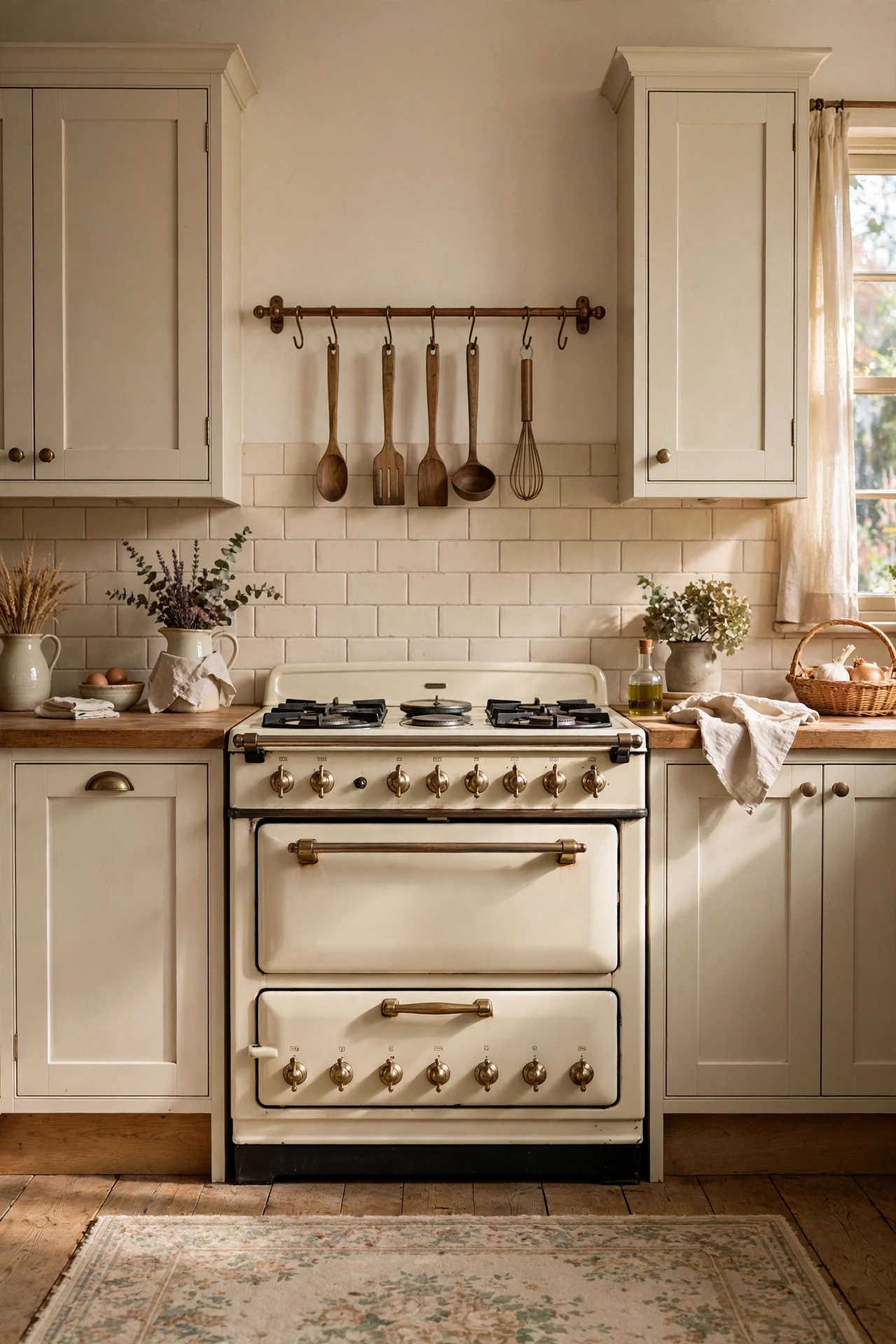
Every cottagecore kitchen needs a hearth, and in a modern house the range is it. A vintage style cooker in cream enamel, with brass details and chunky knobs, changes the whole energy of the room. It says someone cooks here. Seriously cooks. Sunday roasts. Bread on Saturdays. Soup when the weather turns.
You do not need the five figure European brands to get this look, lovely as they are. Plenty of modern ranges come in cream and soft colors with retro styling at a fraction of the price. What matters is the silhouette. Curved edges, a generous cooktop, an oven window you can peek through.
Treat the wall above it simply. A copper rail with wooden utensils. Maybe a small shelf with your most used spices. The range is the star. Everything else is the supporting cast.
7. Copper Pots on a Hanging Rail
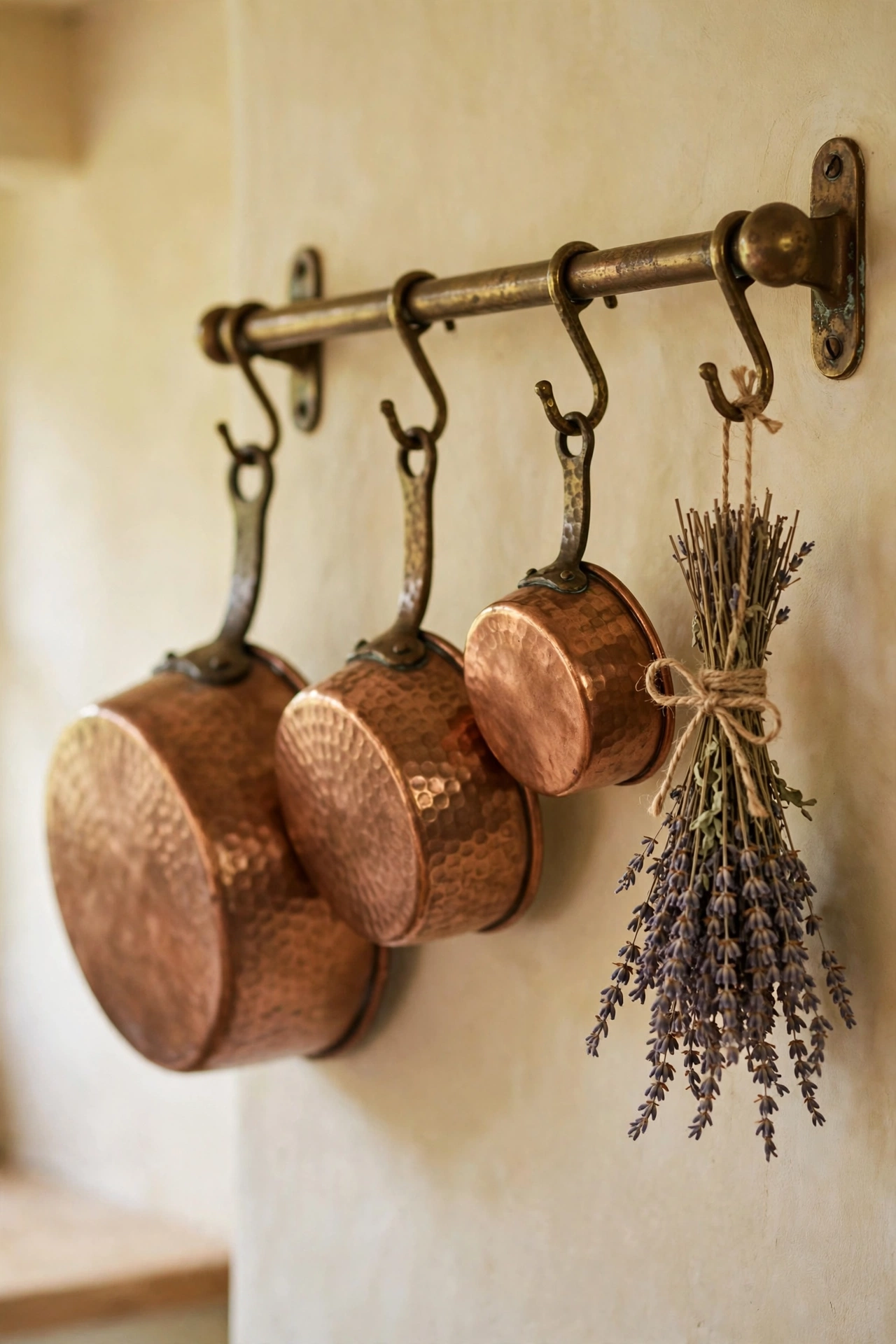
This is my favorite kind of decor. The kind you cook with. A wall mounted brass or iron rail with hammered copper pots hanging from S hooks is beautiful, useful, and so cottagecore it almost hurts. The copper glows. The shapes are sculptural. And everything is within reach when you need it.
Mix your metals with confidence. Copper pots, a brass rail, maybe an iron skillet in the mix. Cottagecore is not precious about matching. It is about warmth, and warm metals love each other. Add a bundle of dried lavender or bay tied with twine and the whole thing smells as good as it looks.
Hang what you use. If a pot has not come off the rail in six months, it is decor, not cookware, and it should go in a cabinet. The rail stays honest. That is what makes it charming.
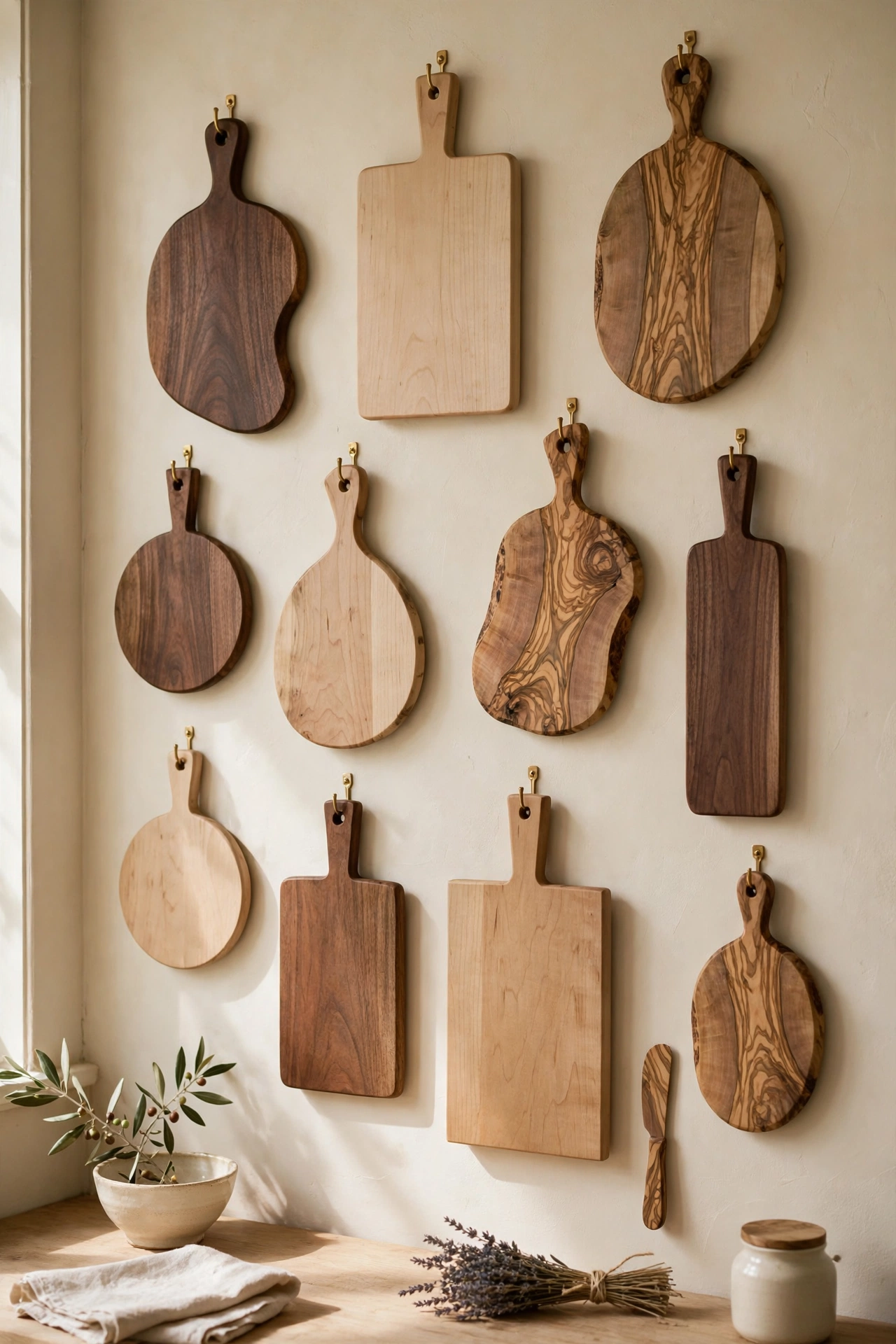
8. A Wall of Wooden Cutting Boards
Find a blank wall in your kitchen. Now cover it in wooden cutting boards. Different shapes, different woods, hung at different heights. It is the easiest art installation you will ever make, it costs almost nothing if you thrift them, and it is pure cottagecore.
The beauty is in the variety. Round boards, paddle boards, a long baguette board, one with a handle shaped like nothing you can name. Light maple next to dark walnut next to olive wood. Together they read as a collection, and collections are the soul of this style.
This works brilliantly on the wall beside the stove or on a narrow stretch between windows. Anywhere that is too small for art and too big to leave empty. Use small brass hooks or simple nails. Let the boards overlap a little. Perfect grids are for other styles.
9. Enamelware and Stoneware on Display
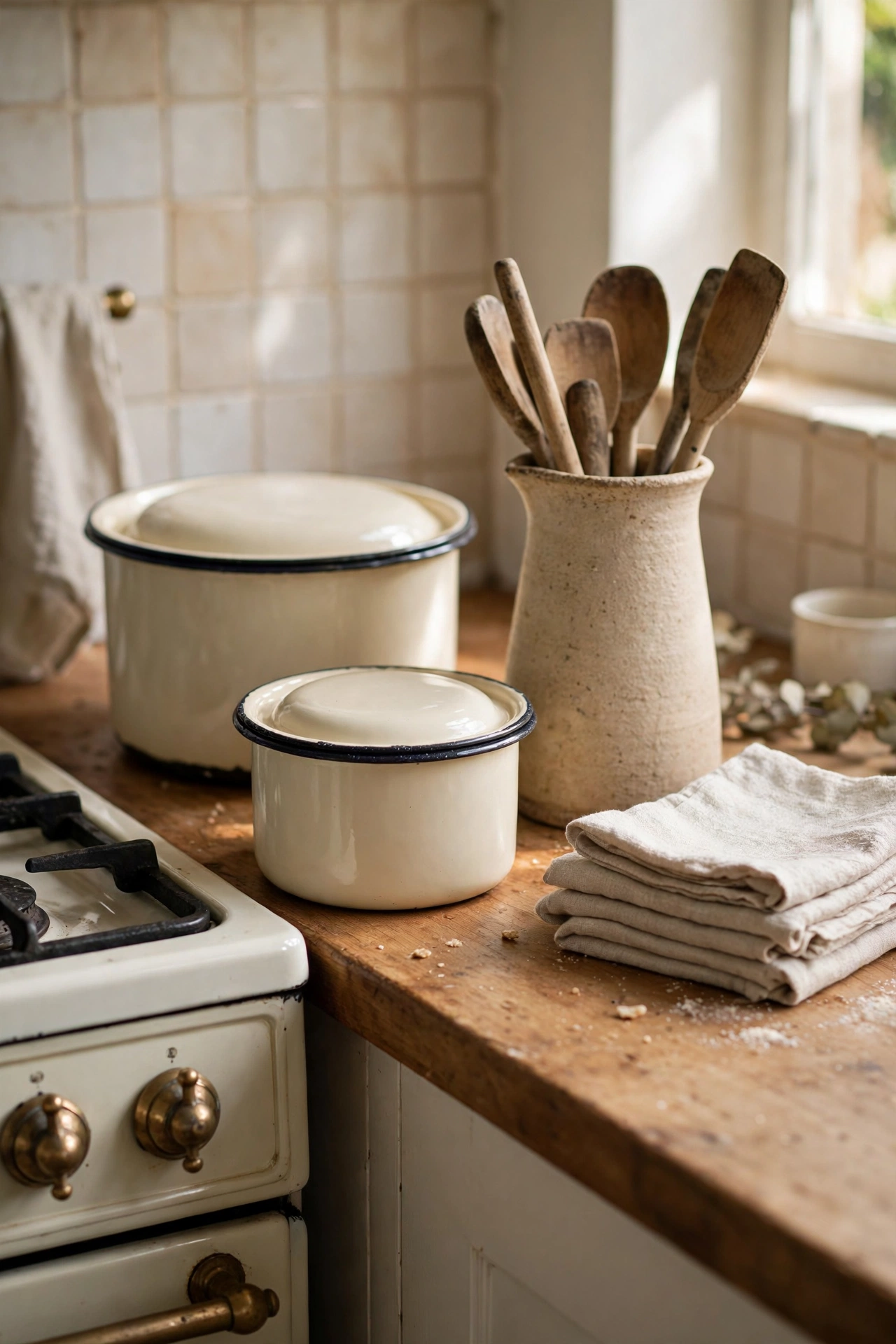
Cream enamelware with a dark rim is the unofficial mascot of cottagecore, and I am fully on board. A stack of enamel bowls, a big enamel stockpot, a stoneware pitcher that is just the right amount of imperfect. Leave them out where you can see them. They are too pretty to hide.
Group them in odd numbers near where you use them. The enamel stockpot lives by the stove. The pitcher lives on the counter with wooden spoons in it. The bowls stack on the open shelf. This is principle two again. Useful things can be the pretty things. Nothing here is just for show.
Watch the color story. Cream enamel, warm white stoneware, maybe one piece in soft sage or rust. Keep it in the muted family and the whole collection reads as one calm, collected thing.
10. A Baking Nook with a Marble Slab
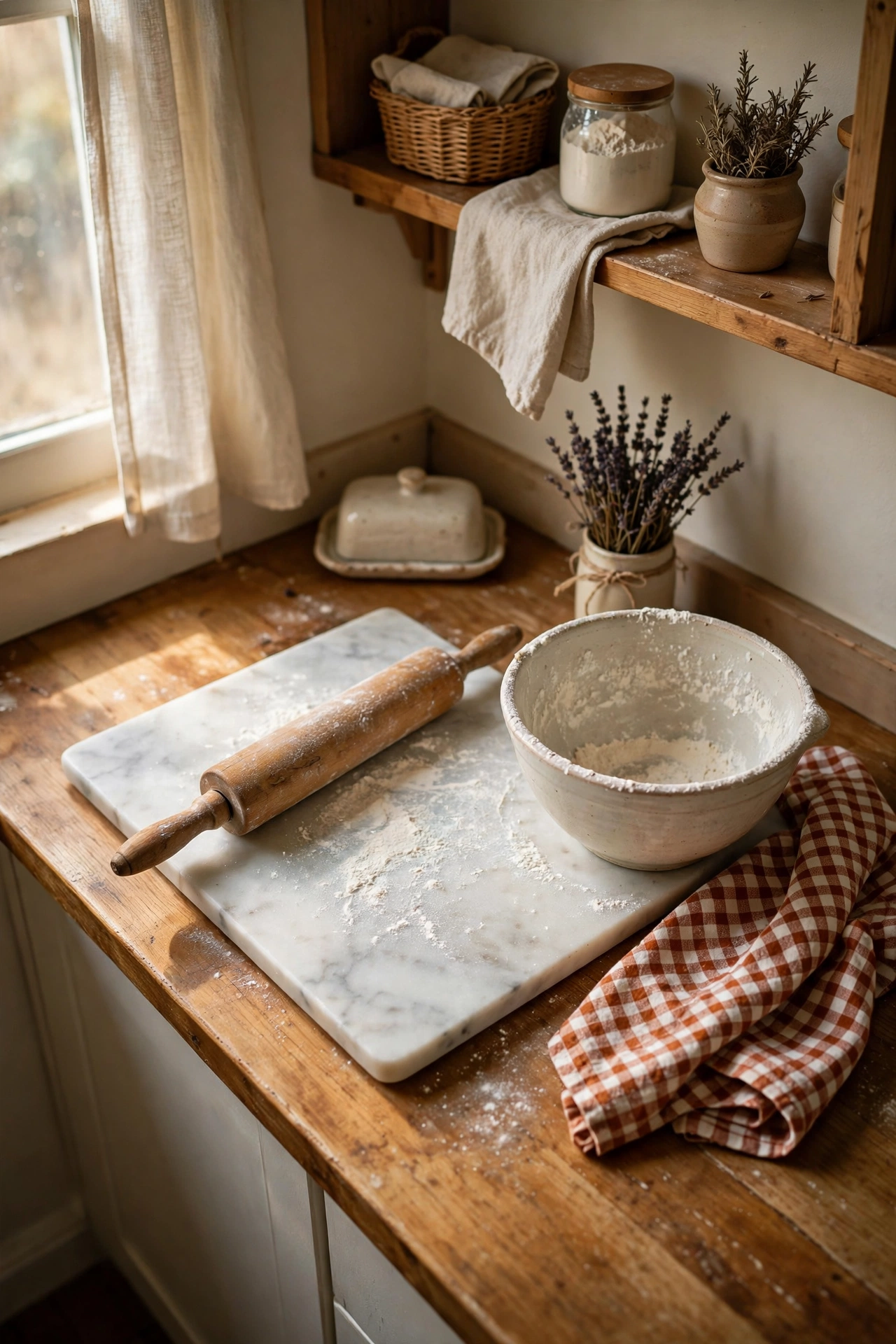
Carve out one corner for baking and the whole kitchen gets happier. It does not need to be big. A stretch of counter, a honed marble pastry slab, your rolling pin, a flour dusted bowl, a checked tea towel. That is a baking nook. It is also a still life that changes every time you use it.
Marble is the practical luxury here. It stays cool, so pastry behaves. It wipes clean in seconds. And it looks beautiful doing nothing, which is more than you can say for most countertop appliances. Tuck the stand mixer in a cabinet and let the marble have the moment.
Keep the tools visible and the ingredients close. Flour in a glass jar, sugar in another, vanilla on a tiny tray. When everything is within reach, you will actually bake on a Tuesday. That is the point.
The soft layers: table, textiles, and light
The bones are built and the hearth is lit. Now comes the part that makes a kitchen feel like a hug. The table you gather around, the fabrics that soften everything, and the light that turns it all golden.
11. A Farmhouse Table That Works as Hard as You Do
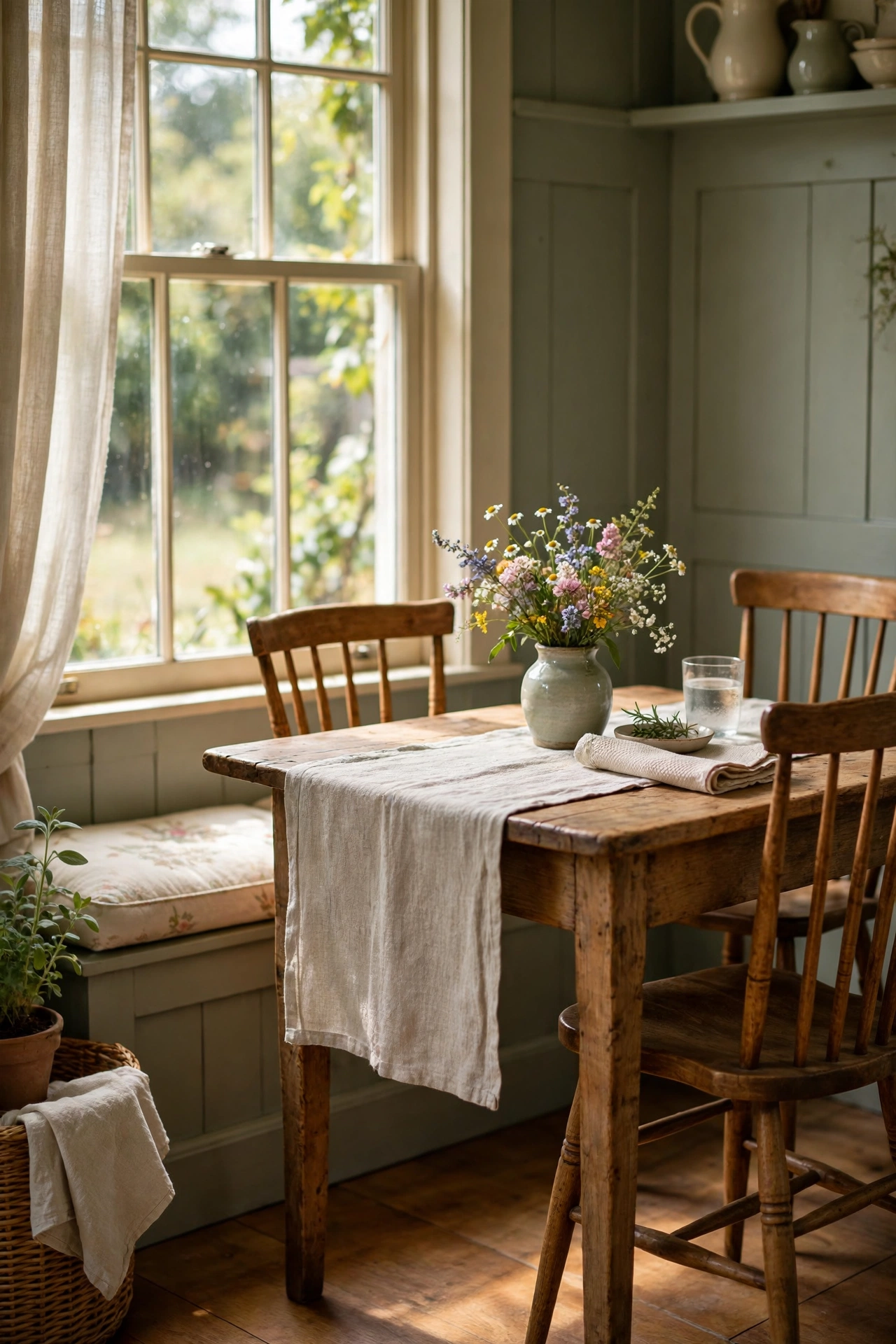
If you have the space, skip the island and put a real farmhouse table in the middle of the kitchen. A thick top, turned legs, room for six. It is a prep station, a homework desk, a place for coffee with a friend, and a dining table when the day is done. No island does all of that.
Let it show its life. Rings from hot mugs, a scratch from a school project, flour worked into the grain. My third principle lives right here. Warmth beats perfection. A table that looks brand new in a cottagecore kitchen feels like a stranger. A table with history feels like family.
Dress it simply. A linen runner down the middle, a low bowl of whatever is in season, two candlesticks for evening. It does not need a centerpiece that requires its own storage unit. The table is the centerpiece.
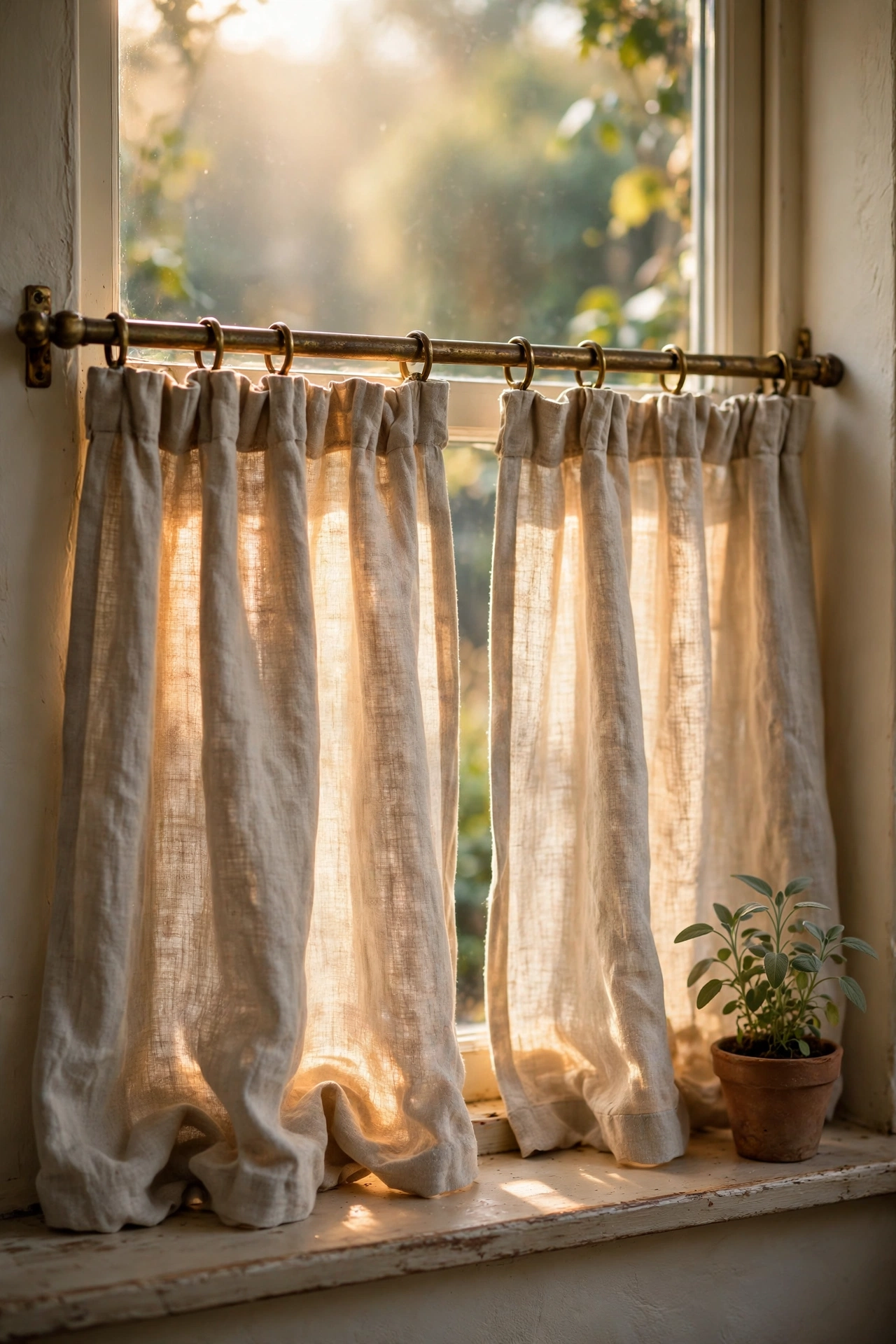
12. Linen Cafe Curtains on a Brass Rod
Full length curtains in a kitchen are a mistake. They catch cooking smells and block the light you actually want. Cafe curtains are the answer. They cover the lower half of the window for privacy, leave the top open for sky, and flutter in the loveliest way when the window is cracked.
Natural linen in oatmeal or warm white is the only choice that matters. It filters light into something golden and soft. Hang them on an aged brass rod with simple rings. No valance, no tiebacks with tassels, no fuss. The fabric is the decoration.
This is a Saturday morning project with an outsized payoff. Measure twice, hem once, and every breakfast gets better. I am not exaggerating. Light through linen is a different substance than light through bare glass.
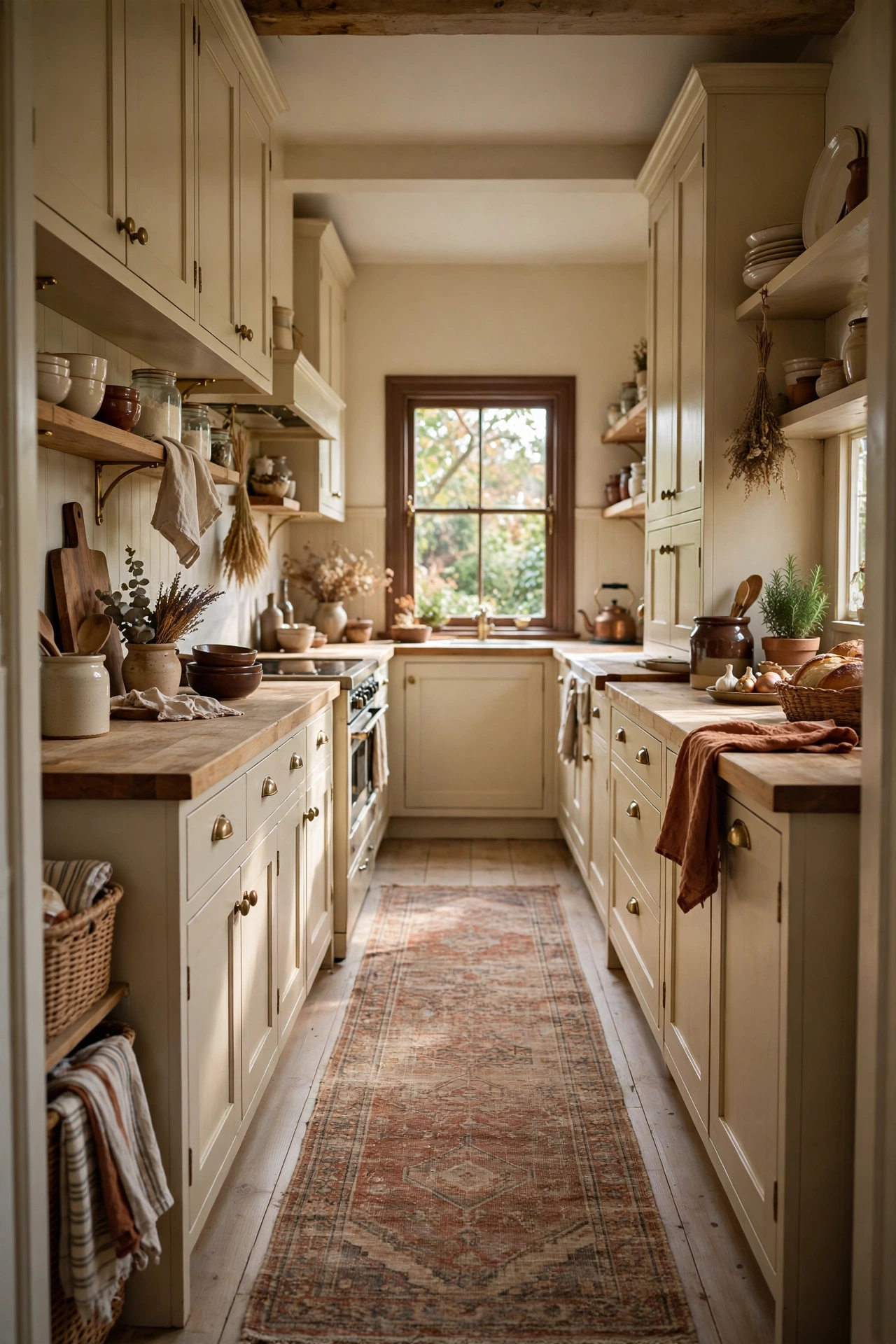
13. A Vintage Runner Down the Galley
A long kitchen gets a long rug. A faded vintage runner in rust, oatmeal, and soft burgundy down the middle of a galley kitchen does three jobs at once. It warms up hard floors, it protects them from the daily traffic, and it adds pattern in the most cottagecore way possible.
Go for the genuinely worn look. Faded is a feature here, not a flaw. The low pile of a real vintage rug handles kitchen life better than anything new and plush. Crumbs shake out. Spills blot up. And every mark just joins the pattern.
Size it right. The runner should run almost the full length of the cabinetry, leaving a few inches of floor at each end. Too short looks like an afterthought. Almost full length looks intentional and generous.
14. Layered Light for Slow Evenings
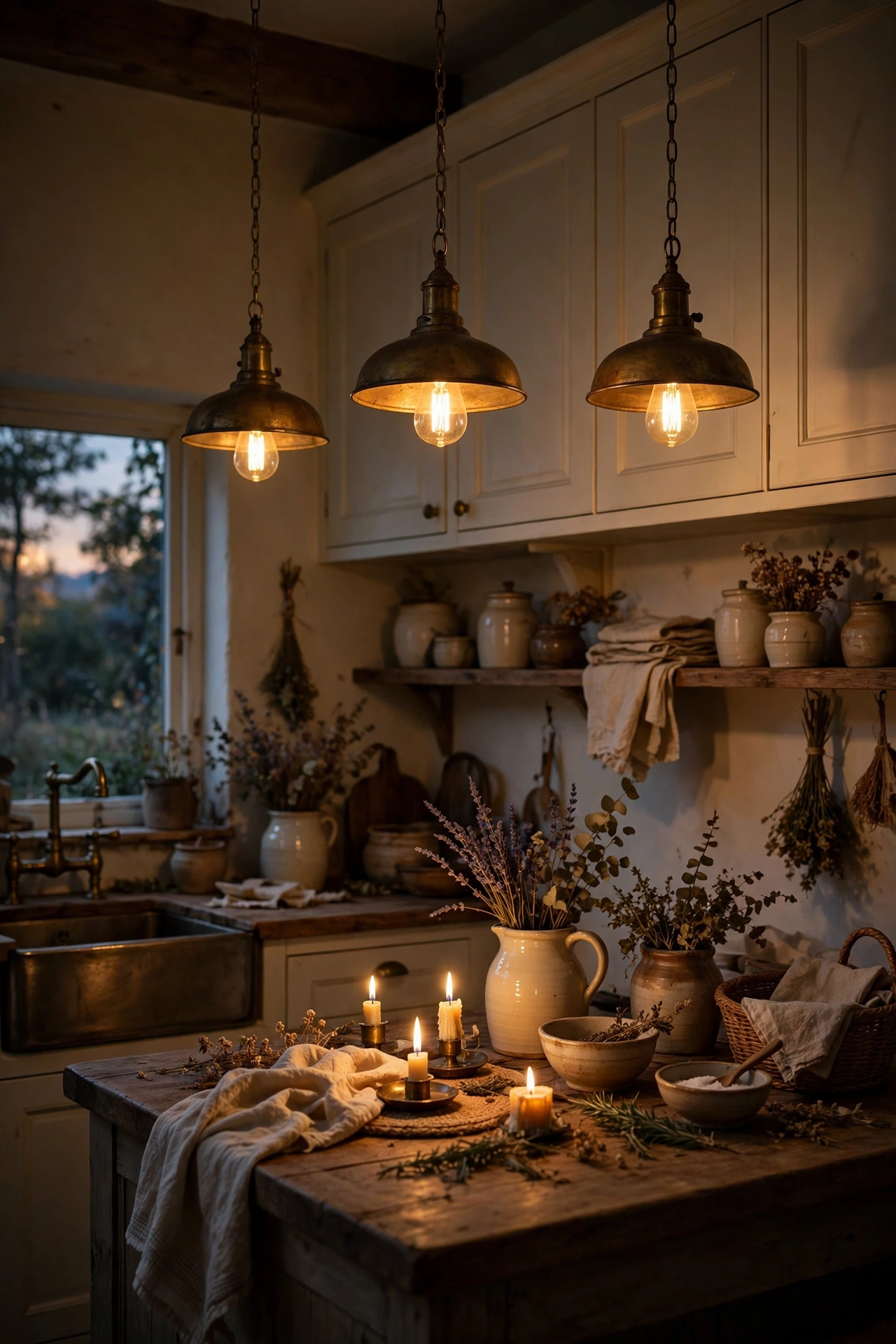
Overhead lighting is for surgery. A cottagecore kitchen at night should glow. Layer it. Warm pendants over the island or table, a small lamp on the counter, candles where it is safe. Three sources at different heights and the room turns to honey.
This matters more than almost any decor choice. Harsh white downlights will undo every warm thing you have done. Swap the bulbs first. Warm white, 2700 Kelvin or lower, everywhere. It is the cheapest transformation in this entire post.
Add the human touches. A candle on the windowsill. A little brass lamp in the corner that you switch on at dusk. Light is not just illumination here. It is the mood, the ritual, the signal that the day is done and the evening is yours.
15. A Freestanding Hutch for the Pretty Storage
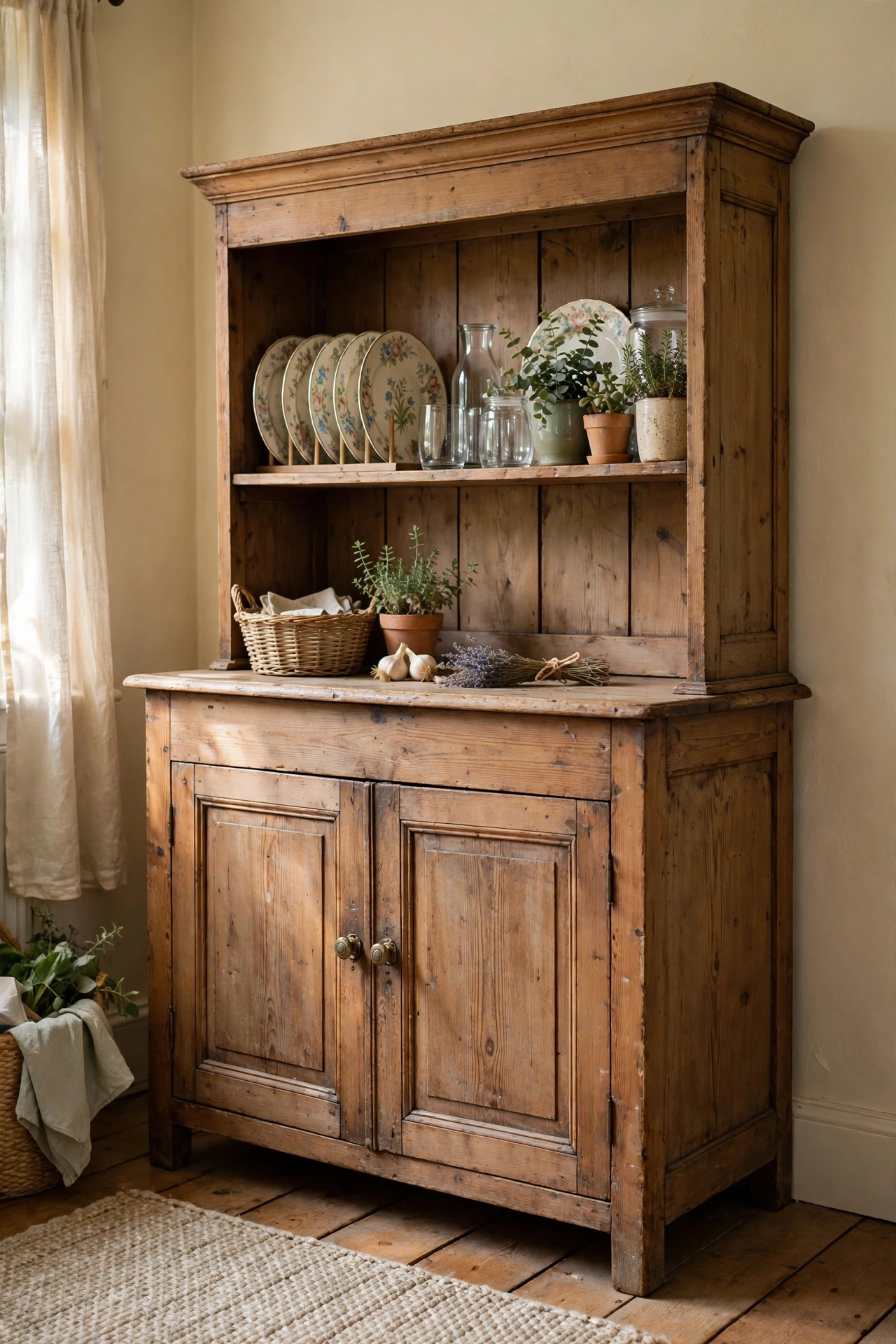
Built in cabinets are fine, but a freestanding hutch has a soul. An antique pine hutch in the corner, styled with floral plates and clear glassware and small potted plants, gives the kitchen something no built in ever can. Furniture energy. The sense that this piece has lived other lives.
Style it like a shop display you would actually buy from. Plates standing in a row on the plate groove. Glasses grouped by type. A trailing plant on top that softens the line where the hutch meets the ceiling. Leave some breathing room. Crammed shelves read as storage. Spaced shelves read as styling.
Paint it or leave it wood. A hutch in soft sage or warm cream is lovely. A hutch in old pine with the finish worn at the edges is lovelier. Either way, it should look like it was found, not ordered.
The finishing touches: small things that sing
The room is built, the hearth is warm, the layers are soft. Now the details that make people walk in and say oh, this is lovely, without knowing exactly why.
16. Herbs and Flowers Hung to Dry
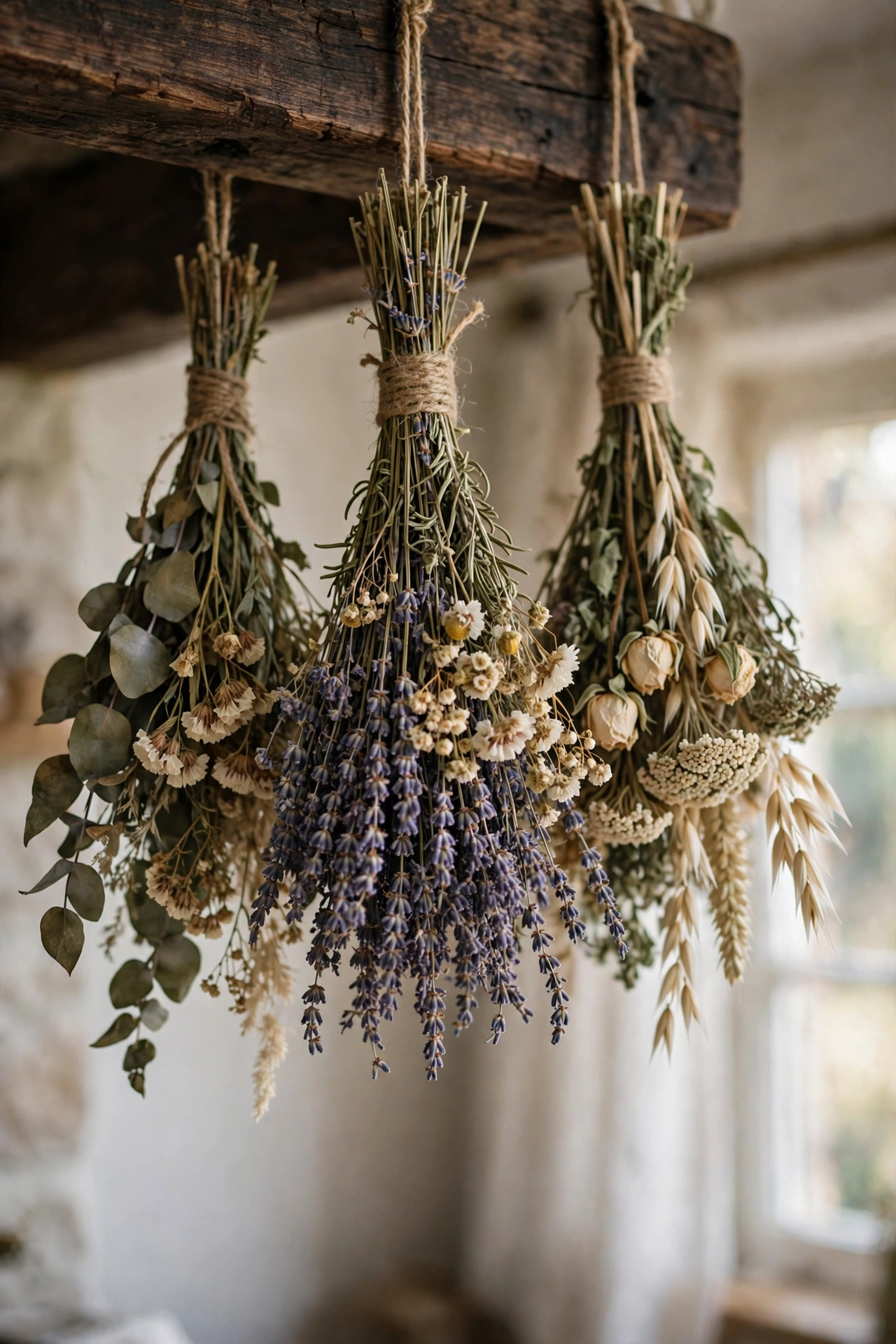
Tie it with twine and hang it from a beam. That is the whole idea, and it might be my favorite one. Bundles of herbs and garden flowers drying upside down from a wooden beam or a simple wall hook. It is decor you can cook with later. It smells wonderful while it dries. It costs nothing if you grow it.
Lavender, bay, thyme, oregano. Little bunches of chamomile or yarrow from the garden. Hang them where air moves but sun does not blast them. A beam over a side counter is perfect. In two weeks you have dried herbs and the prettiest installation in the house.
Replace them as you use them. That is the rhythm of a cottagecore kitchen. Nothing is permanent. Everything cycles. The room stays alive because you keep touching it.
17. Fresh Flowers on the Sill, Always
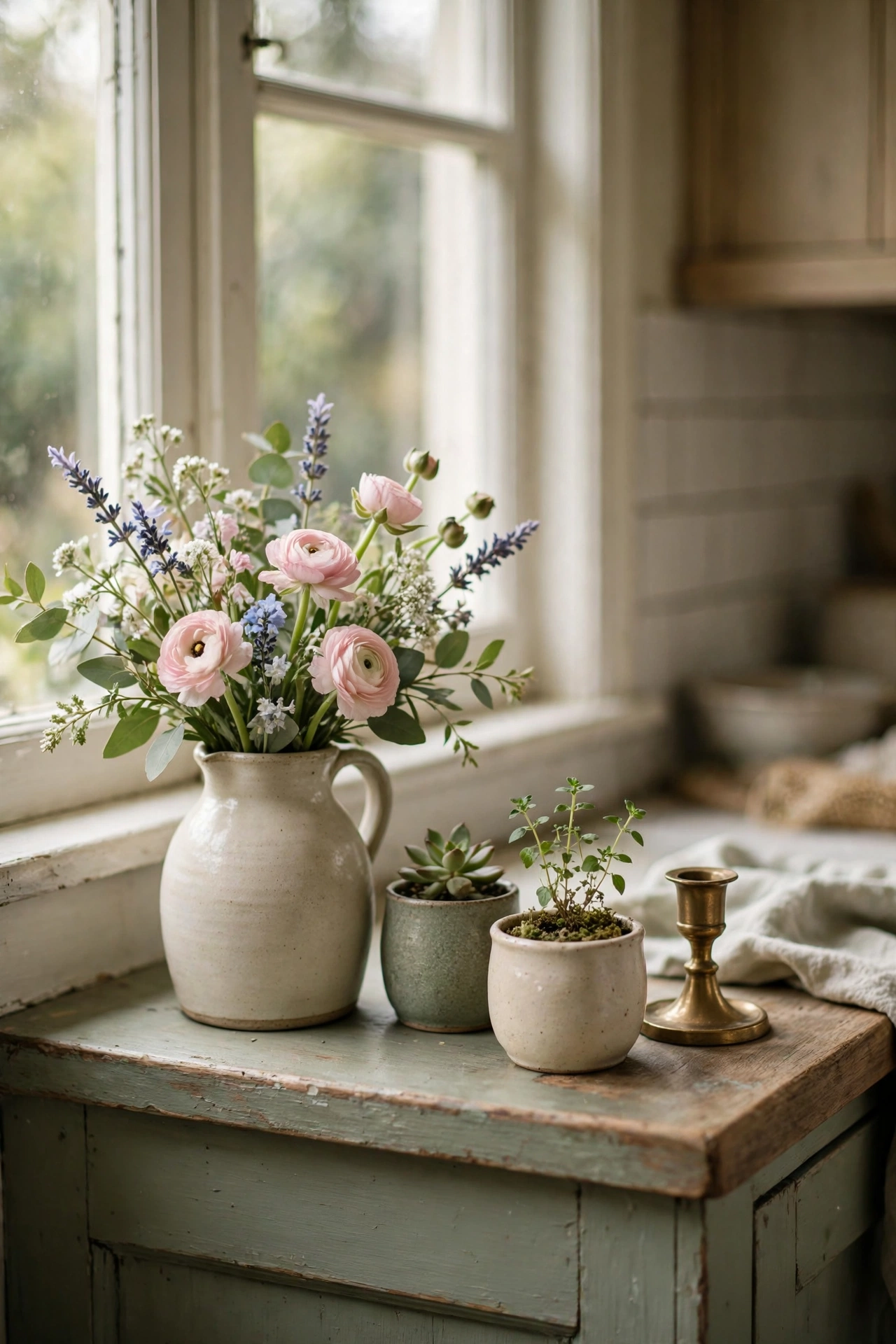
This is the smallest idea in the post and maybe the most powerful. Always have something alive on the windowsill. A little jug of garden flowers. A pot of basil doing its best. A sprig of eucalyptus in a tiny brass vase. Living things change the feeling of a room more than any object can.
You do not need a flower budget. Grocery store stems split across three small vessels look more cottagecore than one big expensive bouquet. Snips from the garden in a jam jar are perfect. In winter, a branch of anything green in water reads just as lovely.
Make it a ritual. Sunday morning, fresh water, whatever is blooming or interesting. Two minutes. The kitchen notices, and so do you.
18. A Pantry Wall of Glass Jars
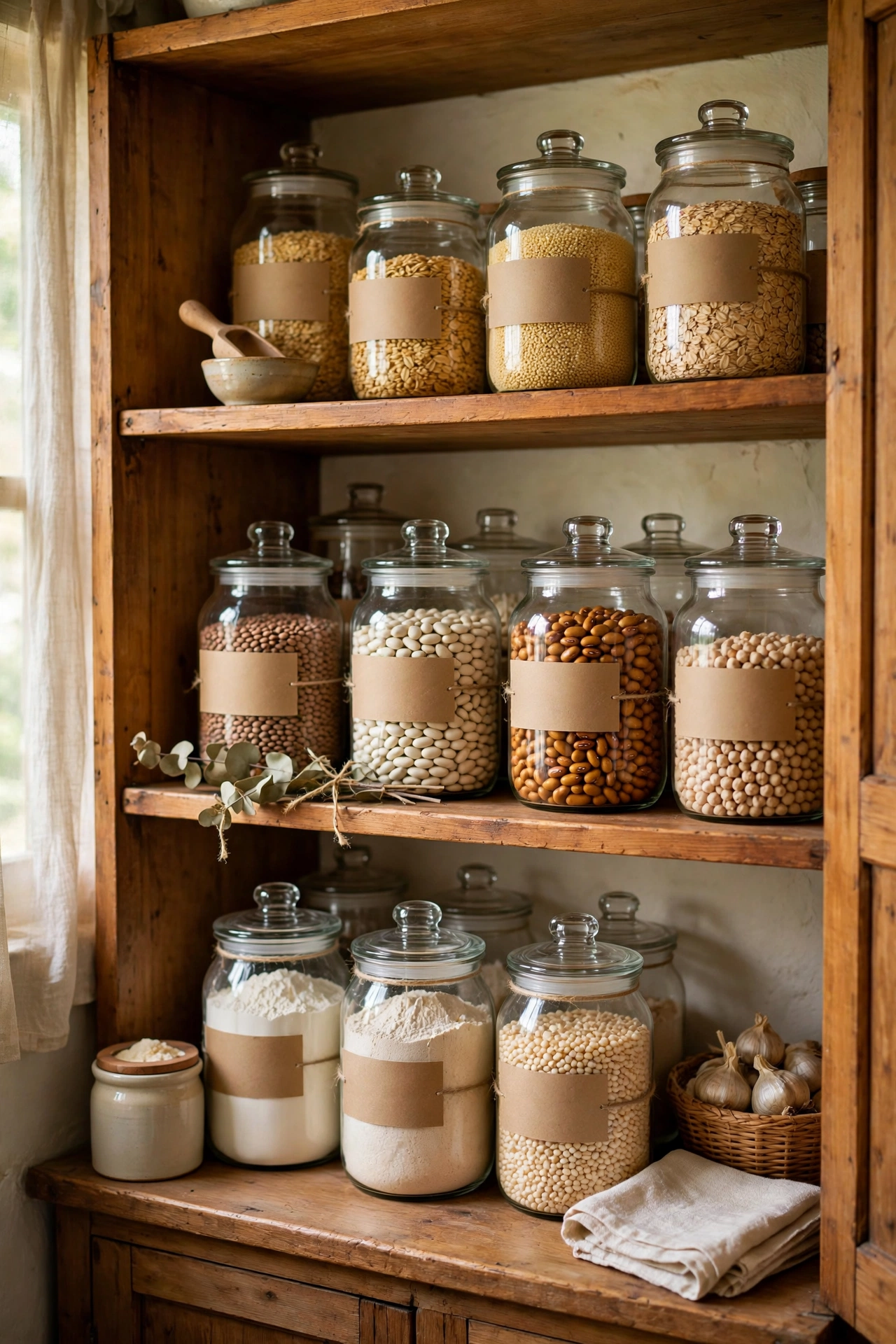
Decant everything. Flour, sugar, rice, lentils, oats, the good salt. Glass jars with simple labels turn a pantry wall or a stretch of open shelving into the most satisfying thing to look at in the house. It is organization as decor, and it is so cottagecore.
Use jars you already have. Mason jars, old pickle jars with the labels soaked off, a few pretty ones with wooden lids for the things you reach for daily. Uniform is nice but not required. The contents are the color story. Golden oats, amber lentils, cream flour. Nature did the styling.
Label simply. Kraft paper tags with twine, or a grease pencil right on the glass. Nothing fussy. You should be able to read it from across the room while holding a wooden spoon.
19. A Little Tea Corner for Slow Mornings
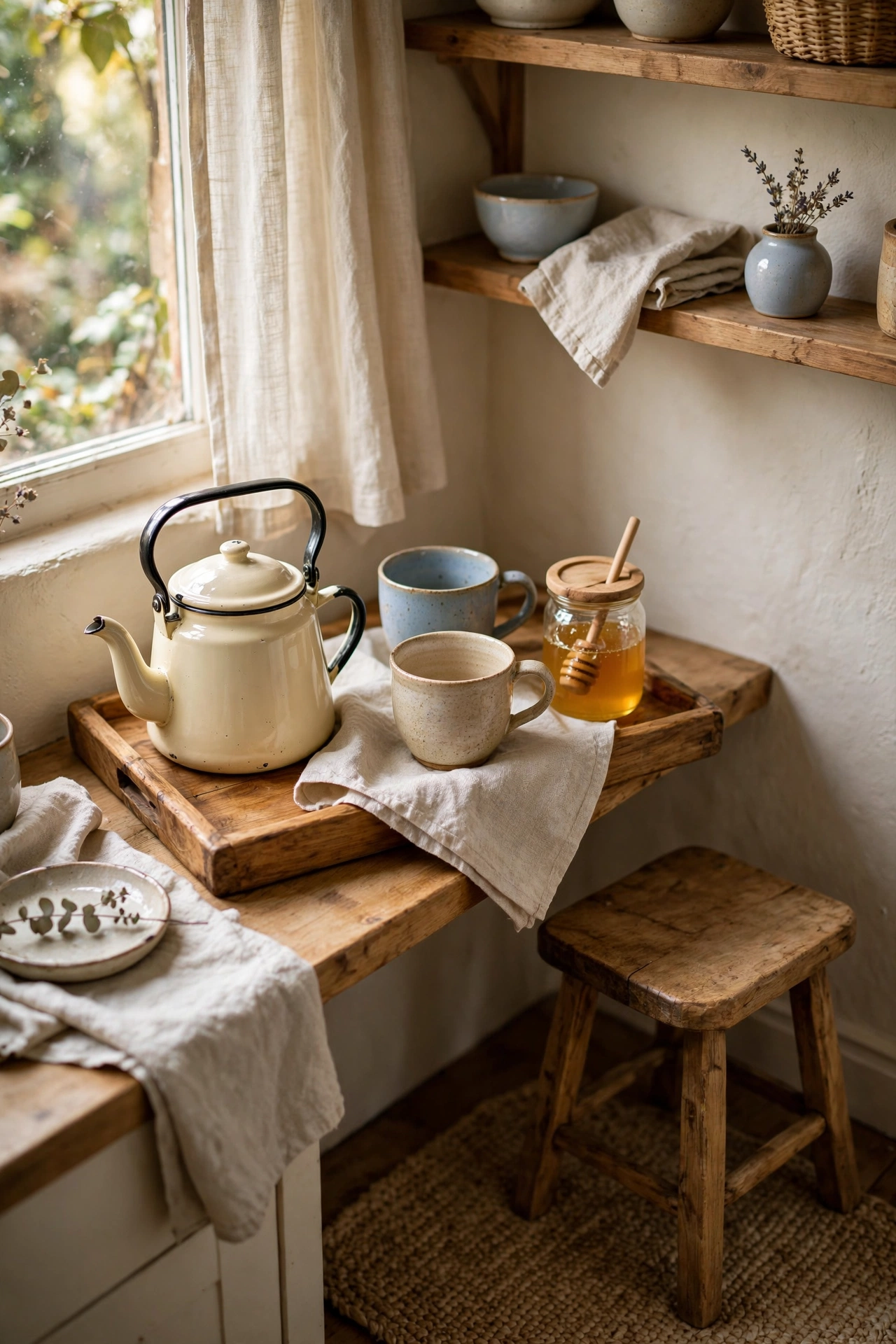
Claim one small corner for slowness. A wooden tray, an enamel teapot, two mismatched cups, a little jar of honey. That is a tea corner. It takes up one square foot and it will change your mornings.
The mismatched part matters. Two cups that do not match say this corner grew over time. One from a trip, one from your grandmother, one you just loved. Gathered, not decorated, all the way down to the teacup.
Keep the kettle nearby and the good tea within reach. When the setup is ready, you will use it. Five quiet minutes with a hot cup before the house wakes up. That is not a decor idea. That is a life idea that happens to look beautiful.
More Favorites
This post contains affiliate links. If you buy through them, I may earn a small commission at no extra cost to you.
A few more favorites from the ideas above:
Gather it slowly, love it daily
You do not need all 19 ideas. Please do not try all 19 at once. Pick the one that made you exhale when you read it. Maybe it is the cream cabinets. Maybe it is the tea corner that is really about slow mornings. Start there.
The formula is simpler than it looks. Gathered, not decorated. Useful things can be the pretty things. Warmth beats perfection. Leave room for the living. Keep those four in your pocket and you cannot go wrong.
If this gathered feeling has you wanting more, my light and airy spring farmhouse kitchen ideas carry the same warmth into brighter days, and the design guides have the full palettes and pairings if you want to go deeper.
Start with one wooden thing, warm up the light, and hang something to dry. Let the room gather itself around you. It will reward you every single evening.
With love and light
Get Fresh Home Ideas Every Week
Seasonal decor ideas, organizing tips, and cozy home inspiration, straight to your inbox.
More Kitchen Ideas You Will Love
Keep browsing for more seasonal inspiration: