

There is a point in December, usually around five in the evening, when the light outside goes blue and the house has a choice. It can feel flat and a little tired, or it can glow. The rooms that glow in my house are the ones dressed in jewel tones. Emerald on the tree. Sapphire on the sofa. A little amethyst at the table, a little burgundy wherever the candlelight lands. These colors are deep enough to feel rich and soft enough to live with, and when the lamps come on they seem to hold the light inside them, the way a stone holds light in a ring.
The rule I follow every year is simple. Pick three jewels and repeat them everywhere. Mine are emerald, burgundy and sapphire, with brass standing in for gold and cream doing the quiet work underneath. Once the palette is set, every choice gets easier. The ribbon, the stockings, the wrapping paper, even the napkins all answer to the same three colors, so the whole house feels like one long, calm sentence. It is the opposite of the rainbow tree I grew up with, and honestly, I find it so much warmer. If you loved the softer mood of my elegant Christmas living room, think of this as its richer, moodier sister.
Velvet is the second half of the secret. Jewel tones in shiny finishes can look harsh, almost like plastic. The same colors in velvet drink the light in and turn plush and deep, and that is what makes them feel expensive. So this list leans on velvet everywhere it can, on the tree, on the sofa, on the mantel, even under the tree. Add brass for warmth and a lot of candles for glow, and a room dressed in strong color somehow feels like the calmest room in the house. Here are nineteen ways I bring the jewels home.
Love these ideas? Get more every week.
Join the newsletter for seasonal decor and cozy home inspiration.
The Tree, Dressed Like a Jewel Box
1. Build the Tree Around Emerald and Gold
Every jewel tone room needs one anchor, and in mine it is the tree, dressed head to toe in emerald and gold. I start with the lights, warm white and lots of them, woven deep into the branches. Then come the emerald ornaments, velvet ones first because they set the mood, placed from the inside of the tree outward so the color has depth. The gold goes on last, brushed and antique rather than bright and shiny, tucked beside the lights so each piece borrows a little glow. Against the dark green branches, emerald ornaments almost disappear in daylight. At night they turn into these soft, deep pockets of color, and the gold carries the sparkle for the whole tree.
The reason this pairing works so well is that emerald and gold flatter each other the way they do in jewelry. The green makes the gold look warmer. The gold keeps the green from going flat or muddy. Keep everything else on the tree quiet, cream ribbon if you want ribbon, a simple star or a cluster of gold bells on top, and let the two colors do all the talking. It is a tree that looks dressed rather than decorated, and guests always ask if I hired someone. I did not. I just stopped adding colors.

Shop This Look
This post contains affiliate links. If you buy through them, I may earn a small commission at no extra cost to you.
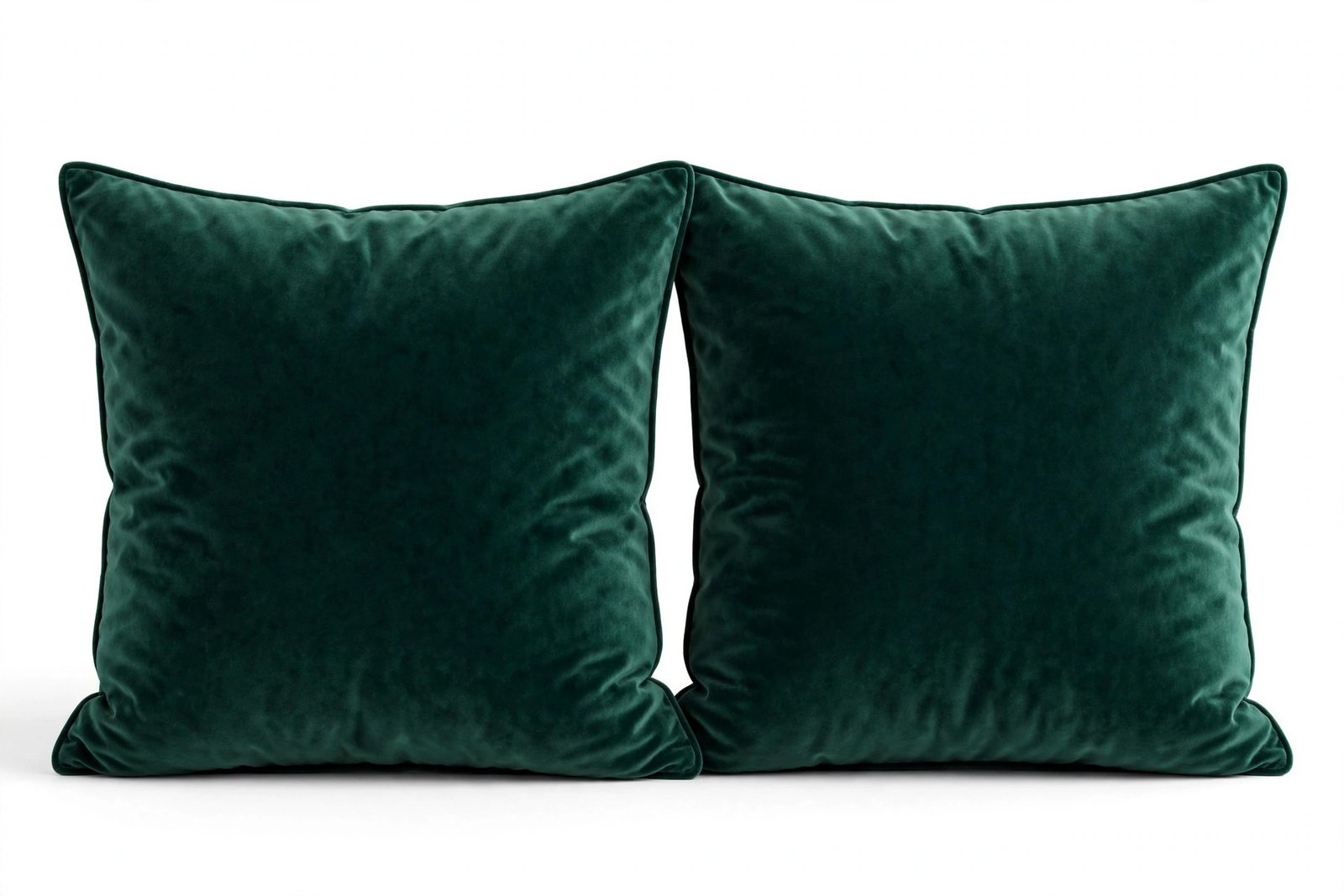
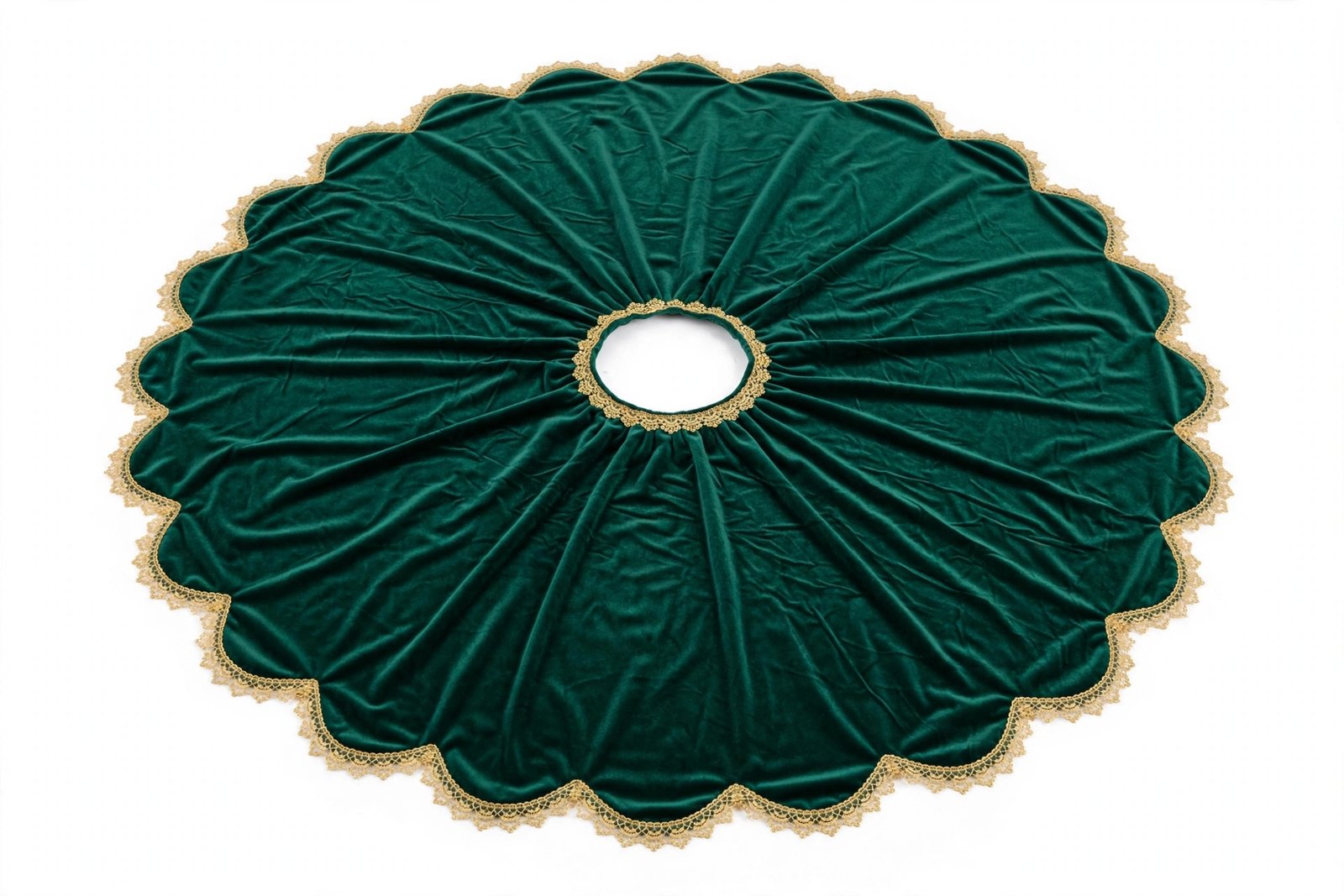
A few favorites featured in the ideas above:


2. Let Sapphire Play the Supporting Role
If emerald is the lead, sapphire is the friend who makes her look good. Deep blue is the calmest of the jewel tones, and a tree touched with sapphire glass reads almost like evening sky through the branches. I keep sapphire in the minority, maybe one ornament in four, mixed with the gold and a little cream so it never turns into a themed blue tree. Glass works beautifully here because it catches the light and throws it back in small bright flashes, where velvet would simply absorb it. That mix of finishes, matte velvet emerald beside shining sapphire glass, is what gives the tree its depth.
Sapphire also travels well into the rest of the room. A blue pillow on the sofa, blue napkins at the table, a blue candle on the mantel, and suddenly the tree does not look like a decision you made in one corner. It looks like a palette the whole house agreed on. That is the repetition rule working quietly in the background. Choose your supporting jewel early, buy a few pieces in it for different rooms, and the house will feel collected instead of decorated all at once.

3. Give a Second Tree the Amethyst Treatment
One tree gets the main palette. A second, smaller tree is where I let myself play, and amethyst is my favorite experiment. Plum and purple sound bold until you see them on a lightly flocked tree, where the white dusting softens the color into something that feels like dusk in the country. I put this tree in the sitting room where we read in the evenings, dressed with amethyst velvet baubles, a few plum glass drops and antique gold to keep it related to the big tree downstairs. It is the tree guests photograph, every single year.
Amethyst pairs beautifully with gray and silver toned neutrals, so it suits rooms that never quite warmed up to emerald. Keep the flocking light. A heavy snow tree with purple ornaments can tip into Frozen party territory, and that is not the mood. A light dusting, warm lights and gold accents keep it grown up and calm. If a full second tree is too much, the same idea works on a tabletop tree in a hallway or bedroom, and it is honestly where I would start.

4. Pile Ruby Glass in a Brass Bowl
Not every jewel in the house has to hang on a tree. Some of my favorite color in the living room sits in a bowl. I keep an aged brass bowl on the coffee table and fill it with garnet red glass baubles, the deep, wine dark red that reads like ruby rather than candy. In daylight it is a quiet, rich still life. At night, with the tree lit behind it and a candle nearby, the glass catches small red glows and the whole table seems warmer. It takes four minutes to arrange and it works on a shelf, a sideboard or the middle of the dining table.
Choose glass for this job, not shatterproof plastic, if the bowl sits somewhere safe. Real glass has a weight and a depth of color that plastic never quite matches, and a bowl is a protected place where breakables can live out of traffic. Mix two or three sizes so the pile looks gathered rather than poured, and tuck a few sprigs of pine or cedar around the base of the bowl to tie it to the rest of the greenery in the room.

5. Hang a Jewel Studded Wreath on the Front Door
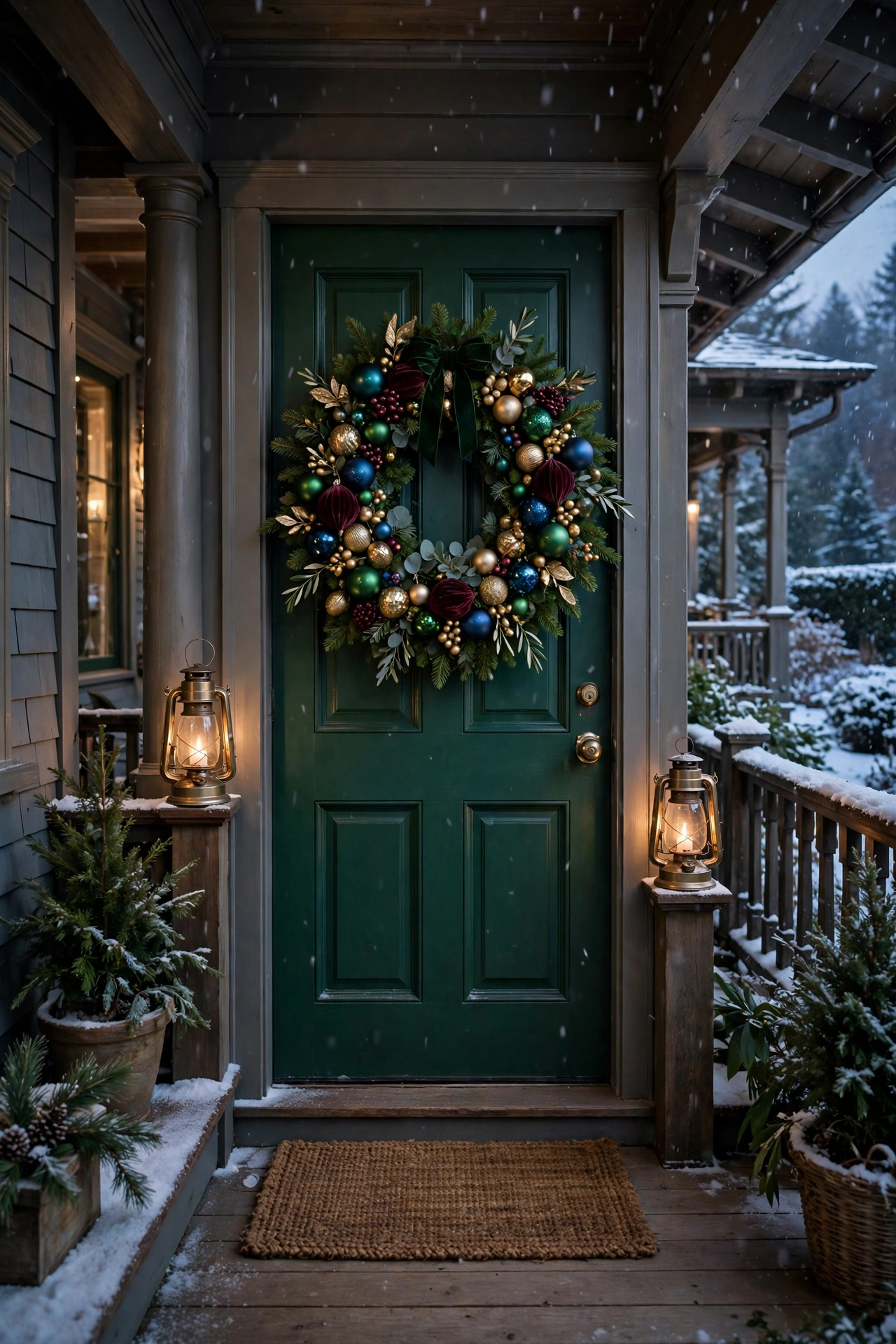
The front door is where the palette makes its first impression, so mine wears a wreath that reads like a piece of jewelry. I start with a plain, full green wreath and wire in ornaments the way a florist would, clusters of emerald and burgundy low on one side, sapphire and gold dotted through the rest, all of it kept a little uneven so it looks gathered rather than engineered. Two brass lanterns with candles flank the door, and their warm light does for the wreath what a ring light does for a portrait. People slow down on the porch. It happens every night.
Wire every ornament on with floral wire rather than relying on the hanging loops. December wind will find anything loose, and a wreath that sheds baubles onto the steps feels sad by the second week. Work in odd numbered clusters, three ornaments together, then a gap of green, then five. The green showing through is not empty space. It is what makes the jewels read as jewels. I use the same cluster logic on my garlands, a trick I first learned styling my fall mantel, and it has never failed me.
Velvet on Every Soft Surface
6. Hang Emerald Velvet Stockings on the Mantel
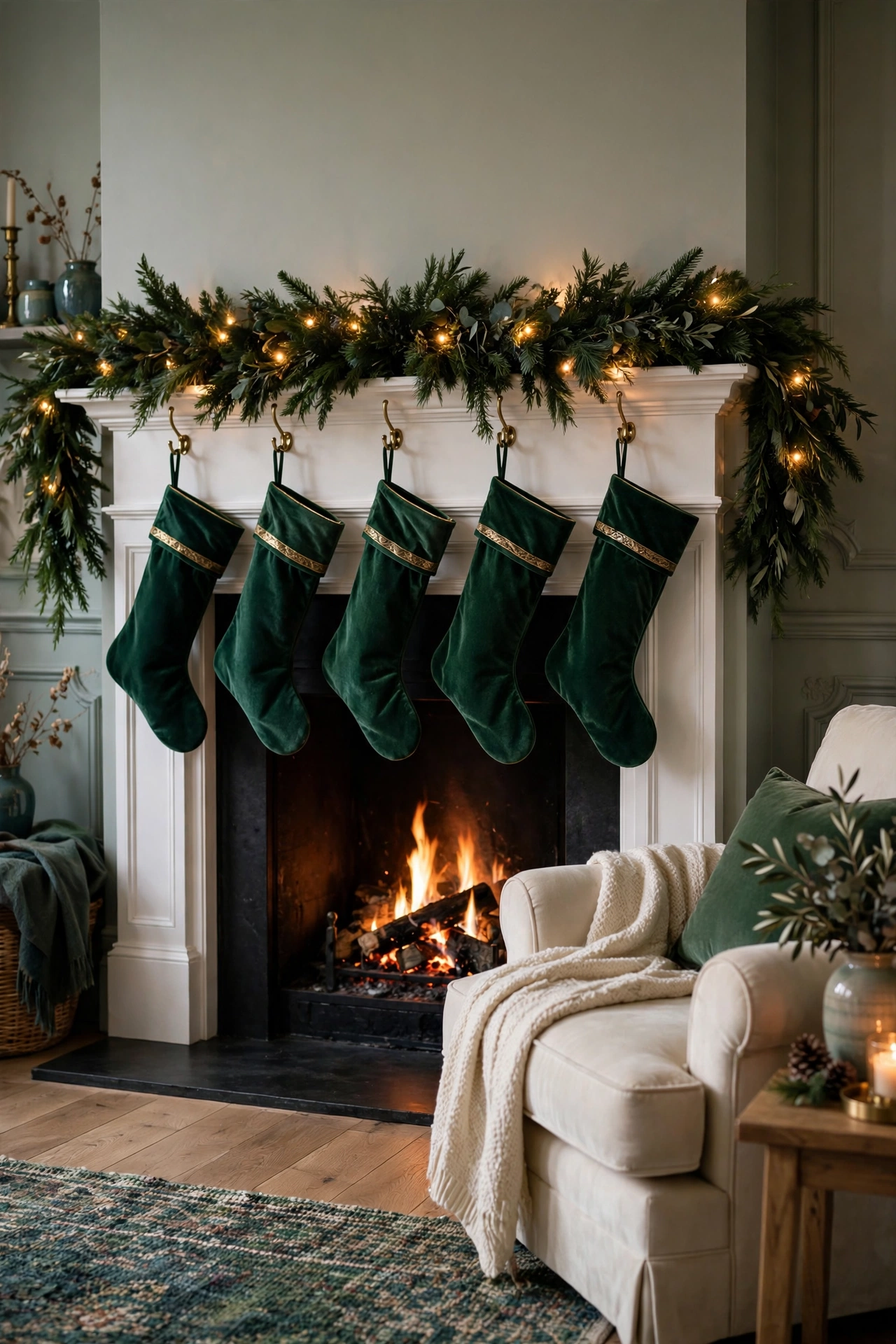
Stockings are the one piece of Christmas decor my family actually touches every day, so they carry a lot of the room mood. Ours are emerald velvet with a scalloped gold edge, and against the green garland they look like they grew there. Velvet stockings hang differently than knit ones. They fall in a smooth, heavy line, they do not curl or twist, and the color stays deep and even from cuff to toe. Hung from simple brass hooks under a full garland, the row reads calm and tailored, which is exactly the note a rich palette needs so it does not tip into formal.
If your family stockings are a beloved tangle of years and colors, I am not asking you to retire them. Keep those for Christmas morning. Let a matched velvet set carry the mantel through the season, and swap in the family ones on Christmas Eve. It is a small kindness to your future self, because a calm mantel makes the whole room feel under control during the busiest weeks of the year. The velvet set also photographs beautifully, and December is nothing if not a month of photographs.
7. Dress the Sofa in Sapphire and Emerald Velvet
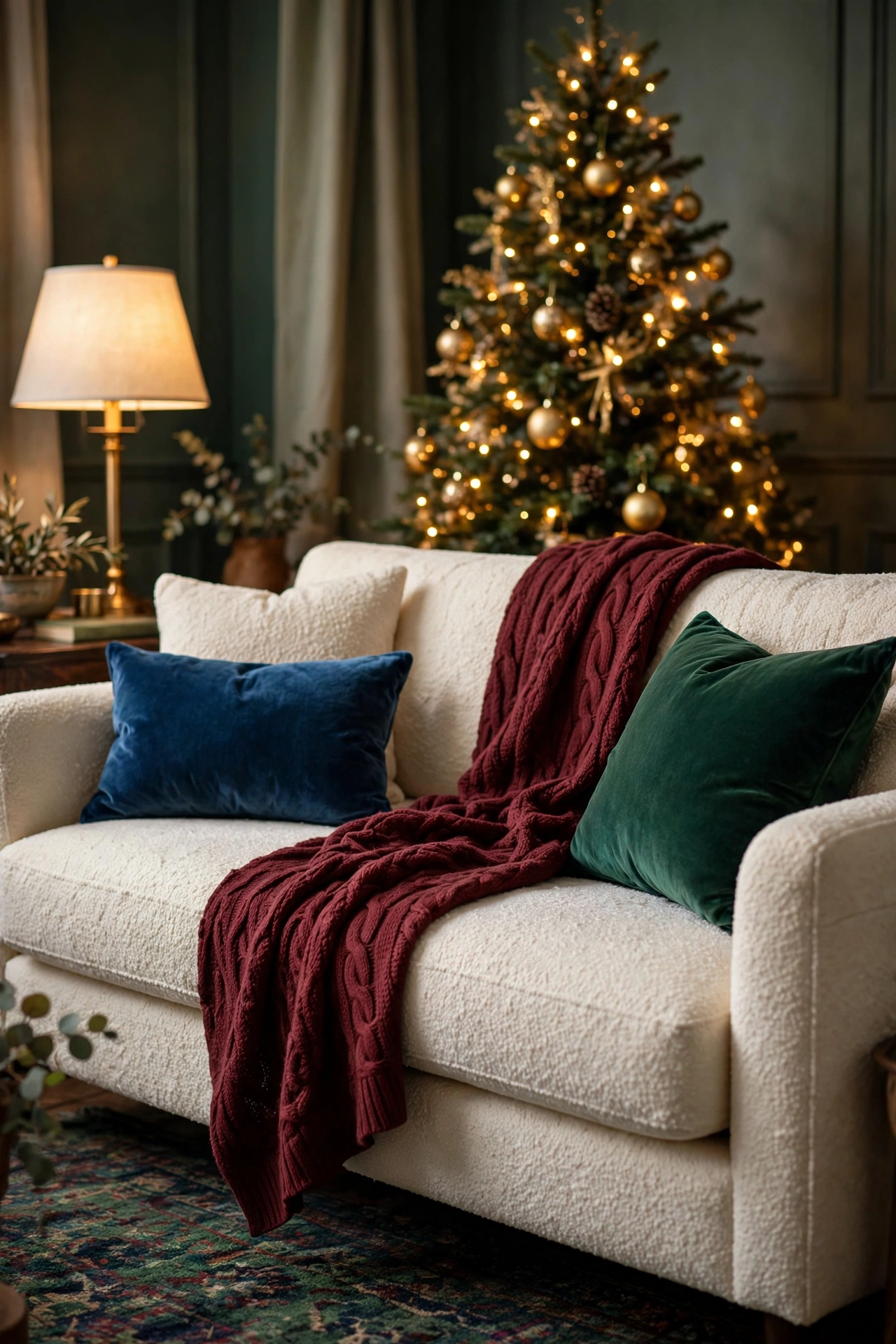
The sofa is where the jewel palette becomes something you can sit on. I swap our everyday pillow covers for velvet in December, sapphire and emerald on the cream sofa, with one burgundy knit throw folded over the arm. The change takes ten minutes and it is the single biggest transformation in the room after the tree. Velvet pillows catch lamplight in soft bands as you move past them, so the sofa seems to change color slightly through the evening. It is the coziest kind of drama, the kind you can lean against with a mug in your hand.
Covers, not new pillows, are the smart way to do this. They fold flat in January and take up almost no storage, and a good velvet cover with a hidden zipper looks like a custom pillow. Size up the insert if your pillows have gone flat. A plump pillow shows velvet at its best, with the light rolling over a full curve. Keep the arrangement simple. Two sapphire, two emerald, one smaller cream in the middle to rest the eye. Every jewel needs a neutral to rest on, and the sofa is where that rule proves itself nightly.
8. Cascade Burgundy Velvet Ribbon Down the Tree
Ribbon is where burgundy takes its turn in the spotlight. I use wide velvet ribbon with a wired edge and work it down the tree in long, soft loops, tucking the top of each loop deep into the branches and letting the bottom billow out before tucking it in again. Done well, it looks like the tree is wearing a gown. The velvet drinks the light, so each loop becomes a deep red shadow running through the green, and the effect from across the room is pure richness. It is also forgiving. Ribbon fills gaps, hides thin spots and makes an ordinary tree look twice as full.
Buy more ribbon than feels reasonable. A full tree can take two or three rolls, and running out halfway down is a special kind of December frustration. Cut nothing. Work with one continuous length so you can reuse the ribbon for years, rewinding it onto the roll in January. And keep the loops uneven on purpose, longer on one side, softer on the other. Trees in nature are not symmetrical, and a ribbon that moves a little looks like it belongs to the tree rather than being applied to it. This is the same burgundy velvet I loved in my cozy rustic living room, given a much grander job.

9. Frame the Windows With Amethyst Velvet Drapes
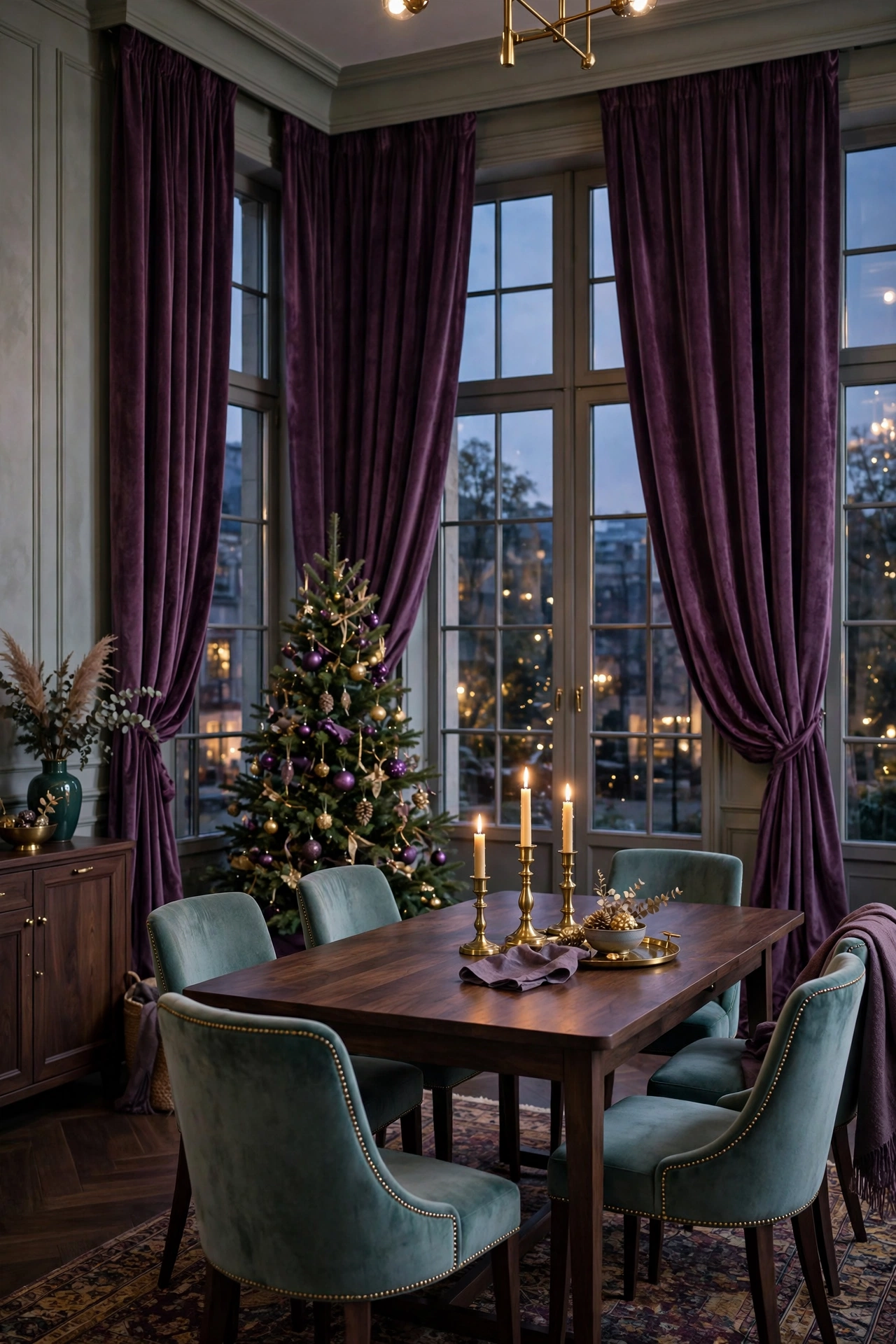
This is the boldest idea on the list, and the one that changes a room even when the tree lights are off. Deep plum velvet drapes at the dining room windows turn the whole wall into a jewel. During the day they frame the gray winter light and make the room feel cocooned. At night, with candles on the table, the fabric glows at the edges and dinner feels like an occasion even on a Tuesday. I hang them high and wide so they stack mostly off the glass, and I let them puddle just slightly on the floor, because velvet that puddles looks like it has always lived there.
Treat drapes as a winter layer, not a lifelong commitment. Mine go up in late November on the same rod as the summer linens come off, and they go back in storage in March. If plum feels like a leap, start with the room you entertain in, or with a single pair behind the tree, where the color doubles as a backdrop and makes every ornament in front of it look deeper. Velvet this dark also has a practical gift. It swallows glare and sound, so a room with amethyst drapes feels noticeably calmer during a loud, happy dinner.
10. Build a Reading Nook Around an Emerald Chair
Every December I claim one corner of the house as mine, and this year it is built around an emerald velvet armchair. A chair in a jewel tone is a commitment, I know, but velvet in emerald behaves almost like a neutral in a warm room. It sits happily beside cream, wood and brass, and it gives the corner a center of gravity that a plain chair never could. Beside it goes a small table, a brass lamp, a stack of books I actually intend to read, and a tabletop tree with tiny gold ornaments. When the house gets loud, that corner glows like a little green harbor.
The nook works because everything in it answers to the palette. The throw is cream. The lamp is brass. The little tree repeats the gold from the big tree across the house. Nothing new was invented for this corner, which is the repetition rule doing its quiet work again. If you do not have a velvet chair, a velvet cushion and a folded emerald throw over your favorite chair gets you most of the feeling. Start where you are. The glow matters more than the furniture.

Candlelight and Colored Glass
11. Line the Mantel With Brass and Burgundy Tapers
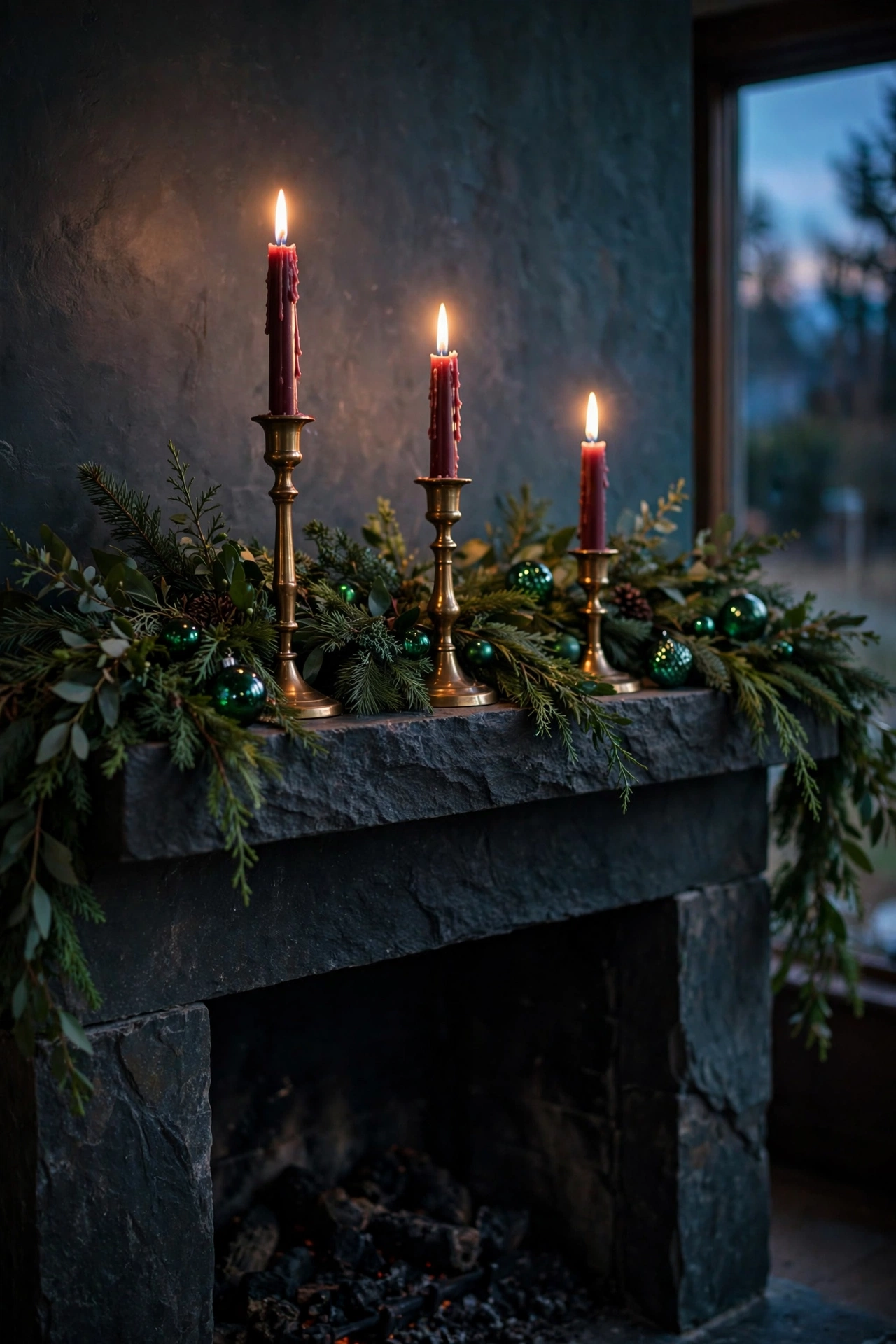
If the emerald mantel is the daytime look, this is its evening twin. On the dark stone fireplace in our den, I skip the garland some years and go straight for candlelight. Brass holders in three heights, burgundy tapers in every one, and just a low line of greenery with a few emerald baubles tucked in. When all the tapers are lit, the mantel becomes a row of small warm flames reflected in brass, and the burgundy wax glows almost black at the edges. It is the simplest styling on this whole list and possibly the most dramatic.
Graduated heights are what make it work. A row of identical holders looks like a shop display. Holders that step up and down look collected, like they arrived one gift at a time over twenty years. Keep the tapers the same color so the rhythm comes from the heights, not the hues. Flameless tapers are welcome here if your mantel greenery sits close, and the good ones in deep burgundy are nearly impossible to spot once the room is dim. Light them a little before you think you need them. Candlelight always looks best against the last of the daylight.
12. Float Candlelight Through Colored Glass Votives
Colored glass is the fastest jewel in the house. A tray of small votive holders in teal, amber, amethyst and ruby, each with a tealight inside, turns any surface into a little constellation of gems. I use them on the coffee table, along the windowsill in the kitchen and down the middle of the dining table when the good candles feel like too much ceremony. The light does not just sit in colored glass. It becomes the color, so a teal votive throws a soft green glow on the table around it, and a row of them mixes into something that feels like stained glass at human scale.
Buy the holders in sets with the colors already mixed, and resist sorting them into groups. The scatter is the charm. Amber is the one I double up on, because amber light is the warmest and it flatters every other color beside it, the way a good host seats guests. Keep the tray brass or dark wood so the glass reads as the jewel and the tray as the setting. And use real tealights when you can. The flame moving behind colored glass is the whole effect, and it never gets old.

13. Cluster Emerald Candles on the Sideboard
The sideboard is the most underused stage in the house, and mine gets a cluster of emerald pillar candles every December. Three or five pillars in deep green, set on brass holders and plates of different heights, with a round gold framed mirror above them. The mirror is the magic. It doubles every flame, reflects the tree lights from across the room, and turns a simple candle cluster into a pool of green and gold light on the wall. I add a small bowl of gold ornaments beside the candles and nothing more. Restraint is what makes it look expensive.
Pillar candles in jewel colors earn their keep because they carry the palette even when they are not lit. A stack of white pillars is invisible against a wall. Emerald pillars are decor all day and a light show all evening. Buy unscented ones for a sideboard near the dining table, so the candles never argue with dinner. And vary the heights boldly, one tall, two medium, two short. Timid height differences look like a mistake. Bold ones look like a decision.

14. Style a Console in the Peacock Palette
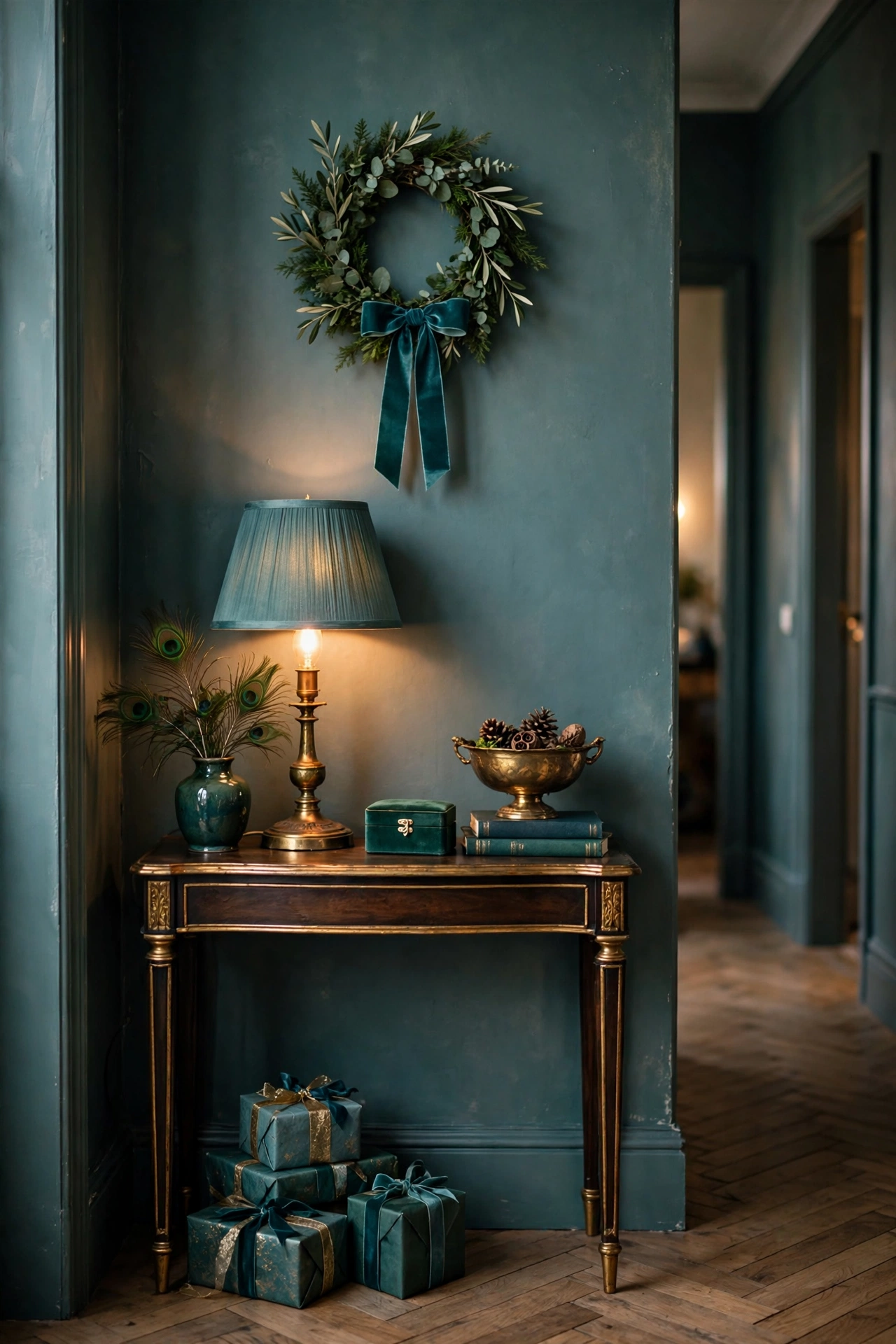
Teal is the jewel tone people forget, and it is the one that makes guests ask what changed. I call this palette peacock, teal with emerald and antique gold, and I use it on the hallway console where first impressions happen. A small green wreath on the wall, a teal velvet ribbon tied in one loose bow, a brass lamp glowing warm, and a few wrapped gifts stacked beneath the table in the same colors. The console takes five minutes to style and it tells everyone who walks in exactly what kind of Christmas this house is having.
Teal sits between emerald and sapphire, so it lets you bridge the two when a room holds both. If your tree is emerald and your sofa pillows are sapphire, a teal accent in the hallway shakes hands with both of them. Keep the gold antique here. Bright gold with teal can veer toward costume, while aged brass keeps it calm and a little moody. This is also a kind palette for narrow spaces, because one lamp, one wreath and one ribbon is the entire recipe, and hallways reward a light touch.
15. Bring the Jewels Into the Bedroom
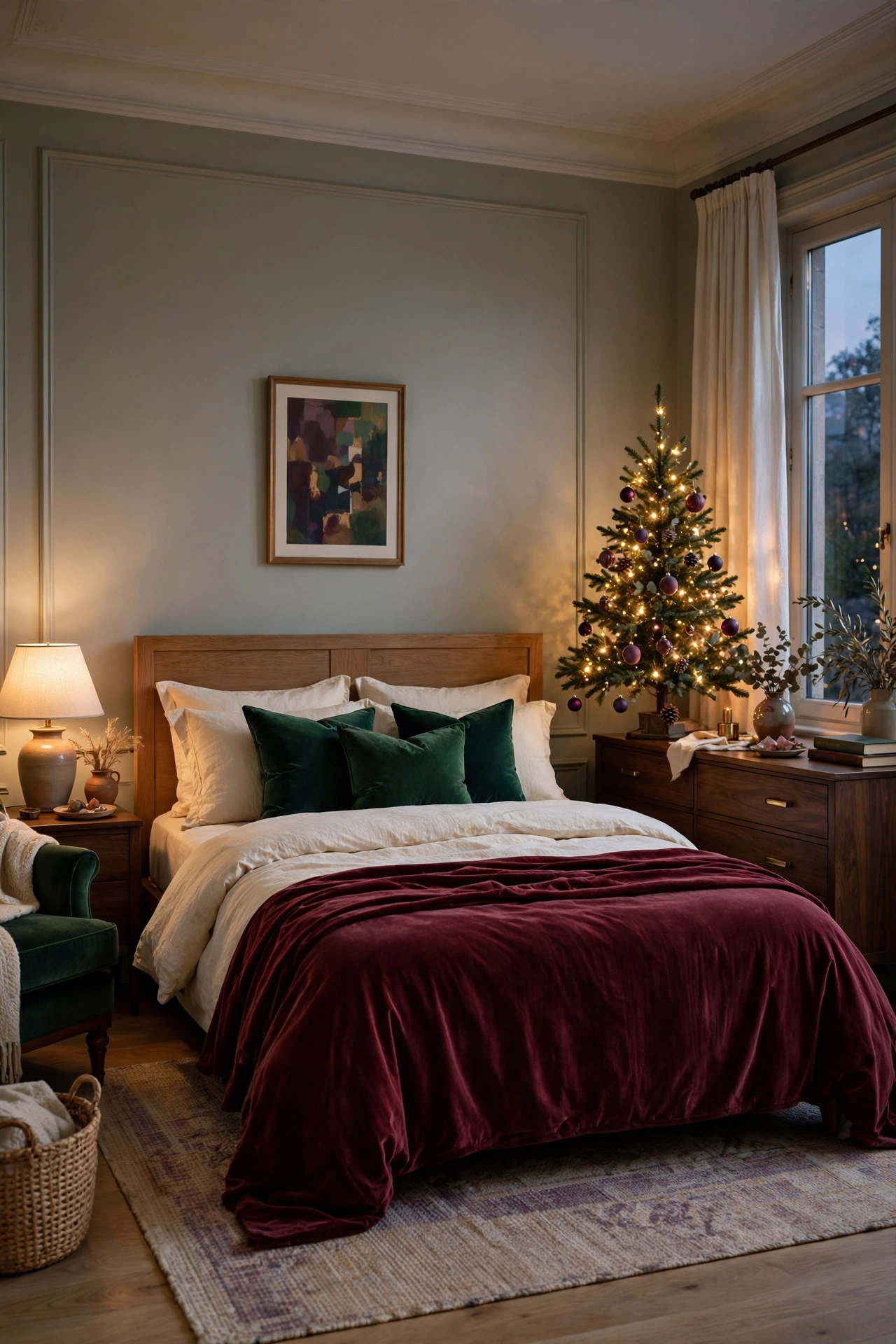
The bedroom is where jewel tones do their gentlest work. Ours stays cream and quiet all year, so in December I add just three things. A burgundy velvet throw across the foot of the bed, a pair of emerald cushions against the pillows, and a small tree on the dresser wearing plum and gold. That is all, and it is enough to make the room feel like it belongs to the same season as the rest of the house. Waking up to a softly lit little tree on a dark morning is a small, private luxury I would not trade for any amount of extra decor downstairs.
Keep the bedroom palette to two jewels at most. Sleep rooms want calm, and a bed dressed in four strong colors will feel busy at exactly the hour you want peace. Burgundy and emerald over cream bedding is my favorite pairing because both colors deepen in low light without turning loud. The little tree goes on a timer, on at dusk, off at bedtime, so the room glows while we read and goes dark when we sleep. Small rituals like that are what a decorated house is really for.
The Table and the Finishing Touches
16. Set the Table in Emerald, Sapphire and Gold
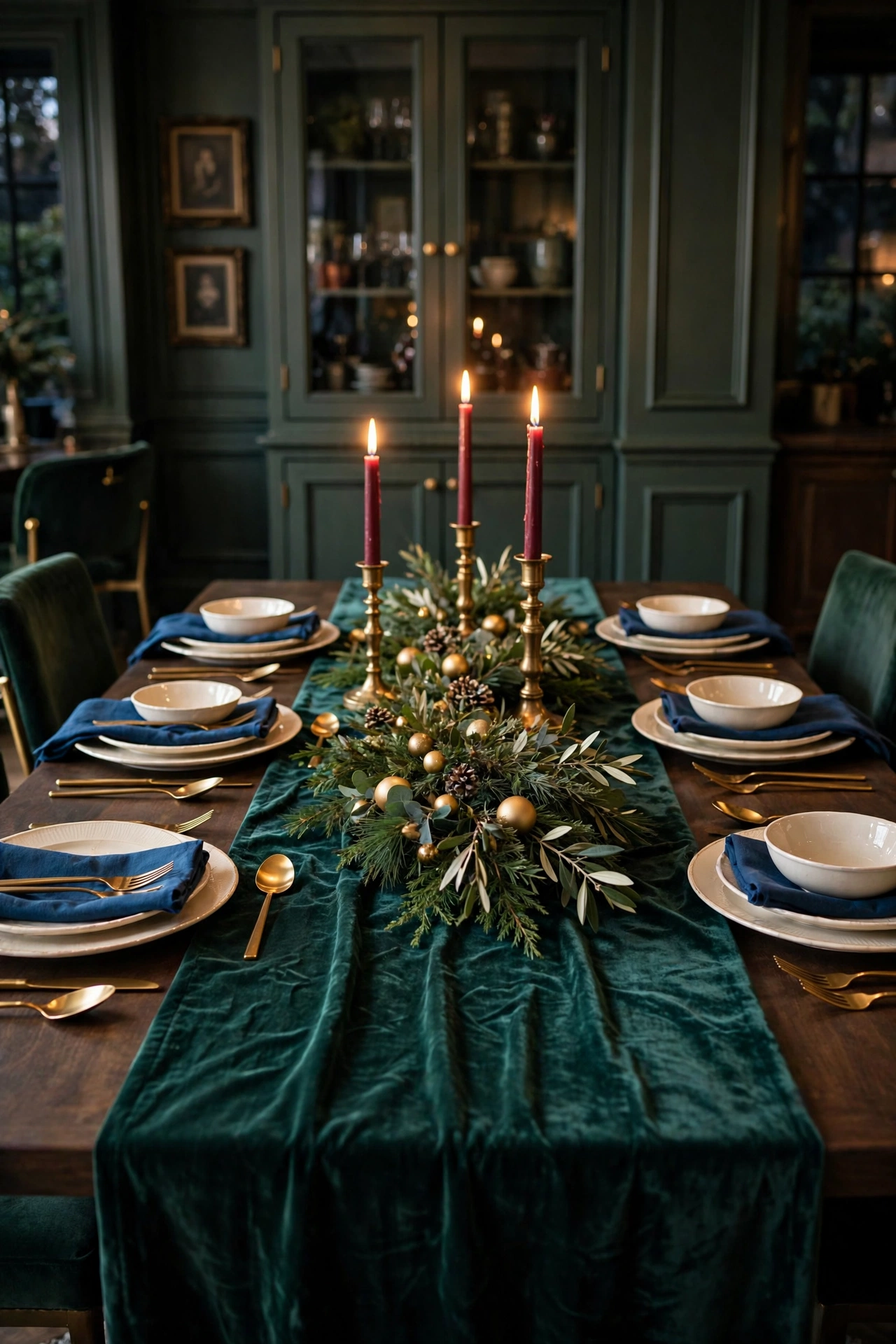
Christmas dinner deserves the full palette, and the table is where all three jewels finally sit down together. I start with an emerald velvet runner down the middle of the table, because velvet under candlelight looks like water at night. Along it goes a low garland with gold baubles tucked in, brass candlesticks with burgundy tapers, and at each seat, cream dinnerware with a sapphire linen napkin. The gold flatware ties the whole thing to the brass. When the candles are lit, every place setting has its own little pool of warm light, and the colors stop being decor and start being atmosphere.
The practical secret is height. Everything in the middle of the table stays low, below eye level for seated guests, so people can talk across the candles without ducking around a centerpiece. The tapers are the only tall element, and flame above eye level is fine because it is thin and it moves. I test the table the night before with two chairs pulled up, sitting down myself to check the sight lines. It takes two minutes and it saves the small embarrassment of rearranging a centerpiece in front of guests. My fall tablescape follows the same low and layered rule, dressed here in much richer color.
17. Give Every Guest an Amethyst Glass
If the full jewel tablescape feels like a lot, this is the one detail to steal. A colored drinking glass at each place, mine are amethyst, does the work of a whole centerpiece. The glass catches candlelight, it makes plain water look like part of the menu, and it gives every guest a small jewel of their own to hold. Beside it, a plum napkin on a cream plate and gold flatware is genuinely all a place setting needs. People compliment the glasses every year, and they are the easiest thing on the table to store, since they stack in a cupboard and come back out for birthdays and autumn dinners too.
Buy a full set in one color rather than a mixed set, and let the color be the deepest one your table can carry. Amethyst works because it is dark enough to feel like a jewel and light enough, once filled, to glow at the rim. Vintage shops are full of colored glass if you enjoy the hunt, and a hunted set with a little variation between glasses has a charm no box set can match. Just keep them all in the same color family, so the table reads planned rather than gathered by accident.

18. Wrap the Gifts in the Palette
By the third week of December, the gifts under the tree are half the decor in the room, so I wrap them like I mean it. Emerald, sapphire and burgundy paper, gold ribbon on the green, velvet ribbon on the blue, and plain cream paper with a burgundy bow for rest. Stacked on the emerald velvet tree skirt, the pile under the tree looks like the jewels spilled out of the branches and settled on the floor. It is the most photographed corner of our house, and it costs nothing but a decision to buy paper in the palette instead of whatever is closest to the checkout.
Buy the paper early, in November, while the deep colors are still on the shelves and before the novelty prints take over. Two rolls of jewel paper, one roll of cream, one spool of gold ribbon and one of velvet will wrap everything we give, with leftovers that roll straight into next year. Wrap a few empty boxes early in the season too, and place them under the tree right away. The corner looks finished all month, and the real gifts join a display that is already beautiful instead of starting one from nothing on Christmas Eve.

19. Echo the Palette in the Entryway
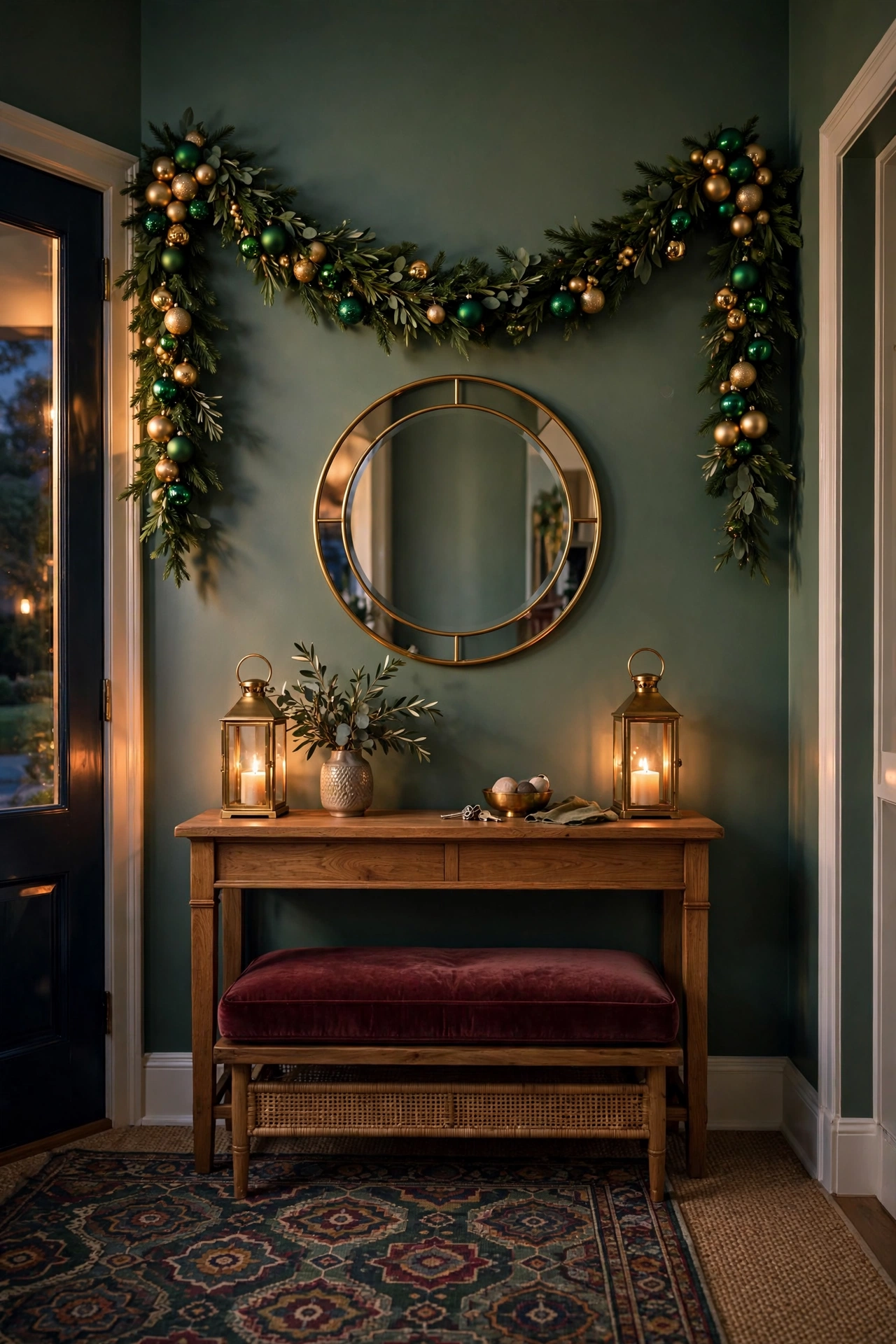
The last idea is really the first one your guests meet. Our entryway console gets a swag of garland with emerald and gold baubles, two brass lanterns with candles, a burgundy cushion on the bench and the round mirror that has lived there all year. Nothing in the entry matches the living room piece for piece, and that is the point. An echo is not a copy. The same three colors, emerald, burgundy and gold, in smaller amounts, tell everyone walking in that the house has one palette and one mood, from the front door to the tree.
Echoes are how a decorated house stays calm instead of turning into a theme park. Choose the entry pieces from what you already own in the palette before you buy anything new. A throw moved from the sofa, the spare lantern, the second bowl of gold ornaments. When January comes, the echo is easy to undo, and the entry returns to itself in ten minutes. But through December, that little garland swag above the console does quiet, important work. It promises the tree before anyone sees it, and the house keeps its promise.
More Favorites
This post contains affiliate links. If you buy through them, I may earn a small commission at no extra cost to you.
A few more favorites from the ideas above:


A jewel tone Christmas is not about owning more color. It is about choosing a small handful of deep, beautiful colors and letting them repeat until the whole house feels calm. If nineteen ideas feel like a mountain, climb three. Dress the tree in emerald and gold. Swap the sofa pillows for velvet. Set one tray of colored glass votives where the evening light lands. Those three moves will change how your home feels tonight, and the rest can arrive slowly, one candle and one ribbon at a time, all season long.
What I love most about this palette is how forgiving it is in January. The tree comes down, the ornaments go back in their boxes, and what remains is a house full of good bones. Velvet cushions that still look rich. Brass that still glows in the lamplight. Colored glass that moves to the winter table without missing a beat. The jewels were never really about Christmas. They were about a home that glows at five in the evening, in the darkest weeks of the year, and makes everyone in it slow down a little. Light the candles early tonight, friend. Pour something warm. Let the colors do their quiet work.
With love and light
Get Fresh Home Ideas Every Week
Seasonal decor ideas, organizing tips, and cozy home inspiration, straight to your inbox.
More Christmas Ideas You Will Love
Keep browsing for more seasonal inspiration: