
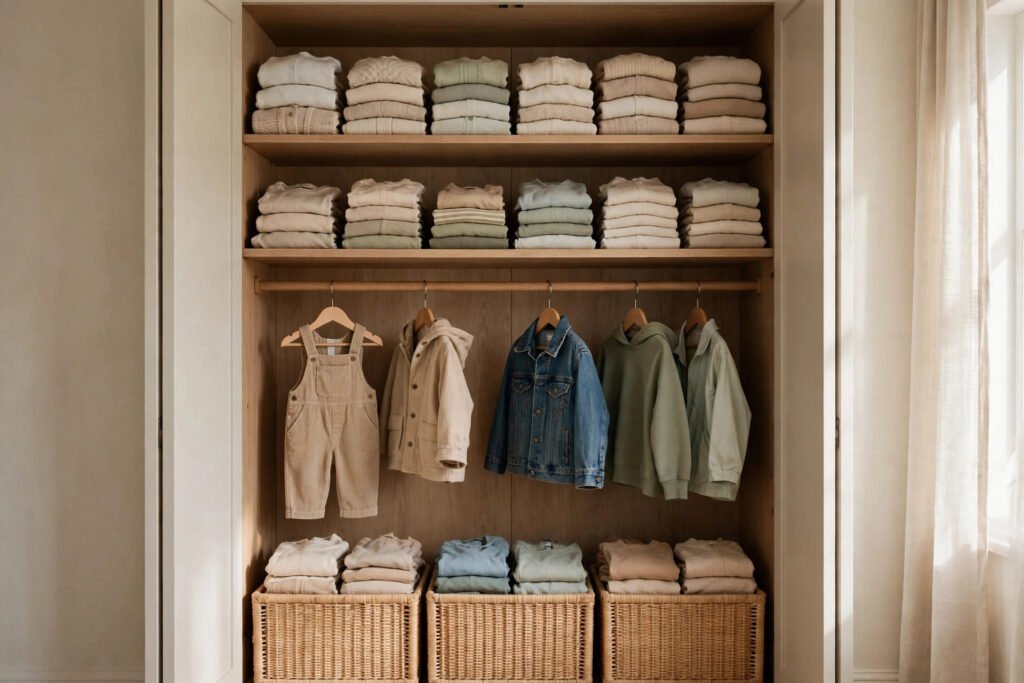
It is 7:15 in the morning. You open the dresser drawer to grab a shirt and the whole thing fights you. Sleeves are jammed in the back. There are three sizes in here and you know at least half of them do not fit anyone anymore. You dig. You pull out a shirt that is clearly two sizes too small, sigh, shove it back in, and grab the one clean shirt you can actually find. Meanwhile the laundry basket is overflowing with the same five outfits that actually get worn, and somewhere in the back of the closet there is a bag of clothes you meant to donate three months ago. It is still sitting there.
And then there is the guilt. The guilt when you look at the tiny newborn onesie you cannot throw away. The guilt about the expensive jacket grandma bought that was worn exactly twice. The guilt about the money, because kids’ clothes are not cheap and somehow there is always another size to buy. So the drawers stay stuffed, the bags stay in the closet, and every morning starts with a wrestling match against a drawer that has given up on life.
Here is the good news: you can purge the piles without the guilt. This post gives you the whole system: how to sort everything in one pass, the honest fit test that ends the “maybe” pile, one keepsake box per kid instead of twelve, how to make peace with the money and the gifts, a hand me down pipeline that actually moves clothes out, and the simple rules that keep the closet small from here on out. By the end, the drawers close easily, mornings are calmer, and the guilt is gone.
Love these ideas? Get more every week.
Join the newsletter for seasonal decor and cozy home inspiration.
TL;DR: Purge the Piles Without the Guilt
- Pull everything out and sort into four stations: keep and fits now, donate or pass on, keepsake box, and trash. Touch every piece once.
- Use the honest fit test: if it does not fit right now and is not for the coming season, it leaves the closet today.
- One keepsake box per kid: the truly sentimental pieces only, not a box per year and not a closet of maybes.
- The money is already spent: clothes sitting in a drawer do not refund themselves. Let them go serve a kid who will wear them.
- Cap the closet going forward: a set number per category per kid, and every new piece in means one piece out.
Why the Guilt Happens
Let us name what is actually going on, because the guilt is not really about the clothes. It is about four different feelings wearing a trench coat and pretending to be one problem.
The money guilt. You paid real money for these clothes. Some of them were not cheap. Letting go of a twenty five dollar shirt your kid wore four times feels like admitting you wasted the money. But here is the truth the guilt does not want you to hear: the money is spent whether the shirt sits in a drawer or goes to a new home. A shirt nobody wears is not saving you money. It is just taking up space and making you feel bad every time you see it.
The gift guilt. Grandma bought that outfit. Your sister picked out those shoes with so much love. Getting rid of a gift feels like rejecting the person who gave it. But the gift already did its job. It was chosen with love, given with love, and received with love. Its purpose was the giving, not permanent residence in your dresser. Grandma does not want you drowning in tiny clothes out of obligation. She wants you happy.
The “what if” guilt. What if the next kid needs it. What if this style comes back. What if you regret letting it go. The what if pile is the sneakiest one, because it feels like being responsible. But most of the what if pile is clothes you would not even remember you owned if someone asked. And if you are honest, when the next kid arrives, you will buy new things anyway, because that is what parents do.
The memory guilt. This is the real one, and it deserves respect. The onesie from the hospital. The outfit from the first birthday photos. The tiny sweater that still smells faintly like baby. These are not clothes. They are time machines. Of course you cannot just toss them in a donation bag. You should not. That is exactly what the keepsake box is for, and we will get there in Step 3.
Understanding the guilt matters because you cannot fight a feeling you have not named. Most moms are not drowning in clothes. They are drowning in decisions, and every unworn shirt is a tiny open loop in the brain. If the mental load has been heavy at your house, know that a stuffed kids’ closet is quietly adding to it every single day. Closing that loop is one of the kindest things you can do for yourself.
The Plan: Your No Guilt Clothes Purge System
This system works in one focused session per kid. Give yourself an hour or two, put on something fun to listen to, and work through the steps in order. The order matters. Do not skip ahead to the keepsake box before you have sorted, and do not start buying storage bins before you know what is staying.
Step 1: Pull Everything Out and Set Up Four Stations
Everything comes out of the drawers and closet first. You cannot purge what you cannot see.
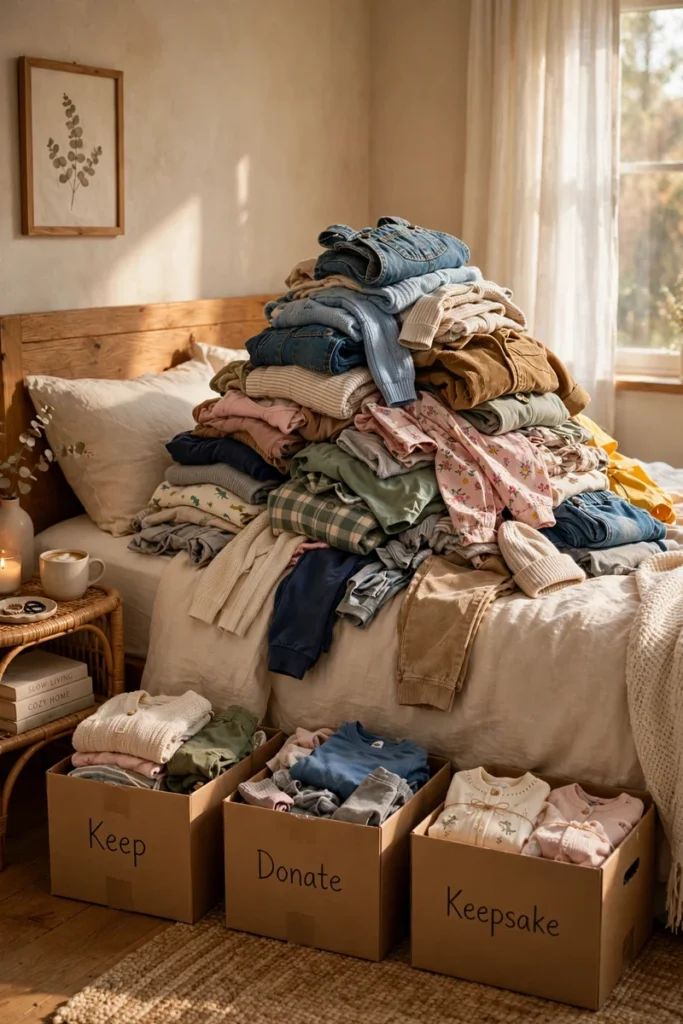
Take every single piece of that kid’s clothing out. Every drawer, every closet shelf, the laundry basket, the “clean but not put away” chair, the bag in the hallway you have been meaning to deal with. Pile it all on the bed. Yes, it will look alarming. That is the point. You need to see the true size of the situation before you can fix it.
Now set up four stations. Use boxes, laundry baskets, or just labeled zones on the floor. Station one: Keep, fits now. Station two: Donate or pass on. Station three: Keepsake box. Station four: Trash. That is it. Four stations, no fifth “maybe” station. The maybe station is where purges go to die, so we are not building one.
Pick up each piece exactly once and make a decision. Do not pick it up, think about it, and set it down to decide later. That is how a one hour purge becomes a four hour emotional marathon. Touch it, decide, move on. If you hesitate for more than ten seconds, it goes to donate. Hesitation means you do not love it enough to keep it.
Step 2: Run the Honest Fit Test and the Seasonal Check
If it does not fit right now and is not for the coming season, it leaves the closet today.
The fit test is simple: would you put this on your kid tomorrow? If the sleeves are too short, the waist is too tight, the pants are floods, or your kid has been refusing to wear it for weeks, it is done. It goes to donate or pass on. Do not keep clothes that do not fit “just in case they shrink.” They will not shrink. They will sit.
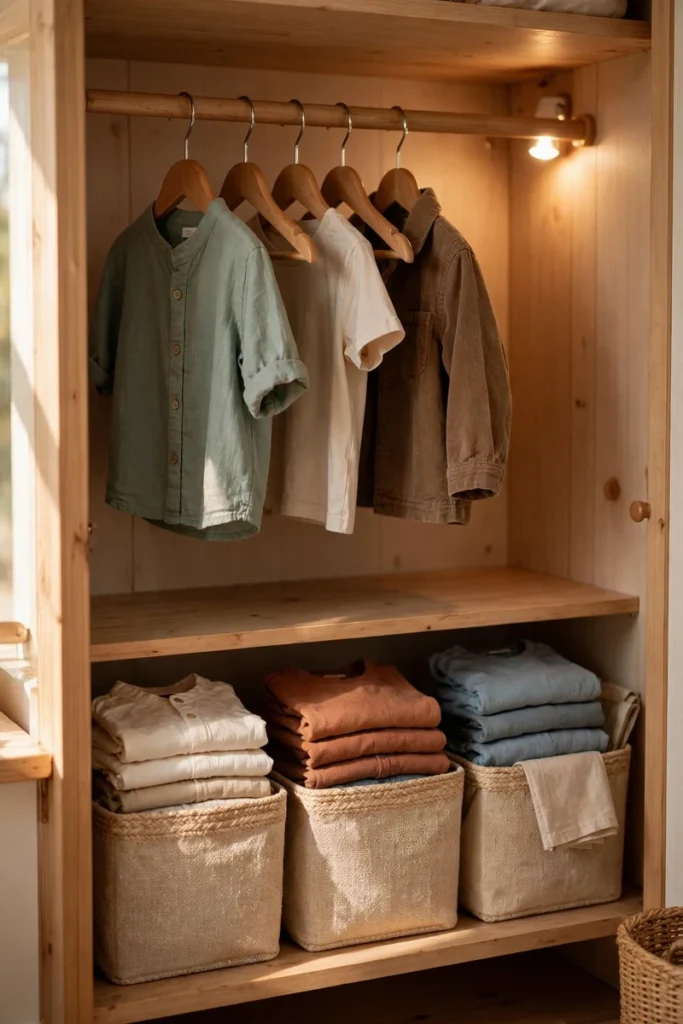
The seasonal check is the one exception to “fits right now.” It is October, so if you find a winter coat in the next size up or snow pants that will fit in December, those stay. But they do not stay in the everyday drawer. They go in a labeled bin for the coming season, out of the daily rotation. Current season clothes live in the drawers. Next season clothes live in the bin. Last season clothes leave the house.
Be ruthless with the stained and worn out pieces. A shirt with a stain that survived three washes is not a donation. It is trash, and that is fine. Donation centers are not laundries or repair shops. They need clothes someone else can actually wear. Letting the truly worn out pieces go in the trash is not wasteful. Keeping them in a drawer for another year is.
Step 3: Keep One Keepsake Box Per Kid
One box per kid for the truly sentimental pieces. Not a box per year, not a closet of maybes.
Here is where the memory guilt gets its proper home. Get one box per kid. A real box, with a lid, a reasonable size. Not a tote the size of a bathtub. Into this box go the pieces that genuinely stop your heart: the coming home outfit, the first birthday shirt, the sweater grandma knit, the tiny shoes from those first steps. The pieces you would grab if the house were on fire.
Here is the filter that makes this work: if everything is special, nothing is special. When you are tempted to add the tenth onesie “because it is cute,” ask yourself which three pieces from that whole size range actually carry a memory. Keep those three. The rest are just clothes that happened to be small. Cute is not the same as meaningful, and your kid will not miss the onesie that was merely cute.
Label the box with the kid’s name and put it somewhere out of the daily path: top of a closet, under a bed, a shelf in the basement. The keepsake box is an archive, not storage. You should not be opening it weekly. Once a year, when you are feeling nostalgic, you can open it and have a good cry over how tiny they were. That is what it is for.
Step 4: Make Peace With the Money and the Gifts
The money is already spent whether the clothes sit in a drawer or go to a new home. A gift served its purpose the moment it was given.
This step is not about the clothes. It is about the feelings, and it deserves its own step because skipping it is why the bags sit in the closet for months. Stand in front of your donate station and say it out loud if you need to: keeping this does not get my money back. The twenty five dollars is gone either way. The only question is whether the shirt takes up space and generates guilt, or goes to a kid who will actually wear it.
For the gifts, try this reframe: the gift was the love, not the fabric. Grandma’s joy was in choosing it and watching your kid wear it. That already happened. Passing it on to another family extends that joy instead of burying it in a drawer. If it helps, snap a photo of the special gifted pieces before they go. The photo keeps the memory. The drawer keeps the clutter.
And for the expensive pieces that barely got worn, give yourself grace. You made the best call you could with the information you had. Kids grow unpredictably, seasons change fast, and sometimes a jacket just does not get worn. That is not a failure. That is parenting. Let the nice pieces go to consignment if that soothes the sting. Getting a few dollars back is a perfectly good ending for a barely worn coat.
Step 5: Build a Hand Me Down Pipeline That Actually Moves
A hand me down pipeline moves clothes out in days, not seasons. No pipeline means bags living in your hallway until spring.
Hand me downs are wonderful in theory. In practice, they become the bag in the corner that you keep meaning to bring to your sister’s house. The fix is a pipeline with exactly three exits, decided in advance. Exit one: a specific younger sibling, with a labeled bin per kid per size. Exit two: a specific friend or cousin who actually wants them. Exit three: the donation bag. Every outgrown piece goes to one of these three exits the same day you sort it. No fourth exit called “I will figure it out later.”
For younger siblings, keep it simple: one bin per kid, labeled with the size range, stored out of the way. When the bin is full, it is full. Do not start a second bin. The size cap from Step 7 applies to stored hand me downs too. And be honest about what the younger kid will actually wear. If your daughter lives in leggings and would never touch a frilly skirt, the frilly skirt goes to donation, not to her bin. Handing down clothes nobody will wear is just relocating the clutter.
For friends and family, ask before you assume. A quick text with “I have a bag of 4T boy clothes, want them?” takes ten seconds and prevents the awkward pile on someone’s porch. Some people love hand me downs. Some people do not, and that is fine. Never donate your guilt to someone else’s closet. If nobody claims the bag within a week, it goes to exit three. The pipeline keeps moving.
Step 6: Schedule the Donation Drop So Bags Do Not Live in Your Trunk
Donation bags get a date on the calendar. Bags without a plan live in the trunk for months and slowly migrate back inside.
Everyone knows the trunk bag phenomenon. You bag everything up feeling triumphant, put the bags in the car “to drop off tomorrow,” and then tomorrow becomes next month, and then the bags come back inside because you need the trunk space, and suddenly the purge never happened. The purge is not done when the bags are packed. It is done when the bags leave your property.
So before you even finish sorting, pick the drop. Choose one donation spot and learn its hours. Many accept drop offs with no appointment. Put it on the calendar for within the next three days, and tie it to a trip you are already making. The donation center on the way to the grocery store. The consignment shop near the pediatrician. Stack the errand onto something that already exists and it will actually happen.
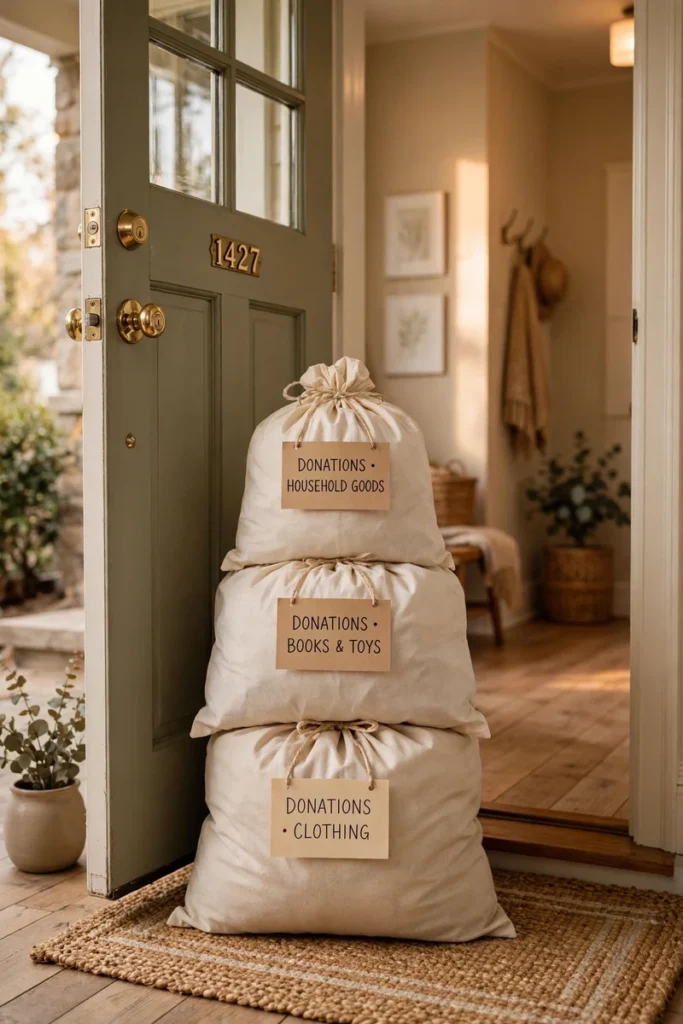
If a drop off keeps slipping, use a pickup service. Several charities will come to your porch and take the bags. You schedule it online, set the bags out in the morning, and they vanish. There is no easier exit. The small effort of scheduling beats the large effort of driving across town with kids in the car. Whatever removes the friction, do that.
One more rule: the bags leave the house within one week of the purge, no exceptions. Tell someone your plan if it helps. Accountability works. And when the bags are gone, notice how the closet feels. That lightness is the whole point. Protect it.
Step 7: Keep the Closet Small Going Forward
Cap the number per kid and match every new piece with one piece out. A small closet stays small on purpose.
A purge without a maintenance plan is just a prelude to the next purge. The system that keeps the closet small has two rules. Rule one: size caps. Pick a number per category that fits your laundry rhythm. For most families, that looks like seven everyday shirts, seven bottoms, a week’s worth of pajamas, and a handful of nicer outfits. If you do laundry twice a week, you do not need fourteen shirts. You need enough for the days between washes plus a small buffer.
Rule two: one in, one out. When new clothes arrive, whether you bought them or grandma sent a surprise package, one piece leaves for every piece that enters. Make it a habit, not an event. New winter coat comes home, old one goes in the donate bag that same day. This takes thirty seconds and it is the single most powerful habit in this entire post. Closets do not fill up overnight. They fill up one unexamined new shirt at a time.
Do a mini reset each season. When you swap seasonal clothes, run the fit test again. It takes twenty minutes per kid and it prevents the slow creep. And keep the everyday tidy up routine doing its job: when the closet is small, putting clothes away takes minutes instead of a whole afternoon. A small closet makes every other system in the house work better, from laundry day to the school morning rush.
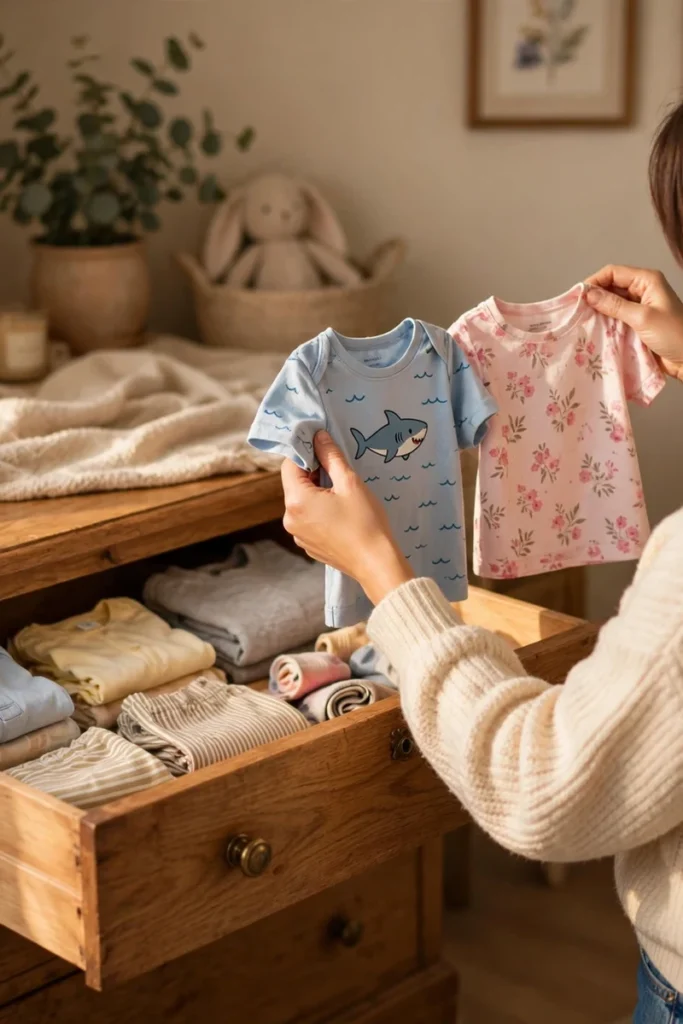
The First Month With a Smaller Closet
The first week after the purge feels strange. You will open the drawer and think something is wrong, because there is actual empty space. That empty space is the point. Sit with it. Within days, the strangeness turns into relief.
Mornings get faster. When every shirt in the drawer fits and is in season, there is nothing to dig through and nothing to reject. Kids get dressed in minutes. The morning argument about the too tight shirt simply stops happening, because the too tight shirt is gone. If school mornings have been chaotic at your house, the smaller closet might be the highest leverage fix you have not tried.
Laundry gets lighter. Fewer clothes in rotation means smaller loads, faster folding, and no more marathon put away sessions. Everything has a home because there is actually room for everything. The laundry system finally works the way it was supposed to, because you stopped asking it to manage three sizes of clothes for one small human.
You will be tempted to refill it. This is the part nobody warns you about. An emptier closet can trigger a strange urge to shop, as if the space needs filling. It does not. When the urge hits, remember the morning you spent wrestling that drawer. The empty space is not a problem to solve. It is the reward. Let it stay empty.
Try It Tonight: The 15 Minute Purge Sprint
You do not need a free Saturday to start. Tonight, after the kids are in bed, sprint one drawer:
- Pick one drawer. Pajamas are the easiest win. Pull every piece out onto the bed.
- Make three piles: fits now, donate or pass on, trash. No keepsake decisions tonight, just the easy calls.
- Bag the donate pile immediately and put it by the front door, not back in the closet.
- Fold the keepers back into the drawer. Notice how easily the drawer closes now.
- Put the donation drop on your calendar for the next three days. The sprint counts only when the bag leaves.
One drawer tonight proves the system works. This weekend, run the full purge per kid and feel the whole closet change.
Mistakes to Avoid
Sorting without stations, straight back into the drawer. If you “sort” by picking things up and putting most of them back, you have just refolded your clutter. The four stations exist for a reason. Every piece needs a verdict and a destination. A purge where everything stays is just tidying with extra guilt.
Starting with the keepsake box. If you begin with the sentimental pieces, you will spend an hour crying over onesies and never get to the actual purge. Do the keepsake box third, after the momentum is rolling. Sentiment deserves its moment, but it should not be the opening act.
Keeping stained and worn out clothes “for play.” Every mom has a secret drawer of stained shirts designated for messy play. Be honest about how many play shirts a kid needs. Three, maybe. Not seventeen. The rest are just trash with a nicer label. Play clothes should still be clothes you would put on your child, not rags you feel guilty throwing away.
Buying storage bins before purging. Do not go to the store for cute bins until you know what is staying. Buying organization products for clutter you have not purged yet is just giving the clutter a nicer house. Purge first, count what remains, then buy exactly what you need. Your wallet will thank you.
Letting the kids veto everything. Little kids will declare every single shirt their favorite if you ask them mid purge. That is sweet and also completely unhelpful. For kids under six, do the purge while they are asleep or at school, then present the smaller closet as a happy surprise. Older kids can participate, but you hold the final call. “We are keeping the ones that fit” is a complete sentence.
Doing the purge when you are already exhausted. This is decision heavy work, and decision fatigue is real. Do not start at 9 pm after a long day. Pick a morning or an early afternoon when your brain is fresh. The clean house reset works the same way: the system matters, but so does the timing. A rested mom makes cleaner decisions.
What About…?
What about keeping clothes for the next kid? Keep them, but keep them on purpose. One labeled bin per size range, stored out of the way, and only the pieces the next kid will actually wear. Skip the stained ones, skip the styles that will feel dated, skip anything you are keeping out of vague anxiety rather than a real plan. And set a limit: when the bin is full, the bin is full. A next kid does not need three bins of 2T. They need a reasonable stash and a mom who is not drowning.
What about the expensive pieces they barely wore? This is the money guilt talking, and Step 4 is your answer. But practically speaking, you have good options. Consignment shops and local buy and sell groups love barely worn kids’ clothes, especially nice outerwear and occasion outfits. List the best pieces the same week you purge, while the momentum is hot. Price them to move. Getting thirty dollars back for a coat beats staring at it in the closet for two more years. And whatever does not sell in two weeks goes to donation. No relisting purgatory.
What about when my partner thinks we should keep everything? This is more common than you think, and it is rarely about the clothes. It is usually about money anxiety or a different relationship with stuff. Do not purge their sentimental items without them. Instead, show them the system: the four stations, the one keepsake box, the size caps. Most reluctant partners come around when they see it is a system, not a whim. And start with your own stuff or the obvious trash. Momentum is persuasive. A half empty drawer convinces better than an argument.
What about storing hand me downs between seasons? Seasonal storage works when it is truly temporary and truly organized. One bin per kid per upcoming season, labeled clearly with the size and season, stored somewhere you will actually remember. When that season arrives, the bin comes down and gets the fit test again, because kids grow in unpredictable spurts. What does not work is the mystery bin: unlabeled, shoved in the basement, full of three seasons mixed together. If you cannot label it and find it, it is not storage. It is a delayed decision.
What about the clothes that come home from school and activities? Build the in and out rule into your after school routine. When the backpack gets unpacked, outgrown or ruined uniform pieces go straight to the donate bag or trash, not back into the drawer. Fundraiser tees, team shirts, the fifth spirit wear shirt: keep the favorites, pass on the rest. The same goes for party favor outfits and holiday matching sets. They had their moment. Let them go have another one with a new family.
Here is to drawers that close on the first try, mornings without the clothing hunt, and letting go of the guilt along with the too small tees. The memories were never in the fabric, mama. They are in you, and they go wherever you go. Purge the piles, keep the love, and enjoy all that beautiful empty drawer space.
Get Fresh Home Ideas Every Week
Seasonal decor ideas, organizing tips, and cozy home inspiration, straight to your inbox.
More Parenting Ideas You Will Love
Keep reading for more calm-home inspiration: