

If you are reading this at ten o’clock at night, sitting on the couch, staring at a living room that looks like a toy store exploded in it, I see you.
You cleaned today. I know you did. You picked up the blocks. You folded the throw blankets. You wiped the sticky handprints off the coffee table. And then five o’clock rolled around and it was like none of it ever happened. The couch cushions are on the floor. There is a trail of crackers from the kitchen to the hallway. Someone’s sock is on top of the TV stand and you honestly cannot explain how it got there.
Here is what I want you to hear first, before anything else. This is not a you problem. Your house is not messy because you are lazy or disorganized or failing at this whole mom thing. Your house is messy because you live with small children, and small children are basically adorable little tornadoes with sticky hands. What follows is not a system for having a perfect house. It is a realistic plan for having a house that feels calm and clean enough, most of the time, without you spending your entire life cleaning it.
The short version
- Close down the house every night. A fifteen minute reset before bed means you wake up to calm instead of chaos.
- Contain the toys to one main zone. Fewer rooms with toys means fewer rooms you have to clean.
- Clean one room a day, not the whole house. A simple rotation beats marathon cleaning sessions every single time.
- Set a timer and make it a game. Five minute resets done together work better than hour long solo sessions after bedtime.
- Lower the bar on purpose. “Good enough” is the whole secret. Perfection was never the goal.
Love these ideas? Get more every week.
Join the newsletter for seasonal decor and cozy home inspiration.
Why This Happens (And Why It Is Not Your Fault)
Let us get something out of the way. The reason your house feels impossible to keep clean has almost nothing to do with your effort and almost everything to do with math. A home with little kids simply generates more mess per hour than one adult can undo per hour. Think about it. You have tiny humans who eat three meals and two snacks a day, change clothes like they are going to fashion week, pull out every toy they own in a burst of creative play, and have zero concept of putting things back where they found them. That is not a character flaw in you. That is childhood.
There is also the stuff problem, and we need to talk about it honestly. Most of us have more things in our homes than any previous generation of parents. The toys multiply. Birthday parties, holidays, grandparents, party favor bags, fast food kids meals, that random plastic thing from the dentist office treasure chest. It all lands in your living room and never leaves. Every single item in your house is something you have to clean around, pick up, or find a home for. When parents on the internet say the mess makes them feel panicky, this is usually a big part of why. It is not just mess. It is volume.
And then there is the comparison trap, which might be the cruelest part of all. You scroll past photos of serene, toy free living rooms with boucle chairs and artfully draped throws, and you look up at your own couch covered in Goldfish dust and feel like a failure. But here is the thing those photos never show you. That serene living room either belongs to someone without small children, or it looked like a disaster zone twenty minutes before the photo was taken. Nobody is living in a catalog with a three year old. Nobody.
This Is a Season, Not a Sentence
I want you to really let this one land. The years when your kids are little are a season. A beautiful, exhausting, sticky fingered season. The toys on the floor and the crumbs under the table are evidence that your house is full of life, not evidence that you are doing it wrong. One day, and it will come faster than you think, the toys will be gone and the house will be quiet and you will miss the chaos a little bit. That does not mean you have to love the mess right now. It just means you can stop treating it like a moral failing.
Mama, you are not behind. You are not messy. You are raising small humans in real time, and real time is gloriously, relentlessly untidy. The goal was never a spotless house. The goal is a home that feels peaceful enough that you can actually enjoy being in it. That is a much smaller, much kinder target. And it is completely reachable with a few simple systems that work with your life instead of against it.
So take a breath. Put down the guilt. Let us build you a plan that fits into the cracks of a real day with real kids, not some fantasy schedule where you have four free hours and unlimited energy. Because you do not. None of us do. And that is exactly who this plan is for.
The Plan
Here is the whole system. Seven pieces, none of them complicated, all of them designed to fit into a day that already feels full. You do not have to start all seven tomorrow. Pick the one that sounds like the biggest relief and start there. Add the next one when the first feels easy. Within a couple of weeks you will have a rhythm, and that rhythm is what changes everything.
Step 1: Run a Nightly Closing Shift
Every night, spend fifteen minutes resetting the main living areas before bed, so you wake up to a calm house instead of yesterday’s chaos.
This is the single most powerful habit on this entire list. If you take nothing else from this article, take this. The closing shift is a short, focused reset of your kitchen, living room, and entryway, done every evening after the kids are in bed or winding down. Dishes into the dishwasher. Counters wiped. Toys back in their bins. Cushions back on the couch. Trash out. It is not deep cleaning. It is not scrubbing baseboards. It is simply returning the house to neutral.
Why does this matter so much? Because mornings set the tone for the entire day. When you walk downstairs to a kitchen with last night’s dinner still on the stove and toys scattered across the rug, your nervous system starts the day in stress mode. You are already behind before you have even had coffee. But when you walk into a kitchen that is clear and a living room that is picked up, everything feels possible. The day starts from zero instead of negative ten. That emotional difference is enormous, and it costs you fifteen minutes.
How to make the closing shift stick
The trick is to attach it to something you already do. Right after the kids’ bedtime routine. Right after you lock the front door for the night. While the dishwasher friendly evening show plays in the background. Pick an anchor and protect it like an appointment. Set a timer for fifteen minutes so it has a clear ending, because “clean until it is done” feels endless and “clean for fifteen minutes” feels doable.
Keep a short checklist on the fridge for the first few weeks until it becomes automatic. Kitchen: dishes in, counters wiped, table cleared. Living room: toys binned, blankets folded, cushions straight. Entryway: shoes lined up, backpacks by the door. That is it. You are not mopping. You are not organizing the pantry. You are closing the store for the night. In the morning, past you will feel like a hero to present you, and that feeling alone is worth the fifteen minutes.
Step 2: Use Five Minute Room Resets
Set a timer for five minutes, pick one room, and race the clock. Short bursts beat long sessions every time.
Here is a truth about cleaning with little kids around. You will almost never get an uninterrupted hour. But you can almost always find five minutes. The five minute reset takes that reality and turns it into a system. Pick the room that is bothering you most, set a timer on your phone, and go. Toss, stack, wipe, done. When the timer rings, you stop, even if the room is not perfect. Especially if the room is not perfect.
This works for a few reasons. First, five minutes is short enough that your brain does not resist starting. The hardest part of cleaning is always starting, and “just five minutes” slips right past that resistance. Second, you will be amazed how much you can actually do in five focused minutes. No phone, no wandering, just speed. Most rooms go from disaster to decent in a single round. Third, it teaches you to triage instead of perfect. You grab the big visible stuff first, which is what actually makes a room feel clean anyway.
Make it a game the kids can join
Here is where the five minute reset gets really good. Kids love a timer. There is something about racing the clock that turns cleanup from a chore into a sport. “Can we get all the blocks in the bin before the timer rings?” works about a thousand times better than “go clean your room.” Make it silly. Narrate like a sports announcer. Offer a high five finish line. Toddlers can carry one toy at a time to a bin. Preschoolers can race you. Bigger kids can own a whole zone.
Do one or two resets a day at natural transition points. Before lunch. Before dad gets home. Before the bedtime routine starts. These little bursts keep the mess from ever reaching critical mass, which means you never again face that overwhelming moment where the whole house needs three hours and you just want to cry. Maintenance beats rescue, every time.
Step 3: Create Toy Containment Zones
Give toys one main home base instead of letting them colonize every room. Fewer toy zones means fewer rooms to clean.
This might be the highest leverage change you can make to your house. Right now, if you are like most moms of little kids, toys have quietly taken over. There are toys in the living room, toys in the kitchen, toys in the hallway, toys in your bedroom, toys in the bathroom. Every room with toys is a room you have to clean, which means you are essentially cleaning the entire house every single day. No wonder you are exhausted.
A containment zone is simply one designated area where the bulk of the toys live. For most families that is the living room corner or a playroom if you are lucky enough to have one. The rule is simple. Toys live in the zone. They can travel out for play, because kids are going to kid, but at cleanup time everything migrates back home. Bedrooms get books and stuffed animals only. The kitchen gets a small bin of quiet toys for cooking time. Everywhere else stays toy free.
Set up the zone so cleanup is brainless
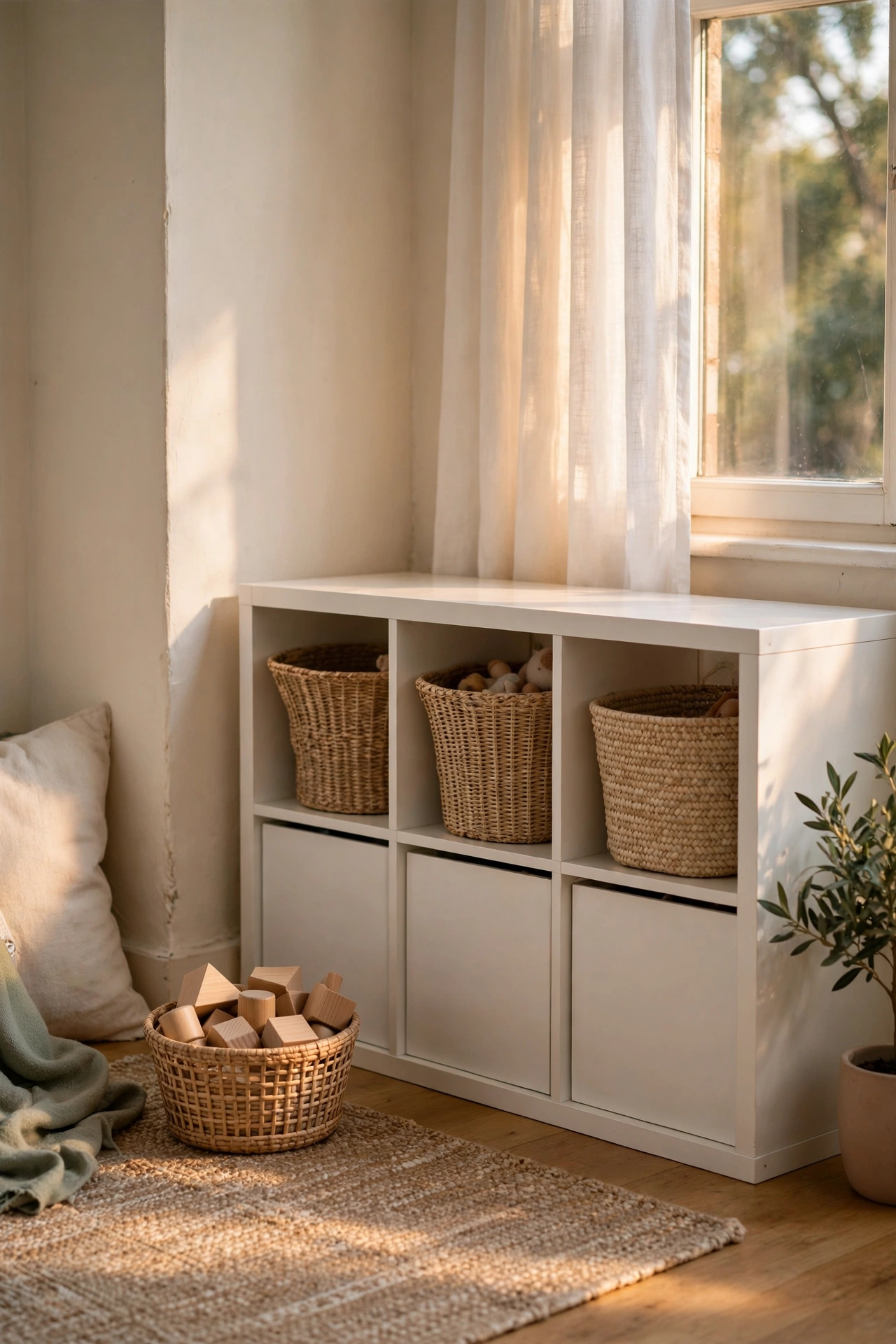
The zone only works if putting toys away is easier than leaving them out. That means open bins, not lidded boxes with latches. Low shelves kids can actually reach. Broad categories instead of fussy sorting, because no four year old is going to file toys by type. Think big labeled bins: blocks, cars, dolls, art stuff, random. If a tired mom and a tired toddler can both do it in the dark, the system is right.
This is also where smart storage earns its keep. A living room corner with pretty woven baskets or a low cube shelf looks intentional instead of chaotic, and it makes the nightly closing shift dramatically faster when every toy has an obvious home. If you want ideas for storage that actually looks good in a grown up living room, check out toy storage ideas that hide the mess. And if you have a dedicated playroom, playroom organization ideas that really work will help you set up zones inside the zone so even the playroom stays manageable.
Step 4: Clean One Room a Day, Not the Whole House
Give each weekday one focus room. The whole house gets attention every week without any single day feeling overwhelming.
The reason most of us fall behind on cleaning is that we think of it as one giant job called “clean the house.” That job is so big and vague that we avoid starting it, and then we try to do all of it on Saturday, and then we spend Saturday resentful and exhausted. The one room a day rotation breaks the giant job into tiny ones. Monday is bathrooms. Tuesday is the kitchen deep clean. Wednesday is bedrooms. Thursday is living areas. Friday is floors and laundry catch up. Each day’s job takes twenty to thirty minutes, tops, because you are only doing one room.
Here is the beautiful part. Your daily maintenance, the closing shift and the quick resets, keeps everything at a decent baseline. The rotation just adds the deeper layer, one room at a time. The bathroom gets its weekly scrub on Monday. The kitchen gets the inside of the microwave and the stovetop detail on Tuesday. Nothing ever gets truly disgusting because nothing ever goes more than a week without attention. And you never again lose an entire Saturday to cleaning, which might be the greatest gift of all.
Make the rotation fit your actual week
Do not copy someone else’s schedule off the internet. Look at your week and assign rooms to the days that make sense. If Tuesdays are chaotic with activities, make Tuesday the lightest room. If you work from home on Fridays, maybe Friday is floors because you are already there. The specific assignment does not matter. What matters is that every room has a day, the list is written down somewhere visible, and the daily job is small enough that you will actually do it when you are tired.
And give yourself full permission to skip a day when life happens. Sick kid, terrible night, surprise visitors, everyone gets a stomach bug at once. The rotation will still be there tomorrow. One missed bathroom Monday does not ruin the system. It just means the bathroom waits until next Monday, and guess what, it will survive. The system works because it is forgiving, not because it is rigid. If you want inspiration for making bedrooms feel calm and restful on bedroom day, cozy fall bedroom ideas has lovely ideas for bedding and layout that make the room feel like a retreat instead of a chore.
Step 5: Build a Morning Launch Pad
Set up one spot by the door where backpacks, shoes, jackets, and tomorrow’s essentials live. Mornings stop being a scavenger hunt.
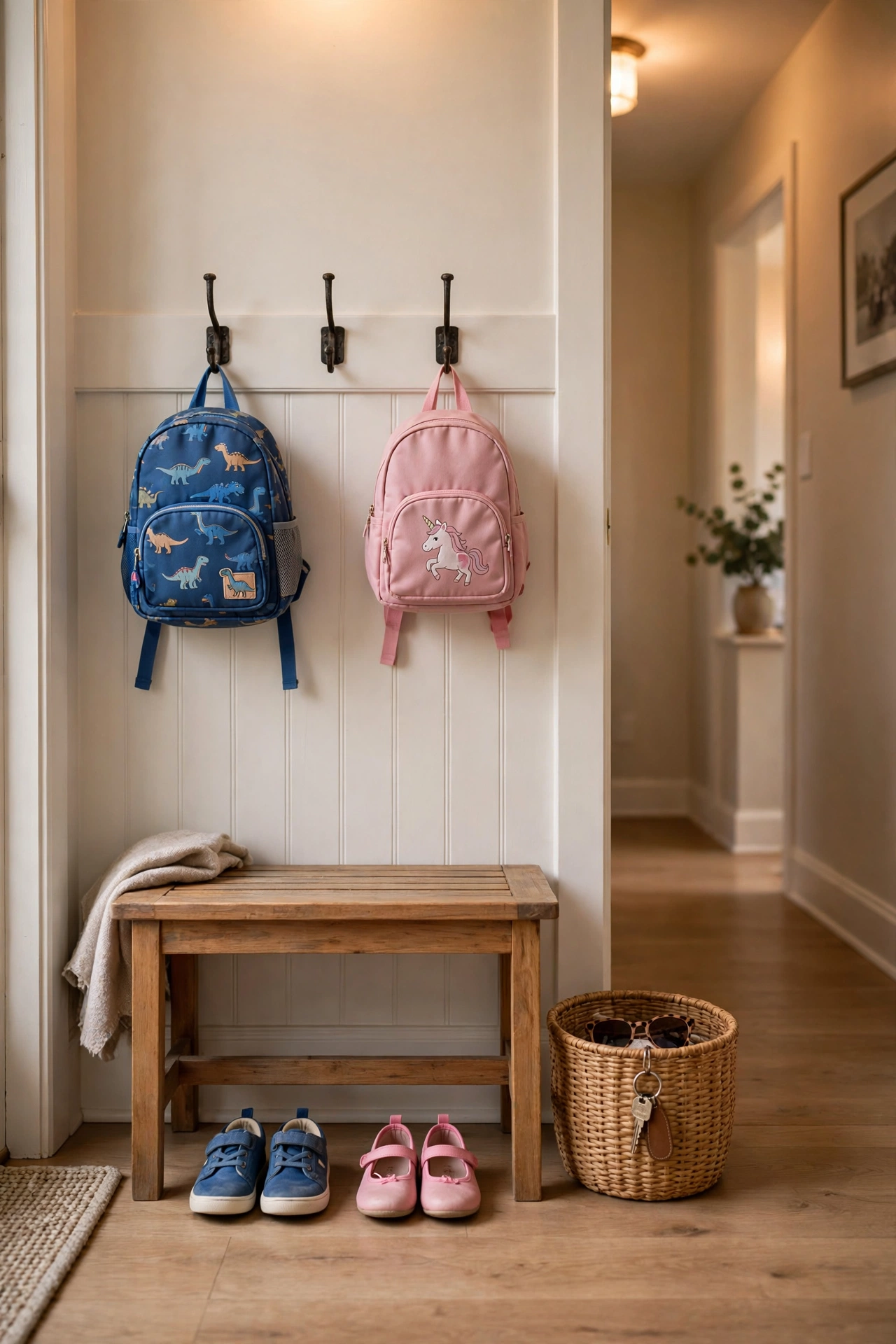
So much household chaos is really just morning chaos wearing a disguise. You cannot find one shoe. The backpack is still in the car. The permission slip is somewhere, possibly in the twilight zone. Everyone is yelling, everyone is late, and the day starts with adrenaline instead of calm. A launch pad fixes this with almost embarrassing simplicity. Pick a spot near the door you use most. Put a bench or a row of hooks there. Add a basket or two. That is the launch pad, and everything needed for the next day lands there the night before.
The magic is in the “night before” part, which ties right back to your closing shift. As part of shutting down the house, you load the launch pad. Backpacks packed and by the door. Shoes paired underneath. Jackets on hooks. Keys and wallet in the basket. Outfits picked out and laid out, because deciding what a four year old will wear at 7am is a negotiation nobody has energy for. When morning comes, there is nothing to find, nothing to pack, nothing to argue about. You just launch.
Keep it small and ruthless
The launch pad only works if it stays clear. The minute it becomes a dumping ground for mail, random toys, and seventeen unmatched mittens, it stops working. One hook per person. One basket per kid. If something does not have a job in the morning routine, it does not live at the launch pad. Purge it weekly, ideally during your Friday rotation, and be ruthless. An entryway that holds only what you need for tomorrow morning is one of the calmest sights in a family home.

Step 6: Set Your “Good Enough” Threshold on Purpose
Decide in advance what clean enough looks like, and stop when you hit it. Vague standards are what keep you cleaning forever.
Here is a question nobody asks but everybody should. What does “clean” actually mean in your house? If you cannot answer that specifically, you will never feel done, because done has no definition. You will wipe the same counter three times. You will reorganize a drawer that was fine. You will spend forty five minutes in a room that needed fifteen. Not because the room needed it, but because you had no finish line.
So let us draw the finish line right now. For the living areas, clean enough means: floors clear, toys in bins, cushions straight, surfaces wiped, trash out. That is it. It does not mean baseboards dusted or windows washed or the couch vacuumed under the cushions. Those are rotation jobs or seasonal jobs. Daily clean enough is about visual calm, because visual calm is what your nervous system actually responds to. When the big surfaces are clear, your brain reads the room as clean, even if the inside of the junk drawer is still a disaster. And that is fine. The junk drawer is not hurting anyone.
Write it down and post it
This sounds silly but it works. Write your good enough list for each main room on an index card and stick it inside a cabinet door. When you are doing your closing shift or a five minute reset, glance at the card. Done means the card is done, not that the room is perfect. This one habit short circuits the perfectionism loop that keeps so many of us cleaning long past the point of diminishing returns. You are not lowering your standards. You are defining them, which is actually a much higher standard than “clean until I collapse.”
Step 7: Get the Kids Involved by Age
Give every child real jobs matched to their age. Kids who help clean grow into adults who can run a home.
Let us be honest about something. A lot of us clean up after our kids because it is faster. It is faster in the moment, absolutely. But it teaches them that messes magically disappear, it doubles your workload, and it breeds a quiet resentment that builds over years. The alternative is slower at first and life changing eventually. Kids as young as eighteen months can carry a toy to a bin. That is not wishful thinking, that is developmental reality. They want to help. They love being capable. Our job is to give them jobs they can actually succeed at and then let them do it imperfectly.
The key phrase is “matched to their age.” A two year old can put blocks in a bucket, throw trash in the can, and wipe a table with a damp cloth (badly, and that is fine). A four year old can sort laundry by color, dust baseboards with a sock on their hand, and set the table. A six year old can vacuum a room, fold simple laundry, and clean a bathroom mirror. An eight year old can load the dishwasher properly, take out trash, and tidy an entire room solo. None of this will be done to adult standards. That is not the point. The point is participation, habit, and the slow building of competence.
Make helping the path of least resistance
Kids will help more when helping is easy. Step stools at sinks. Kid height hooks. Bins they can reach without asking. Cleaning supplies in a caddy they are allowed to use. And make it social, not solitary. “Let us race to see who can pick up ten things first” beats “go clean your room” every time. Put on music. Be silly about it. Thank them specifically, not generically. “You got every single car into the bin, that was amazing work” lands harder than “good job.” And when they do it badly, resist the urge to redo it in front of them. A streaky mirror cleaned by a six year old is a victory. Redoing it teaches them that their effort was not good enough, and they will stop offering.
Try it tonight: the 20 minute whole house reset
Do not wait for the perfect moment. Tonight, after the kids are down, set a timer for twenty minutes and do a speed round through your three main living areas. Kitchen: dishes in the dishwasher, counters wiped, table cleared. Living room: every toy into a bin or basket, cushions straightened, blankets folded. Entryway: shoes lined up, backpacks by the door, tomorrow’s essentials staged. Do not organize anything. Do not deep clean anything. Just reset the surfaces. When the timer rings, stop and look around. That calm you feel? That is your new morning. Do it again tomorrow night, and the night after. This one habit will change your home life more than any organizing product ever could.

Mistakes to Avoid
Before you go build your new rhythm, let us talk about the traps. These are the mistakes I see moms make over and over, myself included, and every one of them will quietly sabotage an otherwise great system.
Marathon cleaning sessions
The Saturday deep clean sounds productive but it is a trap. You spend four hours scrubbing, the kids undo it in forty five minutes, and you spend the rest of the weekend resentful. Marathon sessions also teach your brain that cleaning is this enormous miserable event, which makes you dread starting next time. Small daily maintenance always beats occasional heroic efforts. If you find yourself “saving up” mess for one big session, that is the signal to switch to the rotation instead.
Cleaning up after the kids instead of with them
Yes, it is faster to do it yourself. But every time you silently pick up behind them, you are signing up to do it forever. Worse, you are teaching them that messes vanish by magic and that cleaning is mom’s job alone. It will feel slower for about two weeks. Then they get faster, you get help, and the whole family owns the house together. The short term inconvenience buys you years of shared responsibility. Take the deal.
Building systems too complicated to maintain
Color coded labels for seventeen toy categories. A chore chart with forty boxes. A cleaning schedule that requires a spreadsheet. If a system needs more energy to maintain than the mess it prevents, it will die within a month. The best system is the simplest one you will actually do when you are tired. Broad bins beat fussy sorting. A short checklist beats a binder. When in doubt, simplify until it feels almost too easy. That is the sweet spot.
Buying organizing products before decluttering
This one gets almost everyone. The cute baskets will not fix the problem if the problem is too much stuff. Containers organize what you keep, but they cannot make excess disappear. Always purge first, then buy storage for what remains. Otherwise you end up with beautifully organized clutter, which is still clutter, just in matching bins. Do the hard part first. Future you will be so glad.
Comparing your home to childfree homes
Your friend with no kids has a spotless apartment. Your sister in law’s house looks like a showroom. Good for them. They are playing a different game with different rules. Comparing your lived in family home to a kid free space is like comparing your marathon time to someone who took a taxi. It is not a meaningful comparison and it only exists to make you feel bad. Judge your home against one standard only: does it work for your family? If yes, you are winning.
All or nothing thinking
“I do not have time to clean the whole kitchen, so I will not start.” “I missed two days of the rotation, so the system is ruined.” This thinking kills more good habits than laziness ever could. A half done reset is infinitely better than no reset. A skipped day is just a skipped day, not a failure. The moms with the calmest houses are not the ones who never miss. They are the ones who miss and simply start again the next day without drama.
What About…?
What about if I work full time and barely have evenings?
Then this system was made for you, honestly. Nothing here requires big blocks of time. The closing shift is fifteen minutes. The resets are five. The rotation is twenty to thirty minutes on one room. That is the whole point. Working moms do not need a system that assumes free afternoons. They need one that fits into the cracks. If even fifteen minutes feels like too much some nights, do a five minute version. Kitchen only. Or living room only. Something always beats nothing, and the habit of showing up matters more than the minutes.
What about if we live in a tiny house or apartment?
Small spaces actually make this easier, not harder. Less square footage means the closing shift takes ten minutes instead of fifteen. It means one toy zone covers the whole main living area. The real challenge in small homes is the stuff volume, because there is nowhere for excess to hide. So be extra ruthless about the inflow. One in, one out is not optional in a small space, it is survival. Use vertical storage, under bed bins, and over door organizers to squeeze function out of every inch. Small homes reward simplicity, which is exactly what this plan is built on.
What about if my partner does not see the mess?
Oh, this one. First, you are not imagining it and you are definitely not alone. A lot of partners genuinely do not register clutter the same way, and it is maddening. The fix is not hinting or hoping. It is specific, kind, direct asks tied to the system. Not “help me clean,” which is vague and easy to dodge, but “can you own the kitchen closing shift while I do the living room?” Give him a defined job with a clear finish line. Most partners do better with concrete tasks than with general vibes. And if he does it differently than you would, let it go. Done by him beats perfect by you, every time.
What about if my kids are under three?
Then lower every expectation in this article by about half and give yourself enormous grace. Under three, you are not running a system, you are surviving a beautiful storm. The closing shift still works, and it might be the only piece you do for a while. That is completely fine. Toddlers can still carry one toy to a bin, which is genuinely helpful and genuinely adorable. But the deep rotation, the launch pad perfection, the kid powered cleaning crew? That comes later. Right now your only job is keeping the main areas functional and keeping yourself sane. The systems will be waiting when you are ready.
Here is the truth I wish someone had told me sooner. You do not need a perfect house. You need a house that does not stress you out. There is an enormous difference between those two things, and most of us waste years chasing the first one when the second one was always the real prize. A calm kitchen in the morning. A living room you can sit in without wincing. An entryway that does not ambush you. That is the whole dream, and it is built from fifteen minutes a night and a few small habits, not from perfection.
Start tonight. Set the timer. Reset three rooms. Wake up tomorrow to a house that feels like a deep breath. Then do it again. That is how calm homes are built, one ordinary evening at a time, by tired moms who decided that good enough is actually pretty wonderful.
With love and light
Get Fresh Home Ideas Every Week
Seasonal decor ideas, organizing tips, and cozy home inspiration, straight to your inbox.
More Parenting Ideas You Will Love
Keep reading for more systems that make family life calmer: