
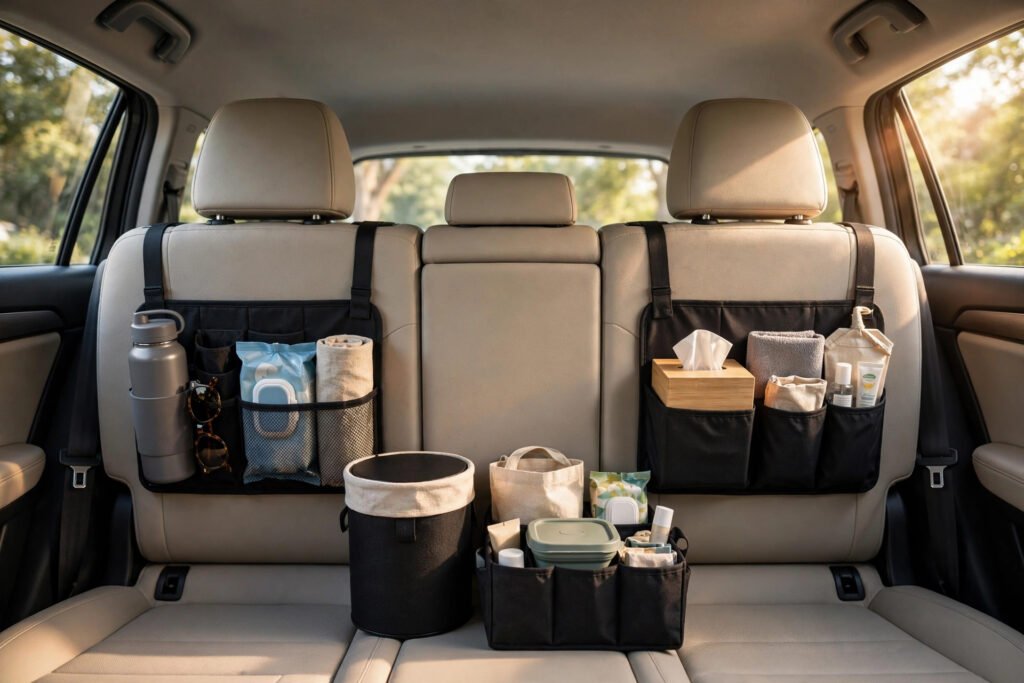
Open your car door right now and take an honest look. Is there a goldfish cracker graveyard under the car seat? A water bottle collection rolling around the floor? Three jackets, one stray shoe, a library book that was due last month, and something sticky you do not want to identify? If your car looks like a trash can on wheels, mama, you are in very good company.
Here is the thing: your car is basically a second home. Kids eat there, change there, do homework there, have meltdowns there, and leave a trail of their entire lives across the back seat. Of course it gets messy. But a messy car is also a stressful car. Every drive starts with moving junk off the seat. Every school pickup involves apologizing for the smell. This post gives you a simple, realistic system to keep your car clean with almost no effort: the zones, the caddies, the two minute reset, and the rules that actually stick with kids.
Love these ideas? Get more every week.
Join the newsletter for seasonal decor and cozy home inspiration.
TL;DR: A Car That Cleans Itself
- Give everything a zone: a trash spot, a snack spot, an entertainment spot. Mess happens when things have no home.
- Build a front seat caddy: wipes, bags, napkins, and a pen within your reach solve 90 percent of car messes on the spot.
- Contain the back seat: one back of seat organizer and one small bin per kid keeps their stuff off your floor.
- Rule: nothing stays overnight. Everyone carries their own stuff inside at the end of the day. Two minutes, done.
- Reset weekly: a five minute Sunday cleanout keeps the slow creep from turning back into chaos.
Why Cars Get Messy (It Is Physics, Not Failure)
Let us do the math on your car. Your kids spend maybe an hour a day in it, but that hour includes the messiest activities of their lives: eating, drinking, crafting, changing clothes, and emoting at full volume. A car is a small enclosed space with no storage, no trash can, and no sink, being used as a dining room, playroom, and locker room simultaneously. The miracle is not that it gets messy. The miracle is that any car with kids stays clean at all.
And unlike your house, the car never gets a natural reset. At home, you tidy the kitchen after dinner and the living room before bed. The car just accumulates. Monday’s granola bar wrapper is still there on Friday, joined by its friends. Without a system, the mess grows until the car feels gross, and then you avoid dealing with it because it feels overwhelming, and then it gets worse. Sound familiar?
The fix is not cleaning the car harder. It is giving the mess nowhere to go. Every system in this post follows one principle: contain it at the source. Trash goes in the trash spot immediately. Snacks stay in the snack zone. When everything has a home, the car practically maintains itself. You are not fighting entropy anymore. You are just doing tiny resets.
And here is the mindset shift that makes it stick: you are not trying to keep the car spotless. You are trying to keep it pleasant. There will still be crumbs. There will still be the occasional sticky spot. The goal is a car you can get into without sighing, give a friend a ride in without apologizing, and clean in five minutes instead of an hour. Pleasant is achievable. Perfect is not, and perfect was never the point.
The Plan: Your Car Organization System
Step 1: Do One Big Reset to Start Fresh
You cannot organize clutter. Clear the car completely once, then build the system on a clean slate.
Before you buy a single organizer, empty the car. All of it. Pull everything out onto the driveway or into the garage. Yes, everything, including whatever is under the seats that you have been pretending not to see. Sort it into piles: trash, belongs in the house, belongs in the car, and mystery items to ask the kids about.
This takes about 20 minutes and it is weirdly satisfying. You will find the missing library book, six hair ties, and enough loose change for a coffee. Once the car is empty, give it a quick vacuum and wipe down the sticky spots. Now you have a blank canvas. Every organizer you add from here goes into a clean car, which means the system starts working on day one instead of fighting old mess.
Do this reset with the kids if they are old enough. It is eye opening for them to see the full archaeological record of their car habits spread across the driveway. No lectures needed. The pile speaks for itself.
Step 2: Set Up a Trash System That Actually Gets Used
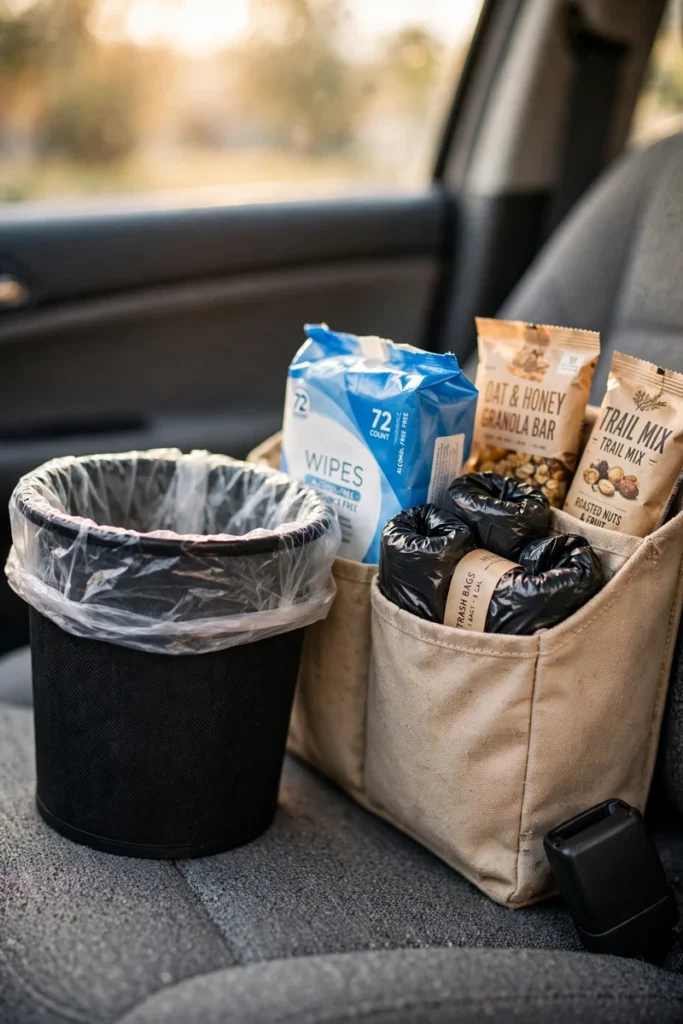
A car without a trash spot becomes a trash can. Give trash a home and the floor stays clean.
This is the highest impact change in the whole post. Most car mess is just trash with nowhere to go: wrappers, tissues, apple cores, receipts, broken crayons. A simple trash solution catches all of it. Hang a small trash bag or a compact car bin from the back of the front passenger headrest, or use a small lidded bin in the center console area. Line it with a grocery bag or a small trash bag so emptying it takes five seconds.
The key detail: it must be reachable from the back seat. If the kids cannot reach the trash spot from their car seats, it might as well not exist. Test it with them buckled in. Can they drop a wrapper in without unbuckling? If yes, you have a working system. If no, move it.
Make emptying it part of your routine, not a separate chore. Every time you get gas, empty the car trash. Gas station, trash out. Tie the new habit to an existing one and it happens automatically. A trash bin that never gets emptied just becomes a decorative trash pile, so this step matters as much as the bin itself.
Step 3: Build Your Front Seat Command Caddy
Keep a small caddy within your reach with wipes, bags, napkins, and first aid. Most car messes are fixable in 30 seconds if the supplies are right there.
The difference between a small spill and a permanent stain is usually about 90 seconds. Juice spills on the seat. If you have wipes in the door pocket, it is a non event. If the wipes are in the trunk under the stroller, it is a disaster. Your front seat caddy is your rapid response kit.
What goes in it: a pack of wet wipes, a roll of small trash bags, napkins or paper towels, a stain stick, band aids, hand sanitizer, a pen, and a few coins or a spare card for parking meters. Use a small caddy, pouch, or even a shower caddy from the dollar store. It lives in the passenger footwell or on the back of the center console, wherever you can grab it without thinking.
Refill it monthly. Wipes run out exactly when you need them most, so check the caddy on the first of the month when you do the rest of your resets. A stocked caddy is a superpower. An empty one is just clutter.
Step 4: Contain Each Kid’s Zone
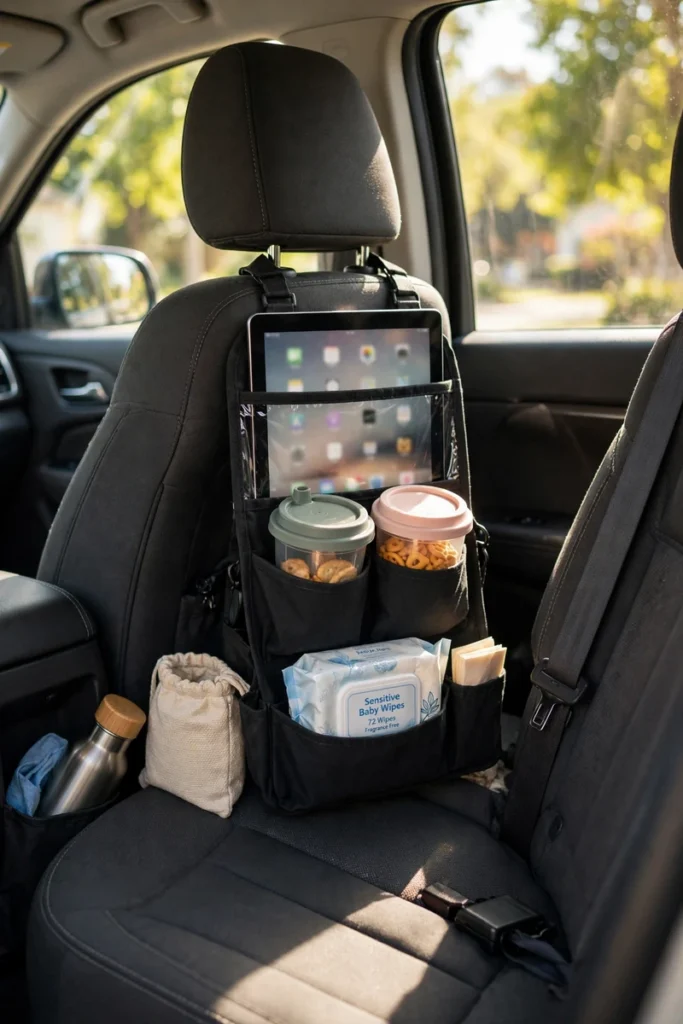
Give every kid one organizer and one small bin. Their stuff stays in their zone, not on your floor.
Back seat chaos usually comes from kids having nowhere to put things. The tablet slides off the seat. The coloring books spread everywhere. The water bottle rolls under your brake pedal. A back of seat organizer on each seatback solves most of this instantly. Tablets, books, headphones, and small toys each get a pocket. Everything is visible, reachable, and off the floor.
Add one small bin per kid for the loose stuff: the rocks, the Happy Meal toys, the treasures. A small plastic bin, a fabric cube, or even a gallon zip bag works. The rule is simple: if it does not fit in your bin, it does not live in the car. This one rule prevents the slow accumulation of random objects better than any lecture about cleaning up.
For babies and toddlers, the zone is simpler: a small bag with diapers, wipes, a change of clothes, and two quiet toys, clipped or stored where you can reach it from the front. Restock it weekly. There is nothing worse than reaching for a diaper that is not there.
Step 5: Tame the Trunk
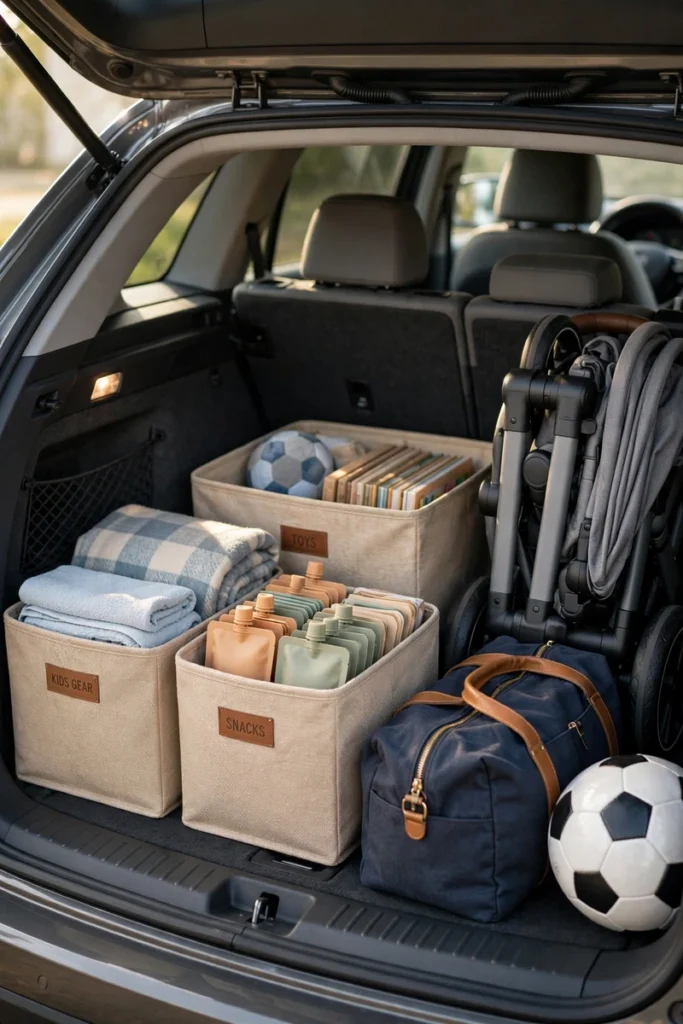
The trunk is not a storage unit. Divide it into zones and cap what lives there.
Trunks become black holes because everything tossed in the back just slides around and piles up. Fix it with containment: one or two trunk organizers or sturdy bins. Common zones that earn their space: emergency kit (jumper cables, blanket, first aid), sports gear (only the current season), stroller, and reusable shopping bags. Everything else has to justify its spot.
Use bins with lids or trunk organizers with dividers so things stay put when you turn corners. A cargo net or a couple of bungee cords keeps bigger items from sliding. And be ruthless about seasonal rotation. The sled does not live in the trunk in July. The beach bag does not live there in January. When the season changes, the trunk changes.
Keep one empty bin or one empty section always. That is your landing pad for groceries, library books, and the stuff of life that needs to ride along temporarily. Without an intentional empty space, temporary items just pile on top of everything else and become permanent.
Step 6: Make the Nothing Stays Overnight Rule
The one rule that maintains the whole system: everyone carries their own stuff inside at the end of the day.
This is the habit that makes everything else work. Every evening, or at the last car ride of the day, everyone takes their belongings inside. Backpacks, jackets, water bottles, bins, trash. It takes two minutes. The car starts every morning empty and clean, and the mess never gets a chance to compound.
For little kids, make it a game: “what belongs to you? Grab it!” For older kids, it is just the rule, like brushing teeth. No negotiating, no “I will get it tomorrow.” Tomorrow’s stuff piles on top of today’s stuff, and that is exactly how the trash can on wheels comes back.
Pair it with something you already do. When you walk in the door, everyone does a pocket and seat check before coming inside. Or make it part of the after school routine landing zone: backpacks go on hooks, car bins go on the shelf, trash goes in the kitchen garbage. The car reset and the house reset become one smooth motion.
Step 7: Do a Five Minute Weekly Reset
Systems drift. A five minute weekly cleanout catches the drift before it becomes chaos.
Even with perfect zones and rules, small messes sneak in. A wrapper missed the trash bin. A new toy migrated to the back seat. Crumbs happen. Once a week, spend five minutes resetting: empty the trash, shake out the bins, wipe the sticky spots, restock the caddy, and pull out anything that does not belong.
Sunday works well for most families. Do it while the kids are eating breakfast or while you wait for something else. Five minutes with a trash bag and a pack of wipes, and the car feels brand new. It is the same principle as the quick house reset that keeps your home calm: tiny, regular maintenance beats heroic deep cleans every time.
If you find the same problem every week, fix the system, not the symptom. Trash always on the floor? The bin is in the wrong spot. Crumbs everywhere? Snacks need a better container. The weekly reset is also a diagnostic. Listen to what the mess is telling you.
Car Snack Rules That Prevent Most of the Mess
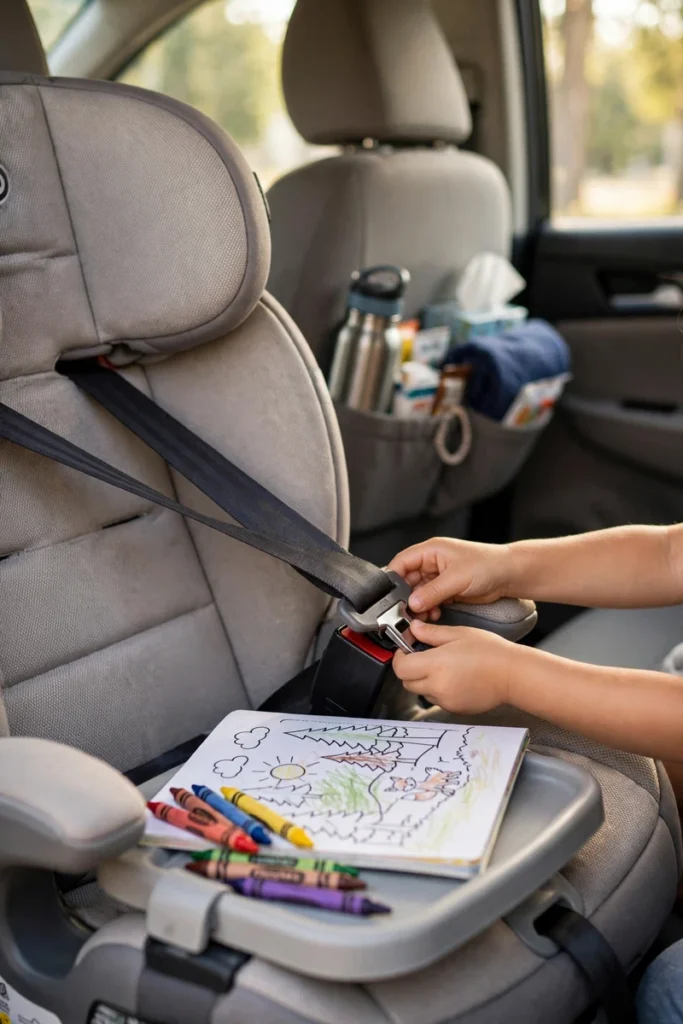
Let us be real: kids are going to eat in the car. Banning car snacks entirely works for about three days, and then someone is screaming with hunger on the way home from soccer. Instead of fighting it, set snack rules that keep the mess contained.
Rule one: lidded containers only. No open bags, no loose crackers in little hands, no boxes tipped upside down. Every car snack goes in a container with a lid: silicone snack cups, small bento boxes, zip bags at minimum. When the container tips over (and it will), the damage is contained. This one rule eliminates the vast majority of car crumb disasters.
Rule two: pick car friendly foods. Some foods are car foods and some are definitely not. Good car foods: cheese sticks, apple slices, crackers in a cup, dry cereal, grapes, granola bars. Bad car foods: yogurt in a cup, anything with red sauce, chocolate on a hot day, powdered donuts, open cups of anything. You do not need a printed list. Just ask yourself: if this spills, how bad is it? If the answer is terrible, it stays home.
Rule three: drinks have lids and stay in cupholders. Open cups in a moving car are just spills waiting to happen. Every drink gets a spill proof lid, and every drink lives in a cupholder while the car is moving. If your car is short on cupholders for the number of kids, a backseat cupholder expander is a cheap fix that prevents a lot of grief.
Rule four: the crumb check. When kids finish their snack, they do a quick lap check: crumbs brushed into their hand and dropped in the trash bag, container closed and back in the bin. It takes ten seconds and keeps the slow crumb buildup from happening. Little kids think this is hilarious. Lean into it.
Seasonal Car Swaps
Your car system needs a seasonal refresh, just like your closet. What the car needs in January is different from what it needs in July. Do a quick swap when the seasons change and the system keeps working year round.
Winter kit: Add a blanket, extra mittens and hats (kids lose them constantly), a small shovel or brush, hand warmers, and lip balm. Winter means wet boots, so a boot tray or an old towel on the floor of the back seat saves your floors. Keep a change of dry socks per kid in their bin. Wet socks are a special kind of misery.
Summer kit: Swap in sunscreen, bug spray, hats, swimsuits and towels if you are pool people, and extra water bottles. Heat melts things, so do a mid summer check for crayons, lip balms, and snacks that have become science experiments in the heat. A small cooler bag for the trunk keeps groceries safe on hot days.
School year vs summer: During the school year, the car carries backpacks, library books, and activity gear. In summer, it carries swim bags, bikes, and park toys. Do a swap at the start and end of summer: school stuff comes inside, summer stuff goes in. The trunk zones change, the kid bins change, and the car stays matched to real life.
Put seasonal swaps on your calendar so they actually happen: one in late fall, one in late spring. Ten minutes, twice a year, and your car is always ready for the season you are actually in.
Teaching Kids the System Without Nagging
A car system only works if the kids use it, and kids only use systems they understand. The good news: car rules are some of the easiest for kids to learn, because the car is small and the routine is short. Here is how to teach it without becoming a backseat nag.
Do one ride along tutorial. On a calm weekend drive, walk them through the system once. “This is the trash bag, it is right here where you can reach it. Your bin is here for your stuff. When we get home, we all grab our things.” One clear tour beats fifty reminders. Kids rise to clear expectations.
Make the exit routine a chant. Little kids love rituals. Create a silly goodbye chant for getting out of the car: “Trash in the bag, stuff in the bin, grab your things and head on in!” Say it together every time for a week. By week two, they will say it themselves. By week three, you will not need to say it at all.
Notice it working. When your kid drops a wrapper in the trash bag without being asked, say so. “You remembered the trash bag all by yourself. That keeps our car so nice.” Kids repeat what gets noticed. A little specific praise does more than any reward chart.
Let natural consequences teach. If the tablet ends up on the floor because it was not in the organizer pocket, the tablet takes a break. If the snack cup was left open and crackers spilled, that snack does not ride along tomorrow. Calm, immediate, related. You do not need to lecture. The consequence teaches.
Try It Tonight: The Two Minute Car Sweep
Do not buy anything yet. Tonight, just do this:
- Grab a trash bag and walk around the car. Throw away every wrapper, tissue, and mystery item. Two minutes.
- Carry one armload inside. Jackets, water bottles, books, toys. Everything that belongs in the house.
- Hang one grocery bag from the passenger headrest as a starter trash bag. Instant trash system.
- Put a pack of wipes in the driver door pocket. Instant spill response.
Tomorrow morning, your car will feel different. Then add the organizers this weekend, one zone at a time.
Mistakes to Avoid
Buying organizers before doing the big reset. Organizers do not fix clutter. They just give clutter nicer containers. Empty the car first, then buy only what the clean car actually needs. Most families need far fewer organizers than they think.
Choosing cute over reachable. The perfect trash bin fails if the kids cannot reach it buckled in. The ideal caddy fails if you cannot grab it from the driver seat. Always test every placement from the actual seated positions before committing. Function beats form in a car, every time.
Letting snacks run wild. Uncontained snacking is the number one source of car mess. If your kids eat in the car (and whose do not), snacks need containers with lids and a crumb plan. A silicone snack cup with a lid beats an open bag every time. And keep the really crumbly or melty stuff for home. Your upholstery will thank you.
Skipping the overnight rule “just this once.” “Just this once” is how the back seat becomes a storage unit. The rule works because it is absolute. The night you skip it, tomorrow’s mess piles on top, and within a week you are back to the trash can on wheels. Two minutes. Every night. Non negotiable.
Forgetting the trunk. Everyone organizes the seats and ignores the trunk, and then the trunk becomes where things go to die. Include it in the weekly reset. Open it, glance in, pull out what does not belong. Thirty seconds keeps it honest.
What About…?
What about long road trips? Does the system survive those? Road trips need a trip version of the system, not the everyday one. Pack a dedicated trip bag per kid with new activities, double the trash bags, and plan a trash stop every couple of hours. Accept that the car will get messy on a road trip. The system is for everyday life. Do a full reset when you get home and move on.
What about sticky spills that already happened? For fresh spills, blot (do not rub) with a damp cloth and a little dish soap. For old mystery stickiness, a paste of baking soda and water, left for 15 minutes then wiped off, works wonders on most car upholstery. Then put the wipes in the door pocket so the next one never becomes permanent.
What about kids who just will not follow the system? Make it theirs, not yours. Let each kid pick their own bin color and decorate their organizer pocket. Kids who chose the system defend the system. And keep consequences natural and immediate: the tablet lives in the organizer pocket, so if it is on the floor, it gets a time out. Natural beats nagging.
What about two cars, or grandparents’ cars? Do not try to run the full system in every vehicle. Put the full system in the primary kid car. In the second car, just do the minimum: a trash bag, wipes in the door, and the overnight rule. Good enough is good enough for the backup car.
Here is to opening your car door without flinching. Start with tonight’s two minute sweep, add one zone at a time, and enjoy the deeply underrated pleasure of a car that smells normal. Your future self, buckling kids into a clean back seat on a busy morning, says thank you.
Get Fresh Home Ideas Every Week
Seasonal decor ideas, organizing tips, and cozy home inspiration, straight to your inbox.
More Parenting Ideas You Will Love
Keep reading for more calm-home inspiration: