

Some entryways you walk through. This one you walk into, the way you walk into a room in a beautiful old hotel, and everything slows down for a second. The walls are a deep, moody green. The trim is crisp white. At the far end, black French doors glow with daylight, and overhead a tiered rattan pendant burns warm against all that green, like a lantern hung just for you. Below it, a cream vintage runner pulls you down light oak floors toward the light. I saw a hall styled like this and could not stop thinking about it for a week. This post is me working out why it works so well, piece by piece, so any of us can borrow it.
The palette is small and it is doing all the heavy lifting. Deep green on the walls. Black on the doors and in a few strong accents. Warm brass repeated in the mirror frame, the sconces and the little dome lamp. Natural texture from rattan, oak and olive branches. Cream in the runner to keep the whole thing soft instead of heavy. Nothing matches exactly, but everything speaks the same language. If your entry currently feels like a pass through on the way to somewhere better, these are the same bones I reach for in my fall front entryway ideas, taken deeper, darker and moodier.
You do not need a grand hall to live in this look. Every idea below has been translated for real houses, narrow halls, small apartments and the little patch of wall beside most front doors. Start with the green and the light, then add the big pieces, then the small styling touches, and stop wherever your space says stop. Even three of these ideas, done well, will change how your home greets you. Here are nineteen ways in.
Love these ideas? Get more every week.
Join the newsletter for seasonal decor and cozy home inspiration.
The Green and the Bones
1. Paint the Walls a Deep Moody Green
Everything in this look hangs on the green. It needs to be deep, almost forest at night, the kind of green that looks nearly black in the evening and rich and leafy in daylight. A green like that changes what an entry is for. It stops being a corridor and becomes a room with a mood. Paint the walls and let the color wrap the whole space, around corners and right up to the doors at the end. The darkness is not a risk here. It is the entire point. Pale walls would make the brass and rattan look like decorations. Against this green, they look like they belong to the house itself.
Choose a green with a little warmth in it rather than a blue leaning one, so the lamplight stays golden on the walls. Test it on the wall that gets the least light and live with it for a full day before you commit. Deep greens shift more between morning and evening than any other color I know. This is also the move that quietly solves the clutter problem, because a dark, calm backdrop makes everyday entry mess read as shadow instead of chaos, one of the lessons in my roundup of fall decor mistakes. One color, every wall, no accent wall. The drama comes from commitment.

Shop This Look
This post contains affiliate links. If you buy through them, I may earn a small commission at no extra cost to you.
A few favorites featured in the ideas above:


2. Set a Matte Black Vase Full of Olive Branches
Every moody room needs one soft, living shape, and in this entry it sits on the console in a matte black vase. Olive branches are perfect for the job. Their leaves are a silvery green that echoes the walls without matching them, and the branches arc and wander in a way that no stiff arrangement ever does. The black vase matters just as much as the branches. Matte black against deep green is a whisper rather than a shout, and it quietly ties the console to the black doors at the end of the hall. One vase, one kind of branch, nothing else competing. That restraint is what makes it look expensive.
Go taller than feels safe. Branches that reach well above the mirror line give the whole vignette its height and keep the console from looking like a row of small objects. Fresh olive branches last a surprisingly long time in water, and good faux stems earn their keep here because an entry gets bumped, brushed and opened to winter air. Trim the stems at slightly different lengths so the arrangement fans out like it grew that way. If olive is hard to find, eucalyptus or any loose, wandering greenery gives the same soft outline against the green.

3. Let Black French Doors Steal the Show
At the far end of the hall, the black French doors do the job a painting does in other rooms. They are the focal point everything else points toward. The glass panes pull daylight deep into a dark space, so the green never feels like a cave, and the black frames give the eye a strong, graphic finish line at the end of the runner. Even the view matters. Greenery beyond the glass, a garden or even a tree on the street, becomes part of the decor, a living picture that changes with the seasons and the weather.
If you are lucky enough to have French doors or a glass panel door anywhere near your entry, paint the frames black and let them lead. If your hall ends in a solid door or a plain wall, borrow the effect. Paint a standard door black, or hang a tall black framed mirror or a pair of black framed prints at the end of the hall to create the same dark punctuation mark. The lesson is the contrast. A deep green room needs one strong dark shape to organize itself around, and glass, real or mirrored, keeps that shape from swallowing the light.

4. Style a Sculptural Oak Console Against the Green
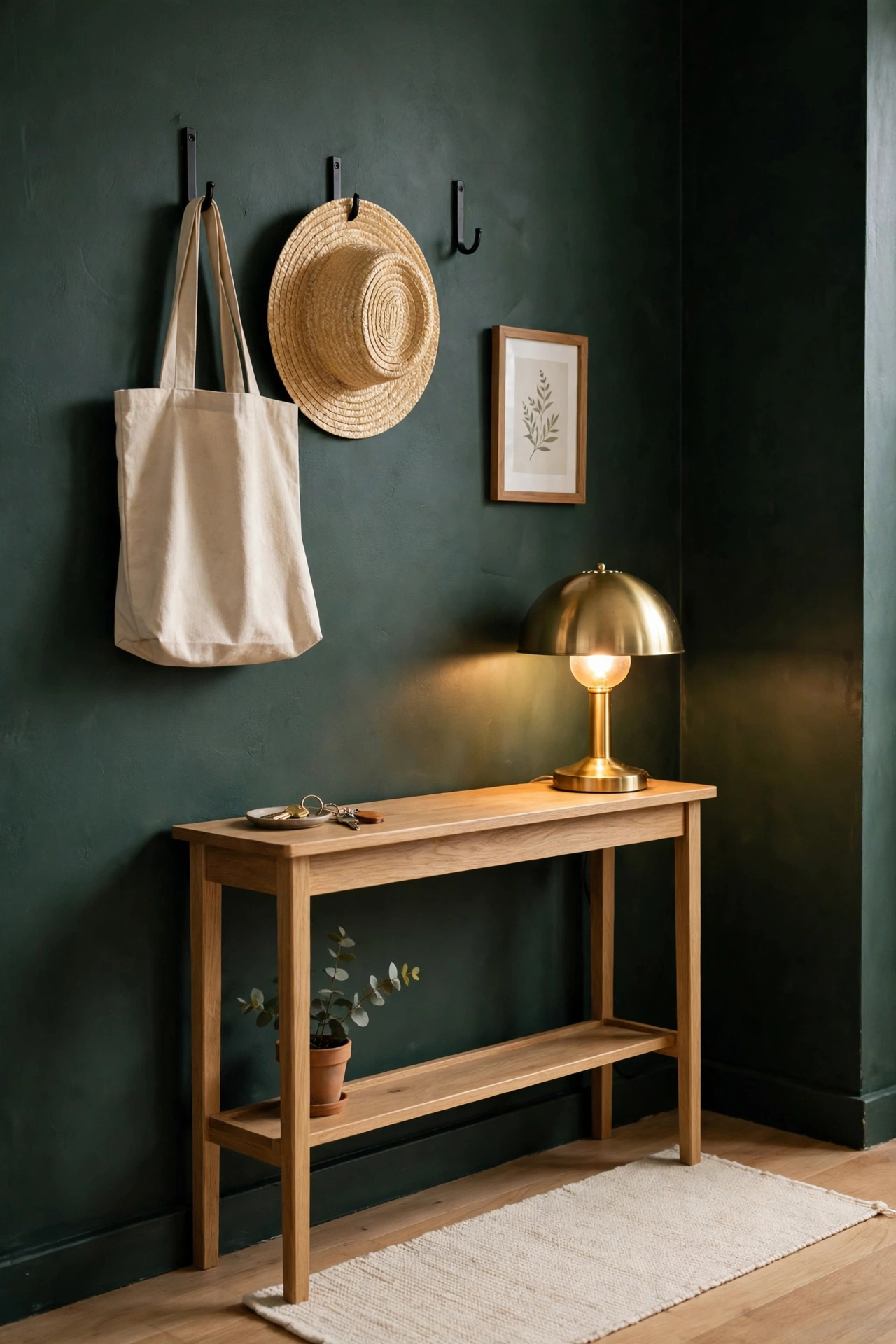
The console is the one piece of furniture this look truly needs, and it should have some shape to it. A light oak table with curved legs, a soft arch in the stretcher or a gentle bow in the top will do more for this room than any amount of small decor. Against the flat, dark wall, those curves cast little shadows and catch the lamplight, so the piece reads almost like sculpture. Light oak is the right wood here. It sits in the same warm family as the rattan and the floors, and it glows against the green instead of disappearing into it the way a dark walnut table would.
In a farmhouse style entry this is easy to picture, but the shape matters more than the style label. What you want is one honest piece of pale wood with a silhouette, deep enough for a lamp and a vase, shallow enough to leave the walkway clear. It is the same warm wood instinct I use all through my cozy rustic living room, just pared down to a single statement piece. Style the top with the black vase, the dome lamp and a small stack of books, then leave the rest empty. Empty space on a console is not wasted space. It is what makes the styled pieces count.

5. Stack Books and Candles Into a Console Vignette
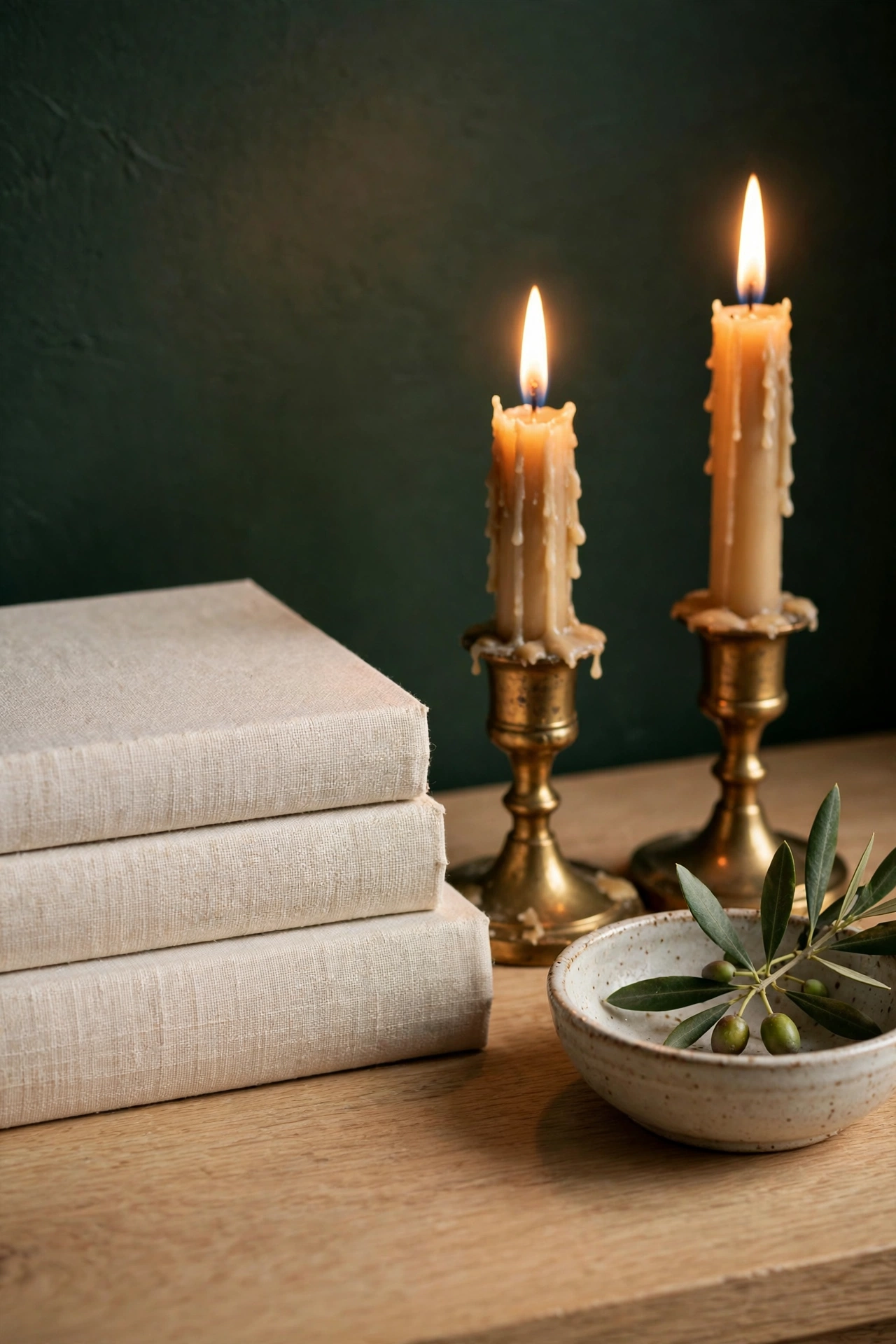
Once the big pieces are in place, the console top gets one small, deliberate arrangement. A short stack of books, two or three at most, with cloth covers in cream, linen or soft black. A pair of candles in brass holders beside them. Maybe a small ceramic bowl for keys, because an entry still has to work for a living. That is the whole vignette. It works because it mixes three things the eye loves together: height from the candles, weight from the books and one useful object that proves real people live here. Styled this way, the console feels collected over time rather than decorated in a day.
Think of the console top the way you would style a mantel, in a loose triangle of tall, medium and low. My approach to styling a fall mantel translates almost exactly: anchor one end with height, balance it with weight at the other end, and leave breathing room in the middle. Keep the palette inside the vignette as tight as the room palette, cream, brass, black and green. The moment a bright color sneaks in on a book spine or a candle, the spell thins. Turn colorful spines to the wall or slip them into simple linen covers if you love the books themselves.
The Glow: Rattan, Brass and Lamplight
6. Hang a Tiered Rattan Pendant Overhead
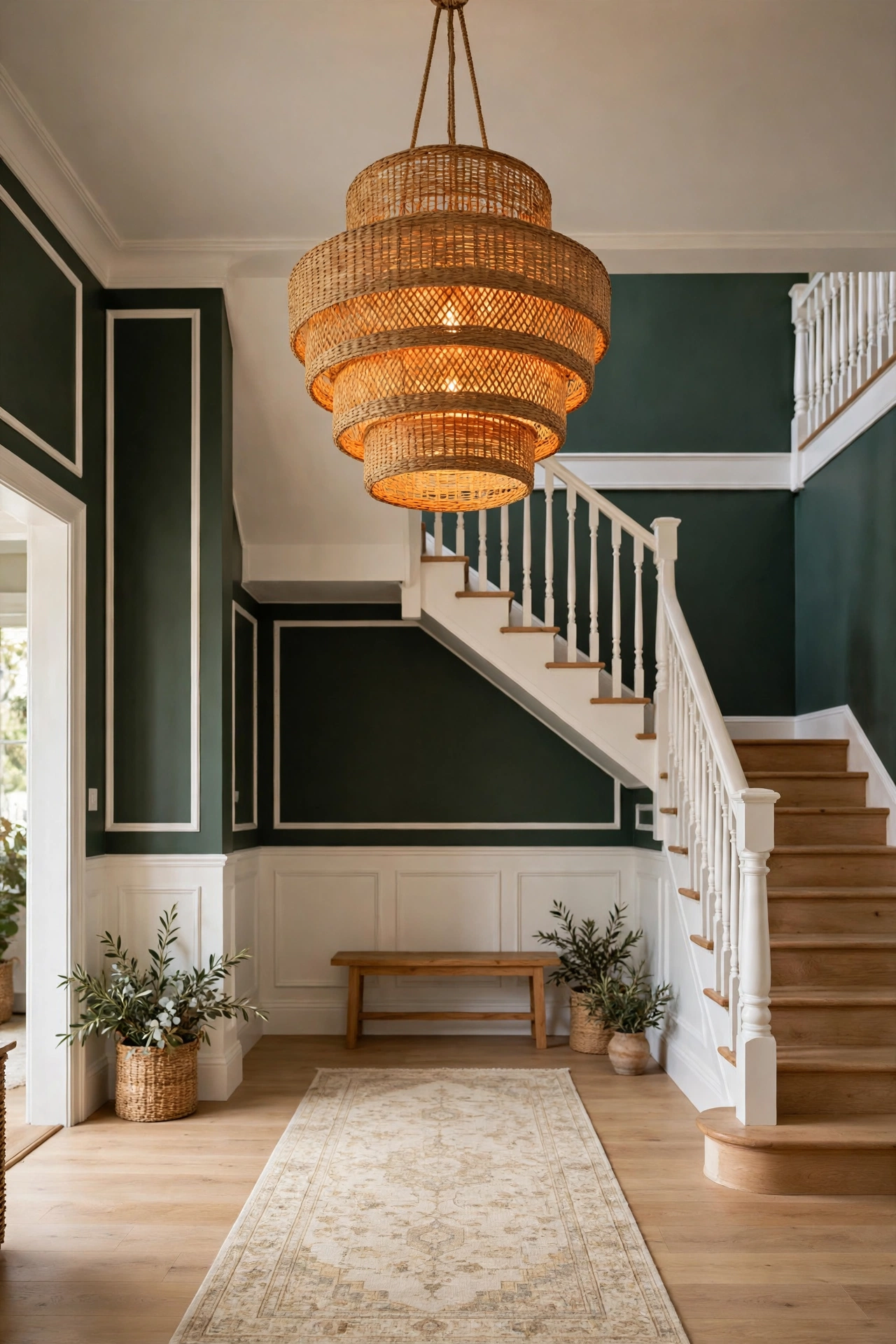
If the green is the mood, the rattan pendant is the heartbeat. A big tiered pendant, layer over layer of woven natural fiber, hangs in the center of the hall and glows from within when it is lit. The weave softens the light and throws it warm in every direction, which is exactly what a deep green room needs at head height. In an entry with stairs, it does even more. It gives the staircase a lantern to climb toward, and it fills the tall, awkward air above a stairwell with something beautiful to look up at. Scale is everything here. The pendant should feel slightly too large for the space, in the way a chandelier feels generous in a dining room.
Hang it low enough to be part of the room rather than part of the ceiling, while keeping clear headroom over the walkway and the swing of the door. One statement pendant beats a row of small fixtures in a hall every time, because it gives the eye a single warm sun to orbit. If your entry has a plain builder grade fixture, this swap is the fastest transformation in the whole post. Keep the bulb warm, around the color of candlelight, and put it on a dimmer if you can. At full brightness it welcomes guests. Dimmed low at night, it turns the hall into the coziest room in the house.
7. Hang a Wavy Arch Mirror in a Slim Brass Frame
Over the console hangs the piece everyone asks about: a tall mirror with a soft, wavy arch and the slimmest brass frame. The shape is the magic. Every other line in the entry is straight, walls, doors, trim, runner. The mirror bends. Its organic wave softens all that architecture and keeps the formality of the green from turning stiff. The thin brass frame adds just enough warmth to tie it to the sconces and the lamp, and the glass itself does quiet practical work, bouncing the pendant light back into the room and giving you one last mirror check on the way out the door.
In a modern townhouse entry, where the lines are often the plainest, this mirror does the work of a whole gallery wall in one piece. Hang it so its center sits a little above eye level, tall enough to feel generous, and let some green wall show on every side. A mirror that fills the entire wall reads as a bathroom. A mirror with breathing room reads as art. If a wavy shape is hard to find, a simple arch in a thin brass frame gives most of the same softness, and the arch shape echoes doorways in a way rectangles never do.

8. Flank It With Glowing Brass Sconces
On either side of the mirror, a pair of brass sconces washes the green wall with light. This is the layer most entries skip, and it changes everything. Overhead light alone flattens a room. Sconces graze the wall at eye level, and deep green paint drinks that light and gives it back richer, with every brush stroke and shadow in the trim suddenly visible. The clear glass shades keep the fixtures light and simple, and the brass ties them to the mirror frame a breath away. Together, mirror and sconces read as one glowing composition, easily the prettiest wall in the house after dark.
Sconces also solve a practical problem in older homes and rentals of the heart, the entry with one sad ceiling fixture and no other light at all. A pair of hardwired sconces takes an electrician an hour. Battery powered and plug in versions have become genuinely good looking, with remotes and warm bulbs, so there is no entry that has to stay dark. Place them level with the upper third of the mirror, close enough to feel like part of the arrangement. When guests arrive at dusk and the sconces are already on, the house feels awake and expecting them.

9. Add a Brass Dome Lamp for a Pool of Light
The third light in the entry sits on the console itself: a small brass dome lamp. The metal shade throws a warm pool of light downward onto the oak, the books and the key bowl, and that low, local glow is what makes the vignette feel like a scene from a film rather than a display. Overhead light tells you where you are. Lamplight at waist height tells you how to feel about it. In a small apartment entry, this lamp might be the only decorative light you have room for, and honestly, it might be enough. A dome lamp, a mirror and deep green paint can carry a tiny entry all on their own.
Choose a dome with a warm brass finish and a shade wide enough to spill light across most of the console top. The inside of the shade matters too. A warm or brass lined interior doubles the golden effect, while a white interior gives a cleaner, brighter pool. Keep the bulb warm and not too strong. This lamp is mood, not task lighting, and its job is to glow rather than illuminate. If your console sits far from an outlet, a cordless rechargeable lamp in the same spirit solves it without a cord trailing across the hall.
The Big Pieces
10. Roll Out a Vintage Style Runner Over Oak Floors
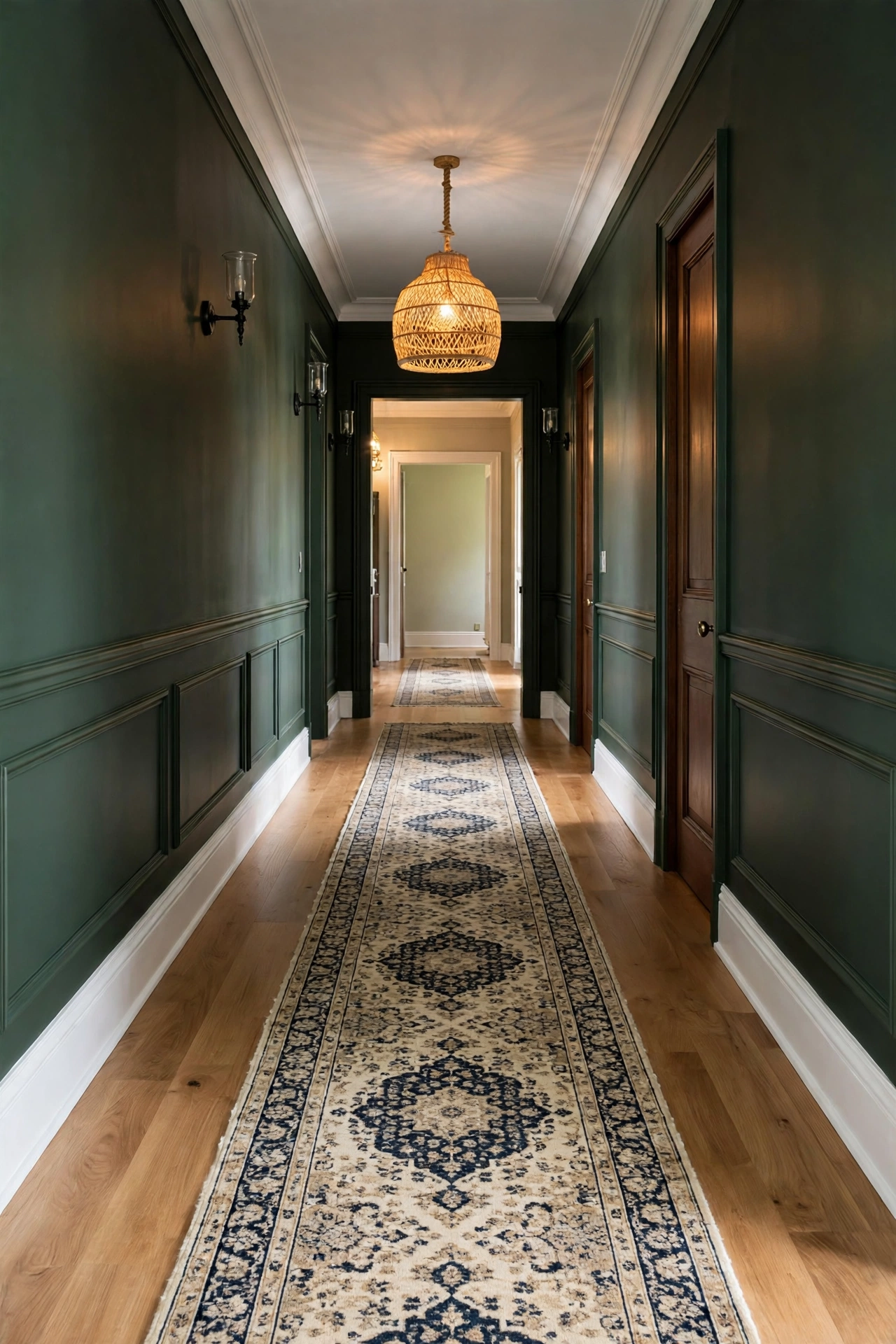
Underfoot, the look softens. A long vintage style runner in cream and beige, with a dark medallion at its heart, runs the length of the hall over light oak floors. The runner does three jobs at once. It leads the eye straight to the black doors, like a path laid through the green. It warms the oak and quiets footsteps in the echo chamber most halls become. And its faded, antique pattern keeps the room from feeling too new or too perfect. The cream ground is important. Against deep green walls and dark doors, a dark rug would sink the whole lower half of the room. Cream lifts it.
Measure generously. A runner should stretch most of the hall, with a border of oak showing on all sides, and it should start a few steps inside the door rather than right at the threshold where it will catch every wet boot. In a long hall, this is the single most transformative purchase after the paint, and it is the piece guests will ask about. It is also where the palette of my fall tablescape ideas feels like a cousin, all cream linen, warm wood and one deep accent color doing the drama. Choose a low pile or a washable vintage style print if your hall works as hard as most do. Beauty that cannot survive a muddy dog is not a plan, it is a countdown.
11. Stand an Olive Tree in a Stone Planter by the Door
Beside the doors stands the tallest living shape in the room: an olive tree in a big, rough stone planter. The planter matters as much as the tree. Its pale, textured weight anchors the corner the way a piece of garden architecture would, and it keeps the tree from looking like a houseplant that wandered in from another room. Together they bring the outdoors right up to the glass, so the greenery beyond the doors and the greenery inside it answer each other. In a modern entry with clean lines, this one pairing does the work of several smaller plants, with none of the fuss.
Height is the point, so choose a tree that reaches at least halfway up the doors, and a planter heavy enough to look permanent. A real olive tree will thrive here if the doors give it light, and it asks for little beyond that. A good faux olive earns its place in darker halls, and no guest has ever once checked. Fill the top of the planter with a little moss or a layer of pale gravel to finish it. That small detail is the difference between a tree in a pot and a tree that looks planted, settled and meant.

12. Keep the Trim Crisp White
Here is the quiet decision that keeps the whole look tailored instead of cave like: the trim stays crisp white. Crown molding, baseboards, door casing, all painted a clean white that draws a bright outline around every green surface. The contrast is doing serious design work. It frames the green the way a mat frames a picture, it catches the lamplight along every edge, and it connects the entry to the rest of a house that may be painted in lighter colors. Without the white, the green could drift muddy. With it, every wall looks intentional, almost graphic.
This is also the friendliest possible news if your home already has white trim, which most do. The green goes on the walls only, and the trim you already own becomes the sharpest part of the design. If your trim is wood toned and you love it, the look can still work, but the white is what gives this particular entry its crisp, dressed feeling. Use a finish with a little sheen on the trim, satin rather than flat, so it reflects the warm light and stays easy to wipe down in the hardest working passage of the house.
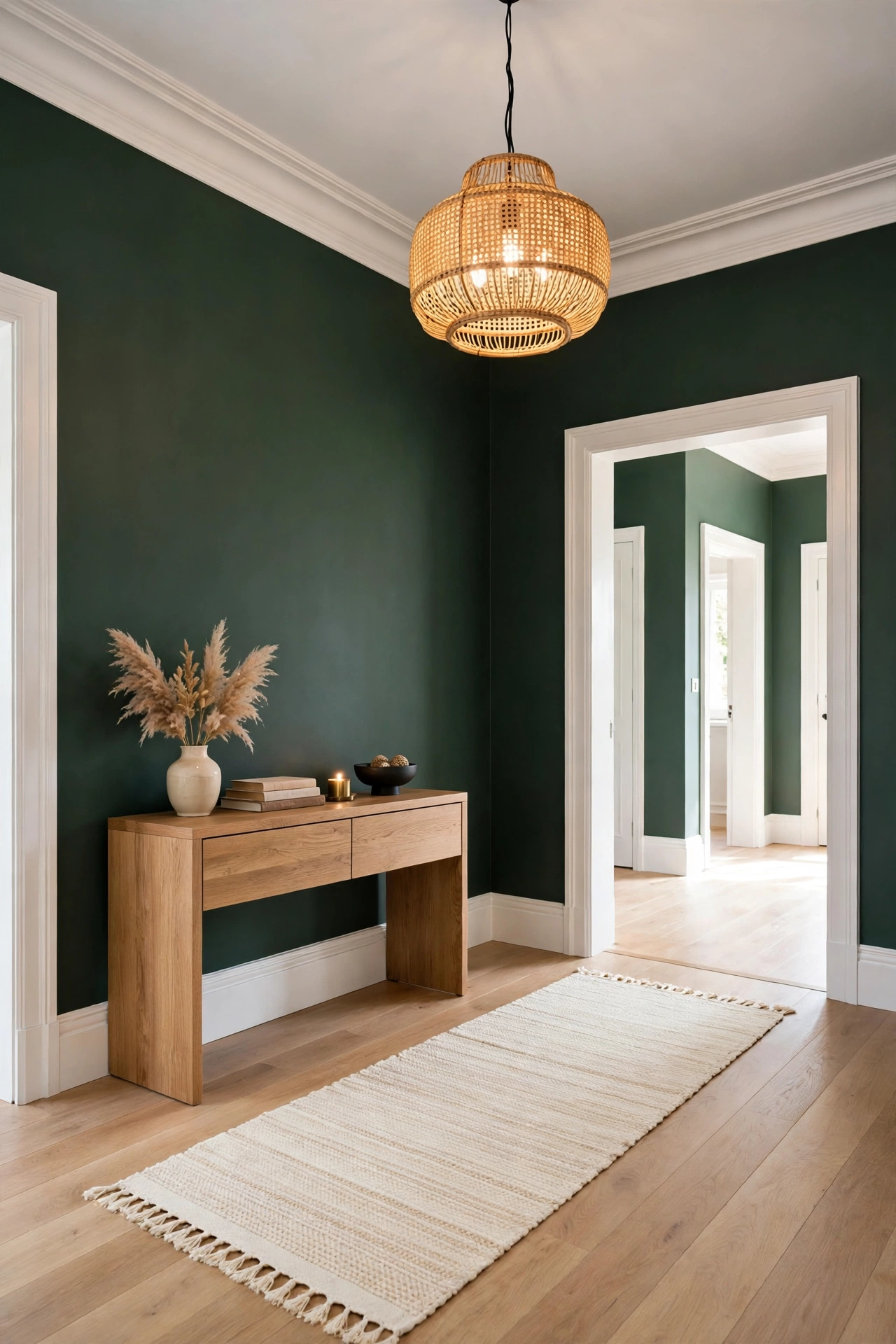
13. Give the Ceiling a Tray Detail
Look up. In a formal foyer, the ceiling joins the design with a simple tray detail, a recessed rectangle painted white, with the rattan pendant hanging from its center. The tray does two things. It gives the pendant a frame in the sky, a reason to hang exactly there, and it repeats the white trim story overhead so the room feels finished on all six sides. Deep green walls under a plain forgotten ceiling can feel like the decorating stopped early. The tray is the period at the end of the sentence.
A true tray ceiling is a renovation, but the effect has friendly shortcuts. A large ceiling medallion in white around the pendant gives a nod to the same idea for very little money. So does a simple border of molding applied to a flat ceiling and painted white, a picture frame in the sky. Keep the ceiling work white or the palest warm neutral rather than green. The pendant glows against it, the room keeps its height, and the green stays where it belongs, wrapped around the walls like a tailored jacket.

The Finishing Touches
14. Line the Wall With Framed Art
The long wall opposite the console gets the last layer: framed art. A row or a loose gallery of prints in thin brass and black frames gives the green a rhythm to walk beside, and it makes the hall feel like a room people linger in rather than a passage they hurry through. Choose art that lives inside the palette, landscapes, botanical prints, soft abstracts in cream, sage, black and ochre. The frames should repeat the metals already in the room, so the gallery feels collected as part of the design rather than hung as an afterthought.
Keep the arrangement calm. One strong row at eye level, or a grid with even spacing, suits the tailored mood better than a scattered salon wall. Add a small picture light in brass above a favorite piece if you want the full old house effect in the evening. And do not forget the practical magic of art in an entry. It gives arriving guests something gracious to look at while coats come off and hellos are exchanged, those ten slightly awkward seconds every good entry should know how to fill.

15. Layer Every Light Source at Once
Now the evening test, the one this whole entry was designed to pass. Stand in the hall at dusk and turn everything on at once. The rattan pendant overhead. The sconces washing the wall beside the mirror. The dome lamp pooling light on the console. A candle or two among the books. Each source alone is modest. Together they build a glow with depth, high, middle and low, and the deep green walls hold that glow the way velvet holds light. This layering is the real secret of the look, more than any single piece in it. Dark rooms do not need more light. They need light in more places.
Build the habit of lighting the entry before the house gets dark, the way you would light a living room before guests settle in. Timers and smart plugs make it effortless, pendant on at dusk, sconces with it, the little lamp last. There is a particular pleasure in coming home on a winter evening, opening your own front door and being met by a hall that is already glowing green and gold, already warm. It changes the whole feeling of arriving home, and it takes your entry about four bulbs to do it.
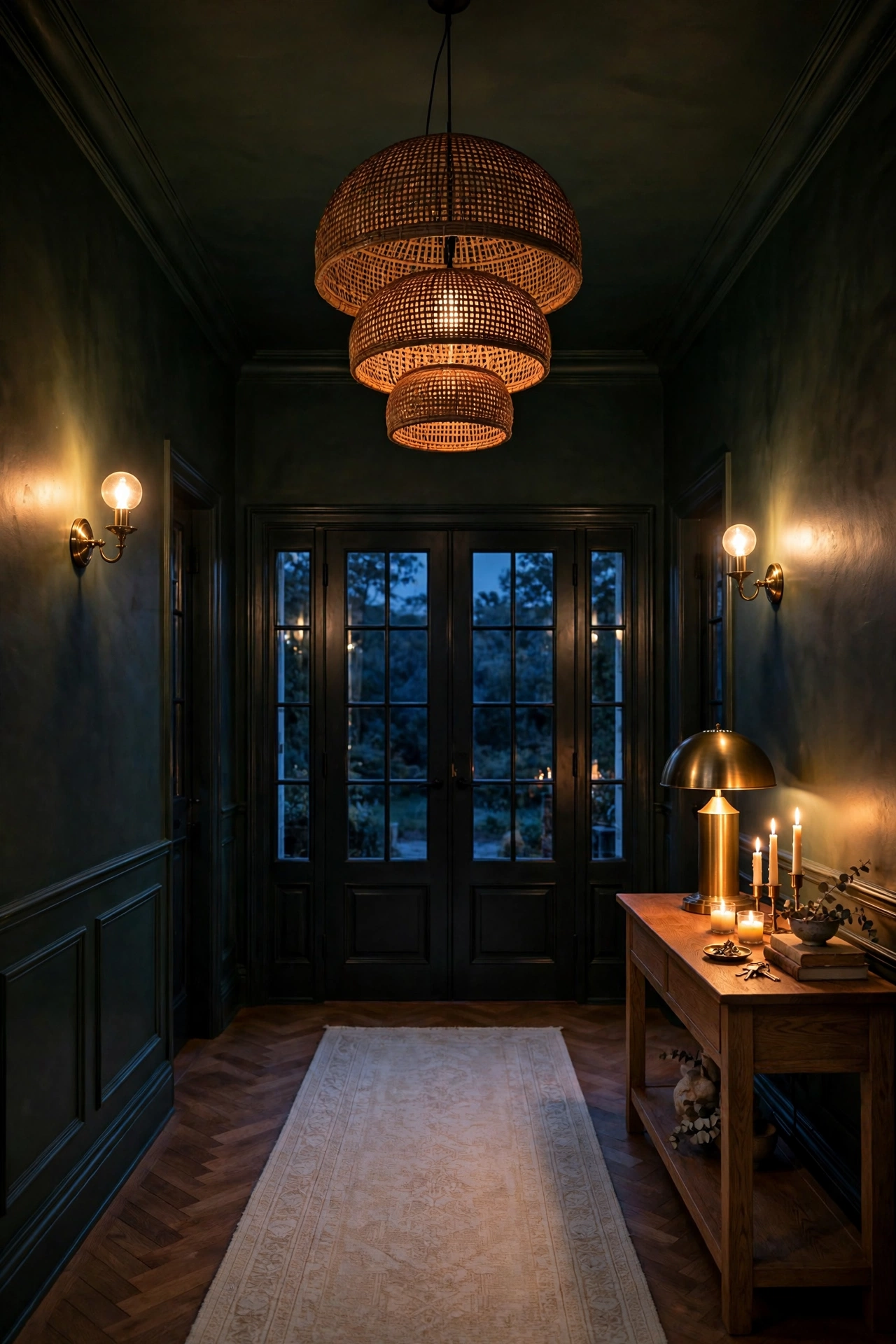
16. Borrow the Look in a Narrow Hallway
Most of us do not have a grand hall. We have a narrow hallway with a door at one end and a coat closet doing its best. Good news: the look survives the shrink beautifully, because its power was never about size. Deep green on narrow walls reads as richness, not darkness, especially with white trim keeping the edges bright. A slim console, twelve inches deep or less, holds a small mirror and a lamp. A runner made for the width of the hall pulls the eye along. One sconce or a small rattan pendant gives the glow. Every element scales, and the mood arrives intact.
Renters can borrow almost all of it too. The runner, the console, the mirror, the lamp and the tree are all freestanding, and even the green has workarounds in deep green peel and stick paper on a single wall stretch. My list of renter friendly fall decor swaps is built on exactly this kind of thinking, pretty changes that leave no trace when you go. In a narrow hall, edit harder than anywhere else. Three pieces, chosen well, will feel like a designed room. Eight pieces will feel like a storage corridor with good taste.
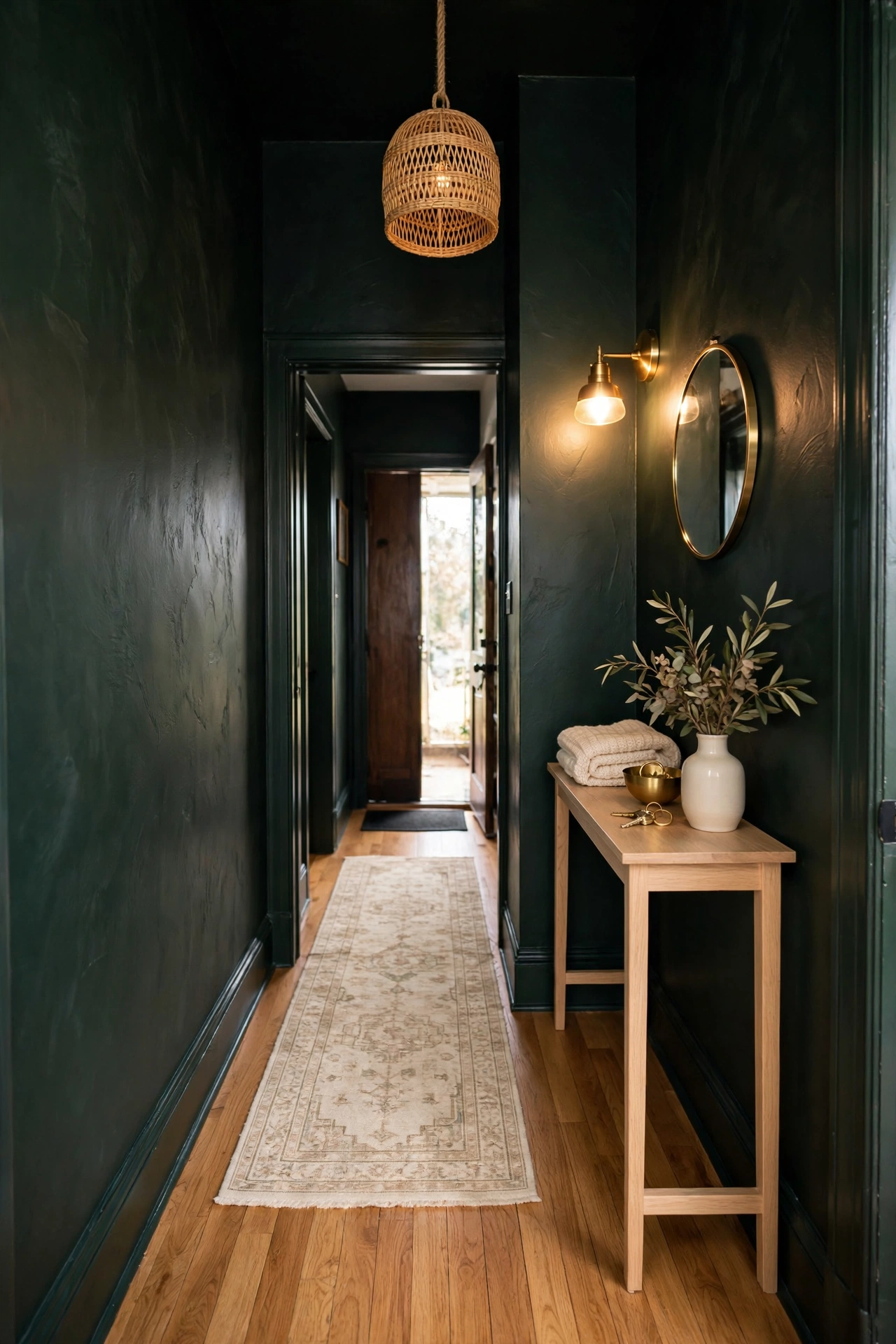
17. Paint the Inside of the Front Door Black
Here is the boldest small move in the whole list. Paint the inside of your front door black. The door you see from inside the house is usually a blank white panel that belongs to no room at all. Painted matte black with its hardware swapped or kept in brass, it becomes part of the entry design, the twin of the French doors at the other end and the anchor that balances the whole hall. In a compact entry with a bench and hooks, the black door turns a leftover corner into a composition. Guests notice it the moment they step inside, usually with a small intake of breath.
The practical side is friendly too. Black hides the scuffs, fingerprints and dog nose prints that a white door collects in an entry better than any other color. Use a durable satin or semi gloss made for doors, and take the hardware off rather than painting around it. If full black feels like a leap, a very deep green matched to the walls is the softer cousin of the same idea. But try the black on a sample board first and lean it against the door for a day. Most people who hesitate end up wishing they had done it a year earlier.

18. Pull Up a Round Boucle Ottoman
The last piece of furniture is the softest: a round boucle ottoman in a deep olive tone, pulled up near the console or tucked into an entry nook. After all that green paint, black metal and woven rattan, the entry needs one piece that is pure softness, and the nubby boucle texture is made for it. The ottoman works for a living, too. It is the perch for pulling on boots, the landing spot for a handbag, the extra seat when the whole family crowds the door at once. Round is the right shape here. In a room of straight lines and glass panes, one soft circle keeps everything human.
Choose the color carefully. Olive boucle stitches the ottoman into the green palette while adding a texture the walls cannot give. Cream boucle works too, echoing the runner and lightening the corner it sits in. Keep it small enough to slide under the console or into a corner when the hall needs to be all walkway. And if your entry has no nook at all, a boucle cushion on a bench borrows the same softness for a fraction of the footprint. Texture is the ingredient guests feel without seeing, and an entry with none can look stunning and still feel cold.

19. Make the First Ten Seconds Count
Step back and take the whole view in, the way a guest will. The door opens. Deep green walls, white trim sharp against them. A woven pendant glowing overhead, brass sconces warming the wall, a wavy mirror catching the light. The cream runner leads down oak floors to black doors full of daylight and green leaves. An olive tree stands in stone. A black vase of branches waits on the oak console beside a small brass lamp and a stack of books. Nothing in the view is loud, and yet it lands all at once. That is the real idea underneath all nineteen: an entry is not a leftover space. It is the first ten seconds of your home, and it sets the emotional temperature for everything after it.
So build it in layers and then, just as carefully, maintain the calm. A basket for the shoes. A bowl for the keys. A hook for the bag that always ends up on the floor. The beauty of this look is not fragile; it was designed around real arrivals, real weather and real life. When the palette is this tight and the light is this warm, everyday order is easy to keep and lovely to come home to. If the green deepens into evening and the lamps come on in their layers, your hall will do what the best rooms do. It will greet people before you even reach the door.

More Favorites
This post contains affiliate links. If you buy through them, I may earn a small commission at no extra cost to you.
A few more favorites from the ideas above:



A moody entry is not really about the paint, though the paint is where it starts. It is about the feeling of crossing a threshold and being received. If nineteen ideas feel like a lot, begin with three. Paint the green deeper than feels sensible. Hang one generous woven light and switch it on before dark. Set a black vase of olive branches on whatever table your entry gives you, and stand back. Those three moves alone will change how your home says hello, I promise. The runner, the mirror, the sconces and the tree can arrive one quiet upgrade at a time, each one settling into the calm the last one made.
And notice how much of this palette gets to stay and deepen through the year. The green, the brass and the layered warm light are the same bones I dress up in my elegant Christmas living room, where the garland goes deep and the candlelight takes over. A moody entry is not a seasonal project. It is a permanent welcome that holidays simply decorate a little further. So light the lamps a touch earlier than you think you need to, straighten the runner with your foot as you pass, and let your home make its first impression the way you always hoped it would: warm, calm and quietly unforgettable.
With love and light
Get Fresh Home Ideas Every Week
Seasonal decor ideas, organizing tips, and cozy home inspiration, straight to your inbox.
More Entryway Ideas You Will Love
Keep browsing for more seasonal inspiration: