

If you are reading this on a Sunday night, sitting on the couch in a house that looks like a laundry basket exploded, realizing tomorrow is Monday and you have absolutely nothing planned, no groceries, no idea what the kids are wearing, and a vague feeling that somebody has soccer practice at some point this week, this post is for you.
Here is how most Sundays go. You tell yourself this will be the relaxing day. You sleep in a little. The kids have cereal while watching cartoons. You scroll your phone. Somebody asks what is for dinner and you realize there is nothing in the fridge, so it is takeout again. The laundry you meant to fold is still in the dryer from Friday. Backpacks are wherever they were dropped on Friday afternoon, and you have no idea if the permission slip got signed. Sunday slides by in a blur of low grade guilt and half finished intentions. Then Monday morning hits like a truck.
Monday morning chaos is not a mystery. It is the direct result of a Sunday with no plan. You wake up late because you stayed up late doom scrolling. The kids cannot find matching socks. There is no bread for lunches. You are signing a field trip form with one hand while pouring cereal with the other. Everyone leaves the house twenty minutes behind schedule, already cranky, already behind. And the whole week starts with that frantic energy, like you are chasing the week instead of leading it.
Here is the promise: there is a simple Sunday rhythm, about one to two hours total, that flips the whole script. A calm Sunday reset where you look at the week ahead, get the house to a baseline, plan meals and make a grocery list, blast through the laundry, set out outfits and backpacks, clear the entryway, and hold a five minute family huddle. Nothing fancy. Nothing perfectionist. Just enough structure that Monday morning feels like a smooth launch instead of an emergency evacuation. This post gives you the entire system, step by step, plus the mistakes that make resets backfire and answers to every “but what about…” you are already thinking.
Love these ideas? Get more every week.
Join the newsletter for seasonal decor and cozy home inspiration.
TL;DR: A Calmer Monday Starts Sunday
- Scan the week in twenty minutes: calendar, appointments, practices, and school events, so nothing ambushes you midweek.
- Reset the house to baseline: a fifteen minute pickup of main living areas, not a deep clean, just clear surfaces and floors.
- Plan meals and write the list: five or six dinners on paper plus a grocery list means no 5 pm panic all week.
- Sunday night launch pad: outfits chosen, backpacks packed, lunch gear ready, so Monday morning runs itself.
- Five minute family huddle: everyone hears the plan for the week, and the mental load stops living only in your head.
Why Sundays Go Sideways (And It Is Not Laziness)
First, let us kill the guilt, because it is doing nothing for you. You are not bad at weekends. You are not lazy. You are a person who spent the entire week holding a hundred details in her head, and by Sunday your brain is simply done. Decision fatigue is real. After five days of making lunches, answering emails, managing bedtime, and remembering who needs to be where, your brain hits Sunday and refuses to make one more decision. So you do not. That is not a character flaw. That is biology.
Second, Sundays have a strange energy. They are supposed to be restful, but they are also the doorway to Monday, so resting feels guilty and planning feels like work. You end up in the worst of both worlds: not truly resting because the undone stuff nags at you, and not planning because planning feels like giving up your one day off. So you hover. You tidy a little. You scroll a lot. You think about meal planning without actually doing it. The day evaporates and you feel worse than if you had just worked or just rested.
Third, the weekend itself creates the mess. Two days of kids home means two days of snack wrappers, craft projects, couch cushion forts, and mystery sticky spots. The house on Sunday night is always worse than it was on Friday, because living happens on weekends. If nobody resets it, Monday starts in a disaster zone, and a messy house makes everything feel harder. There is actual research behind this: visual clutter raises stress hormones. You are not imagining it. The messy kitchen really does make Monday feel worse.
And here is the part nobody talks about: the mental load does not take weekends off. Even while you are “relaxing” on the couch, part of your brain is running the background program. Permission slip. Dentist appointment. The thing the teacher mentioned. Groceries. That email you forgot. The reset works because it takes all of that out of your head and puts it somewhere visible. A calm week is not about having fewer things to do. It is about having them all written down in one place instead of rattling around in your skull at midnight.
So no, you do not need more discipline. You need a rhythm so simple you can do it tired, on a Sunday, with kids underfoot. That is what this is.
The Plan: Your Sunday Reset System
The whole reset takes about one to two hours, and you do not have to do it all at once. Many families split it: a chunk in the late morning, a chunk after lunch, and the launch pad stuff after dinner. Some do it all in one focused Sunday afternoon sprint while the kids have screen time. There is no sacred order and no sacred time slot. Pick the version that fits your Sunday, and protect it the way you would protect any appointment that matters. Because it does.
Step 1: Scan the Week Ahead
Spend twenty minutes looking at the whole week so nothing ambushes you on Wednesday.
Grab your calendar, your phone, the school app, the fridge where the permission slips live, all of it. Sit down with a coffee and walk through the next seven days, day by day. What appointments are booked? What practices, games, lessons, or rehearsals? Any early dismissals, late starts, picture days, or spirit weeks? Any birthdays, parties, or playdates? Any work deadlines or travel that change who does pickup? Write it all down in one place, even the stuff you are sure you will remember. You will not remember. That is the whole point.
This is also when you spot the collisions. Tuesday has soccer practice at 5 and a dentist appointment at 4:30 across town. Thursday is the class field trip and somebody needs a packed lunch instead of hot lunch money. Friday is pajama day and the good pajamas are in the laundry. Finding these things on Sunday means you can solve them calmly. Finding them the morning of means panic. The Sunday scan turns midweek surprises into Sunday problems, and Sunday problems are solvable.
Make a simple week at a glance, on paper or a whiteboard or a notes app, whatever you will actually look at. One line per day with the non negotiables. Stick it on the fridge or the family command area where everyone can see it. This becomes the source of truth for the week, and it is the first thing that gets the mental load out of your head. When your partner asks “what is happening Thursday,” you point at the fridge instead of reciting it from memory for the hundredth time.

Step 2: Do the Fifteen Minute House Reset
Clear surfaces and floors in the main living areas. Baseline, not spotless.
Set a timer for fifteen minutes. That is the whole trick. Fifteen minutes is short enough that you will actually start and long enough to make a visible difference. Hit the main living areas only: the living room, the kitchen, the entryway, the main bathroom if you are feeling ambitious. Not the bedrooms. Not the closets. Not the garage. Just the spaces you will see and use all week.
The reset has a simple order: trash first, then dishes to the sink, then things that live elsewhere get carried to their rooms (not put away, just relocated in a basket), then a quick wipe of the main surfaces, then floors if there is time. Work top to bottom and room to room without doubling back. If the kids are old enough, hand them each a basket and make it a game: everyone grabs ten things that do not belong. Put on music. Make it loud. Fifteen minutes of family pickup with music beats an hour of you doing it alone while resentful.
Here is the mindset shift that makes this stick: you are not cleaning the house. You are resetting it to baseline. Baseline means you can walk through rooms without stepping on things, the kitchen counters are clear enough to cook on, and the couch is sittable. That is it. The deep cleaning has its own rhythm, and if you want the full system for that, the clean house routine breaks it into manageable pieces. The Sunday reset is about starting the week in a house that feels calm, not a house that is perfect. For keeping the daily clutter from rebuilding, the ten minute tidy up habit is the perfect weekday companion to this Sunday reset.
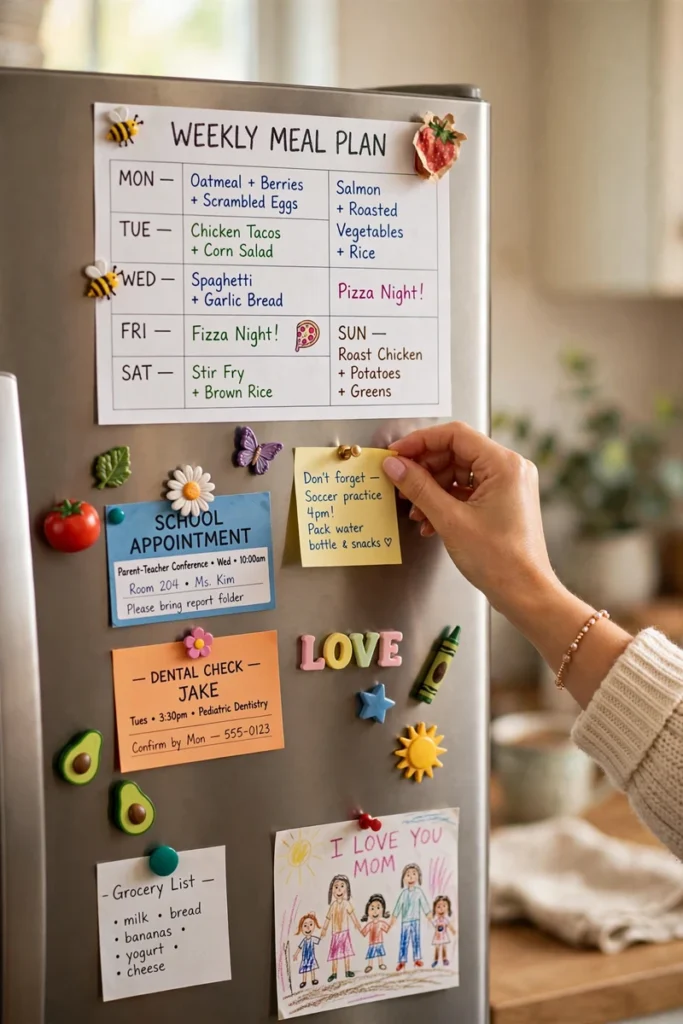
Step 3: Plan the Meals and Write the Grocery List
Five or six dinners on paper plus a grocery list ends the 5 pm “what is for dinner” panic for the whole week.
This is the step with the highest return on investment in the entire reset. Twenty minutes of meal planning saves you roughly five hours of weeknight stress, three emergency grocery runs, and at least two takeout orders you did not really want. Sit down with your week at a glance from Step 1 and plan dinners around the busy nights. Late practice Tuesday? That is a slow cooker night or a sheet pan night. Free evening Thursday? That is when you can do the slightly fancier thing.
You do not need seven brand new recipes. Plan five or six dinners, assume one night is leftovers or takeout or fend for yourself night, and build in one wild card. Lean on your rotation of family favorites. Write each dinner next to the day on your week at a glance, so the plan is visible. Then make the grocery list directly from the plan, plus breakfast and lunch staples and snacks. One list, one trip or one delivery order, done. If meal planning has always felt overwhelming, the weekly meal plan system walks through the whole method in detail, including how to build a rotation your family will actually eat.
Two pro moves that make this even better. First, do a two minute fridge and pantry scan before you write the list, so you buy what you actually need instead of your third jar of cumin. Second, prep one thing while you are already in planning mode: wash the fruit, chop the veggies for the first two dinners, or marinate something for Monday. Future you, walking in the door Monday at 5:30, will be so grateful. A little Sunday prep is the difference between cooking feeling like a chore and cooking feeling like assembling.
Step 4: Run the Laundry Sprint
Get every load washed, dried, and folded on Sunday so the week starts with full drawers and empty hampers.
Laundry is the task that most quietly ruins weeks. Not because it is hard, but because it is never done. There is always a load in the washer, a load in the dryer, and a mountain on the couch that everyone pretends not to see. By Wednesday the kids are wearing the weird backup socks and you are doing emergency loads at 9 pm. The Sunday laundry sprint breaks the cycle: everything gets processed in one focused push, and the week starts clean.
The sprint works best as a background operation. Start the first load when you start the reset. Move loads along between steps. The actual hands on time is maybe thirty minutes total: sorting, switching, folding. Fold as things come out of the dryer instead of letting them pile up, because the pile is where laundry goes to die. Put on a show or a podcast. Make it pleasant. This is maintenance, not punishment.
The real win is Monday morning drawers. When every kid has clean uniforms, clean gym clothes, and actual matching socks, mornings get dramatically easier. No digging through the clean pile. No “my favorite shirt is dirty” meltdowns. If laundry is the thing that always defeats you, the laundry system that actually works covers the daily habits that keep the mountain from rebuilding between Sundays. Sunday is the big reset. The weekday habits are what protect it.

Step 5: Set Up the Monday Launch Pad
Outfits chosen, backpacks packed, and lunch gear ready on Sunday night means Monday morning runs itself.
This is the step your Monday morning self will thank you for most. After dinner on Sunday, spend twenty minutes setting up the launch pad, ideally with the kids. Each kid picks out Monday’s full outfit, down to socks and underwear, and lays it out or hangs it on a hook. Check the weather first so there is no morning debate about shorts versus pants. Backpacks get packed: homework inside, permission slips signed, library books returned, water bottles filled and in the fridge. Lunch boxes get packed or at least prepped: containers out, snacks portioned, anything that can be made ahead is made ahead.
Do not skip involving the kids in this. Yes, it is faster to do it yourself. But a kid who picked her own outfit cannot argue about it in the morning. A kid who packed his own backpack knows where everything is. This is one of those small independence builders that pays off in mornings with dramatically less negotiating. And it connects directly to smoother school mornings all week long: the whole morning system works ten times better when the night before setup actually happens.
Extend the launch pad to yourself, too. Pick your outfit. Pack your work bag. Set out your keys, wallet, and anything you need to bring. Charge the devices. The number of chaotic mornings caused by a parent who cannot find her own keys is higher than anyone admits. And lay out breakfast basics: bowls on the counter, cereal accessible, fruit washed. Monday morning you is basically a different person, a groggy one. Set her up for success.
Step 6: Reset the Command Zone
Clear the entryway, sort the mail and papers, and make the drop zone functional again.
Every house has a spot where the world enters: the entryway, the mudroom, the kitchen counter by the door. By Sunday it is usually buried. Backpacks, shoes, jackets, mail, school papers, receipts, random kid treasures, a permission slip from two weeks ago. The command zone reset takes ten minutes and it changes how the whole house feels, because this is the first thing you see when you walk in and the last thing you touch on the way out.
Sort it ruthlessly. Shoes that do not fit anyone go in a donate bag. Papers get triaged into three piles: action (sign it, pay it, respond), file (keep), recycle (almost everything else). Be honest about the school papers. Most of them are newsletters you already read as an email. Keep the action items, recycle the rest, and if paper chaos is a chronic issue, the school paper system keeps it from piling up again. Mail gets opened and sorted now, not stacked. Put the outgoing mail by the door. Restock the essentials: the basket of sunscreen and hats, the spare masks or tissues, whatever your family grabs on the way out.
Finish by making the zone inviting for Monday. Clear counter or shelf space where backpacks will land after school. Make sure each kid has a hook or spot that is actually reachable. A command zone that works is one where a kid can walk in, hang the bag, drop the shoes, and put the papers in the inbox without thinking. When the landing spot is clear, the after school routine practically runs itself, because the physical setup does half the work.
Step 7: Hold the Five Minute Family Huddle
Gather everyone for five minutes to hear the week ahead, so the plan stops living only in your head.
This is the step that looks small and changes everything. Gather the family, even for just five minutes, and walk through the week together. “Here is what is happening this week. Monday is a normal day. Tuesday you have soccer right after school, so we eat early. Wednesday is library day, bring your books. Thursday is the field trip, wear the red shirt. Friday is pizza night.” Kids who know what is coming are dramatically more cooperative than kids who get ambushed by transitions. Adults who hear the plan stop asking you what is happening every single day.
Keep it short and positive. This is not a lecture and not a complaint session about how busy everyone is. It is a briefing. Let the kids ask questions. Let them add their own things: “I have a spelling test Friday.” “Can my friend come over Saturday?” Write the answers on the week at a glance. The huddle works because it makes the week a team project instead of a secret only mom knows. The mental load gets distributed, even if just a little, and that little matters enormously.
End the huddle with one fun thing to look forward to. Friday pizza night. Saturday park trip. A baking project on the free evening. When the week has a bright spot in it, everyone faces Monday with better energy. And honestly, so do you. The huddle is also your moment to notice: this week is doable. It is all on the paper. Nothing is hiding. You have got this.

Try It Tonight: The 20 Minute Sunday Starter
Do not have two hours? Start here. Twenty minutes tonight buys you a calmer Monday:
- Scan the week. Open your calendar and note the three biggest things happening this week. Write them on a sticky note on the fridge.
- Start one load of laundry. Just start it. Future you will deal with the folding.
- Set out Monday outfits. Yours and the kids. Full outfits, down to socks.
- Pack the backpacks. Homework in, papers signed, water bottles ready.
- Clear the kitchen counter. One clear surface to land on Monday morning.
That is it. Twenty minutes, and Monday morning will already feel different. Next Sunday, add the meal plan. The Sunday after that, add the huddle. Build the rhythm one layer at a time.
Mistakes to Avoid
Trying to do the whole reset perfectly the first time. If you attempt all seven steps in full detail on your first Sunday, you will burn out and never do it again. Start with the 20 minute starter above. Add one step per week. A partial reset you actually repeat beats a perfect reset you do once. This is a rhythm, not a project.
Turning the reset into a marathon deep clean. The Sunday reset is maintenance, not spring cleaning. The moment you find yourself reorganizing the pantry or scrubbing baseboards, you have drifted. Save the deep stuff for its own day. The reset is about baseline: clear surfaces, clean clothes, food planned, week mapped. If it takes more than two hours, you are doing too much.
Doing it all yourself while everyone else relaxes. This is the fastest way to grow resentful of your own system. The reset is a family rhythm, not mom’s Sunday chore list. Even small kids can carry laundry baskets, match socks, and pick outfits. Older kids can pack their own bags and help with the pickup. A partner can own the grocery run or the meal plan. If you are the only one resetting, the system will collapse under the weight of your resentment within a month.
Planning meals without checking the actual week. A beautiful meal plan that ignores Tuesday’s late practice is a fantasy, not a plan. Always plan meals after the calendar scan, never before. Busy nights get easy meals. Free nights get the cooking projects. The plan has to fit the real week or it will fall apart by Wednesday and you will feel like you failed. You did not fail. The plan just did not match reality.
Skipping the huddle because it feels silly. It does feel a little silly the first time, gathering everyone to announce the week like a tiny team meeting. Do it anyway. The huddle is the step that gets the plan out of your head and into the family. Without it, you did all the planning and still get asked “wait, what is happening today?” every morning. Five minutes. It is worth it.
Letting one missed Sunday kill the rhythm. You will miss Sundays. Travel, illness, holidays, or just a Sunday where you needed to do absolutely nothing. That is fine. A missed reset does not mean the system failed. It means you had a week off. Just pick it up next Sunday. The rhythm is resilient. It does not require perfection. It requires returning.
What About…?
What about single parents? There is no partner to split this with. Then the reset matters even more, and it needs to be smaller. You cannot do a two hour reset solo while also parenting. So shrink it to the highest impact twenty minutes: outfits, backpacks, calendar scan. Get the kids involved at whatever age they are, even tiny ones can choose between two shirts. And give yourself full permission to outsource pieces: grocery delivery instead of a store run, a simplified meal plan of five easy dinners on rotation. The reset is not about doing more. It is about doing the few things that prevent the most chaos. You are already doing the job of two people. The system should lighten your load, never add to it.
What about tiny houses or apartments with no entryway or command zone? You do not need a mudroom. You need a landing spot, and it can be tiny: one shelf, one hook per person, one basket for papers. The principle is the same at any scale. Every person has a spot where the bag lands and the shoes go. The papers have one inbox, even if the inbox is a single folder. Small spaces actually benefit more from the reset, because clutter shows faster when there is nowhere for it to hide. Fifteen minutes in a small apartment can transform the whole place.
What about a partner who will not participate? Start without them. Seriously. Do the reset for yourself and the kids, keep it visible and low drama, and let the results do the persuading. When Monday mornings get calmer and the 5 pm dinner panic disappears, most partners get curious. Invite, do not nag: “I am doing the Sunday reset at 2, want to join for the meal plan part?” Give them one owned piece that plays to their strengths, like the grocery run or grilling on their night. And if they truly never join, the system still works. It was never dependent on them. It is your rhythm, and it makes your week better regardless.
What about Sundays that are already full? Work weekends, sports tournaments, travel. Then you do the pocket version. The 20 minute starter in the “Try It Tonight” box above is designed exactly for this: calendar scan, one load of laundry, outfits, backpacks, one clear counter. Twenty minutes on a packed Sunday still prevents eighty percent of Monday chaos. And on truly impossible weekends, do a five minute version on Sunday night: just the outfits and backpacks. The reset scales. Full version on free Sundays, starter version on busy ones, five minute version on chaotic ones. Something always beats nothing.
Here is to Sundays that feel like a deep breath instead of a countdown to chaos. Start small, keep it simple, and let the rhythm do the heavy lifting. By the time Monday rolls around, you will already be ahead of it, coffee in hand, kids dressed, lunches packed, week mapped on the fridge. That calm Monday morning feeling? It starts tonight, mama. You have got this.
Get Fresh Home Ideas Every Week
Seasonal decor ideas, organizing tips, and cozy home inspiration, straight to your inbox.
More Parenting Ideas You Will Love
Keep reading for more calm-home inspiration: