

It is 7:45 am. Your kid is supposed to be on the bus in ten minutes, and you just found the permission slip. It is crumpled at the bottom of the backpack, due today, and it needs your signature and twelve dollars in cash. You are hunting for a pen with one hand and emptying the change jar with the other while your kid eats toast standing up. This was not a surprise trip. That slip came home eleven days ago. You remember seeing it. You put it somewhere safe. Somewhere safe, it turns out, was the black hole between the kitchen counter and the front door.
Last month it was the dentist appointment. You had it in your phone. You also had it nowhere near your phone, because the reminder was buried under seventy two notifications and you swiped it away during a meeting thinking you would remember. You did not remember. The receptionist called at 10:15 to ask if you were coming. You were not coming. Your kid still talks about it because the dentist gave her a prize anyway when you rebooked, and she thinks missing appointments is how you get free toys.
Here is the truth nobody tells you: the problem is not your memory. The problem is that your entire family runs on your memory. You are the calendar, the filing cabinet, the coat check, and the lost and found. Everything lives in your head, and your head is already full. What you need is not a better brain. What you need is a place for everything to live that is not your brain.
That is what a family command center is. One wall, or one corner, or one small station where the whole family’s logistics live in plain sight. The calendar everyone can see. The trays where papers land instead of vanishing. The launch pad by the door where backpacks, shoes, keys, and jackets live. The charging station where devices sleep at night. One source of truth the whole family can check, so they stop asking you everything and start finding answers themselves.
This post gives you the whole system: how to pick the spot, the four zones that do all the work, the ten minute weekly meeting that keeps it alive, and the rules that make your family actually use it. Nothing fancy. No Pinterest perfect wall that takes a weekend and three hundred dollars. Just a simple setup you can build tonight with stuff you probably own already.
Love these ideas? Get more every week.
Join the newsletter for seasonal decor and cozy home inspiration.
TL;DR: The Command Center Fix
- Pick one visible spot: a wall or corner everyone passes daily becomes the single source of truth for the whole family.
- Build the four zones: a family calendar, an inbox and outbox for papers, a launch pad by the door, and a charging station for devices.
- Run a 10 minute weekly meeting: Sunday night, the whole family, reviewing the week ahead keeps the system alive.
- Write the rules down: clear rules for what goes where mean the family maintains it instead of you policing it.
- Keep it low maintenance: a command center that needs daily upkeep will die in two weeks. Simple survives.
Why Everything Keeps Getting Forgotten
Let us talk about why this keeps happening, because it is not a character flaw. The mental load of running a family is enormous, and right now it lives entirely in your head. Doctor appointments, permission slips, library books, birthday parties, practice schedules, the thing the teacher mentioned at pickup that you have to remember to mention to your partner, the field trip money, the shoes that are suddenly too small. Hundreds of tiny open loops, all humming in the background, all the time.
Here is the problem with storing all of that in your head: heads are terrible filing systems. Things slip. Things get overwritten. A notification you meant to deal with later gets buried. A paper you set down for one second gets buried under six other papers. And the worst part is the stress of it. You are not just forgetting things. You are spending energy all day worrying about what you might be forgetting. That background hum of anxiety is the real cost.
Then there is the second problem: paper has no home. Think about every piece of paper that enters your house. School forms, permission slips, fundraising packets, report cards, art projects, bills, takeout menus, the calendar the dentist handed you. Where does it go? On the counter. On the table. In a pile that moves from room to room. You are not disorganized. You just never gave paper a place to land. So it lands everywhere, and then it vanishes exactly when you need it.
And the third problem is the one that might sting: everyone asks you because you are the system. Where are my cleats? When is the field trip? Did you sign the form? What are we doing Saturday? You answer because you are the only one who knows. Not because your family is lazy, but because the information lives nowhere else. There is no board to check, no tray to look in, no calendar on the wall. There is just you. So of course they ask you. You are the only source of truth in the house.
A command center fixes all three at once. The mental load gets a parking spot outside your head. Paper gets a home the second it walks in the door. And your family gets a source of truth that is not you. The result is not just fewer forgotten things. It is fewer interruptions, less evening chaos, and mornings that do not start with a permission slip treasure hunt.
The Plan: Your Family Command Center System
Step 1: Pick One Spot Everyone Walks Past
Your command center must live where the family already goes. Invisible systems die in a week.
The biggest mistake people make with command centers is putting them somewhere sensible and quiet. The office. The spare bedroom. A corner of the dining room nobody uses. Then they wonder why nobody looks at it. A command center works because it is unavoidable. It has to sit on a path the whole family travels every single day.
For most families, that path runs from the kitchen to the front door. The wall next to the fridge. The hallway by the entry. The inside of a pantry door. The side of a kitchen cabinet. Somewhere you pass while making coffee, while packing lunches, while herding kids toward the door. If the spot is not on that route, the calendar will be beautifully decorated and completely ignored.
Do not overthink the space. You need a wall area roughly the size of a small poster, plus floor space by the door for the launch pad, plus one flat surface for the paper trays. That is it. Some families use the whole wall next to the mudroom. Some use one section of hallway. Some use a rolling cart parked by the kitchen. Work with what you have. The system does the work, not the square footage.
One rule: keep the command center out of the kids’ bedrooms and away from homework zones. It needs to be communal territory. When it lives in shared space, the whole family owns it. When it lives in one person’s space, it becomes one person’s job. And that one person will be you.
Step 2: Set Up the Visible Family Calendar
One calendar everyone can see replaces a hundred “when is that?” questions every week.
The family calendar is the heart of the command center. Not the one on your phone that only you see. A real, physical calendar that anyone in the house can walk up to and read. This is the single source of truth. When anyone asks “what is happening this week,” the answer is “go check the calendar.” Every time.
Paper or whiteboard? Honestly, either works, so pick the one you will actually maintain. A big paper wall calendar is cheap, simple, and satisfying to write on. A whiteboard calendar is reusable and easy to wipe clean each month. Some families use a big corkboard with printed month pages pinned up. The format matters less than the visibility. It must be large enough to read from a few feet away, and it must show the whole month at a glance.
Color coding is what turns a calendar from decoration into a system. Give each family member a color. Mama is blue. Kid one is green. Kid two is orange. Partner is purple. Shared family events get a fifth color, maybe red for anything urgent or deadline driven. Write everything in the right color and the week becomes readable at a glance. You can see your blue appointments, the kids can find their own colors, and the whole month tells a story without anyone reading a word.
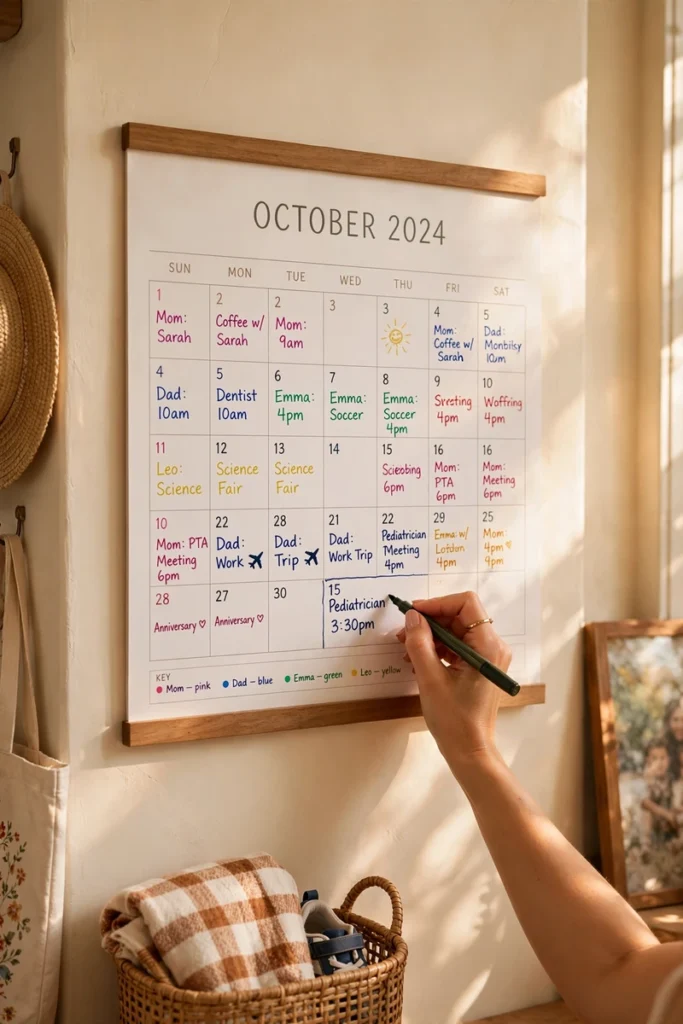
What goes on it: everything. Doctor and dentist appointments. School events and early dismissals. Practices, games, lessons, and recitals. Birthday parties and playdates. Travel dates. Deadlines for forms and payments. Even the weekly meal plan can live on the bottom row if you want dinner decisions visible too. If it involves a family member leaving the house, it goes on the calendar. The rule is simple: if it is not on the calendar, it does not exist. That sounds dramatic. It works.
Keep one more rule: the calendar is sacred. Nobody erases, moves, or adds without the weekly meeting or a quick family text. When everyone trusts the calendar, everyone uses the calendar. When it gets scribbled and crossed out and unreliable, everyone goes back to asking you. Protect its accuracy and it protects your mornings.
Step 3: Build the Inbox and Outbox for Paper
Every paper that enters your house lands in one tray. No more piles on every flat surface.
Remember the permission slip at the bottom of the backpack? It died because paper had nowhere to land. The inbox fixes that. It is one tray, one basket, or one wall mounted file, labeled INBOX, sitting in the command center. Every paper that comes home goes in it. Permission slips. Fundraising forms. Report cards. The dentist’s new patient paperwork. Bills. All of it. One place.
The habit that makes it work: kids empty their backpacks into the inbox the moment they get home. Not later. Not after snack. Right when they walk in. This is the single highest leverage habit in the whole system. The after school routine gets a built in checkpoint, and papers stop living in backpacks where they crumple and die. Shoes off, backpack emptied into the inbox, then snack. Three steps, thirty seconds, and the paper problem shrinks by eighty percent.
You need three trays, not one. Label them simply: INBOX, ACTION, FILE. The inbox is the landing zone. ACTION is for things that need doing: forms to sign, payments to send, RSVPs to answer. FILE is for things to keep: report cards, tax documents, the warranty you might need. Every Sunday during the family meeting, you sort the inbox into action and file. Takes five minutes. Papers flow through instead of piling up.

The outbox is the secret weapon nobody thinks of. It is where completed things wait to leave the house. The signed permission slip with the cash paper clipped to it. The birthday gift wrapped and ready. The library books to return. The bag of outgrown clothes for donation. Put the outbox right next to the door or on the launch pad. When it is time to leave, you grab everything in the outbox and go. Nothing gets left behind because nothing is sitting in random rooms.
If you are drowning in school papers specifically, make the inbox the law for the whole school year. Kids learn fast that everything paper goes in the tray. Teachers will think you got organized overnight. You did. It just looks like magic from the outside.
Step 4: Create the Launch Pad by the Door
Backpacks, shoes, jackets, and keys staged by the door turn chaotic mornings into grab and go.
The launch pad is the zone that changes your mornings the fastest. It is a small station right by the door your family uses most: hooks for backpacks and jackets, a basket or shelf for shoes, a small dish or hook for keys, and room for whatever each person needs to grab on the way out. Everything staged the night before. Everything grabbed in one motion on the way out.
Give every person a hook and a basket. Label them if the kids are young: names, or even photos for little ones who cannot read yet. Each person’s hook holds their backpack and jacket. Each person’s basket holds their shoes. That is the whole system. When it is time to leave, nobody is searching three rooms for one missing shoe. The shoes are in the basket. They are always in the basket, because the basket is where shoes live now.

The night before reset is what makes the launch pad magic. Part of the evening routine: backpacks packed and hung, shoes in baskets, jackets on hooks, lunches in the fridge, keys in the dish. This takes ten minutes and it buys you a calm morning. Pair it with your school mornings rhythm and the difference is night and day. The morning is for getting dressed and eating breakfast, not for staging a search and rescue operation for a missing library book.
Keep a small “launch checklist” taped inside the door for the first month: backpack, lunch, water bottle, jacket, shoes, keys. Kids check it themselves. After a month, they will not need it. The habit will be built. And if you ever forget something anyway, the outbox from step three is sitting right there with the signed forms and the stuff that needs to leave the house. The door area becomes a machine that loads your family into the day.
One more tip: put a small bench or stool at the launch pad if you have room. Little kids need to sit to put shoes on. Without a seat, they sit on the floor in the hallway and block traffic. A bench keeps the flow moving and gives you a spot for the “one extra thing” basket: sunscreen, hats, umbrellas, whatever the season demands.
Step 5: Set Up the Charging Station
Every device sleeps in one spot overnight. No more dead phones, lost tablets, or chargers in every room.
The charging station is the smallest zone and the one families resist the most. Every device in the house, yours included, plugs in at the command center overnight. Phones, tablets, school Chromebooks, smartwatches, earbuds. One power strip, one organizer, everything in its slot. The devices sleep there. The family sleeps without them.

Why does this belong in a command center? Two reasons. First, the practical one: no more morning panic over a dead phone or a missing school tablet. Every device is charged and findable. The homework station can stay focused on actual homework instead of doubling as a charger graveyard. Second, the bigger one: devices that sleep in the kitchen do not sleep in bedrooms. Bedtime gets calmer, mornings start without screens, and you model the boundary you want the kids to have.
The rules are simple. Devices go on the charger when the evening routine starts, not at bedtime when everyone is tired and forgetful. Each person has a labeled slot or shelf so nobody is unplugging someone else’s phone by accident. And the family agrees: the charging station is the only overnight charging spot. No chargers in bedrooms. This one rule does more for sleep and morning calm than almost anything else in this post.
Keep it tidy with a cable organizer or a simple charging dock. A tangled mess of cords will make everyone hate the station. Ten dollars of cord management turns a rat’s nest into something that looks intentional. Label the cords if your family shares chargers. Small details, big compliance.
Step 6: Run the 10 Minute Family Meeting
Ten minutes every Sunday night keeps the whole system alive. Skip it and the command center slowly dies.
Here is the honest truth about command centers: the setup is the easy part. The maintenance is where they die. Calendars go stale. Trays overflow. The launch pad becomes a dumping ground. The system rots quietly over three weeks and then you are back to the counter piles. The weekly family meeting is the antidote. Ten minutes, same time every week, and the system stays alive.
Pick a time and protect it. Sunday evening works for most families: dinner is done, the week is ahead, everyone is home. Set a timer for ten minutes and do not let it run long. The moment the meeting feels like a chore, the kids will dread it and you will start skipping it. Short and snappy is the whole game.
The agenda never changes. First, look at the calendar together and walk through the coming week. Who has what, when, and what needs prep. The dentist appointment gets noticed now, not the morning of. The permission slip deadline gets flagged now, not at 7:45 am. Second, sort the inbox: sign what needs signing, toss what is junk, file what is keepable. Third, check the launch pad and outbox: anything that needs to leave the house this week gets staged. Fourth, one quick question: does anyone need anything from anyone this week? That is it. Ten minutes, four items, done.
Let the kids participate for real. Little ones can point to their color on the calendar and say what is happening. Older kids can own their own week: practices, homework due dates, social plans. The meeting is where you hand the mental load back, piece by piece. When a kid says “I have a field trip Thursday” and walks to the calendar to write it in their color, that is the system working. That is one less thing living in your head.
End with something good. A fun plan for the week. Dessert. A silly award for whoever kept their hook tidy. The meeting should feel like a team huddle, not a lecture. Families that enjoy the ten minutes keep doing the ten minutes. Families that dread it do not. You know your crew. Make it yours.
Step 7: Write Down the Rules for What Goes Where
Written rules turn the command center from your project into the family’s system.
Every zone needs one or two dead simple rules, and they need to be written down where everyone can see them. Not in your head. On the wall, next to the zone. Because the moment the rule lives only in your head, enforcing it becomes nagging. When the rule is on the wall, the wall does the nagging.
Keep the rules tiny. Calendar: if it is not on the calendar, it does not exist. Inbox: every paper lands here the second it enters the house. Action tray: sorted every Sunday, nothing older than a week. Launch pad: backpacks packed and hung every night before bed. Charging station: devices docked when the evening routine starts, no chargers in bedrooms. Outbox: if it needs to leave the house, it waits here. Six rules. That is the whole operating manual.
Paper versus digital is worth deciding once, out loud, as a family. The guidance is simple: anything the whole family needs to see lives on paper at the command center. The wall calendar is the source of truth, even if you also keep a phone calendar. Anything that is only your business can live on your phone. Bills, personal appointments, work stuff: digital is fine. Family logistics: paper, on the wall, where everyone can see it. When the two disagree, the wall wins. Write that rule down too.
Post the rules on a small card or a cute printed sheet right in the command center. It feels official. Kids respect official. And when someone asks “where does this go,” you point at the card instead of answering. Every pointed finger is one less interruption.
Step 8: Get the Family to Actually Use It
A command center nobody uses is furniture. Buy in comes from ownership, not orders.
You cannot nag a family into using a system. Trust me, you have tried. What works is ownership. Give each person a piece of the command center that is theirs. The kids pick their calendar color. They label their own hook. They choose the basket for their shoes. When a seven year old picks the green marker and writes her own name on the calendar, she will check that calendar. It is hers now.
Start with the zones that give instant wins. The launch pad changes mornings in three days. Kids notice when they are not late and not stressed. The charging station ends the dead tablet drama immediately. Lead with the wins and let the family feel the difference. Then add the calendar habit and the inbox habit. Systems that make life visibly easier do not need selling. The results sell them.
Expect a messy first two weeks. The inbox will overflow. Someone will hang their jacket on the floor next to the hook. The calendar will have a wrong date. That is normal. Systems are not born perfect. They get shaped by use. Fix what is annoying, keep what works, and do not rebuild the whole thing because week one was bumpy. Adjust one rule at a time.
Keep it low maintenance or it will not survive. This is the standing law of the command center: if it needs daily upkeep from you, it will die. The weekly meeting is the only scheduled maintenance. Everything else runs on habit and the written rules. Resist the urge to reorganize it, redecorate it, or add zones. Four zones, one meeting, six rules. Simple survives. Fancy gets abandoned by March.
And give yourself the win you have earned. When the first calm morning happens, the first morning nobody asks you where anything is, notice it. That is the system working. That is hundreds of open loops finally parked somewhere that is not your head. You built that.
Try It Tonight: The 20 Minute Command Center Starter
You do not need to build the whole thing tonight. Twenty minutes gets you the two zones that change mornings fastest:
- Set up the launch pad. Clear space by the door. One hook and one basket per person, labeled with names. Hang tomorrow’s backpacks and jackets now.
- Create the inbox. One tray or basket labeled INBOX in your chosen spot. Walk the house and collect every loose paper into it.
- Put a power strip in the command center spot and plug in tonight’s devices. One home for chargers starts now.
- Grab a wall calendar (or a whiteboard) and hang it where everyone passes. Write this week’s events on it in one color.
- Stage tomorrow morning: backpacks packed, shoes in baskets, keys by the door, outbox items ready.
Tomorrow morning will feel different. This Sunday, hold your first ten minute family meeting and add the action tray, the outbox, and the written rules. That is the whole system, built in one week.
Mistakes to Avoid
Building it where nobody walks past it. The office wall, the spare bedroom, the cute corner nobody visits: all command center graveyards. If the family does not pass it daily, the family will not use it. Location is the whole game. Ugly and visible beats beautiful and hidden every single time.
Adding too many zones and supplies. The craft store will sell you seventeen organizers, label makers, and color coded file systems. Resist. Four zones, three trays, one calendar. Every extra piece is one more thing to maintain and one more reason the system feels like work. You can always add later. You cannot uncomplicate a system that started complicated.
Skipping the weekly meeting. This is the one everyone skips, and it is the one that kills the system. The meeting is only ten minutes. Put it on the calendar in your family’s color. When the meeting stops, the calendar goes stale, the trays overflow, and within a month you are back to counter piles. The meeting is the heartbeat. Protect it.
Making yourself the only maintainer. If you are the only one who sorts the inbox, updates the calendar, and resets the launch pad, you have not built a command center. You have built yourself a new job. The written rules and the kids’ ownership exist so the family maintains the system. Let the eight year old sort the inbox with you on Sundays. Let the ten year old own the calendar. Delegate or die.
Letting the launch pad become a dumping ground. The launch pad works because it holds only what leaves the house tomorrow. The moment it becomes general storage, it stops working. If random stuff starts accumulating, do a thirty second sweep during the evening reset. Hooks hold backpacks and jackets. Baskets hold shoes. Everything else lives somewhere else.
Chasing perfection instead of good enough. Your command center will never look like the photos. The calendar will have scribbles. The trays will get messy midweek. The hooks will occasionally hold a costume and three library books. That is a working system, not a failed one. A command center that is used looks lived in. Do not rebuild it because it is not pretty. Pretty was never the point.
What About…?
What about small homes with no wall space? You do not need a wall. You need a station. The inside of a pantry door holds a calendar and a hanging file. A rolling cart parked in the hallway holds the trays and the charging strip. A section of the fridge holds the calendar with magnets. The launch pad can be three hooks on the back of the front door and a basket under a bench, or even under a small table. Command centers scale down beautifully. One door, one cart, one corner. The system is the zones and the rules, not the square footage.
What about partners who will not use it? Do not try to convert them. Just build it and let the results do the talking. Most reluctant partners come around the first time they find their keys without asking, or check the calendar instead of texting you from the parking lot. Keep their bar low: one hook, one calendar color, one rule (devices on the charger at night). If they will not do the Sunday meeting, run it with the kids. The system works with whoever shows up. And never use the command center as evidence in an argument. The second it becomes a weapon, everyone stops using it.
What about renters who cannot drill holes? Everything in this system works without a single hole in the wall. Over the door hooks for the launch pad. Command strips for the calendar and small shelves. A rolling cart for the trays instead of wall mounted files. A freestanding key hook that sits on a table. A power strip tucked into a basket for the charging station. When you move, the whole command center moves with you in one carload. Renting is not a limitation here. It is barely a footnote.
What about kids who destroy everything? Build for the kids you have, not the kids in the photos. Toddlers get the calendar hung high and a picture based launch checklist at their eye level. Hooks go low enough for little arms but sturdy enough for yanking. Use baskets instead of trays for small kids: harder to knock over, easier to toss things into. Laminate the rules card so it survives sticky fingers. And give destructive kids a job in the system, like being the official inbox emptier. Kids who own the system protect the system. Kids who are just told not to touch it will touch it.
Here is to the end of the 7:45 am permission slip panic and the last missed appointment you ever have to apologize for. Build the four zones, hold the ten minute meeting, write the rules on the wall, and let your family finally run on something sturdier than your memory. You were never supposed to be the whole system, mama. Now you do not have to be.
Get Fresh Home Ideas Every Week
Seasonal decor ideas, organizing tips, and cozy home inspiration, straight to your inbox.
More Parenting Ideas You Will Love
Keep reading for more calm-home inspiration: