

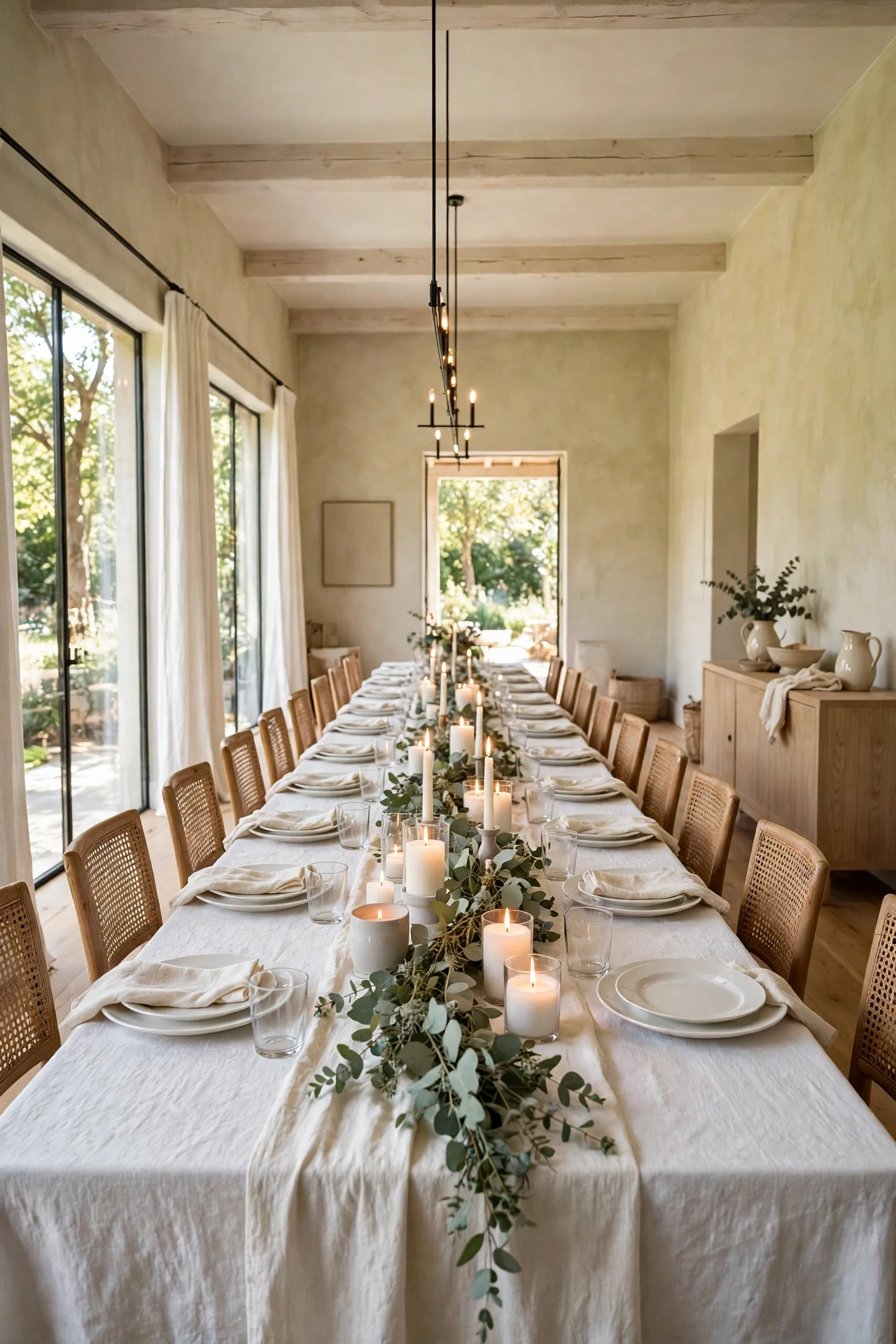
A white Christmas dinner should feel hushed in the best way. Candlelight moving across white linen. Clear glass catching a little sparkle each time someone lifts it. Pale greenery lying soft down the middle of the table, and a room so calm that conversation naturally drops to a warm, easy level. I chase that feeling every December, and I have learned it never comes from buying more white things. It comes from layering the whites I already own, keeping the light low, and planning the kitchen so the table never has to work hard. My palette for the night is whites and cream and ivory, soft silver and clear glass, pale eucalyptus and white pine, warm candlelight, and small touches of natural wood and champagne gold to keep it all feeling human. If you love a calm table as much as I do, my Christmas tablescape ideas are the natural place to wander next.
Love these ideas? Get more every week.
Join the newsletter for seasonal decor and cozy home inspiration.
Set a Calm White Table
1. Layer Three Whites Over a White Linen Cloth
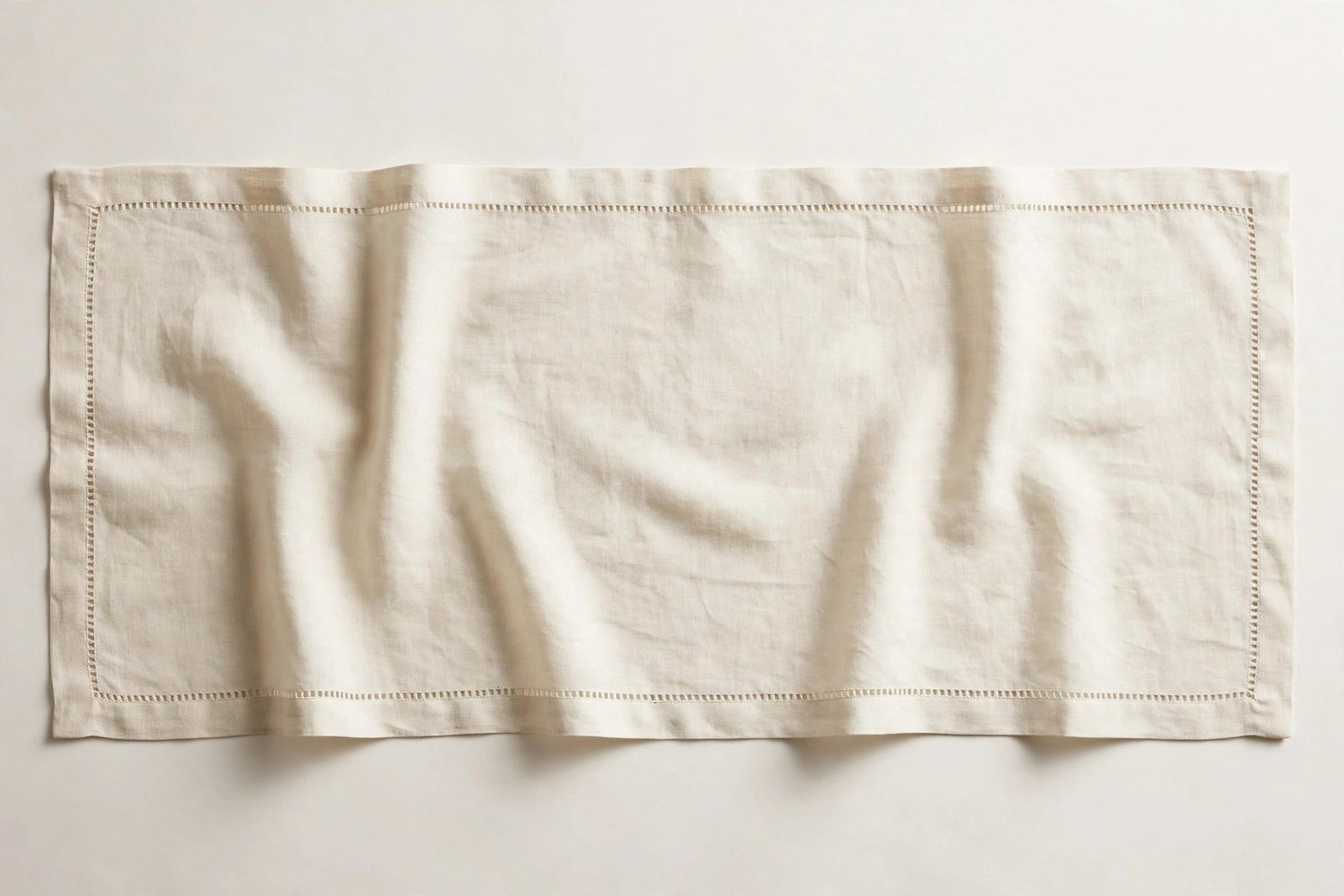
A white Christmas dinner should feel like candlelight landing on fresh snow. Quiet, soft, and a little bit hushed, the way a room feels right before everyone sits down and the good conversation starts. That calm only works when the white has depth, so I never use just one white on this table. I start with a white linen cloth with a soft, lived in drape. Over it I lay an ivory runner with a gentle sheen, and then I set cream napkins beside bright white plates. Three whites, each a breath apart in tone, and the table reads rich instead of flat or cold. This is the first principle I lean on all evening. Layer three whites so the table looks gathered and warm, never stark. The linen does the cozy work, the ivory catches the candlelight, and the true white plates keep everything feeling clean and awake. Once those three layers agree, every later choice gets easier, because I am only ever asking whether a piece belongs with the whites already on the table.
Shop This Look
This post contains affiliate links. If you purchase through these links, we may earn a small commission at no extra cost to you. Read our full disclosure here.
A few favorites featured in the ideas above:
2. Rest White Plates on Natural Wood
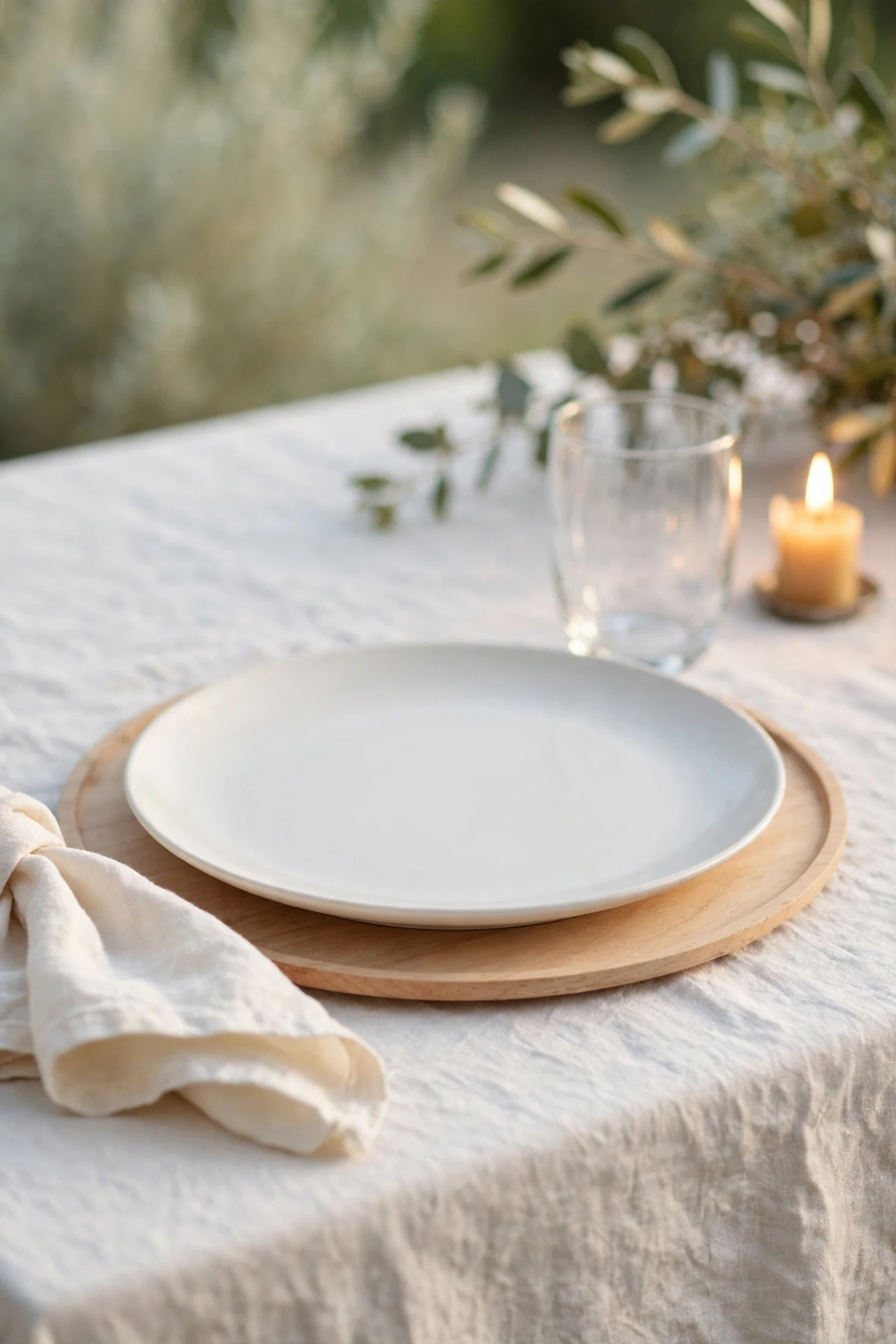
Pure white on white can go quiet in the wrong way, so each place setting gets one warm anchor under it. I rest every white dinner plate on a thin natural wood charger, and that slim ring of warm wood changes the whole seat. The eye reads plate, then wood, then linen, and suddenly the white looks intentional instead of washed out. Wood is my warmth insurance on a white table. It keeps the setting grounded the way a wood beam keeps a white kitchen from feeling like a showroom. I keep the chargers plain and matte, never glossy, and I let the grain show because that small bit of nature echoes the greenery coming down the center. If you do not own chargers, a woven pale placemat or even a slice of light wood under each plate does the same job. What matters is the pause of warmth between the white plate and the white cloth. One warm note per seat, repeated six or eight times, and the table feels like a place where people will linger.
3. Fold Ivory Napkins Simply, With One Green Sprig
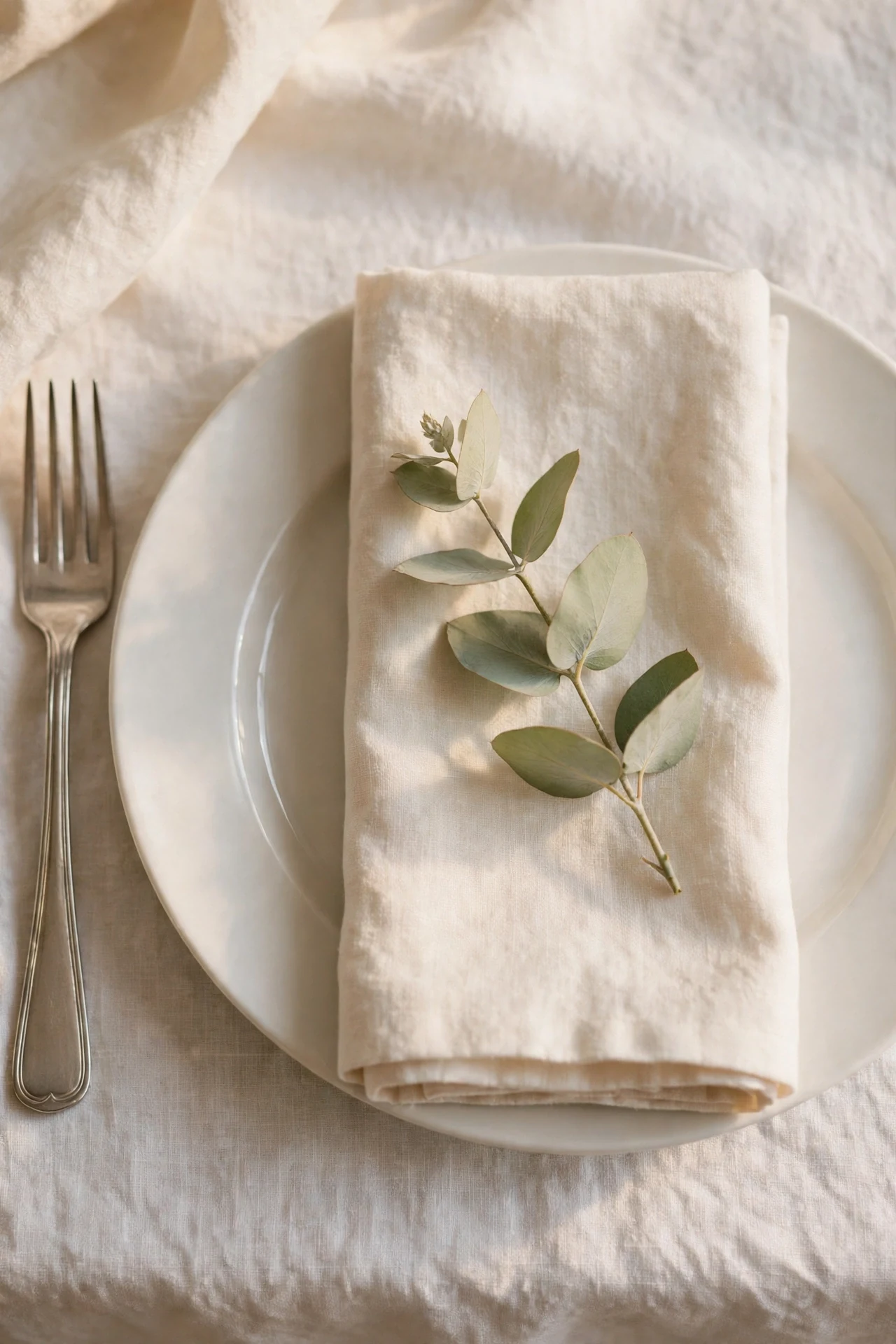
At each place I fold the ivory napkin once, long and simple, and lay it under the fork or straight on the plate with a single sprig of greenery resting on top. That tiny bit of pale green is the only color at the seat, and it is enough. Guests always touch it, move it aside gently, and smile, because it feels like the table was finished by a person and not a store display. I use whatever green is already in the house. A snip of eucalyptus from the center garland, a short piece of white pine from the yard, or a stem of rosemary from the kitchen when the other two run short. Rosemary earns a special mention because it smells wonderful the moment a warm hand rests near it. Keep the fold plain and the sprig small. A napkin folded into a shape that needs instructions has missed the point of a calm table. Simple fold, soft linen, one green note. That is the whole recipe, and it photographs like a dream.
4. Run a Low Eucalyptus Garland Down the Center
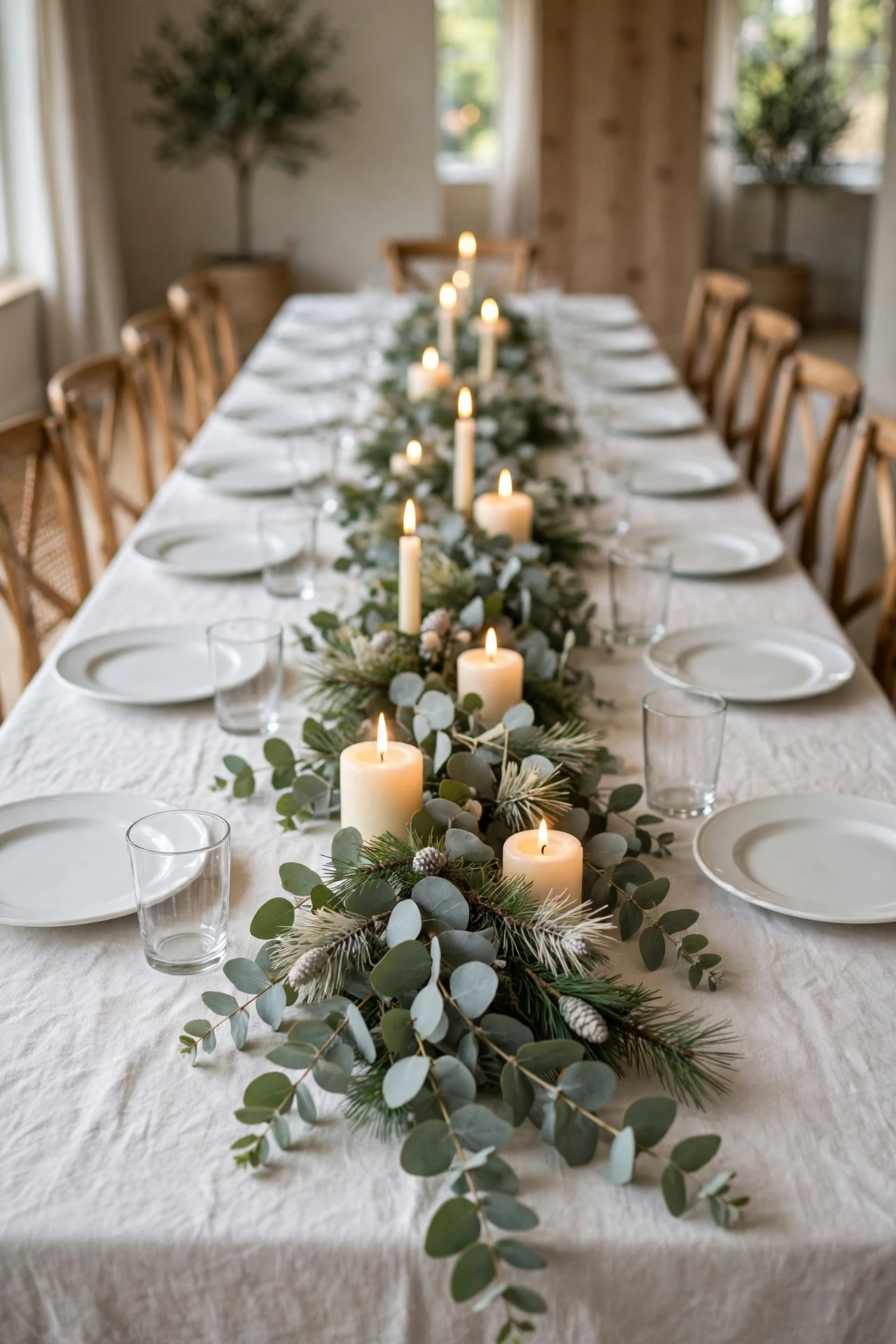
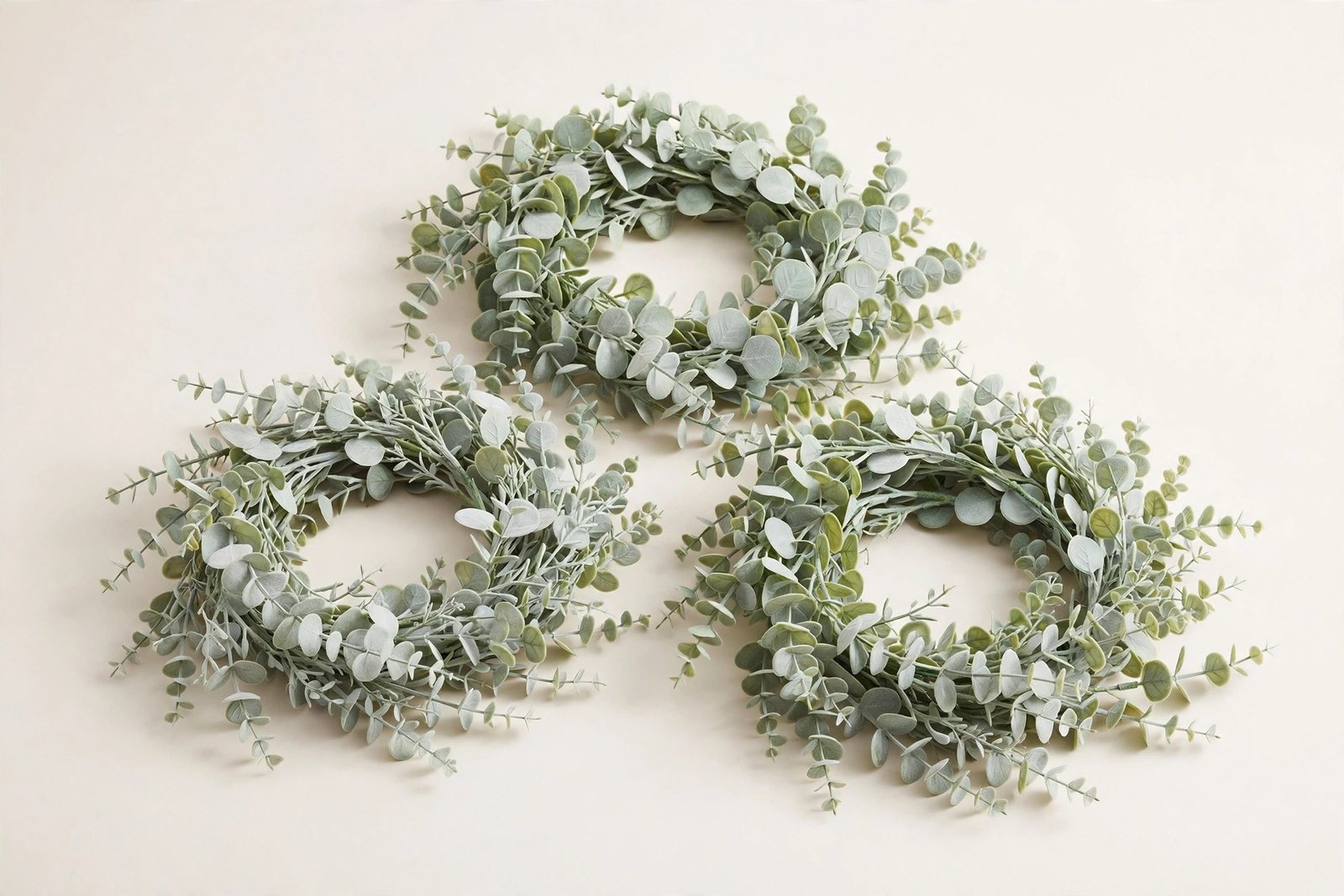
Down the middle of the table I run one low garland of eucalyptus, loosened and fluffed so it lies like it grew there. Eucalyptus is the perfect green for a white table because it is not really green at all up close. It is pale sage and soft silver, dusty and quiet, so it warms the whites without shouting over them. I lay the garland in a gentle wave rather than a straight line, and I tuck a few short stems of white pine into it for a hint of Christmas that never turns busy. Low is the rule that matters most here. Nothing in the center of my table rises above a wine glass, because I want faces visible and conversation easy from the first course to the last. This is where my second principle lives. Candlelight and greenery do the decorating at a dinner table, and both of them work best lying low and staying close. A tall arrangement may win the photograph, but a low garland wins the evening.
5. Cluster Clear Glass and Soft Silver Down the Middle
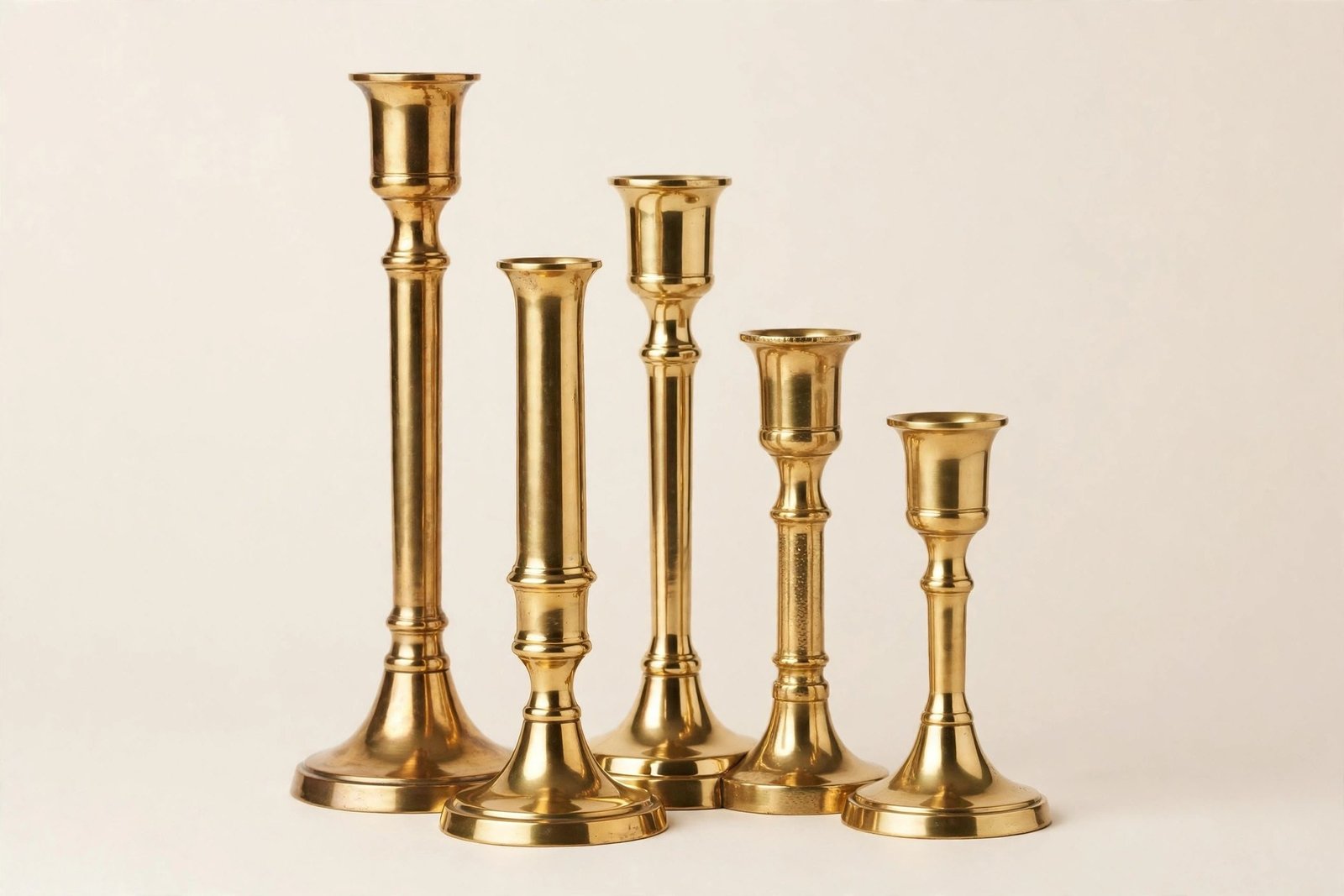
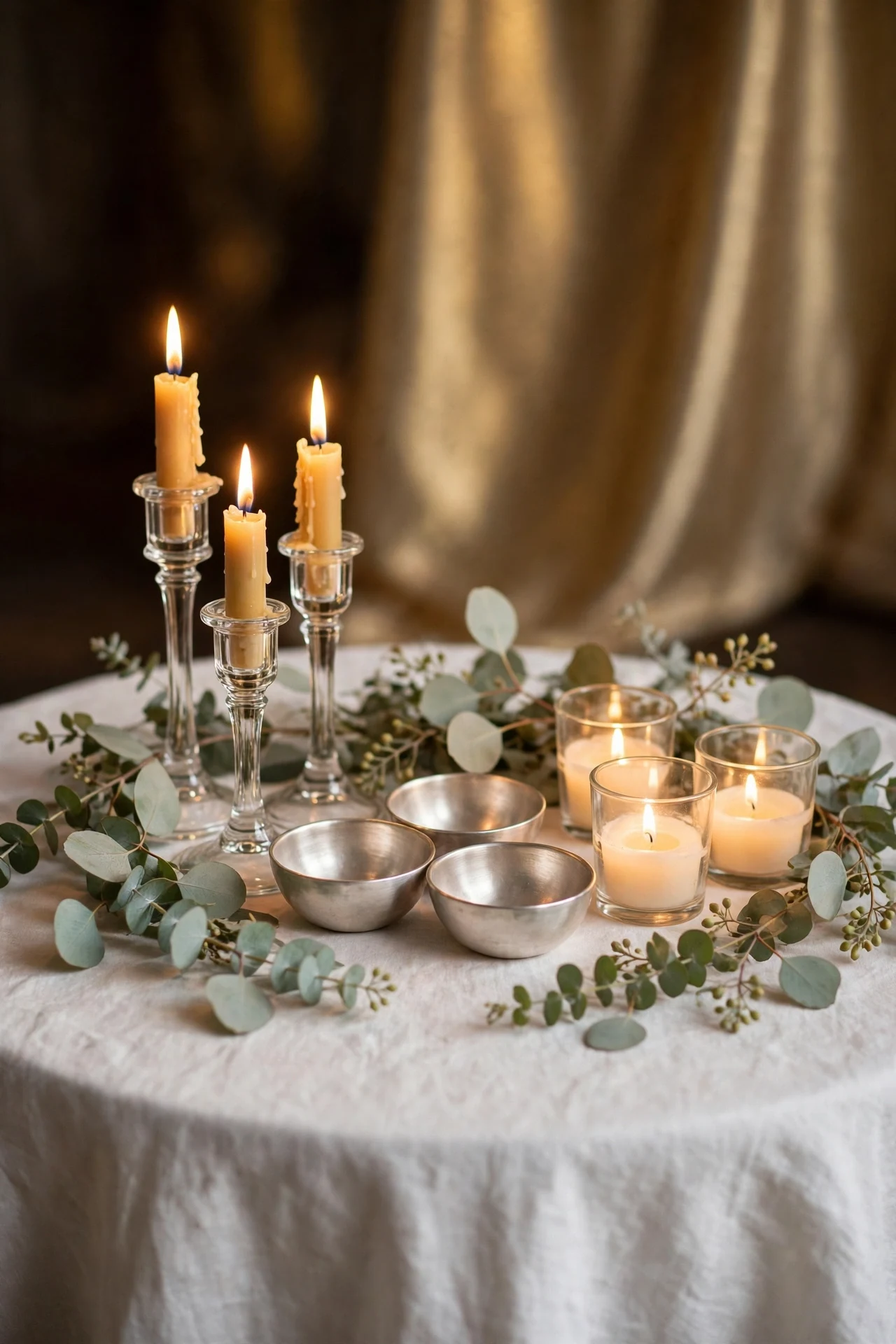
Between the waves of the garland I cluster the sparkle, and I keep it to two materials only. Clear glass and soft silver. Glass candlesticks, small silver bowls, clear votive holders, and a pair of silver serving pieces resting ready for the meal. Glass is the magic material on a white table because it holds candlelight without adding any color at all. It just bends the light and hands it back warmer. Silver does the same trick in a quieter voice, softer than chrome and kinder than bright gold, though a touch of champagne gold here and there is welcome when it keeps company with the silver. I group these pieces in loose clusters of three rather than spacing them in an even row. Even rows read as retail. Clusters read as a home where someone with taste set things down and stepped back happy. If you remember my Christmas tablescape ideas, this is that same cluster habit dressed all in white for a dinner party.
6. Keep the Centerpiece Low, Wide, and Calm
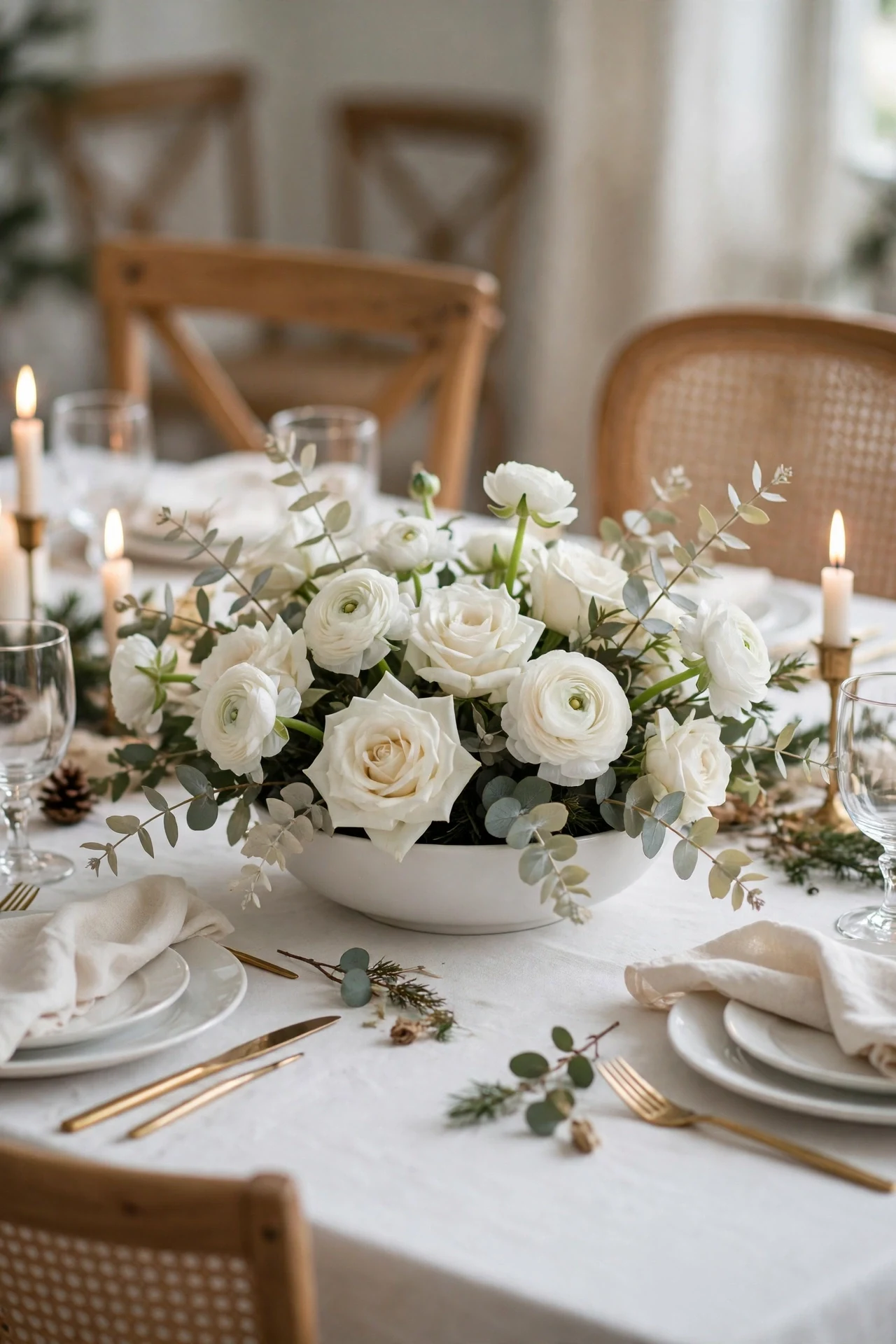
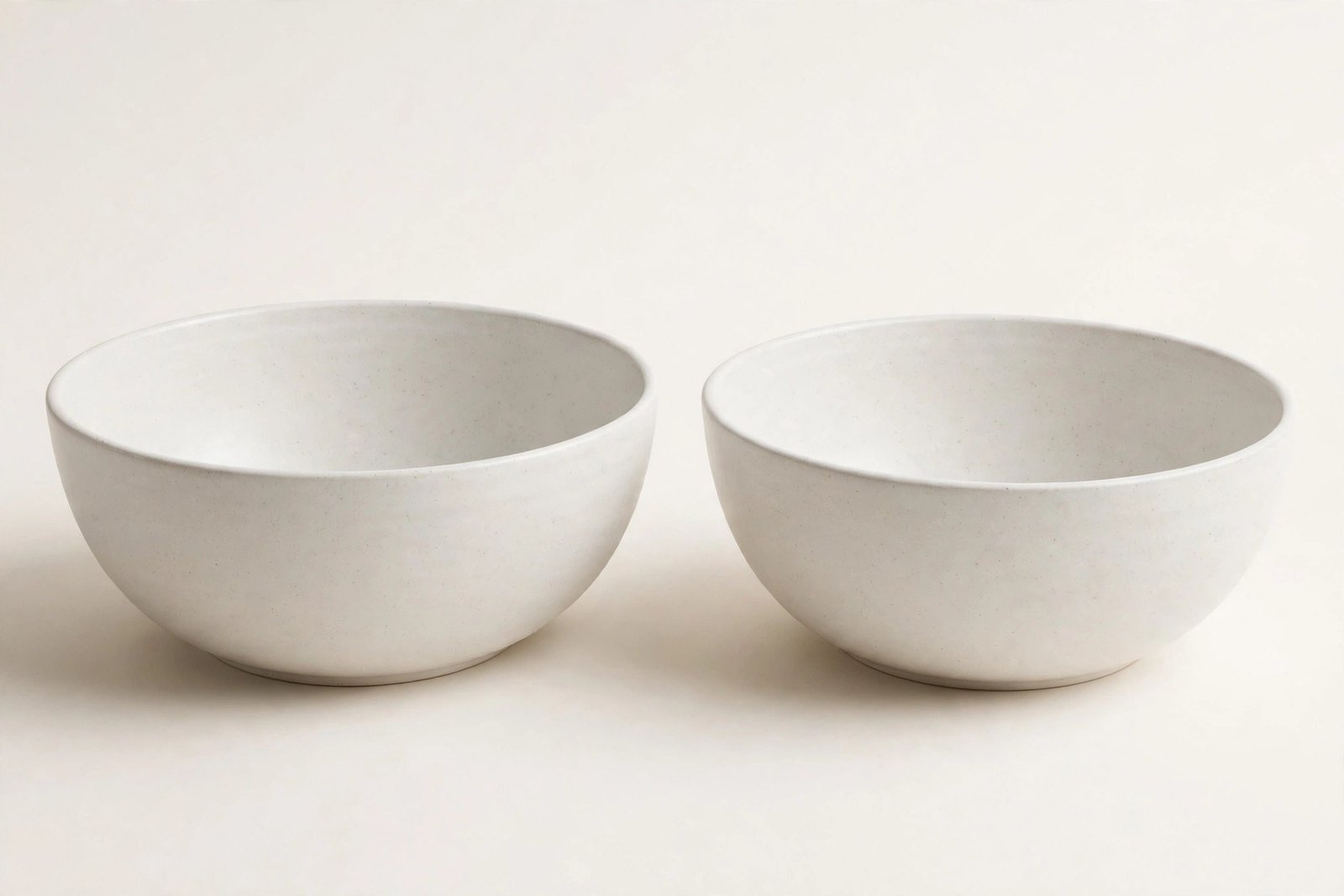
If you want one true centerpiece on top of the garland, make it low, wide, and calm. Mine is a shallow white ceramic bowl filled with white roses and ranunculus when I can find them, white grocery store carnations fluffed open when I cannot, and a few stems of eucalyptus laid through for that pale green thread. The bowl sits in the middle like a held breath. Wide enough to anchor the table, low enough that I can see every guest over it without leaning. I am firm about this because I have sat at the other kind of table, the one where a tall arrangement turns dinner into a game of peekaboo and everyone gives up talking across it by the second course. A white table is about calm, and calm includes seeing the people you invited. Flowers in one color also age gracefully through the evening. They do not compete with the food, the plates, or the candles, and at midnight they still look like themselves.
7. Set a Tiny White Village at the Far End
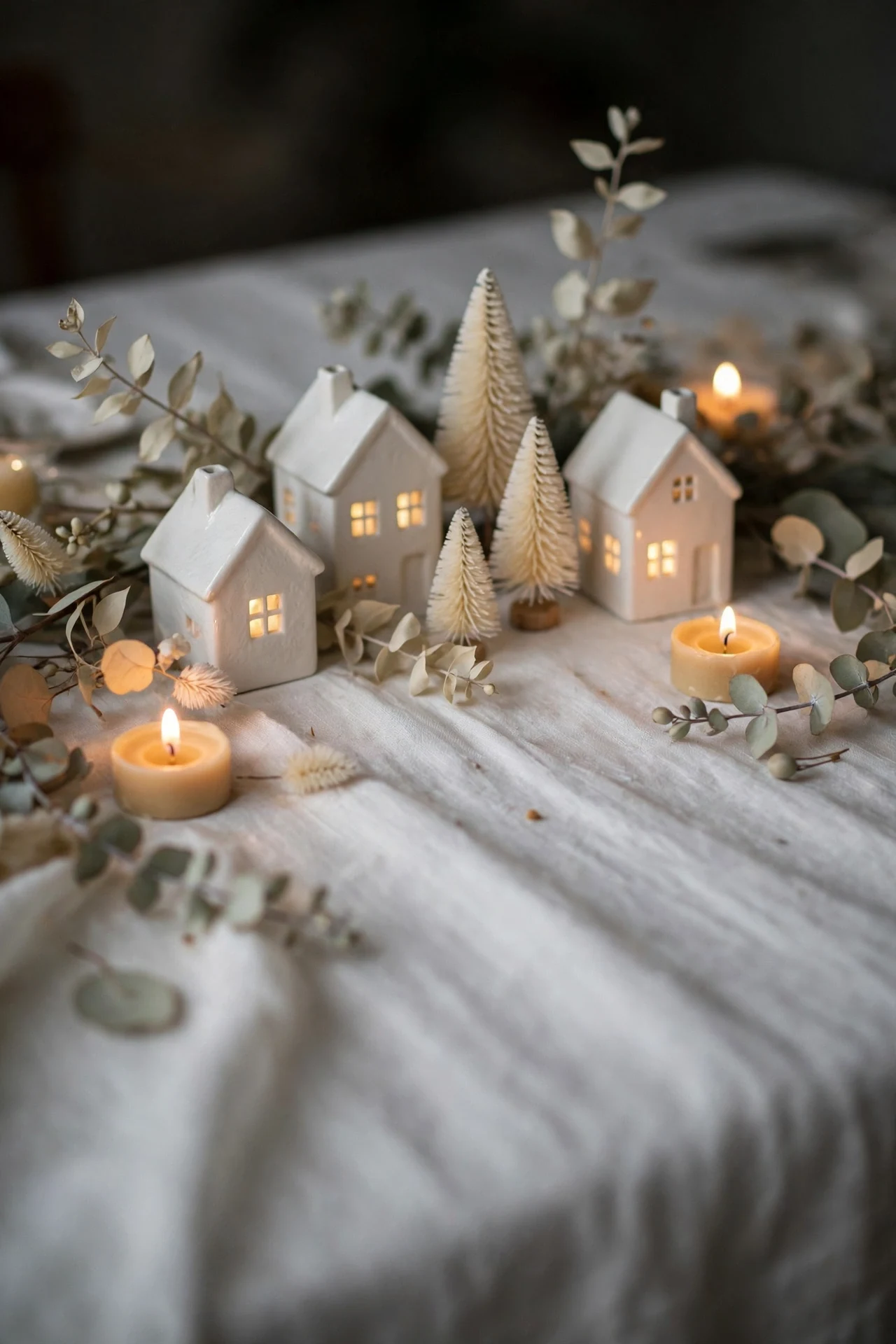
At the far end of the table, past the last place setting, I set a tiny village of white ceramic houses with warm light glowing in their windows. It is the one playful note on the whole table, and guests adore it because it feels like the dinner is happening at the edge of a small snowy town. The houses sit on a bed of the same eucalyptus, with one or two bottle brush trees in cream standing between them. Keep the village small, three to five houses at most, and keep it at the end where no one needs the space for elbows or serving dishes. I light mine with tiny battery tea lights so there are no cords crossing the table. This little scene also solves a real styling problem. Long tables often fade out at the ends, all dressed in the middle and bare at the edges. A small glowing village gives the eye a kind ending point, and it gives anyone seated at that end something lovely to look at all night.
Build Serving Zones in the Kitchen
8. Clear One Counter as the Main Serving Zone
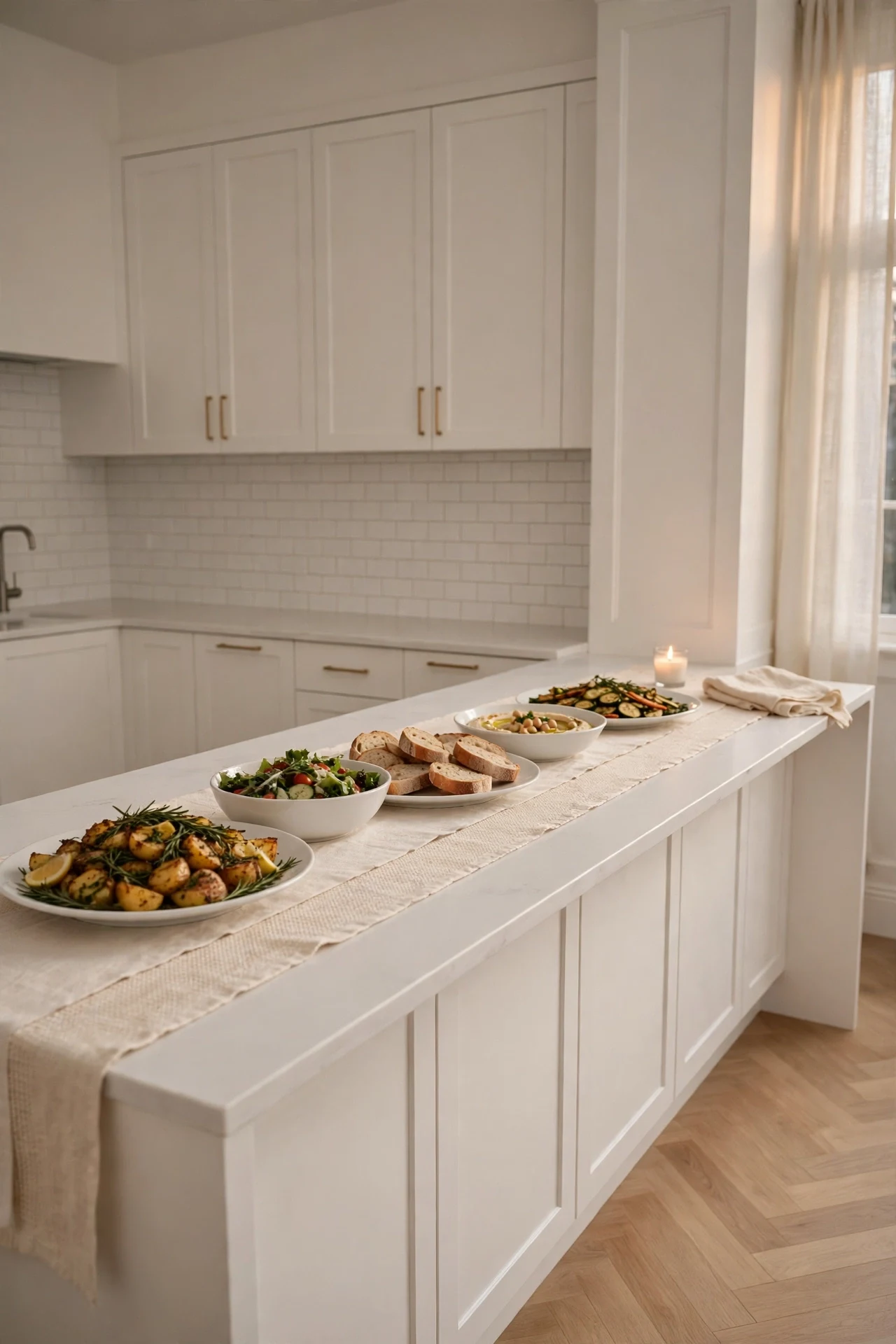
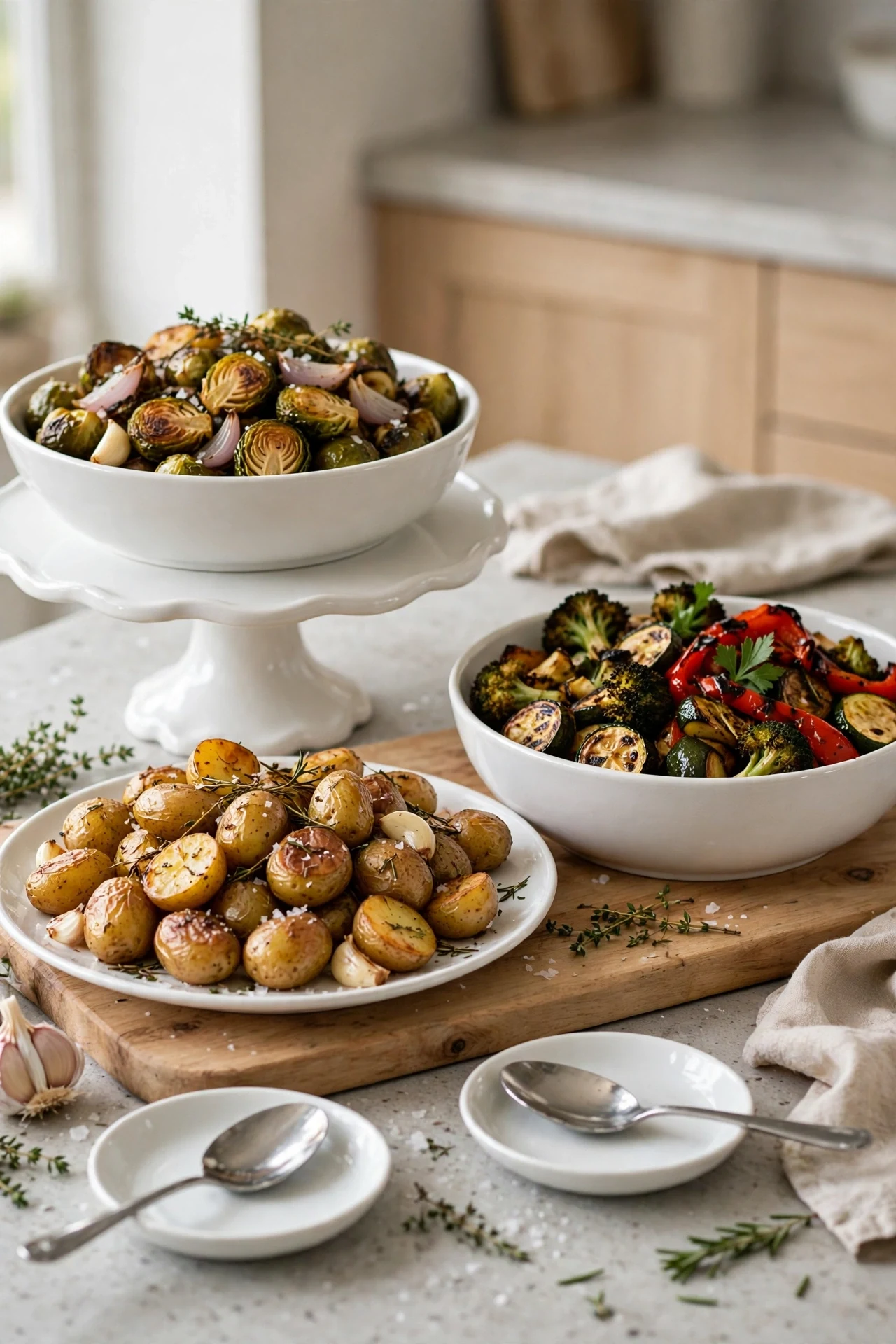
Here is the hosting principle that changed my December dinners more than any decor ever did. Keep serving zones separate from seating, so the table stays calm all night. That means the food does not live on the dining table at my house. It lives on one cleared kitchen counter, set up as the main serving zone, close to the stove and out of the conversation. Guests serve themselves there, or I plate from there, and the dining table keeps only what belongs to the meal in progress. The counter gets the same white treatment in a simpler key. A white runner or a stack of cream linen towels under the platters, the white serving bowls in a loose row, and one small candle at the end for warmth. Everything else comes off that counter. The mail, the mixer, the fruit bowl, all of it moves to a bedroom for the night if it has to. A clear zone reads as generous. A crowded counter reads as stress, and stress is contagious at a party. Calm is contagious too, and it starts right here.
9. Serve From White Platters at Two Heights
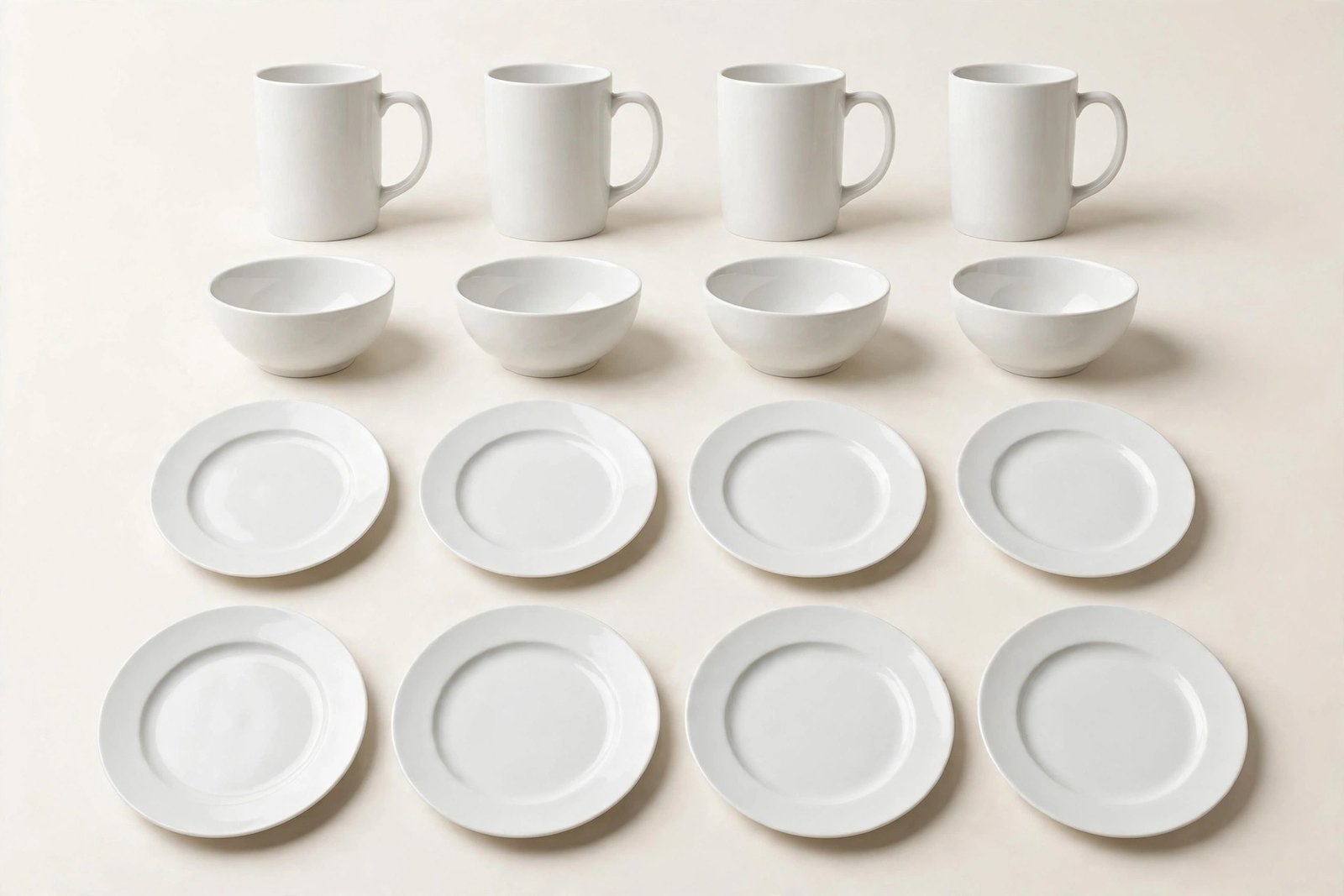
Within the serving zone, I serve almost everything from white platters and white ceramic bowls, and I set them at two heights. Half rest flat on the counter. The rest rise on cake stands, small wood boards, or an upturned white bowl used as a quiet pedestal. Two heights turn a plain row of food into something that looks abundant and planned, and it costs nothing but a minute of arranging. White serveware does for food what the white table does for candlelight. It makes color glow. Green beans look greener, roasted carrots look like sunset, and a pale gravy in a white boat looks like something from a very good restaurant. I keep one rule for the zone. Every dish gets a serving spoon resting on the platter or on a small white dish beside it, never balanced across the food. Guests should never have to hunt, ask, or fish a spoon out of the sauce. When the serving zone runs itself, I get to sit down, and a host who sits down is the whole point of planning zones in the first place.
10. Make a Drinks Zone on the Kitchen Island
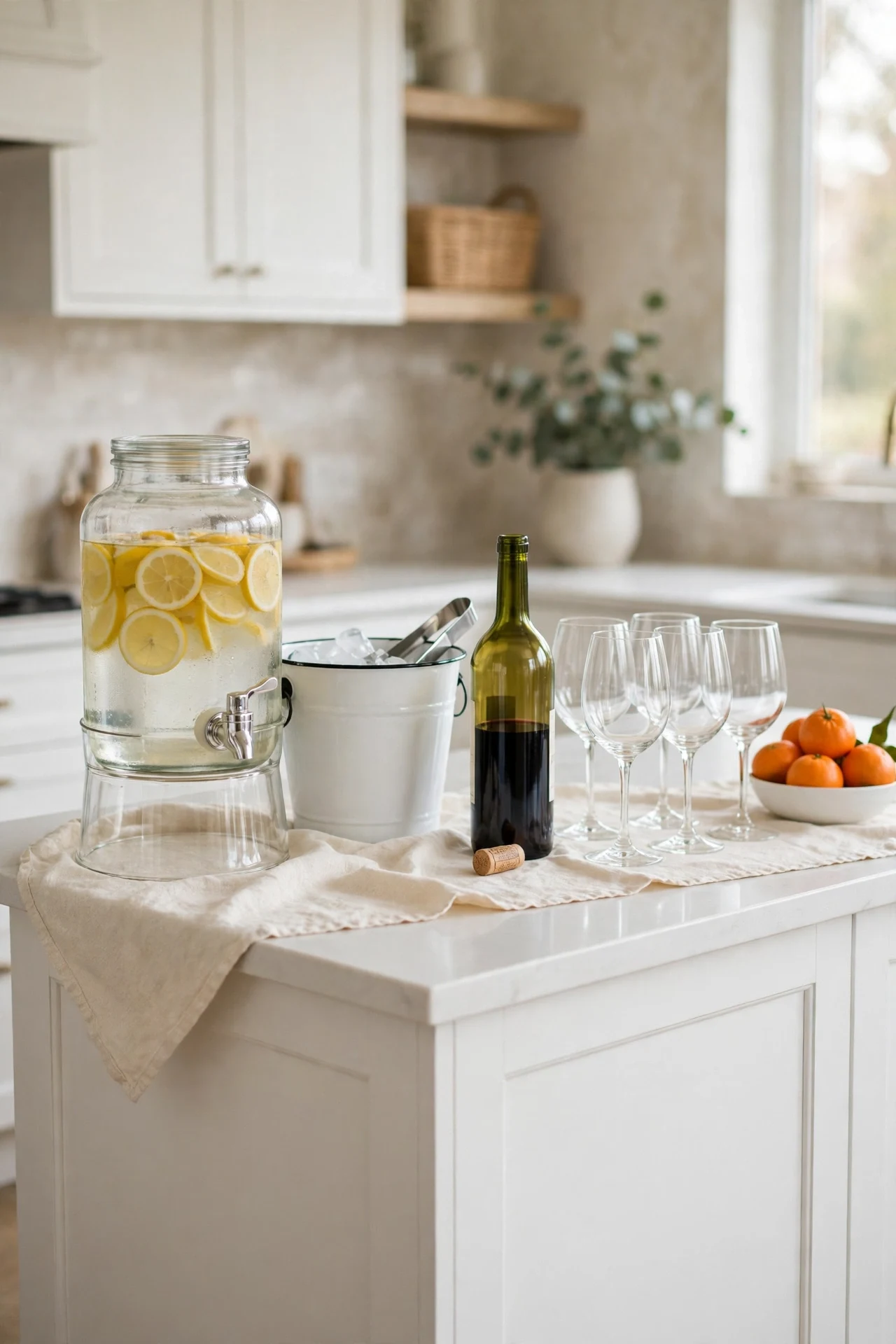
Drinks get their own zone too, and at my house that is the end of the kitchen island. A clear glass dispenser of water with lemon and cucumber, a white ice bucket, the wine opened and breathing, and a neat row of clear stemware on a cream linen towel. Guests can help themselves all evening without opening cupboards, asking for glasses, or drifting into the cooking space where I am trying to baste and think. I add one pretty touch and stop there. A small white bowl of clementines or a short stem of eucalyptus beside the bucket, echoing the table without turning the island into a second tablescape. Glass and white do all the work, just like they do in the dining room. For more ways to keep a whole home speaking one language at Christmas, my guide on how to create a cohesive Christmas theme walks through the palette thinking room by room. Zones are really the same idea in kitchen form. Decide what each space is for, dress it simply, and let it be.
11. Set a Small Cocoa and Coffee Zone by the Kettle
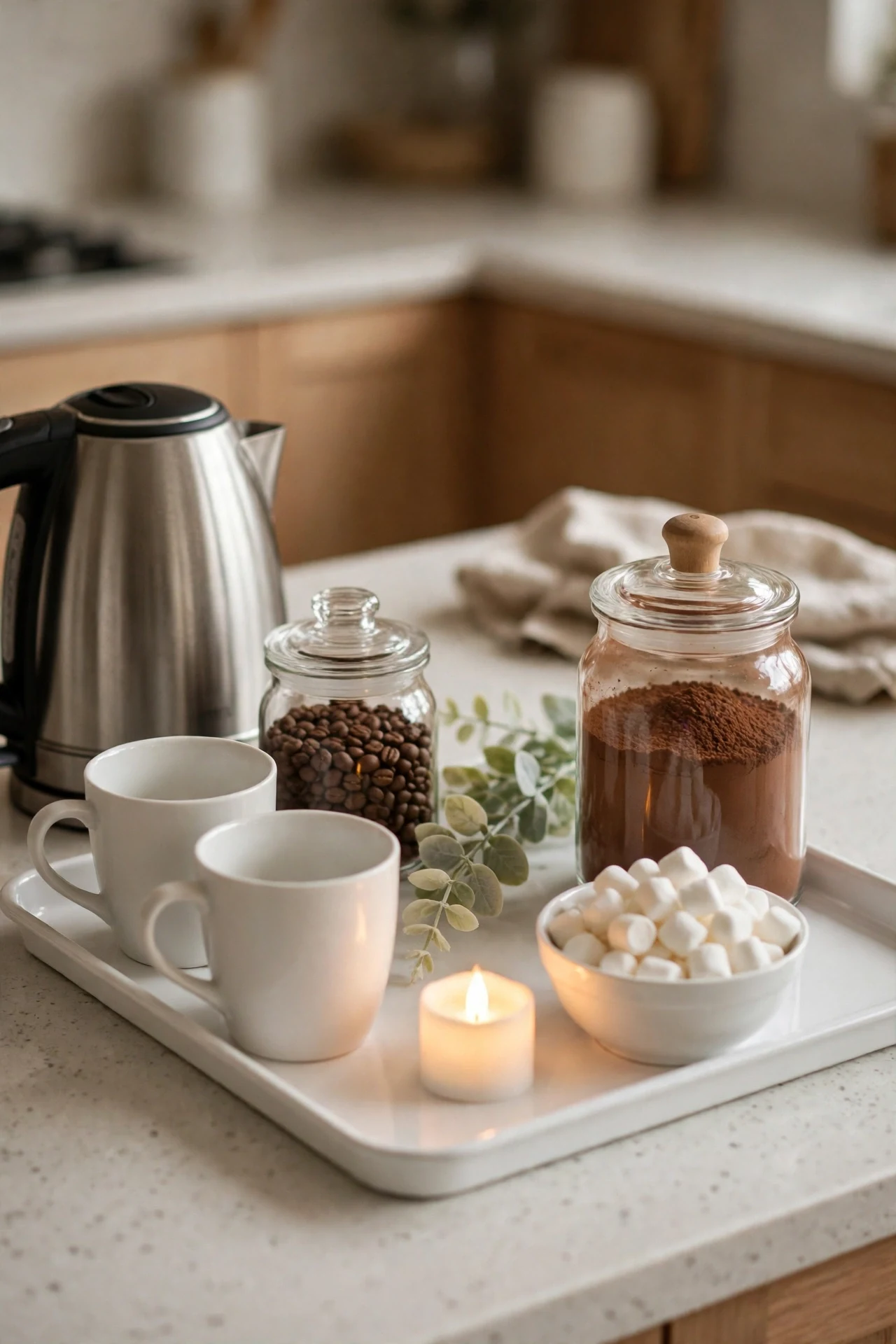
By the kettle I set a small cocoa and coffee zone, because a December dinner in our part of the world ends with something warm in both hands. It stays compact on purpose. A white tray holds the mugs, a clear jar of cocoa, a small bowl of marshmallows, and the coffee things in a tidy group. Guests drift here between dinner and dessert, and it gives the evening a gentle middle chapter while I clear and plate sweets in peace. I borrow the bones of my Christmas cocoa station ideas and shrink them to tray size for a dinner party, all in white and glass so it matches the night. White mugs only, one small sprig of greenery on the tray, and a flameless candle nearby for that low warm light. It takes ten minutes to set up and it makes people feel cared for in a way that is hard to explain until you watch three guests standing around a tray of cocoa, talking softly, in absolutely no hurry to leave.
12. Keep a Quiet Dessert Zone on the Sideboard
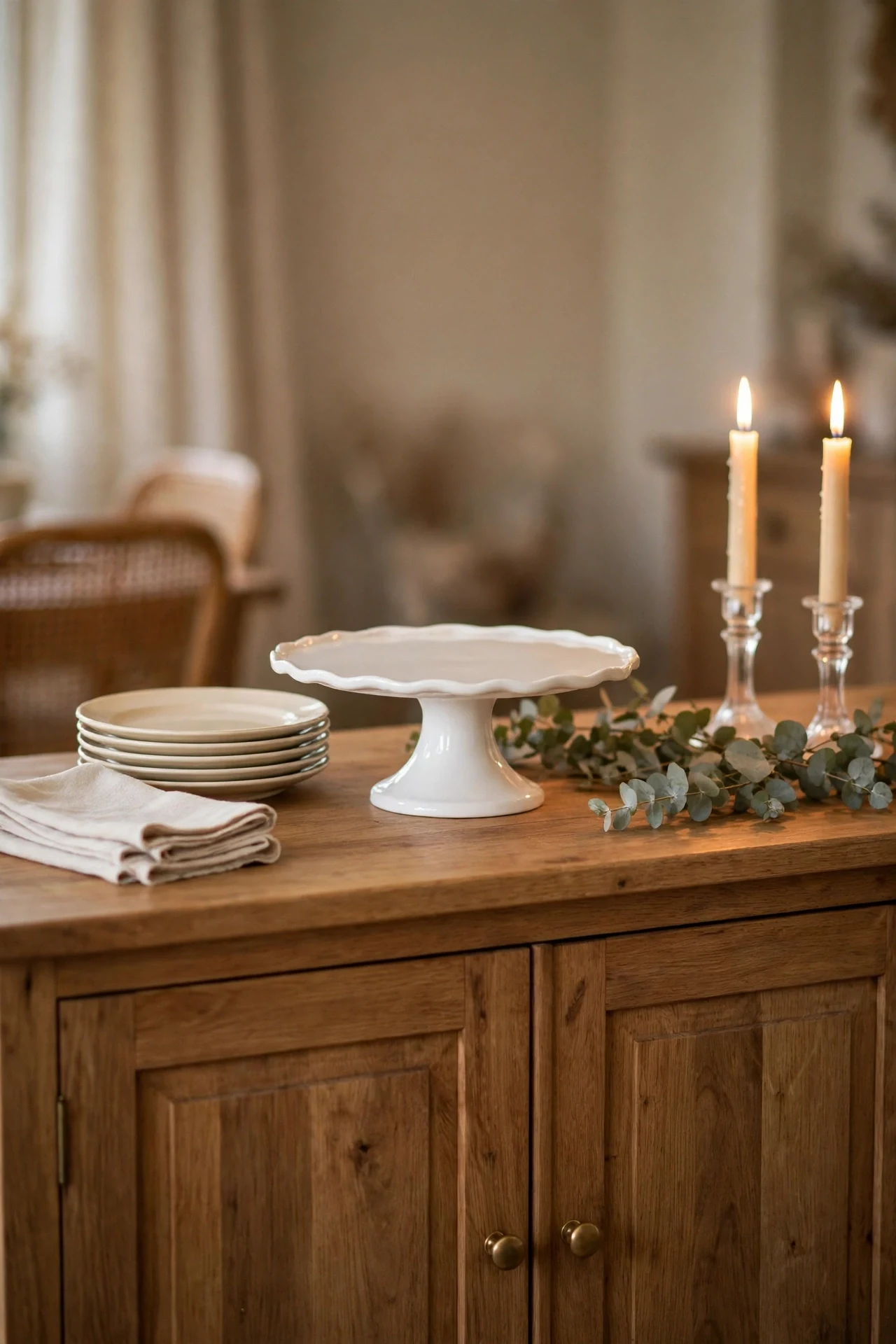
Dessert lives on the dining room sideboard, dressed as the quiet encore of the table. A white cake stand waits there from the start of the night, empty and patient, with dessert plates stacked in cream and a small pile of pale linen napkins. Keeping dessert in the dining room rather than the kitchen does two kind things. It keeps sweet traffic out of the kitchen while I am clearing dinner, and it lets the reveal happen in candlelight, in the room where everyone is already soft and happy. I style the sideboard with the same restraint as the table. One short run of eucalyptus, two glass candlesticks, and the white stand. When the cake or pavlova arrives, it lands on a stage that was ready for it, and the whole room makes that small appreciative sound people make when dessert appears looking calm and beautiful. If your dining room has a mantel nearby, my Christmas mantel decor ideas pair beautifully with this kind of sideboard, all glow and greenery with no extra color arguing across the room.
13. Stage Extra Glassware on a Tray, Ready to Move
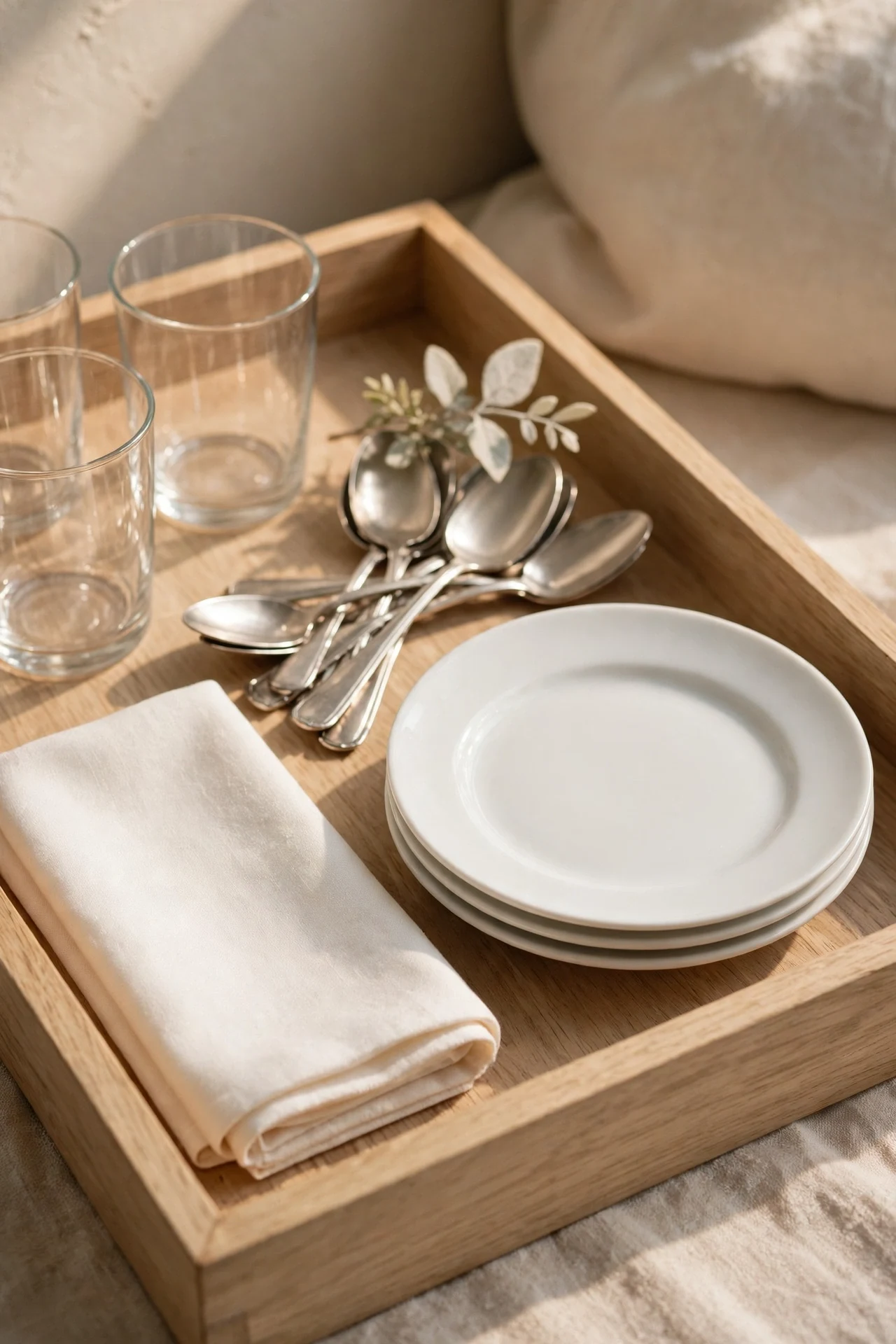
The last zone is the smallest and the one guests never notice, which is exactly why it works. On a tray in a quiet corner I stage the extras. Spare clear glasses, extra ivory napkins, a second set of serving spoons, a corkscrew, and a small stack of white side plates. Every dinner party produces the same small emergencies. A dropped fork, a cracked glass, a second helping that needs a clean plate. With the tray staged, each emergency takes twenty seconds and zero cupboard opening, and the calm of the evening never even ripples. I use a simple wood tray so it reads as decor if anyone does spot it, and I tuck one sprig of greenery on top for the same reason. Think of this tray as the stagehand of the night. Invisible, prepared, and responsible for more of the magic than anyone will ever know. Hosts who look relaxed are almost never lucky. They are staged. This tray is where that secret lives in my house, and now it can live in yours too.
Add Glow and Finishing Touches
14. Light the Table With Tapers in Mixed Holders
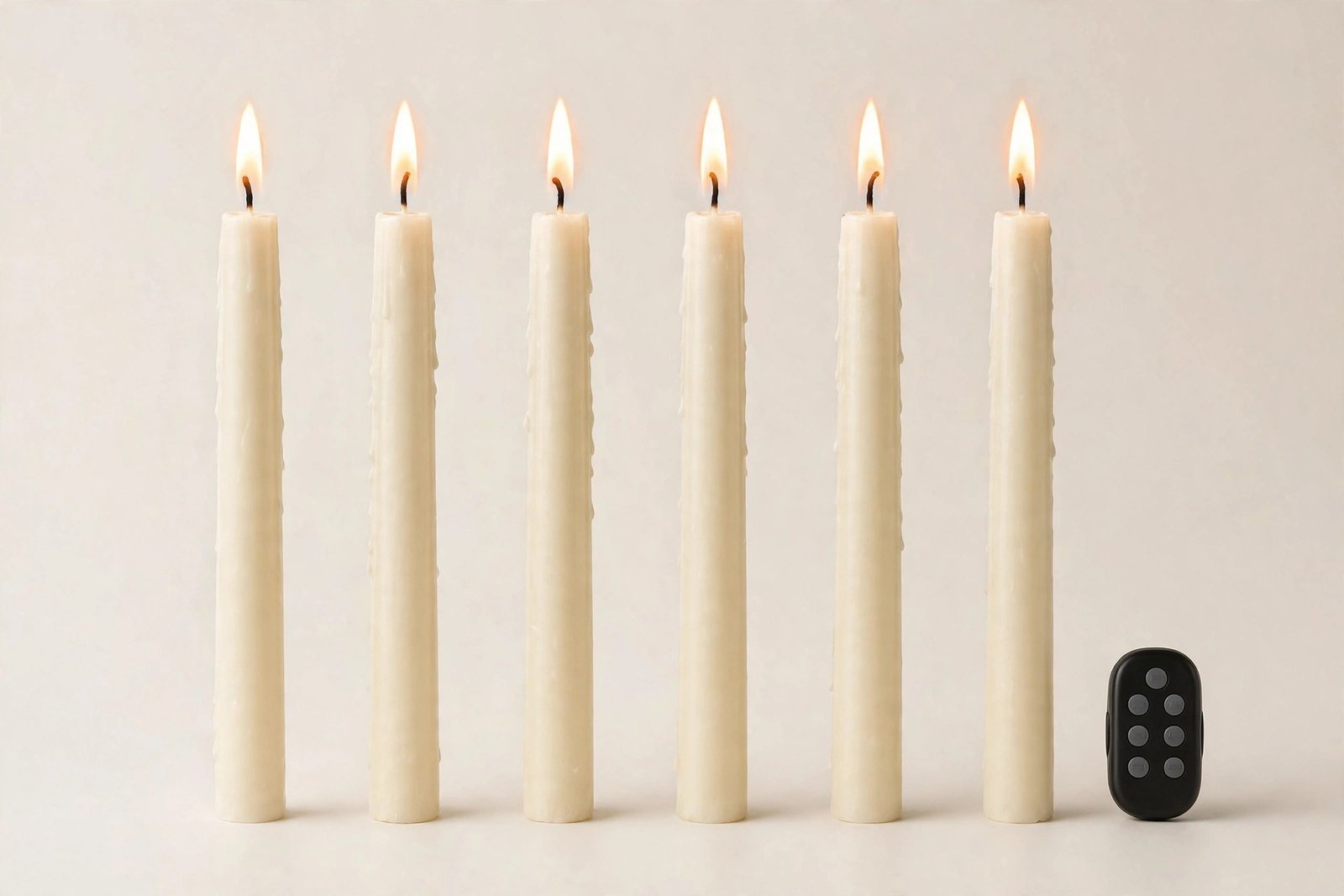
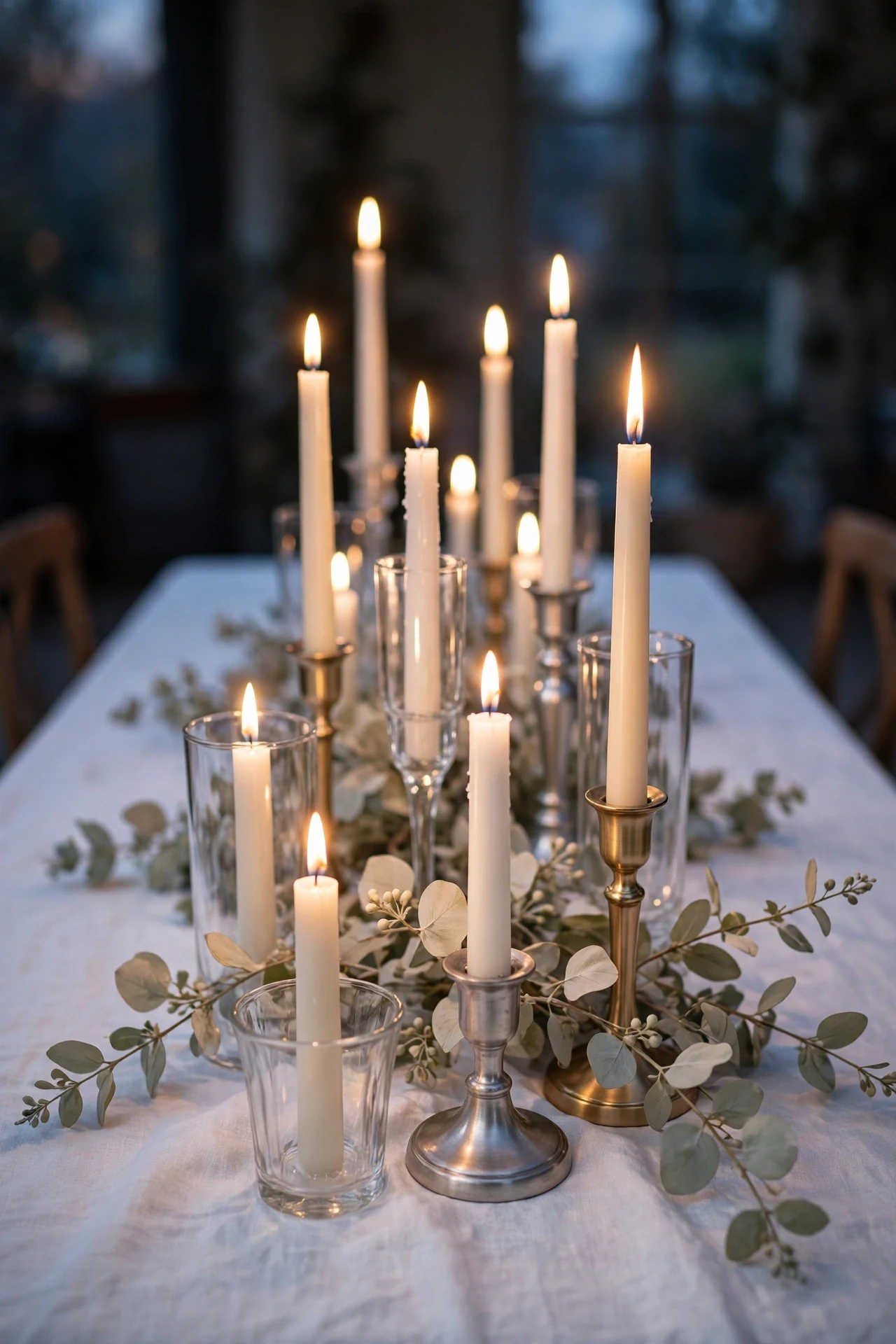
Now the glow, because a white table is only ever as beautiful as its light. Down the center I set white and ivory tapers in mixed holders, some clear glass, some soft silver, a few in champagne gold for warmth. Mixed heights, mixed holders, one color of candle. The mix keeps the table from feeling like a rental set, while the single candle color keeps it serene. I always mix real tapers with a few flameless ones where sleeves and reaching arms make me nervous, and I will tell you honestly that in candlelit photographs even I have to look twice to spot the difference. Height matters more than count. I aim for flames at two or three levels so the light feels layered, the way the whites are layered. If the tree is in sight of the table, and I hope it is, this is where the room comes together. Our tree leans pale and calm in the same family as this table, much like the ones in my neutral Christmas tree ideas, and the tapers and the tree lights end up having a quiet conversation across the room all night.
15. Scatter Mercury Glass Votives Through the Greenery
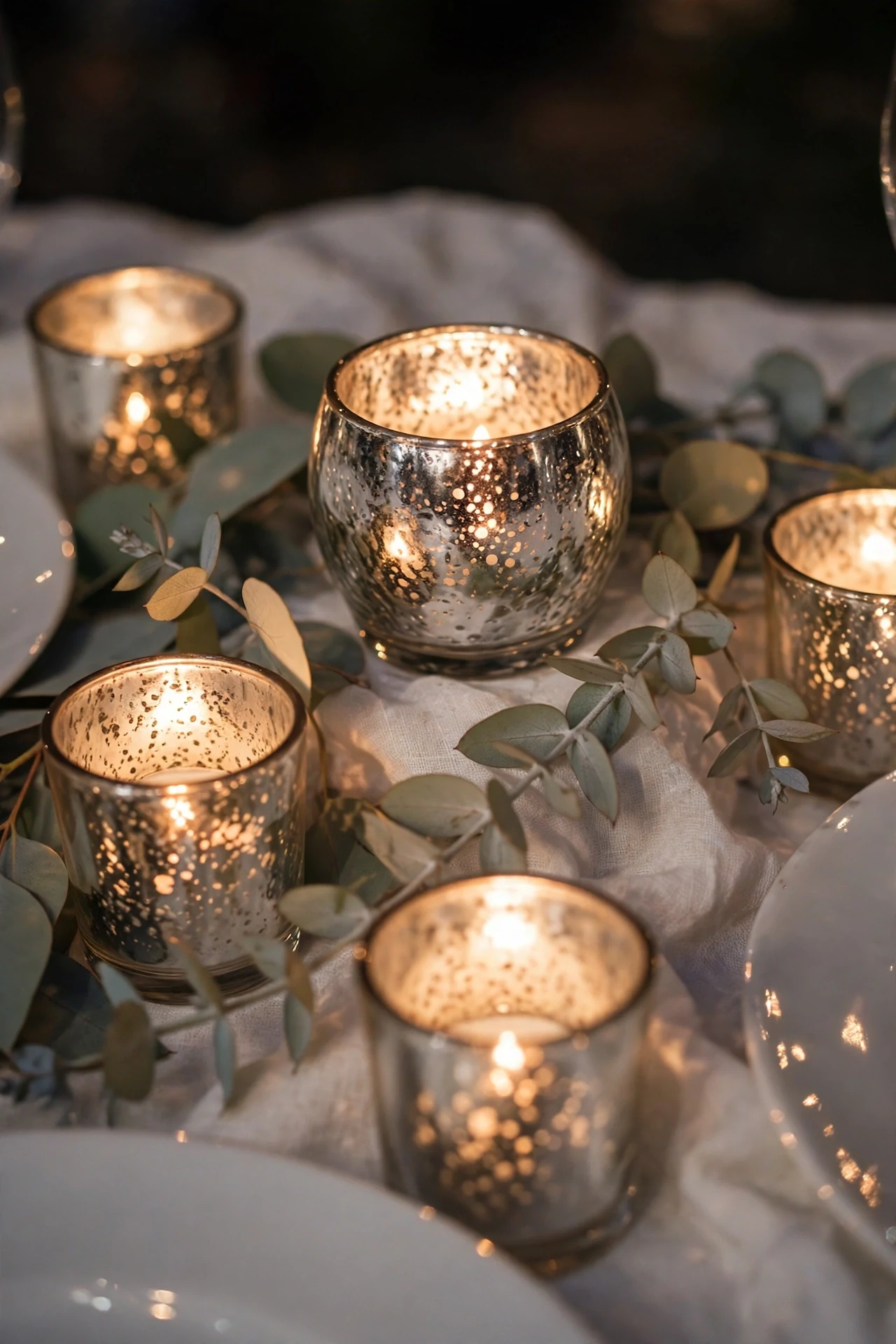
Between the tapers I scatter mercury glass votives through the eucalyptus, the silvered kind that glow like small moons when they are lit. Votives do a job tapers cannot. They put light down low, right inside the greenery, so the whole center of the table seems to shimmer at leaf level. That low shimmer is what makes a white table look expensive in person and in photographs, because the light is coming from inside the arrangement instead of only above it. I use flameless tea lights in most of mine, partly for safety among the leaves and partly because they last the whole long evening without a single one drowning in its own wax. Space them unevenly, a pair here, a single there, a trio near the centerpiece. Even spacing is the enemy again. Clusters and gaps read as natural, like light falling where it pleases. On a white table, with white plates catching tiny reflections from every votive, the effect by dessert is pure quiet sparkle, and nobody wants to leave the table. I count that as the highest praise a dinner can earn.
16. Add Flameless Pillars Inside Glass Hurricanes
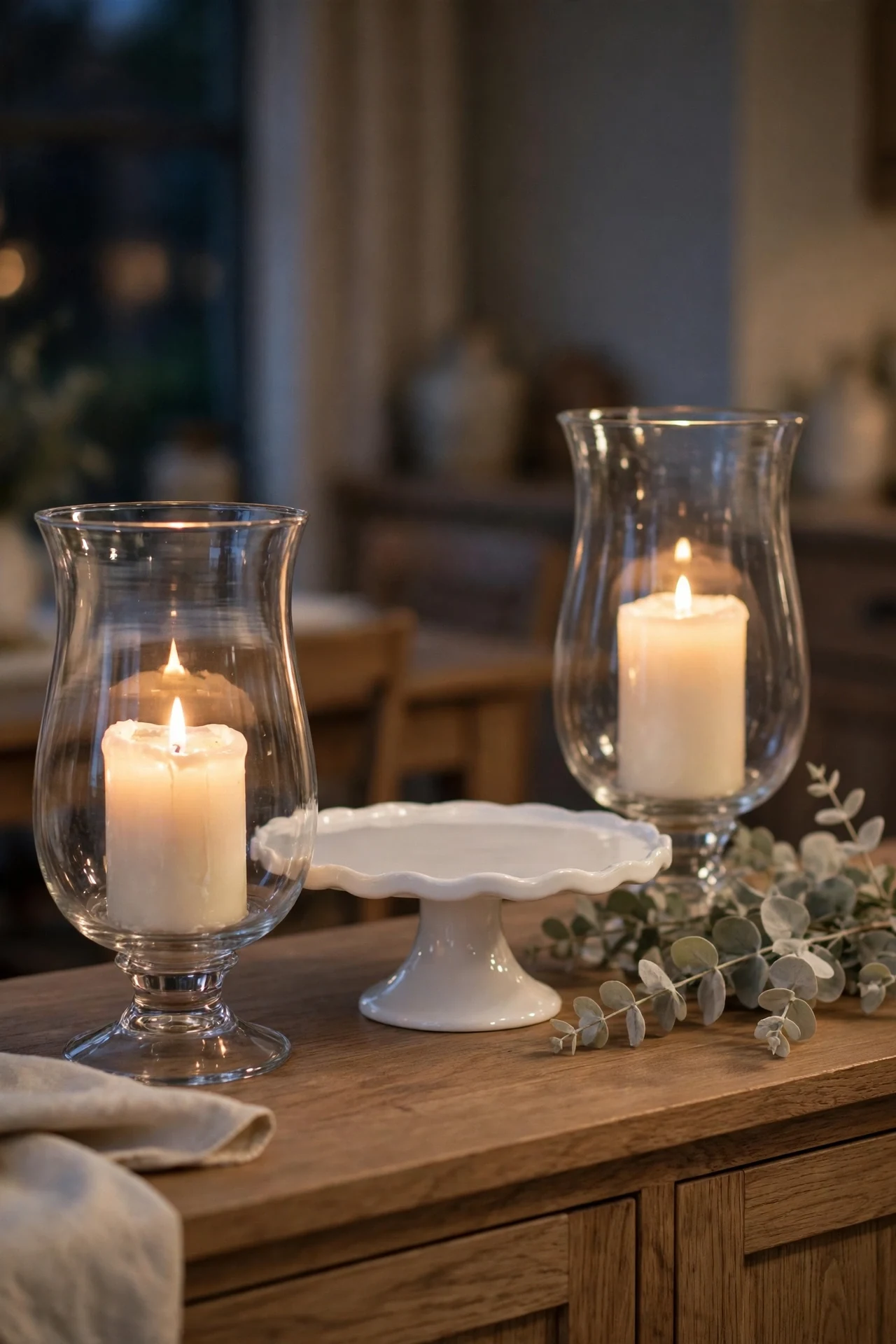
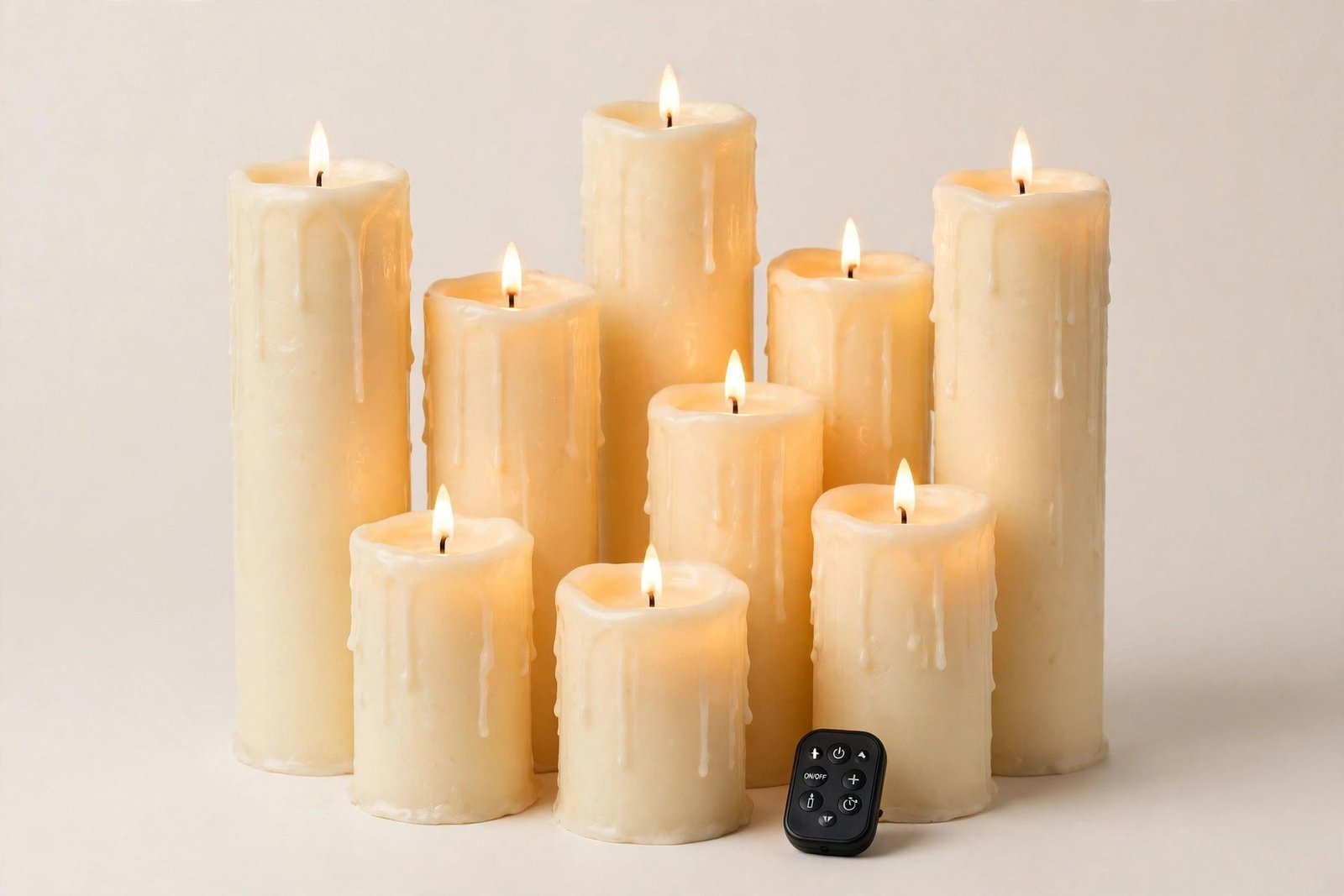
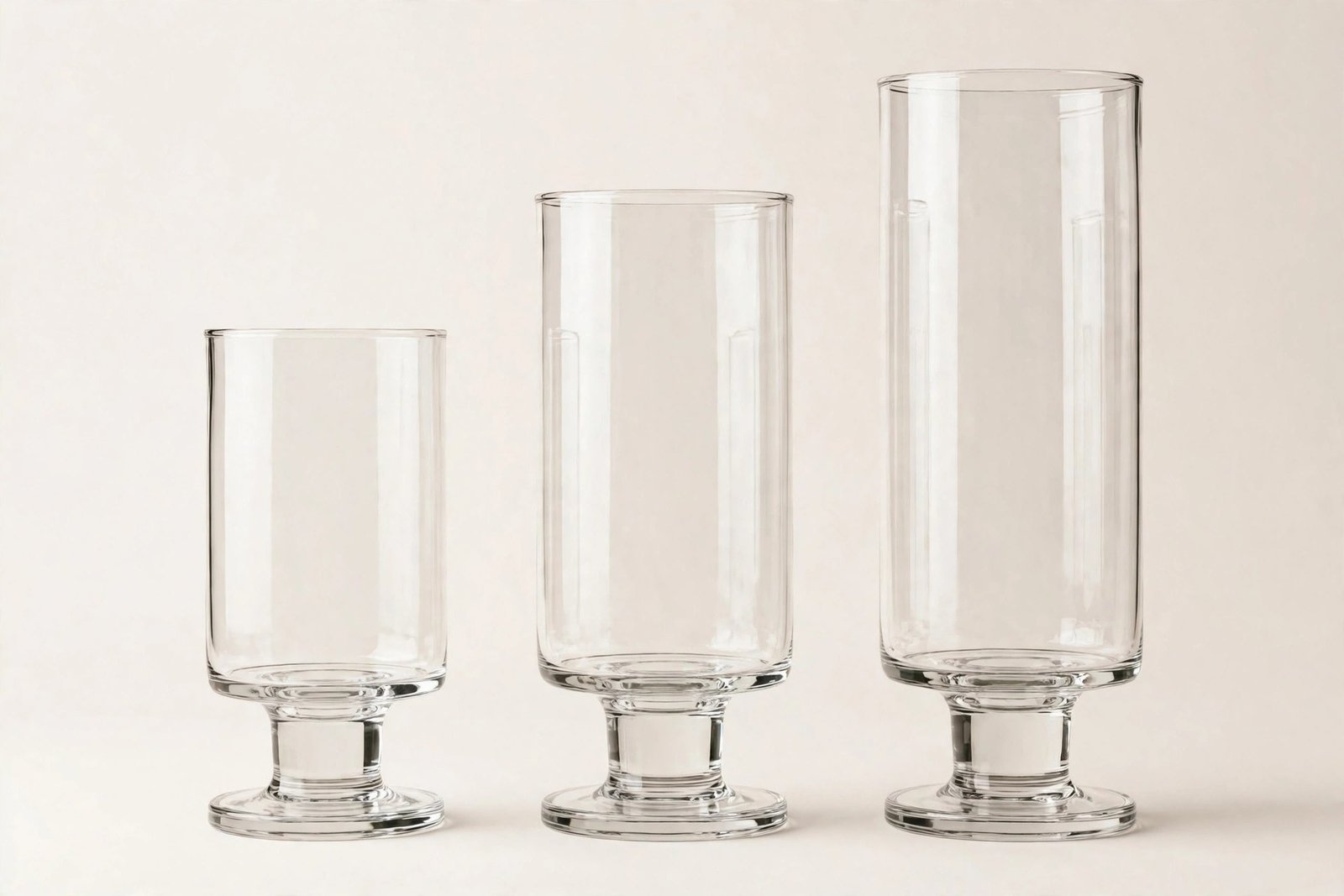
At both ends of the table, and again on the sideboard, I set flameless white pillars inside clear glass hurricanes. The glass wall around each flame does three lovely things. It steadies the glow, it makes a modest candle look grand, and it keeps the light safe from December drafts every time the front door opens and the whole house breathes in cold air. Pillars are the anchors of the lighting plan. Tapers give height and elegance, votives give shimmer, and pillars give weight, the sense that the light has settled in and plans to stay. I choose pillars in two whites to match the layering on the table, bright white in one hurricane and warm ivory in the next. On the sideboard the hurricanes flank the dessert stand like two calm sentries, and when the cake finally lands between them, the whole end of the room looks like a painting I would hang in the kitchen and never tire of. Simple glass, honest light, nothing more. It never fails me.
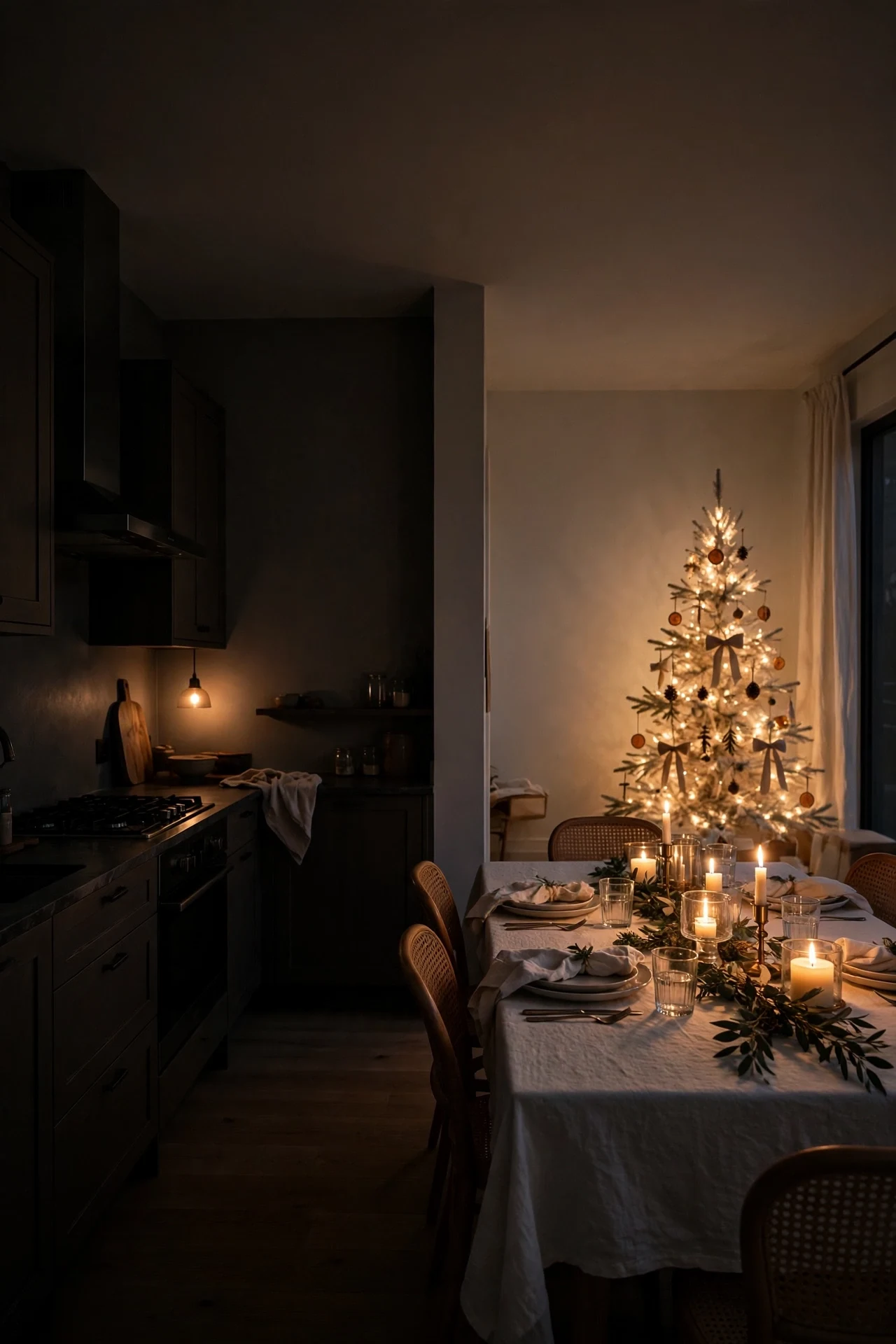
17. Dim the Kitchen and Let the Dining Room Glow
When we sit down to eat, I change the light in the whole house, and it might be the most dramatic free decorating move I own. The kitchen goes dim, one low lamp or the light over the stove only, just enough for safe trips to the serving zone. The dining room keeps its candles, the tree lights, and one warm lamp in the corner turned low. The contrast does something guests feel in their shoulders. The working part of the house recedes, the gathering part glows, and everyone settles deeper into their chair. Bright overhead light is the enemy of a white Christmas dinner. It flattens the layered whites, turns ivory a little gray, and makes candlelight look like a decoration instead of the main event. Warm, low light does the opposite. It melts the whites together into one soft field and lets the silver and glass sparkle at their own pace. If your kitchen and dining room share one open space, dim the kitchen end and light the table end, and let the zones you built do the separating. Light is a wall you do not have to build.
18. Bring White Into the Entry for the First Hello
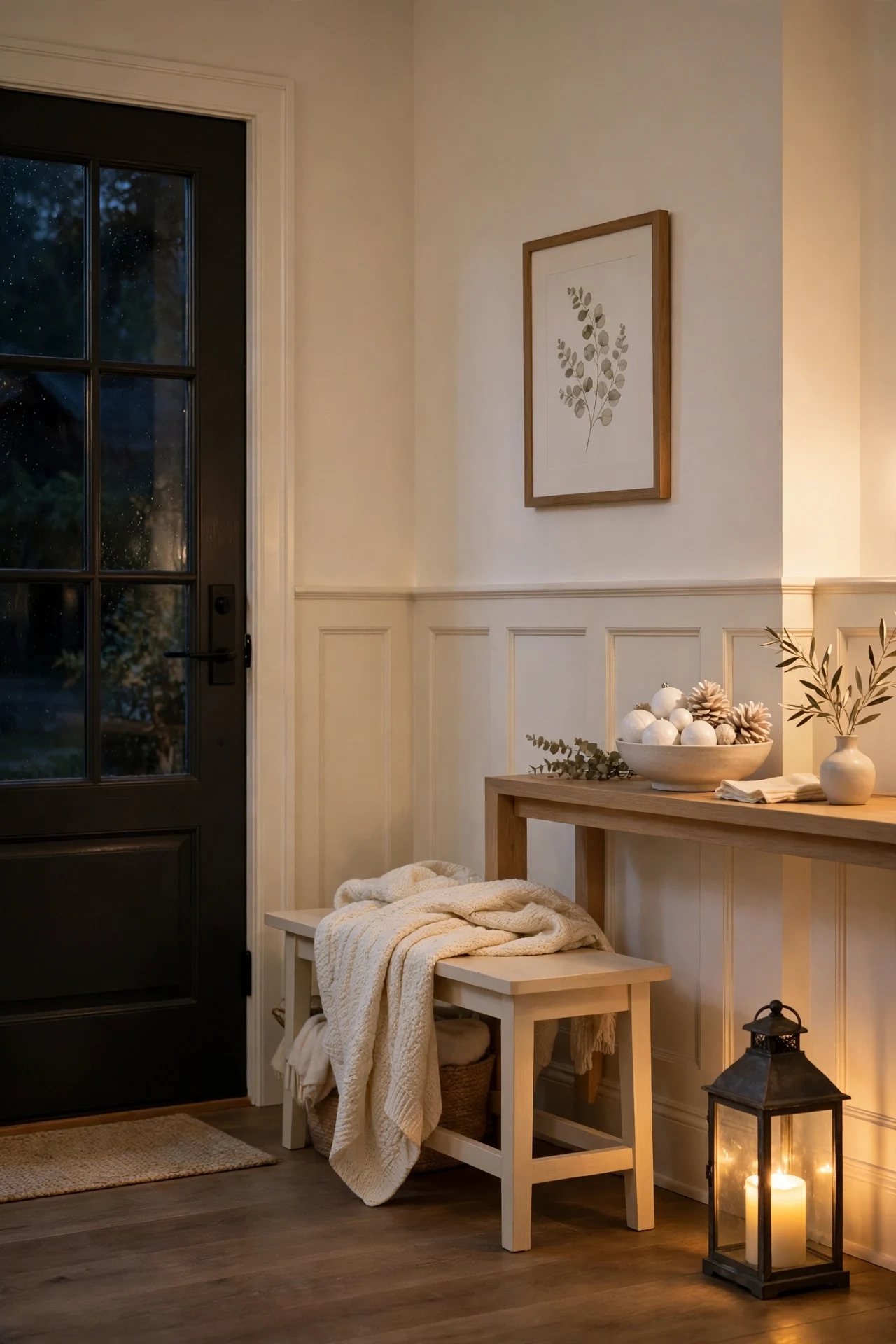
Before the first guest arrives, I give the entry a small white hello of its own. A cream throw over the bench, a bowl of white ornaments or pinecones in pale tones on the console, and one lantern with a flameless pillar glowing at floor level. The entry is the opening sentence of the evening, and I want it to promise exactly what the dining room delivers. Calm, warmth, and white done softly. Guests step in from the cold and the dark, and the first thing they meet is low golden light and pale, quiet color. Coats come off, voices drop a little, and the night has begun well before anyone sees the table. Keep the entry touches few and sturdy. This is a working space with wet boots and swinging bags, so the lantern goes where it cannot be kicked and the bowl sits back from the edge. One minute of styling here buys the whole evening a graceful beginning, and it costs nothing but a few things carried from rooms you have already dressed.
19. End the Night With a Slow Candlelit Dessert
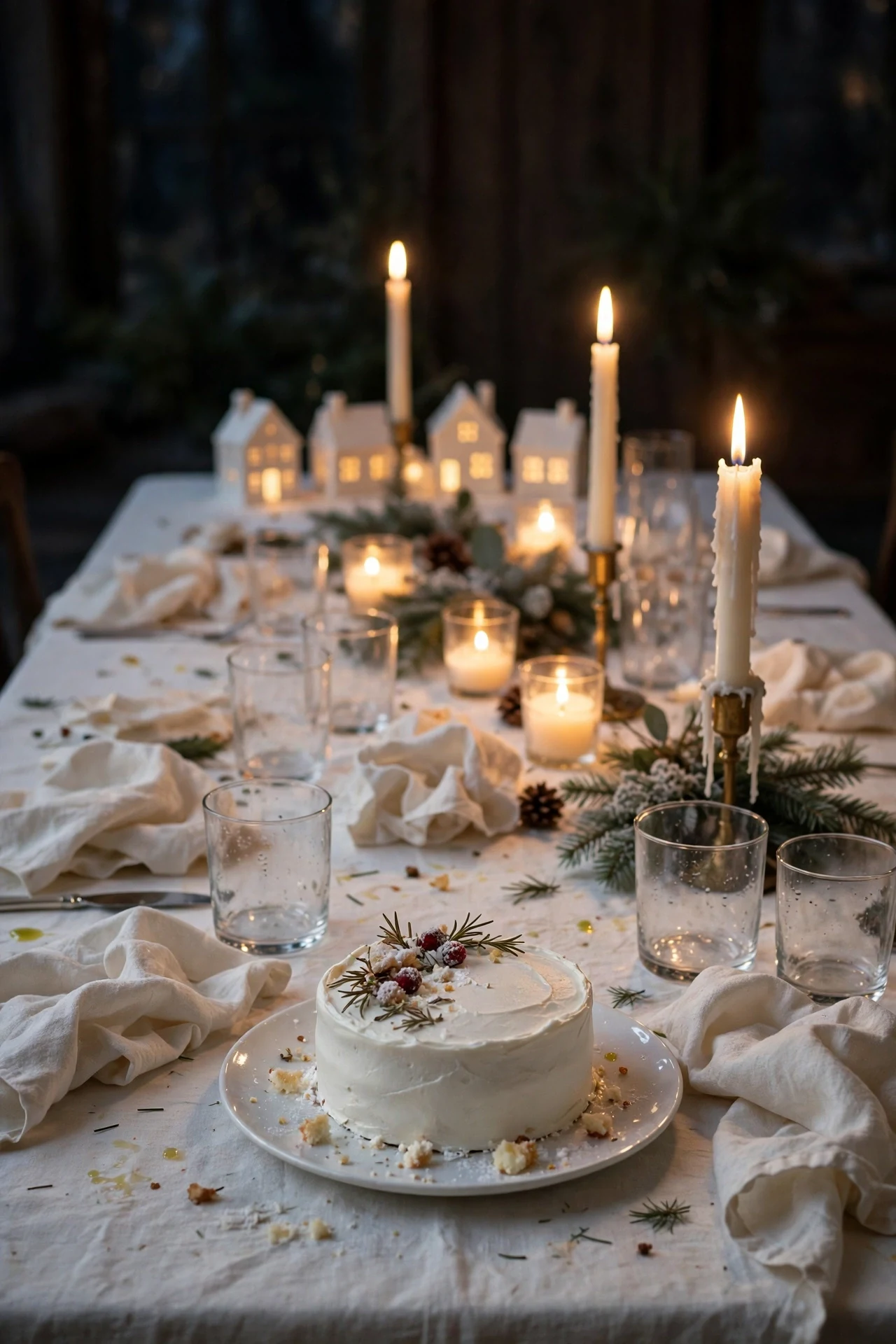
The last idea is not a purchase or a project. It is a pace. When dessert is served, I let everything slow down on purpose. The main course dishes stay in the kitchen. The music drops a little. Nobody touches the overhead lights. We eat something sweet in the candlelight we have built all evening, with the white table now softened by the meal, napkins loose, glasses low, the little village still glowing at the far end. This is the moment the whole design was for. The layered whites, the quiet zones, the low greenery, all of it exists so that eight people can sit in warm light and feel completely unhurried at the end of a December night. I plan dessert to be easy for exactly this reason. Something made ahead, served simply on white plates, with coffee and cocoa from the little zone by the kettle appearing like they were always going to. Hosting well is not about impressing people. It is about building a room where the people you love can relax all the way down. A white Christmas table, done softly and lit with care, does that better than anything I know.
More Favorites
This post contains affiliate links. If you purchase through these links, we may earn a small commission at no extra cost to you. Read our full disclosure here.
A few more favorites from the ideas above:
By the time the candles burn low, nobody at my table remembers whether the napkins matched the runner. They remember that the room felt calm, the light was kind, and nobody once had to ask where the serving spoons lived. That is what the zones and the layered whites are really for. They carry the work of the evening quietly, so the people can carry the joy of it out loud. You do not need a new set of anything to host a white Christmas dinner like this. Start with the whites already in your cupboards, layer three of them with intention, keep the center of the table low, and give the food, the drinks, and the dessert each a simple home of their own. Then light every candle you have and sit down with your people. The table will do the rest, and it will do it beautifully.
With love and light
Get Fresh Home Ideas Every Week
Seasonal decor ideas, organizing tips, and cozy home inspiration, straight to your inbox.
More Christmas Ideas You Will Love
Keep browsing for more seasonal inspiration: