

It is Saturday morning at the park and my son has both hands wrapped around a red toy truck like his whole life depends on it.
Another little boy reaches for it. My son yanks it back and shouts mine at a volume that turns every head on the bench row. The other child bursts into tears. His mom looks at me. The whole park seems to look at me. And out of my mouth, before I can even think, comes the line I swore I would retire.
Say sorry. Say sorry right now and give him a turn.
My son stares at the ground. He mumbles a sorry that sounds like anything but sorry. He holds the truck tighter. The other boy cries harder. And I stand there with hot cheeks thinking, why does sharing turn my sweet kid into a tiny bouncer, and why does my go to fix make it worse every single time?
If you have lived that park moment, or the living room version, or the birthday party version with an audience of relatives, I need you to hear this first. Your child is not selfish, and you are not raising a kid who cannot share. You are watching a young brain do exactly what young brains are built to do, while a well meaning grown up script pushes against it.
I spent years forcing apologies and prying toys out of small hands because I thought that was the job. I thought a good mom produced a sharing child on the spot, in public, on demand. What I know now changed everything in our house. Sharing is a skill that grows from the inside, and it cannot be installed with a forced sorry. It grows when kids feel secure, when they watch generosity modeled, and when we coach the moment instead of policing it.
This post is the plan that replaced our park standoffs. It is gentle, it is practical, and it works in real rooms with real siblings and one very beloved truck. I will show you what to say instead of say sorry, how to handle turns without becoming a full time referee, and how to help a child make a genuine repair when someone truly gets hurt. If sharing battles tend to melt into bigger blowups at your house, my plan for how to stop sibling fights before they start pairs beautifully with everything here.
Love these ideas? Get more every week.
Join the newsletter for seasonal decor and cozy home inspiration.
The short version
- Kids guard their things because ownership feels like safety to a young brain. Guarding is a stage of learning, not a character flaw.
- A forced apology teaches a child to say a word to end the pressure. It does not teach them to notice feelings or to mean the repair.
- Coach the moment in short calm lines. Name what each child wants, hold the boundary, and offer a trade, a timer, or a turn plan.
- Protect special treasures before guests arrive, stock the room with doubles where you can, and narrate your own sharing out loud every day.
- When someone gets hurt, swap the scripted sorry for a real repair. A drawing, a rebuild, a cold cloth, or a kind offer teaches more than any mumbled word.

Why This Happens
Let me tell you the part that lifted a weight off my shoulders. Young children are wired to hold on before they are wired to let go. That order is not an accident. It is development, right on schedule.
Think about what mine actually means in a small child’s mind. Mine means I know what is mine. Mine means the world has edges I can count on. A toddler who can say mine is showing you that they understand they are a separate person with their own things, and that understanding has to arrive before generosity can. You cannot give away what you do not yet believe is yours.
Sharing, real sharing, asks for a stack of skills all at once. A child has to notice another child’s feelings, hold back a strong impulse, trust that a turn will actually come back, and tolerate the ache of waiting. Each one of those skills lives in a part of the brain that is still under construction for years. Expecting a three year old to share smoothly is a bit like expecting them to read a chapter book because they love stories. The love is real. The wiring is still growing.
Then there is the forced apology itself, and I say this with love because I used it for years. When we demand a sorry, most kids learn one of three lessons, and none of them is empathy. Some learn to say the word fast to escape trouble, the way you tap a button to stop an alarm. Some learn that sorry is a magic token that erases anything, so they say it while doing the same thing again a minute later. And some, like my son at the park, learn to dig in, because being marched through a public apology feels like shame, and shame makes small people protect themselves, not open their hands.
None of that means we shrug and let kids grab and guard forever. Boundaries still matter. Feelings still matter. A child who got bonked or lost a turn deserves care and a real response. The goal is not to drop the teaching. The goal is to teach the thing underneath the word. We want kids who notice, who care, and who know how to make things right. That is a bigger and better goal than a fast sorry, and luckily it is also an easier one to reach.
So take a breath with me. The grabbing stage is not your failure and it is not your child’s verdict on the future. It is the starting line. Here is how we coach from it.
The Plan
Here is the whole system in the order I use it. The first steps set up your home and your words before a conflict ever starts, because calm preparation does half the work. The later steps are for the hot moment itself, and for the sweet minutes after, when the real learning lands.
Step 1. Retire the forced sorry and say what you actually mean
Swap the demanded apology for honest narration, and your child will learn the feeling instead of the script.
The next time a grab happens, try narrating like a calm sports announcer instead of a judge. You wanted the truck. You grabbed it from Ben. Ben is crying. He was not done yet. Four short sentences, no lecture, no shame. You have just taught your child to connect an action to a feeling, which is the exact root system empathy grows from. A forced sorry skips all of that and goes straight to the performance.
It helps to decide your replacement lines before you need them, because a stressed brain reaches for old habits. My three workhorses are these. I will help you make it right. Let us check on Ben. And, you can be mad and still be kind with your hands. I say them slowly, at eye level, with a hand gently available but not gripping. The tone does as much teaching as the words.
Will people think you are letting your child off the hook? Maybe, for about a week, until they watch your child start checking on other kids unprompted. Meaning beats performance every time, it just takes a little longer to show. Trust the longer game. You are building a person, not passing a park inspection.
Step 2. Guard the treasure, share the rest
A child who knows their most precious things are safe can relax and share everything else far more freely.
Before playdates and family visits, I walk through the playroom with my kids and we choose a small treasure shelf. The lovey, the special truck, the art project still in progress. Those things get put away with full ceremony before anyone arrives, and my kids know I will defend that boundary for them. Everything left out is understood to be community property for the visit.
This one habit ended half our playdate meltdowns before they started. So many sharing wars are really ambush wars. A guest picks up the one item a child would never have offered, the child panics, grabs, and suddenly we are all talking about manners when the real issue was a setup that set a small person up to fail. Remove the ambush and you remove most of the war.
It also teaches a grown up truth in kid size language. Even adults do not share everything. I do not hand my phone or my journal to guests, and nobody calls me unkind for it. Kids deserve the same dignity in miniature. Generosity that includes a protected core is sustainable. Generosity demanded over everything a child owns just teaches them to hide things and guard harder.
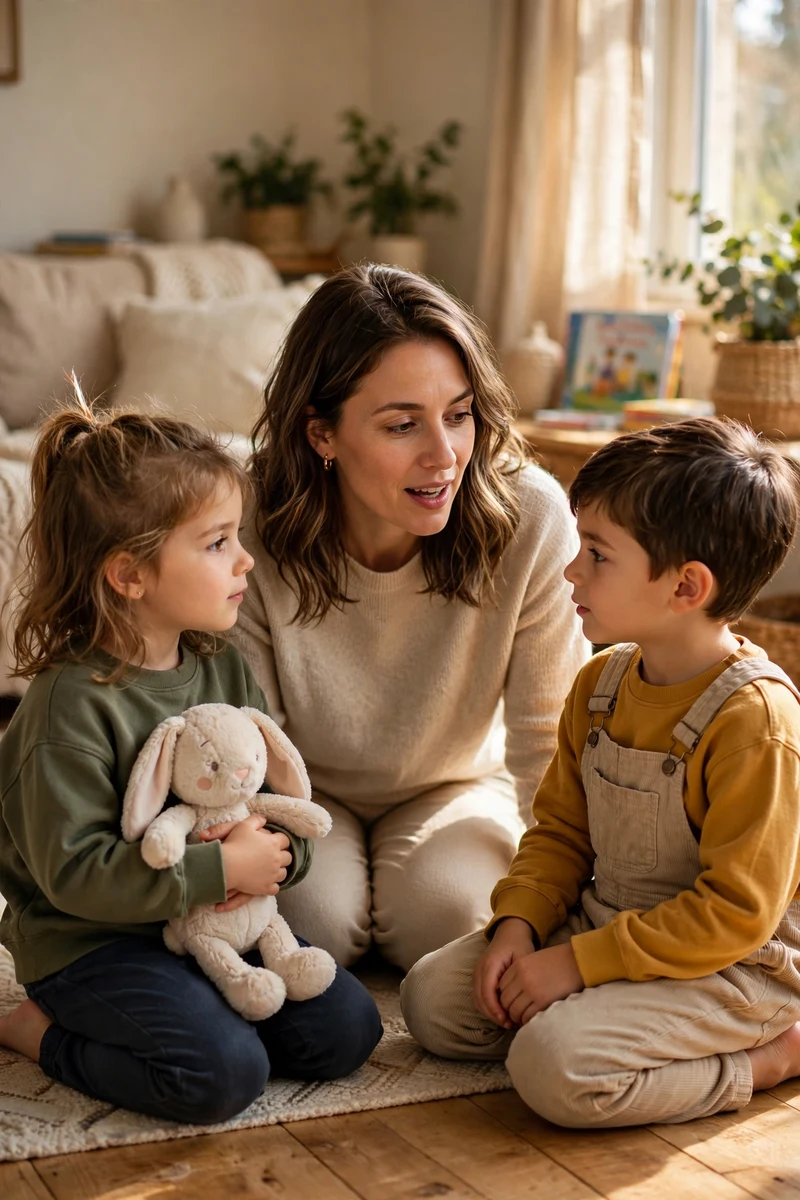
Step 3. Teach turns as a promise, not a punishment
A turn feels safe when the child believes, from experience, that waiting ends with getting.
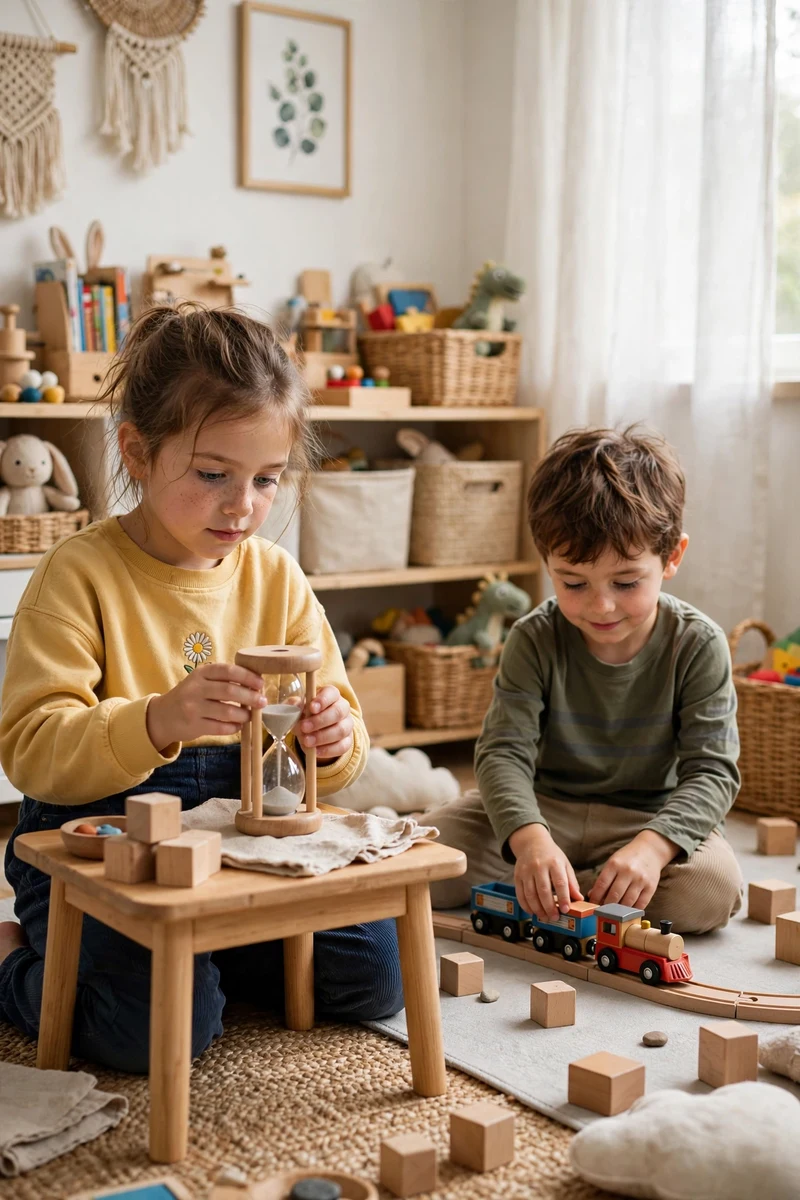
Young kids refuse turns mostly because waiting feels endless and uncertain. So make waiting visible and make it honest. A simple sand timer on the table works wonders, because a child can watch their turn getting closer instead of taking my word for it. When the sand runs out, the swap happens, kindly and without negotiation, every time. Follow through is the curriculum here. A timer that sometimes gets extended by whining teaches whining. A timer that always lands teaches trust.
Language matters in this step too. I stopped saying you need to share and started saying you may use it until the timer ends, then it is Maya’s turn, and I will help Maya wait. Notice how each child gets a job and a promise. The holder gets dignity instead of a countdown to loss. The waiter gets an advocate instead of a lecture about patience.
For very little ones, shrink the turn. Thirty seconds of waiting with a timer and a silly song is a real rep for a two year old. Celebrate it like the rep it is. You waited while it was hard. That was strong of you. Small reps, honestly praised, are how the sharing muscle actually gets built.
Step 4. Stock the room for success
The easiest sharing conflict to solve is the one the room solves for you.
Walk your play space with fresh eyes and count the flashpoints. One beloved truck and three kids is a math problem, not a manners problem. You do not need to buy out a toy store. A few cheap doubles of the highest demand items, two buckets and two shovels at the sandbox, two pads of paper and two sets of crayons at the art table, and suddenly most afternoons run themselves.
Side by side play is the quiet hero here. Young children naturally play alongside each other before they play together, and doubles let them do exactly that without a referee. One child builds a tower while the other builds a tower an inch away, glancing over, copying, chatting. That is not failed sharing. That is the on ramp to it.
Rotation helps too, and this is where a light system saves your sanity. A small bin of toys that comes out for playdates, then goes back on a shelf, keeps novelty high and guarding low. If toy volume in general is swallowing your house, my gentle approach in how to stop the toy flood without the mom guilt will help you trim the collection without a single tearful purge.
Step 5. Coach the hot moment in four short moves
When a grab happens, move close, get low, narrate, and offer the plan. In that order, every time.
Here is the exact sequence I use, and I have used it in living rooms, parks, and one memorable grocery store aisle. First, I move my body close and get down low. Proximity calms kids in a way a voice across the room never will. Second, I put a gentle hand near, not on, the contested item, so nobody gets hurt while we talk. Third, I narrate both sides out loud. Sam is building with the truck. Jonah wants a turn. Both things are true and both kids deserve to hear their side said fairly. Fourth, I offer the plan. Sam, you may finish loading your truck. Jonah, I will sit with you and we will watch the timer together. Then it is your turn, and I will stay until it happens.
What if the grab already landed and someone is crying? Care first, coaching second. Comfort the hurt child, involve the other child in the comfort if they are willing, and keep it concrete. You can hold the cold cloth. You can fetch his water. Doing a kind thing teaches more in ten seconds than saying a sorry word teaches in ten minutes, because the child feels the repair in their own hands.
And what if your child refuses every plan and melts down on the spot? Then the lesson for today is simply that big feelings pass and Mom stays calm and close. Some days the win is not a shared truck. Some days the win is a child who learns that a meltdown does not make love or safety disappear. That lesson, quietly repeated, is the soil sharing grows in later.
Step 6. Model generosity where they can see it
Kids copy the sharing they watch far more faithfully than the sharing they are assigned.
Start narrating your own generous moments in plain, slightly proud language. I am giving Dad the last slice because he loves this pie. I made extra muffins so we can take some to our neighbor. Your turn with the big spoon, I will use the small one, it still works great. It feels a little silly at first. Do it anyway. You are laying down a soundtrack, and small ears record soundtracks word for word.
Let them catch you being generous to them in ways that cost you something real, and name it lightly. I was saving this sticker for my journal, and I want you to have it because your picture made me smile. A child who regularly receives freely given things from a cheerful giver learns the emotional math of giving from the receiving end first. It feels good to be shared with. That feeling, remembered, is what later moves their own hands to open.
Siblings are the daily practice field, so celebrate every genuine offer you witness between them, out loud and specifically. You gave your brother the blue car even though you love the blue car. That was generous and he is beaming. Specific praise tells a child exactly which behavior built the warm moment, and kids repeat what gets named with love.
Step 7. Replace sorry with a real repair
When a child is ready to make things right, offer actions, not a script, and let them choose one.
Here is the heart of the whole post, so let me slow down. A real repair has three parts. The child notices someone is hurt or left out. The child does something that helps, in a way that fits their age. And the child sees the other person feel better because of it. That loop, completed even clumsily, builds true remorse and true pride at the same time. No mumbled word can do that.
Keep a small menu of repairs in your back pocket so you can offer choices in the moment. Fetch an ice pack or a cold cloth. Help rebuild the knocked down tower. Draw a picture for the child who is sad. Offer a turn with a different favorite toy. Ask, would a hug help or would space help? A child who picks their repair owns it, and a child who owns it remembers it.
Timing is everything in this step. A repair offered while a child is still flooded will land as a demand and bounce off. Wait for the shoulders to drop and the breathing to slow. Sometimes that is two minutes. Sometimes it is after lunch. A sincere repair at three in the afternoon beats a forced performance at ten in the morning, every single time, and it is never too late in the day to make something right.
Step 8. Praise the process through the messy middle weeks
Sharing grows in spurts and stalls, so measure progress in small honest moments, not in perfect playdates.
The first week you try this, expect it to feel slower. Narrating and timers take longer than grabbing a toy and demanding a word. By the second week, you will likely notice your child checking a playmate’s face after a bump, or holding a toy out for one brief shining second before taking it back. That second counts. That second is the seed.
Keep a tiny mental list of wins and tell your partner about them at night, or tell me in your head while you fold laundry. He waited by the timer without crying today. She offered her sister a crayon before I even looked up. Naming wins keeps your own hope fueled, and a hopeful parent coaches with a warmth that kids can feel. Despair makes us police. Hope makes us teach.
This calm, coach first approach also supports the wider rhythm of your days. Children who practice waiting and repairing in play carry those same skills into chores, routines, and family jobs, which is why this plan sits so nicely beside my simple ideas in how to get your kids to tidy up without nagging. One philosophy, many rooms of the house.

Try it tonight
Tonight, in under twenty minutes, set up tomorrow’s sharing success before anyone wakes up grumpy about a truck.
First, walk the playroom with a laundry basket and pull out each child’s true treasures, the lovey, the special car, the project in progress, and place them on one treasure shelf that is off limits to guests and siblings alike. Second, find or buy nothing fancy, just a cheap sand timer or set a phone timer where kids can see it, and practice one silly round of turns with a stuffed animal so the timer feels like a game, not a rule. Third, pick your three calm lines and say them out loud twice while you tidy. I will help you make it right. Let us check on her. You can be mad and still be kind with your hands. That is the whole setup. Tomorrow, the room and your words are already working for you.
Mistakes to Avoid
Forcing the word and calling it empathy. A child can say sorry a hundred times and learn only that the word ends adult pressure. Worse, some kids start deploying it as a shield, sorry, while grabbing again, because we accidentally taught them the word is the whole transaction. Retire the demand and teach noticing, caring, and repairing instead. The genuine apology will arrive later, unforced, and the first time you hear a real one from your child, you will know in your bones it was worth the wait.
Snatching the toy away as the lesson. I understand the urge. A grab happens, and handing the toy straight to the other child feels like justice. But to the grabber, it feels like proof that grown ups grab too, only bigger. Hold the boundary with words and presence, guide the item back if someone is being hurt, and coach the return so your child practices the giving motion instead of watching you perform the taking one.
Labeling a child selfish in front of others. Labels stick to small people like burrs. A child who hears that they are selfish, or that they do not share, starts to believe the sharing ship has sailed without them, and stops trying. Describe the moment instead of the child. That grab hurt Ben’s feelings. You are still learning turns, and I will help you. One keeps the door open. The other quietly closes it.
Expecting the same sharing from every age at the table. A two year old guarding a shovel and a six year old refusing any turn with a new game are not the same problem and do not deserve the same response. Match your coaching to the child in front of you. Guarding in the littlest ones gets narration and doubles. Refusal in older kids gets a calm conversation later about guests, gratitude, and the kind of host they want to be.
Skipping the repair because the moment passed. Parents often tell me the conflict ended, everyone moved on, so bringing it back feels wrong. But a brief, gentle return is where the learning lives. After lunch you can say, Ben was sad about the truck this morning. Want to draw him a picture before rest time? Low pressure, warm tone, real repair. Moving on without ever circling back teaches that feelings evaporate. Circling back teaches that people matter after the noise stops.
What About…?
What about grandparents who insist a child must say sorry on the spot?
This one is tender, because it usually comes from love and from the way many of our parents were raised. I do not debate it in front of the kids. In the moment I smile and say, we are working on showing we are sorry with helping actions, and he will check on his cousin in a minute. Then I follow through visibly, so Grandma sees the cloth fetched or the tower rebuilt. Results persuade grandparents far better than lectures do. Later, one on one, you can share the why if the relationship holds it well. And if a grandparent occasionally prompts a sorry anyway, your child will survive it, and your steady coaching at home remains the main soundtrack.
What about small spaces, where there is no playroom and every toy is in the living room?
Then the treasure shelf becomes a treasure basket, and it lives on top of the fridge or inside your bedroom closet during visits. Small homes actually make this system easier in one way, because the setup takes five minutes and one basket. For turns, the timer on the kitchen counter does the refereeing, and the couch becomes the waiting spot with a pillow and a book. You do not need square footage for any of this. You need a protected basket, a visible timer, and your three calm lines. That fits in every apartment I have ever lived in.
What about toddlers, who cannot take turns or repair on purpose yet?
With toddlers, your job shrinks to three things, and all three are about the environment and your voice, not their performance. Narrate feelings in four or five words. Offer doubles so side by side play can succeed. And gently move the item or the child when someone might get hurt, while you say the boundary out loud for both kids to hear. I will not let you grab. I will help you wait. Repairs at this age are mostly you modeling them while your toddler watches or half helps, holding the cloth with you, patting a back beside you. Watching is learning at this age, even when it looks like nothing is happening. One day, usually out of nowhere, your toddler will pat a crying friend entirely on their own, and you will get to witness all that quiet watching pay off at once.
What about budgets? Do I need to buy doubles and timers and new toys?
No, and please do not let a shopping list delay the real work. Doubles can come from a dollar store, a thrift bin, a toy swap with a friend, or your own recycling, since two clean yogurt tubs and two spoons are a world class sandbox set to a three year old. A timer can be a phone, a kitchen clock, or a song everyone sings, because the turn ends when the song ends. The heart of this plan costs nothing at all. It is narration, a protected treasure spot, a fair turn promise, and repairs made of drawings and cold cloths and rebuilt towers. Your voice and your follow through are the whole engine, and you already own both.
How I Know It Is Working
Progress here is quiet, so let me tell you what to watch for, because it rarely arrives as a dramatic park announcement. It looks like your child glancing at a friend’s face after a bump, checking the damage before you say a word. It looks like a small hand holding a toy out for two seconds, then ten, then for a whole turn by the timer. It looks like a child fetching a cloth for a crying sibling without being asked, then looking up at you with enormous pride.
It also looks like fewer ambushes. When treasures are protected and doubles are out, whole afternoons pass without a single sharing standoff, and you realize you spent the playdate actually drinking your coffee while it was warm. Prevention does not photograph as well as a forced apology, but it feels a whole lot better to live inside.
Give this plan an honest month before you judge it. The first week you will mostly catch yourself mid old habit, hand halfway to prying fingers apart, and that noticing still counts as growth, yours this time. The second week the narration starts arriving in your own voice before you have to think. By the fourth week, most families I know report the same sweet shock. Their child offered something, freely, to someone else, and meant it. Not because a word was demanded. Because a skill had grown.
And when a genuine apology finally comes out of your child, unprompted and a little wobbly, resist the urge to make it bigger with praise fireworks. A warm, simple response lands best. I saw that. That helped her feel better. You keep the moment true sized, and true sized moments are the ones kids repeat.
A Last Word Before the Next Park Morning
I want to leave you with the truest thing I know about this. The fact that a forced sorry ever bothered you, that you went looking for a kinder way to teach a lifelong skill, tells me exactly what kind of mom you are. Moms who do not care about real empathy do not stay up reading about it. You care about raising a child who is genuinely kind, not just publicly polite, and that caring is the whole foundation this plan stands on.
Start embarrassingly small. Protect the treasures tonight. Narrate one conflict tomorrow instead of judging it. Offer one repair instead of one demanded word. Small true reps, repeated on ordinary days, are what grow a sharing child. Not performances. Not park inspections. Reps.
And on the days it all still goes sideways, because some days the truck will win and everyone will cry including possibly you, remember that bedtime gives the day a soft landing and a fresh start. If your evenings need the same kind of calm reset, you will find more of our family rhythms waiting in how to keep your house clean with little kids, written for real homes on real hard days.
Your kids do not need a mom who can produce a perfect apology on command at the park. They need a mom who coaches the feeling underneath, who protects what is precious, who keeps turn promises, and who shows them, cloth by cloth and tower by tower, how people make things right. That is exactly the mom you already are, and now you have the words to match her.
With love and light
Get Fresh Home Ideas Every Week
Seasonal decor ideas, organizing tips, and cozy home inspiration, straight to your inbox.
More Parenting Ideas You Will Love
Keep browsing for more seasonal inspiration: